A 90-day law firm marketing strategy moves through three phases, foundation in Days 1 to 30, optimization in Days 31 to 60, and controlled growth in Days 61 to 90. Each phase needs specific deliverables, one owner, a budget, and measurable goals.
What breaks most plans is simple: firms start with channels instead of the business outcome they want. They launch ads, post on social media, or publish a few pages, then wonder why the phone still isn't ringing with the right cases.
Table of Contents
Why Most Law Firm Marketing Plans Fail Before They Start
Why do so many law firm marketing plans fail before they ever get traction? Because the firm buys activity before it defines the result. A law firm marketing strategy that starts with Google Ads or LinkedIn posts is already behind, since the core work is deciding which matters the firm wants, where it serves clients, what those matters are worth, and how many new clients the attorneys can truly handle.
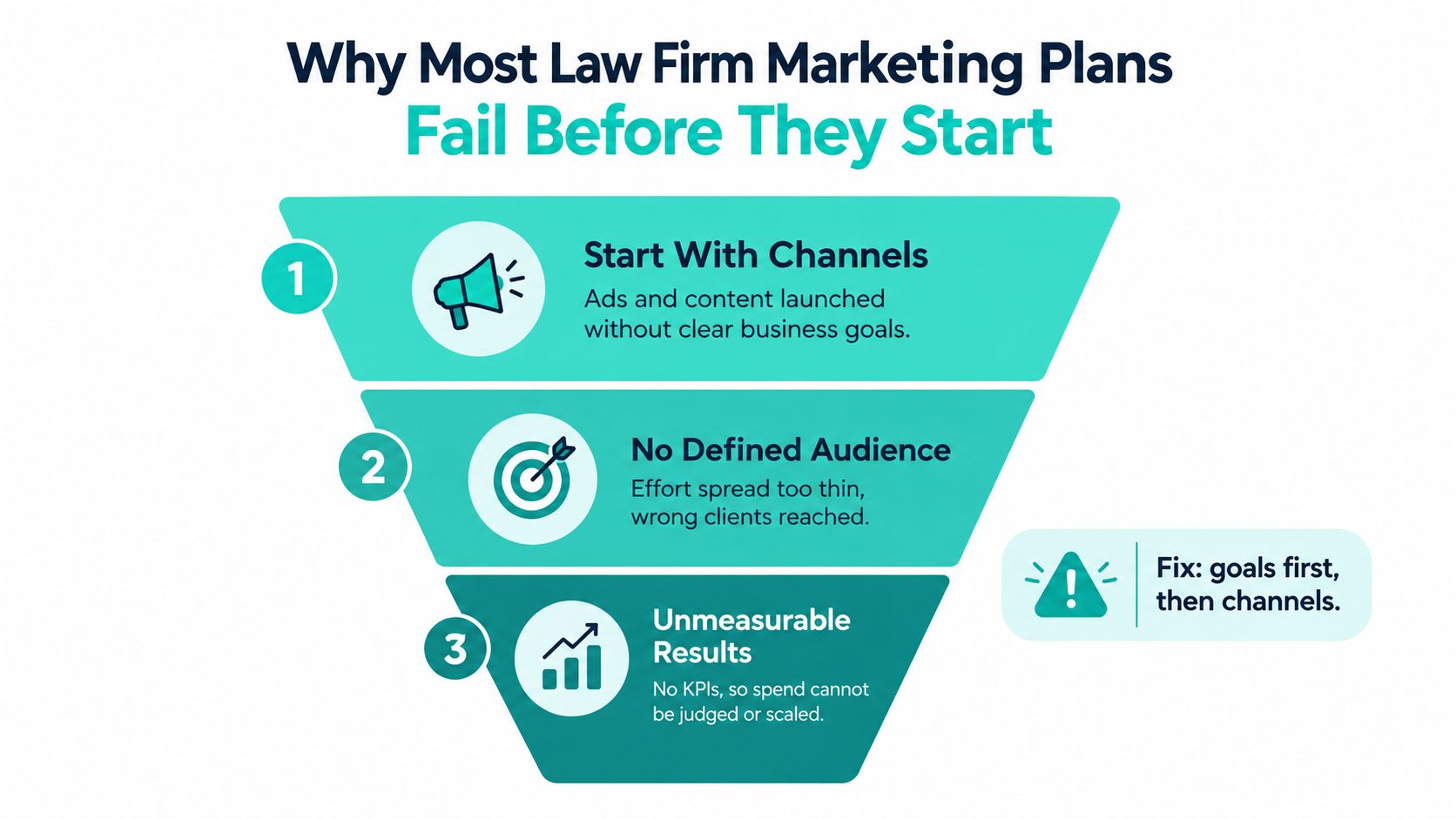
Start with business goals, not channels
The ABA's 2022 Websites & Marketing TechReport shows the gap clearly. 77% of surveyed firms with websites said their sites were mobile-friendly, but only 25% said a client had retained the firm directly through the website, which means visibility alone doesn't produce measurable acquisition (ABA TechReport). That's why a plan needs to connect the front end of marketing to the back end of intake and signed matters.
Practical rule: if a tactic can't be tied to a qualified consultation or a retained case, it's not a strategy yet.
A good 90-day plan avoids the usual trap of spreading budget across disconnected tactics. Instead, it creates a foundation phase, then a performance phase, then a scaling phase. That structure keeps the firm from confusing attention with revenue.
The fastest way to clean up the thinking is to ask one hard question. Which practice area are we trying to grow, and what has to happen between first touch and signed client for that growth to be real?
Building the Foundation in Days 1 Through 30
The first 30 days decide whether the rest of the quarter is productive or expensive. Over that period, the firm audits what exists, checks whether the market wants what it's promoting, and makes sure the tracking is in place before any spend goes live.
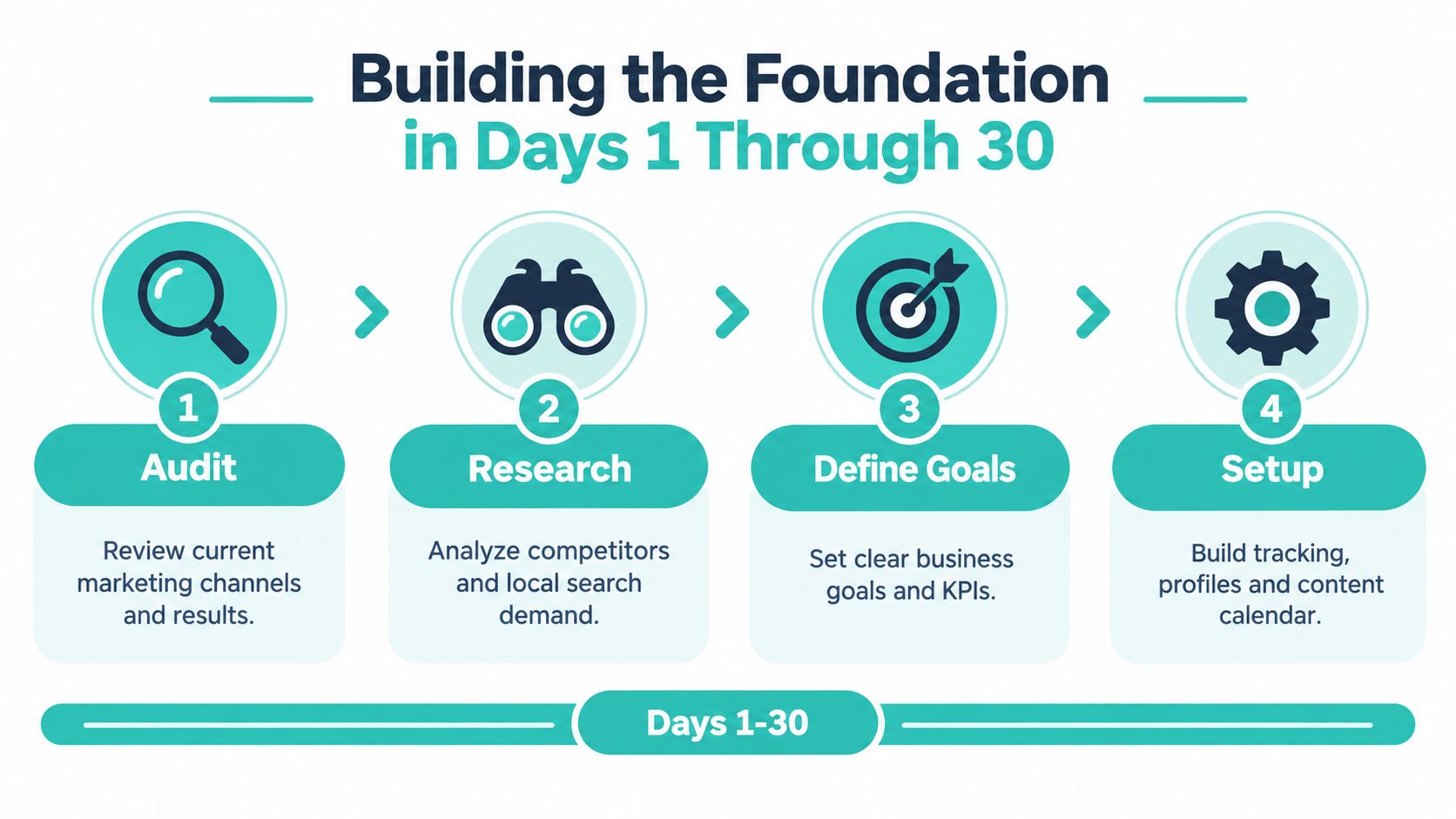
Audit the current state before you touch media
Start by reviewing the existing website, intake path, ads, directory profiles, review flow, and follow-up process. If the landing page is vague, the form is long, or the phone isn't being answered promptly, more traffic just multiplies the leak.
A practice-area-specific funnel works better than a generic “contact us” approach. Map one high-intent search theme to one service page and one conversion action, then add proof, jurisdiction, eligibility, fee or process details, and tracking for phone and form activity. The practical version of that structure is described in this landing-page guide for law firm consultations, and the reason it matters is simple, people don't hire firms in the abstract.
For email nurture, deliverability matters too. If the firm is going to rely on inbox follow-up, it should warm up an SMTP server before putting volume behind outbound campaigns.
Set KPIs from signed-client economics
Good KPIs start with the goal, not the platform. Work backward from the number of signed clients the firm wants, then estimate expected collected fees, delivery costs, intake capacity, and the maximum acquisition cost that still leaves healthy margin.
| Phase | Primary Focus | Key Deliverables | Success Metrics |
|---|---|---|---|
| Days 1 to 30 | Foundation and launch readiness | Audit, positioning, landing pages, intake tracking, CRM fields, KPI definitions | Tracking live, pages aligned to practice area, qualification rules agreed |
| Days 31 to 60 | Performance improvement | Lead-quality review, message testing, landing-page changes, intake fixes | Better consultations, fewer missed calls, clearer source quality |
| Days 61 to 90 | Controlled growth | Budget reallocation, scaling proven channels, next-quarter plan | More retained matters from acceptable acquisition cost |
The tracking model should record keyword, campaign, landing page, call, consultation, signed matter, revenue, and lost-matter reason in the CRM. That's the only way to judge whether a channel is creating matters or just generating noise.
A campaign that looks cheap at the lead stage can become expensive at the client stage.
One practical way to avoid junk data is to separate intake status from marketing status. If a lead isn't qualified, that should be visible immediately, not buried in a spreadsheet after the fact.
Choosing the Right Channels for Your Practice Area
Channel choice should follow audience behavior, not habit. A consumer-facing practice and a business-to-business practice don't need the same mix, and the wrong mix burns budget quickly because the message, intent, and decision cycle are different.

Match the channel to the client's search behavior
The ABA's 2025 survey found that 80% of firms maintained a social media presence, with LinkedIn used by 78% of firms, Facebook by 53%, Instagram by 22%, and X by 18% (ABA survey on tech trends). Those numbers don't mean every firm should be on every platform. They show that professional-network visibility is dominant, while consumer platforms support specific audiences and practice areas.
For local consumer work, Google Ads, Local Services Ads, and Meta Ads usually make the first cut because the prospect is already signaling need. For business law, professional referrals and targeted LinkedIn outreach may deserve more weight because the buyer is less impulsive and more relationship-driven.
| Practice Area | Primary Channels | Supporting Channels | Rationale |
|---|---|---|---|
| Family Law | Google Ads, Meta Ads | Reviews, remarketing where permitted | People often want immediate help and local reassurance |
| Estate Planning | Google Ads, Meta Ads, Email | Webinars, educational content | Prospects may need explanation before they book |
| Immigration | Google Ads, Meta Ads | Facebook, email follow-up | Trust, clarity, and language-access messaging matter |
| Personal Injury | Google Ads, Local Services Ads, Meta Ads | Intake follow-up, reviews | High-intent search and fast response are critical |
| Business Law | LinkedIn, referrals | Email nurture, thought leadership | Decision-makers value credibility and direct relationships |
Don't confuse presence with owned assets
Social media can create awareness, but it should not replace the firm website, service pages, and intake workflows. That's where the prospect can be measured, qualified, and moved toward consultation.
If you want a tool for local visibility planning, local seo software for lawyers can help organize location signals, but it still has to feed a real conversion path. Social posts without a strong landing page just create more clicks that don't turn into cases.
The practical move is to choose one or two core channels first, then support them with dedicated pages and follow-up. For real estate firms, for example, the right channel mix is often different again, which is why a real estate law marketing guide can't be copied wholesale into other practice areas.
Optimizing Performance in Days 31 Through 60
Once the campaign is live, the job changes. This phase is where you stop asking whether the ads are running and start asking whether the firm is getting the right inquiries, handled the right way, at the right pace.
Use intake feedback as a performance signal
Weekly reviews with intake should cover lead quality, response times, consultation bookings, signed clients, and the reasons prospects don't move forward. That's how you learn whether the issue is targeting, message fit, landing-page clarity, or the intake team itself.
Missed calls and slow follow-up are usually not marketing problems in the narrow sense. They're revenue leaks. If a campaign brings in qualified people and nobody follows up quickly enough, the best creative in the world can't save it.
SEO belongs in this phase too, but expectations need to stay realistic. Google Search Central says changes can take effect in a few hours or several months, and it generally recommends waiting a few weeks before judging whether SEO work helped search results (Google Search Central core updates guidance). That means you improve page quality now, but you don't confuse early volatility with failure.
Fix the page before you blame the campaign
If qualified leads are clicking but not converting, the landing page usually needs work. Tighten the headline, clarify the practice area, remove extra choices, and make the next step obvious.
A focused review should answer three questions:
- Does the page match the search intent? If the query is about estate planning, the page should speak to estate planning, not general firm branding.
- Can the visitor understand the process fast? Clear eligibility, jurisdiction, and next-step language reduce friction.
- Does the firm know which source produced the inquiry? Source-level tracking keeps budget decisions honest.
For measurement discipline, how to measure law firm marketing ROI is useful only if the CRM and intake process already capture the right statuses. Without that, the numbers look organized but don't tell you what to fix.
Don't judge a campaign on the first visible metric. Judge it on the quality of the next step.
Operational fixes should happen immediately, while campaign tests get enough time to show a pattern. That balance keeps firms from killing useful efforts too early or letting broken workflows continue because the ad dashboard looks busy.
Scaling Controlled Growth in Days 61 Through 90
By the final month, the goal isn't to spend more for its own sake. It's to put more budget behind the sources that are producing suitable clients, while protecting the firm from overloading intake or attorney capacity.

Scale only what the data can defend
Google Analytics describes conversions as a consistent way to measure important actions across Analytics and Google Ads, and its lead-measurement mechanics include generate_lead for new leads and close_convert_lead for converted leads (Google Analytics lead measurement). In a law firm, that means the analytics map should distinguish calls, forms, bookings, qualified matters, retained clients, and revenue, not just raw submissions.
The budget decision should follow retained-client performance, not cheapest inquiry volume. If a channel is producing more signed matters within the firm's geography, practice focus, and capacity, it earns a larger share of spend.
That doesn't mean every successful channel gets unlimited growth. If the attorneys can't handle more cases, or if intake response times start slipping, scaling faster just recreates the same bottlenecks at a larger cost.
A good rollup for this phase looks like this:
- Source quality first: compare sources by retained matters, not by raw lead counts.
- Capacity second: confirm that intake and attorney bandwidth can absorb more demand.
- Budget reallocation third: move spend toward the campaigns that keep producing suitable clients.
- Next-quarter planning last: carry forward the channels and pages that proved themselves.
Keep social and nurture tied to the funnel
If the firm is using social channels, they should push prospects into the same measured path, not into a dead-end feed. social media management for law firms only matters when posts, short videos, and follow-up support the consultation path.
A controlled-growth quarter is usually quieter than people expect. The best sign is not a bigger dashboard, but a cleaner one, where the firm can explain exactly why budget is increasing and exactly what kind of client is arriving because of it.
The Referral Conversion Gap Most Firms Ignore
Why do referrals still stall after a warm introduction? Because the referral is only the start. A referred prospect still checks the website, reads reviews, compares options, and decides whether the firm responds fast enough to hold attention.
Analysts at RankScience referral research found that referred legal clients often research firms online before reaching out, place more weight on reviews than word of mouth, and move on if a firm does not respond within 24 hours. That changes referral management from a courtesy issue into an operational one.
Build the referral handoff like a real funnel
A referred lead needs the same handling as a paid lead, and sometimes more discipline. The firm should connect referral tracking, review recency, service-specific landing pages, call handling, text or email follow-up, and consultation scheduling into one operating model. If the handoff breaks, the referral value leaks before intake ever sees it.
That is also where client intake guide for law firms and a simple email nurture sequence for legal leads become operational tools, not marketing extras. They tie response time and qualification to revenue generation, which is how a firm keeps referral and digital follow-up aligned.
A referral is not a signed case. It is a credibility test with a clock attached.
Many firms miss at this point. They assume the referrer already did the selling, so they relax the follow-up process. In practice, the prospect still wants proof, speed, and a low-friction next step.
The firms that handle referrals well use the same source tracking, the same response expectations, and the same consultation path for referred and paid matters. That is where signed-client economics start to improve.
Essential Takeaways for Your Law Firm Marketing Journey
The easiest way to keep a law firm marketing strategy on track is to remember that every phase has a different job. Days 1 to 30 build the foundation, Days 31 to 60 improve performance, and Days 61 to 90 scale only what has already proven itself.
Use this checklist:
- Define the business goal first. Choose the practice area, service geography, matter type, and capacity limits before launching channels.
- Set conversion tracking before spend. Record keyword, campaign, landing page, call, consultation, signed matter, revenue, and lost-matter reason.
- Make the intake team part of marketing. Missed calls, delayed responses, and poor qualification can sink a campaign faster than weak ad copy.
- Judge channels by retained matters. Cheap leads don't matter if they don't turn into cases.
- Keep SEO expectations realistic. Start in the first 30 days, then evaluate over a longer cycle.
- Review compliance before launch. Claims, testimonials, disclaimers, and jurisdictional limits need review before the first ad goes live.
- Treat referrals like active opportunities. They still need proof, speed, and follow-up.
The true advantage comes from connecting visibility to conversion infrastructure. Firms that do that can make better budget decisions, improve intake economics, and build a plan that survives beyond the first burst of activity.
If you want a law firm marketing system that ties paid media, landing pages, SEO, and follow-up into one measurable plan, visit SimpleLab Digital. We build around qualified inquiries and signed-client outcomes, not vanity metrics, and we can help you turn this 90-day framework into a practical roadmap for your practice area.
Written with Outrank tool