There's no single Google Ads cost, and fixating on one is where budgets go wrong. A 2025 Search Engine Land analysis found U.S. search campaigns averaged $5.26 per click, while attorneys and legal services averaged $8.58. Neither number tells you what a lead costs.
The standard advice, compare CPC averages and pick a monthly budget, is incomplete. A click can be cheap and worthless, or expensive and commercially valuable. Start with what a qualified inquiry is worth to your business, then work backward through clicks, conversion rates, and lead quality.
Your actual spend depends on campaign format, auction competition, location, search intent, and landing page quality. The practical answer is a workable range tied to the inquiries and revenue your campaign needs to produce, not a universal price.
Table of Contents
What Advertising on Google Actually Covers
“Advertising on Google” can mean different campaign formats, and each one buys a different kind of opportunity. Before estimating cost, decide what you need the advertising to do.
Choose the format that matches the goal
- Search campaigns show text ads to people searching for relevant terms. They're usually the clearest starting point for capturing existing demand, such as someone looking for a local attorney or a particular home service.
- Display campaigns place visual ads across websites and apps in Google's network. They're generally suited to reach and awareness, or to reconnect with people who have already visited your site, rather than capturing a specific search at the moment of intent.
- Shopping campaigns show product listings with details such as images and prices. They're designed for retailers who want to promote products directly in search and other Google placements.
Those formats don't share one universal price. A campaign may charge by the click, by impressions, or according to a selected conversion-based bidding strategy. The charging model and the result you optimize for aren't always the same thing: a business can pay for clicks while judging success by booked consultations or sales.
That difference matters. For a law firm, a click from someone seeking the right practice area in the service region may be more valuable than several clicks from people seeking general legal information. For an online retailer, product sales may be the target. A brand-building campaign may care about reach rather than immediate inquiries.
Define the desired outcome before comparing prices. For high-intent demand capture, start by evaluating Search. Use Display when reach or follow-up visibility is the goal, and Shopping when product listings are central to the sale. The format, auction, and conversion event all affect what “cost” means for your business.
How the Google Ads Auction Sets Your Price
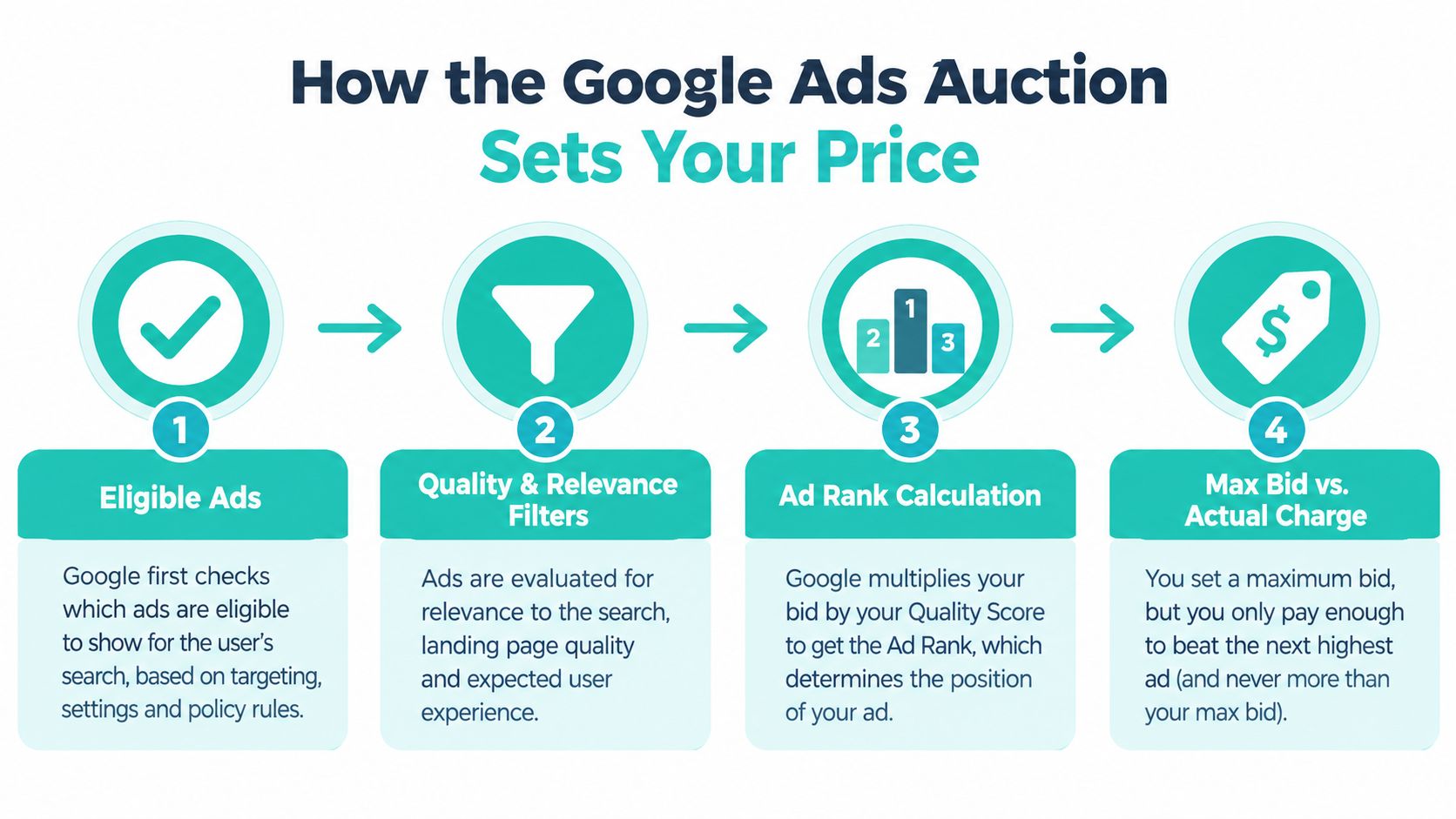
Google doesn't publish a fixed rate card for Search ads. For each search, it identifies ads that match the query, checks whether they meet targeting and policy requirements, and ranks eligible ads through an auction. The final price depends on that auction, not on the bid you entered. (Google's overview of how ad costs are determined)
Maximum CPC isn't the amount you automatically pay
A maximum cost-per-click bid is a ceiling, not a promise that every click will cost that much. Google calculates the actual CPC at auction time. It's often the minimum amount needed to clear the relevant Ad Rank threshold and beat the next eligible competitor, although the price can vary with the auction and its context. (Google's explanation of actual CPC)
Ad Rank takes more than the bid into account. It incorporates ad quality and relevance, the search context, minimum thresholds, and the expected impact of assets such as sitelinks. The highest bidder doesn't automatically get the top position. A more useful, relevant ad can outrank a larger bid when its overall Ad Rank is stronger.
That's why two advertisers can face different costs for the same keyword. Their bids, ads, landing pages, and auction circumstances aren't identical. Google's guidance on Ad Rank and Quality Score also makes an important distinction: the displayed 1–10 Quality Score is a diagnostic tool, not a direct auction input.
Practical rule: If costs look high, inspect the search terms, ad group, and landing page before raising bids. More spend can buy more auctions, but it won't fix a mismatch between what someone searches for and what your ad or page delivers.
For a practical look at the signals behind CPC, use this guide to Google Ads Quality Score. Better relevance and a more useful landing-page experience can improve efficiency as well as visibility. In highly competitive services, though, you may still need a substantial bid to enter the auction.
How Daily and Monthly Budgets Work
Google Ads uses an average daily budget, but your spend won't necessarily match that amount every day. When traffic or demand is stronger, Google may spend up to twice the average daily budget on a particular day, while limiting the total monthly charge according to its monthly spending rule. (Google's explanation of daily and monthly limits)
The standard monthly calculation is the average daily budget multiplied by 30.4 days. For example, with a $50 average daily budget, Google may spend up to $100 on a high-demand day, while the monthly charge should not exceed $1,520 under that calculation. Those are platform budget rules, not a guarantee of how many clicks or inquiries you'll get.
Turn the budget into a working forecast
Use a simple chain: media budget divided by average CPC estimates clicks; clicks multiplied by the landing-page conversion rate estimates inquiries; inquiries multiplied by the qualification rate estimates qualified inquiries. Your forecasts will only be as useful as the assumptions behind them, so treat CPC and conversion rates as estimates to validate against campaign results.
For example, if you expect a particular budget to buy enough clicks to generate more inquiries than your team can handle, the problem isn't solved by spending faster. Conversely, a budget that produces too little relevant traffic may make it difficult to assess whether the campaign is working. Set the daily amount with expected qualified-inquiry volume and follow-up capacity in mind.
A daily budget controls pacing over time. It doesn't promise a fixed CPC, a fixed number of clicks, or a fixed number of leads.
Before launch, decide what level of day-to-day fluctuation your cash flow can absorb and check the account's monthly limit. For a broader small-business planning framework, see this practical guide to pay-per-click advertising for small businesses.
Real CPC Benchmarks by Industry in 2024 and 2025
A $2.53 click is not automatically cheaper than an $8.58 one. If the expensive click reaches someone ready to hire and the cheap click reaches a casual browser, the higher CPC wins on cost per signed client. Keep that framing in mind while you read the numbers below. Benchmarks describe what advertisers pay on average, not what a lead is worth to you.
According to Search Engine Land's 2025 benchmark report, which analyzed more than 16,000 Google Ads Search campaigns, the cross-industry average CPC reached $5.26 in 2025, up 12.88% from $4.66 in 2024. The same report found that 87% of industries recorded CPC increases. Treat these figures as directional market data. They are a starting point for a forecast, never a quote for your account.
Compare the reported averages
| Industry | 2024 Avg CPC | 2025 Avg CPC | YoY Change |
|---|---|---|---|
| Cross-industry average | $4.66 | $5.26 | +12.88% |
| Attorneys and legal services | Not provided | $8.58 | Not provided |
| Home and home-improvement businesses | Not provided | $7.85 | Not provided |
| Business services | Not provided | $5.58 | Not provided |
| Real estate | Not provided | $2.53 | Not provided |
The empty 2024 cells exist because the report published industry-level CPCs for 2025 only, so there is no honest year-over-year comparison at that level. Do not invent one.
A firm evaluating Google Ads for personal injury lawyers should treat the legal benchmark as a rough planning figure, then tighten the estimate using its own market, target queries, and intake capacity. Legal and home-services clicks cost roughly three times a real estate click in this data, and that gap reflects auction pressure plus the value of a signed case, not lead quality. A personal injury practice can absorb an $8.58 CPC because one client repays hundreds of clicks. A real estate agent on thinner margins cannot. Run your own economics before you copy any industry average into a budget.
For market context, Alphabet reported approximately $264.6 billion in total Google advertising revenue for 2024, up roughly 11.2% from $237.9 billion in 2023, per EBSCO's overview of Google Ads. That revenue spans Search, YouTube, and Google's ad network. Rising revenue and rising CPCs point the same direction: Google keeps getting better at charging for attention, so plan for click costs to drift up rather than down, and win on conversion instead.
From Clicks to Cost per Qualified Inquiry
A CPC tells you what a click costs. It doesn't tell you whether that click becomes a suitable lead, a customer, or profitable work. To budget responsibly, estimate qualified inquiries instead.
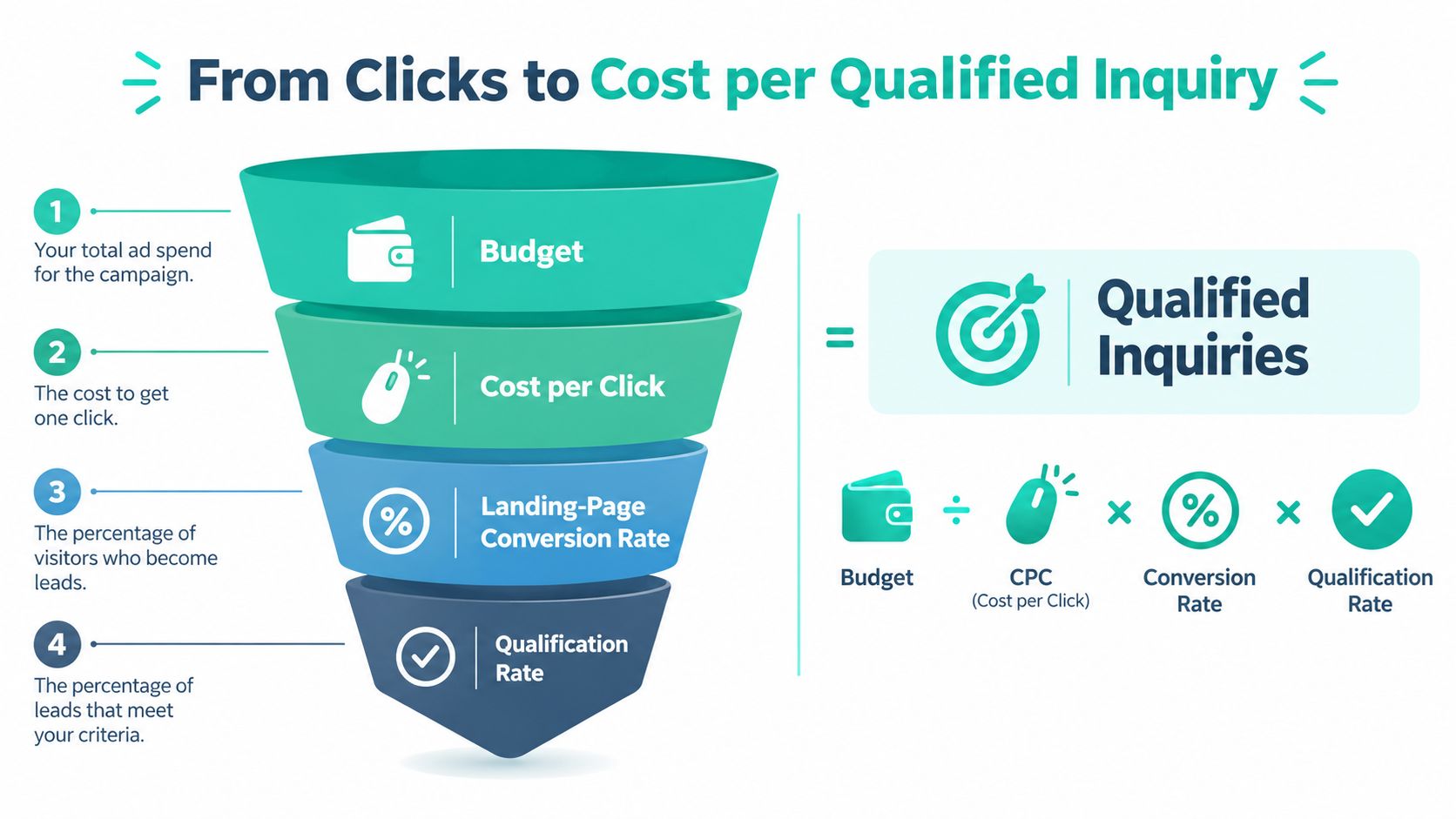
The planning equation is:
Expected qualified inquiries = budget ÷ CPC × landing-page conversion rate × qualification rate
For a worked example, take a $3,000 monthly media budget and a $15 average CPC. That buys roughly 200 clicks. At a 7% conversion rate, those clicks produce about 14 inquiries; if 50% qualify, that's about 7 qualified inquiries. The resulting cost is approximately $429 per qualified inquiry, before agency fees and other costs. (Google's budget guidance)
Set an economic ceiling, not just a click target
Work backward from the business economics, too. Your maximum sustainable cost per qualified inquiry equals the expected gross profit per acquired customer multiplied by the close rate from qualified inquiry to customer. If a lead has a low likelihood of closing or produces little gross profit, even a seemingly inexpensive inquiry may be too costly.
That makes lead qualification essential. Agree on what counts as a qualified inquiry: the right service, service area, eligibility, and level of intent. Then make sure your intake process records which inquiries become customers. A conversion-rate framework can help you define and measure the landing-page step consistently. (SimpleLab Digital's guide to conversion rate)
For law firms and local services, raw form submissions can hide a wide spread in value. A family-law inquiry and an estate-planning inquiry may differ in fit, urgency, and potential revenue. Review campaign performance weekly against qualified inquiries and downstream revenue, not clicks alone. That's the number that tells you whether the campaign can support more spend.
Levers That Actually Lower Cost
Don't treat a lower CPC as the only definition of efficiency. The goal is to reduce waste and improve cost per qualified inquiry. Start with the parts of the campaign that determine whether the right person sees a relevant ad and lands on a page that answers their need.
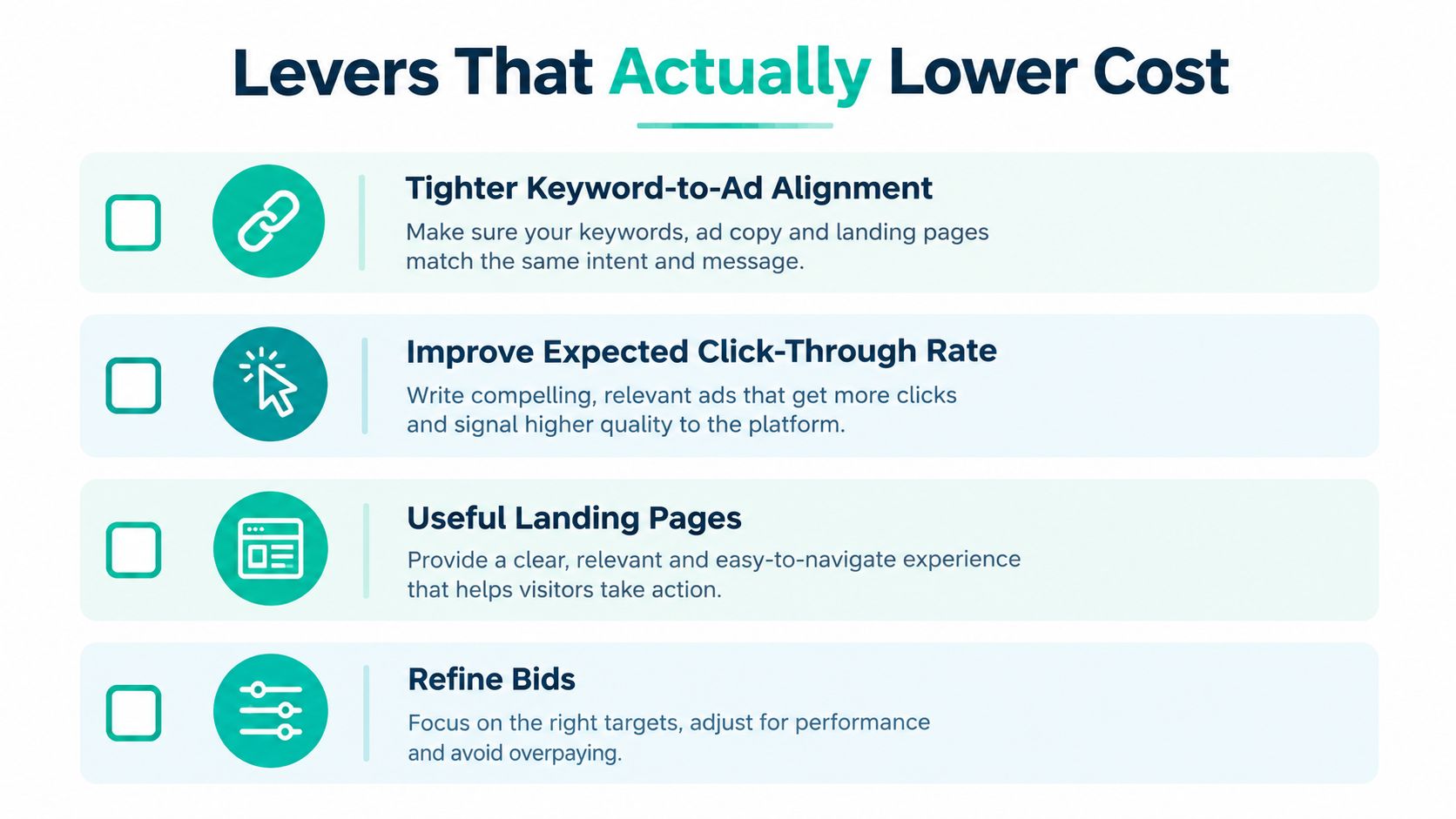
Fix intent and relevance before bids
- Match keywords to ads: Group searches with similar intent, then make the ad's promise specific to that intent. Don't send someone searching for estate planning to a general family-law message.
- Improve the landing page: Carry the ad's offer and service through to a page with a clear next step. A mismatch can waste paid traffic even when the click price looks reasonable.
- Use negative keywords: Review search terms and exclude irrelevant queries. This keeps the campaign from paying for searches that don't fit the service or intended customer.
- Separate service campaigns: Keep distinct services, such as estate planning and family law, in separate campaigns or tightly organized ad groups. That makes it easier to align budgets, ads, and destination pages with each service.
The 1–10 Quality Score can help you diagnose expected click-through rate, ad relevance, and landing-page experience, but the displayed score itself isn't a direct auction input. Improve those underlying signals because they make the ad experience more relevant, not because a higher number is a magic cost lever. (Google's Quality Score guidance)
Change bids only after diagnosis
When traffic is expensive, inspect the query, ad group, and landing page before raising bids. Check search-term quality, impression share, conversion rate, and cost per qualified inquiry; then decide whether to refine targeting, improve the page, or adjust bids to match the campaign's objective. This Google Search Ads practices guide offers additional campaign checks.
For businesses comparing acquisition channels, ROAS benchmarks can provide context for evaluating return on ad spend. But revenue return isn't the whole picture if costs vary or lead quality is uneven. Connect campaign reporting to gross profit and qualified-lead outcomes before deciding which campaigns deserve more budget.
AI Overviews and the Changing Search Page
AI Overviews haven't made paid search irrelevant, but they've made it less safe to assume every search results page behaves the same way. A Pew analysis of browsing by 900 U.S. adults found that users clicked a traditional result in 8% of visits when an AI Overview appeared, compared with 15% when one didn't; only 1% clicked a link inside the summary. (The Register's report on the Pew analysis)

Those figures describe clicks on traditional results and links inside summaries. They don't establish that ads have stopped reaching valuable searchers, or that every query with an AI Overview has the same commercial value. The practical question is which searches remain worth bidding on, where ads appear, and whether the visitors who do click are more qualified.
A Semrush analysis of more than 10 million keywords found AI Overviews appearing for nearly 25% of keywords in July 2025, then 15.69% in November. The same research reported ads at the bottom of about 25% of AI Overview results, with ads also appearing alongside them increasingly often. The changing prevalence and placement make a single assumption about the page risky.
Track commercial outcomes by query type. Separate branded, high-intent commercial, informational, and local-service searches, then compare qualified conversion rates across those segments. If a click comes from an informational query, judge it by the outcomes you intended that query to deliver, not by whether it costs less than a service query.
Fewer clicks aren't automatically a worse result. If the remaining clicks come from people with stronger intent, the economics may still work. Measure that rather than guessing.
If organic visibility is part of your search strategy, this resource can help you audit your AI Overviews rankings. For a visual overview of how the search experience and paid placements can change, watch:
Planning Your Google Ads Budget With Confidence
Build a budget from the business outcome backward. A CPC benchmark can seed an estimate, but your own qualified-lead rate, closing performance, and customer economics should decide whether the spend is sustainable.
A practical launch checklist
- Define a qualified inquiry in writing. Specify the service, location, eligibility, and intent that make a lead worth following up.
- Set your ceiling. Calculate your maximum sustainable cost per qualified inquiry from expected gross profit per acquired customer and your close rate from qualified inquiry to customer.
- Choose an average daily budget for the outcome. Estimate how many qualified inquiries you need and what the campaign's clicks and conversion rates may support. Don't set the budget solely to maximize traffic.
- Separate campaigns by service intent and geography. Keep different offers and markets distinct enough to evaluate their costs and outcomes.
- Build a matching landing page for each service. Make the promise, page content, and next step consistent with the search and ad.
- Review performance weekly. Check search terms, impression share, conversion rate, and cost per qualified inquiry. Compare inquiries with downstream revenue, then adjust the campaign based on what you learn.
Use Google's official documentation for auction and budget mechanics; treat industry CPC figures as starting points rather than universal prices. Google Ads cost is a planning question, not a headline number. The right answer is a range tied to the qualified inquiries and revenue your business needs.
SimpleLab Digital provides Google Ads campaign management, landing pages, and connected marketing services for small businesses, including law firms. If you want a plan that measures qualified inquiries rather than clicks alone, visit SimpleLab Digital to review its services.