
A law firm website typically costs about $2,000 to $6,000 for a basic or solo-firm build, $5,000 to $15,000 for a small-firm site, and $15,000 to $30,000 for a mid-sized firm competing in a crowded market. Those are planning benchmarks, not verified averages. No bar association, the ABA or Clio publishes a statistically representative price for legal website design, so every published range is a vendor estimate you measure scope against.
That's why two quotes at the same price can buy completely different products. One is a configured template with six pages and a contact form. The other is custom information architecture, three office pages, a practice-management integration and an accessibility testing pass. The headline number hides the difference, and the invoice reveals it later.
The fix is structural. Split every quote into six buckets: the one-time build, copy, migration, accessibility, ongoing maintenance and tracking. Compare bidders bucket by bucket instead of price against price, and the cheap quote usually stops looking cheap.
Table of Contents
- What Law Firm Website Design Costs in 2026
- Build Line Items That Move the One-Time Price
- Copy, Migration and Handoff Costs
- Accessibility Work and Where It Lands in the Quote
- Ongoing Maintenance, Hosting and Tracking Costs
- Small Firm Versus Multi-Location Scope Examples
- What a Landing Page Design Agency Does and How to Judge Fit
- Confirm the Quote Checklist Before You Sign
What Law Firm Website Design Costs in 2026
A 2026 review of the market found that neither the American Bar Association, Clio, nor a bar association publishes a verified average price, which makes every commonly quoted figure a vendor estimate rather than a statistically representative finding (AttorneyPlot's cost review). The tiers those vendors publish still work, as long as you use them to compare scope rather than to predict a final invoice.
| Tier | Typical scope | Published range (USD) | Best fit |
|---|---|---|---|
| Basic or solo-firm site | Template configuration with a few pages | $2,000–$6,000 | One-attorney practices |
| Small-firm site | Adapted design with practice-area pages | $5,000–$15,000 | Firms with several attorneys |
| Mid-sized or competitive market | Custom information architecture, integrations and accessibility work | $15,000–$30,000 | Multi-attorney firms in crowded markets |
| Bespoke major-market build | Full custom design with complex intake and portals | Above $30,000 | Large firms with heavy intake needs |
Read each row as a scope statement, not a price tag.
- Basic or solo-firm site. A configured template with a handful of pages, which suits one attorney who needs a credible presence and a contact form that works on a phone.
- Small-firm site. An adapted design with dedicated practice-area pages and attorney bios, sized for several attorneys sharing one office and one intake process.
- Mid-sized or competitive market. Custom information architecture, integrations and accessibility work, which is what pushes a quote into this band when a firm competes for expensive searches.
- Bespoke major-market build. Full custom design with complex intake, client portals and a multi-office structure, priced above $30,000.
The driver behind every jump is scope. Template configuration costs less than custom information architecture, original copy, practice-area pages, accessibility work, technical SEO, integrations, analytics, security and conversion-focused forms. A firm paying the top of the mid-sized band is usually buying architecture and integrations, not prettier typography.
A second 2026 pricing guide puts entry-level sites at $2,500 to $10,000, mid-range sites at $8,000 to $25,000 and bespoke builds at $20,000 to $100,000 or more (VXT). The overlap with the table matters more than the differences. Both describe the same market from different vendor vantage points.
One number the tiers leave out is the recurring line. The same review notes that typical agency projects land between roughly $2,000 and $15,000, that custom builds reach $17,500 or more, and that ongoing hosting or maintenance adds about $400 to $1,500 per month. Budget the monthly cost before you fall in love with a build price.
Before requesting bids, write your scope against one tier and keep it there. If you're replacing an existing site, work through these law firm website design tips first so migration risk gets priced rather than discovered.
Build Line Items That Move the One-Time Price
The one-time build is a base site plus optional systems. The base is straightforward: template configuration or custom design, a page count, and the number of unique page types. Everything after that is a system, and each system adds development, testing and privacy review rather than visual design alone.
| Add-on | What it includes | Published estimate (USD) |
|---|---|---|
| Client portal | Secure login area for documents and case updates | $5,000–$15,000 |
| Practice-management integration | Data mapping between intake forms and case software | $3,000–$8,000 |
| Multilingual content | Translated pages and language switching | $2,000–$5,000 |
| Single landing page | One focused offer page with a clear next step | From $595 one-time |
The integration row deserves the most scrutiny. Mapping intake fields into case management means authentication, field mapping, error handling, a privacy review of what data crosses which system, and maintenance every time either platform changes an API. A proposal that lists "CRM integration" as a bullet without those items isn't scoped yet.
Multilingual content is often underestimated for the same reason. Translation is the visible cost. Language switching, URL structure, hreflang and testing every form in each language are the invisible ones.
Not every campaign needs a full site. SimpleLab Digital builds landing pages from $595 as a one-time fee, which gives one practice area or one campaign a focused destination with a clear next step, separate from the main site build.
Hidden costs tend to appear at the boundaries between these line items, and this breakdown of hidden fees in redesign projects is worth reading before you sign. If you're replacing a site rather than starting fresh, the lawyer website redesign planning guide covers the sequencing that keeps a rebuild from losing the visibility you already paid for.
Keep the rows you need this quarter. Delete the rest before you ask for pricing, so every bidder prices the same list.
Copy, Migration and Handoff Costs
Copy is the line item that vanishes from most proposals. A quote listing twelve pages rarely says who writes them, and the gap between template placeholder text and original practice-area copy is the gap between a site that ranks and a brochure with your logo on it.
Who writes what. Practice-area pages need someone who understands the matter type and writes for a worried client, not for another lawyer. Attorney bios need each attorney's input on credentials, admissions and representative matters. Location pages need real detail: parking, the courthouse, transit, the towns served. FAQs need the questions intake hears on the phone.
If the proposal assumes the firm supplies all copy, that work lands on a partner's calendar in the busiest month of the quarter. Ask directly: does this price include original copy, and how many revision rounds per page?
Migration is the second invisible line. Moving existing URLs protects search visibility, and a rebuild without redirects can discard ranking signals the firm spent years earning. Run it in this order.
- Audit existing pages and their traffic. Pull a year of analytics and search console data, and list every URL that earns impressions, links or inquiries.
- Map old URLs to new ones and set redirects. One-to-one where possible, and a documented rule for anything consolidated.
- Write or rewrite practice-area copy. Assign an owner and a deadline per page, and get partner sign-off before design freezes.
- Confirm attorney bios and credentials with each attorney. Credentials change, and outdated admissions on a live site are a compliance problem.
- Test forms and thank-you pages. Submit each form, confirm the notification reaches intake, and check the confirmation page fires a conversion event.
- Document the handoff. Domain, hosting, CMS access, source files, tracking accounts and exportable content, all in one place the firm controls.
The research doesn't publish a verified per-page copy price, so mark copy and migration as unconfirmed in any comparison until a provider itemizes them. That single habit exposes more padding than any negotiation.
The question to ask every bidder: who owns the copy and the content files after launch? If the answer involves the vendor's account, the firm is renting its own marketing.
Accessibility Work and Where It Lands in the Quote
Accessibility and performance raise law firm website cost because they require measurable implementation and validation, not a theme setting. Published estimates identify accessibility as its own cost category, ranging from roughly $1,500 to $5,000 for WCAG 2.1 AA implementation, while another estimate prices a basic accessibility pass for a solo-attorney site at $600 to $1,000 and a fuller AA build-and-test process at approximately $2,300 to $4,050 (project cost estimates for law firm sites).
The work behind those numbers is specific: semantic HTML, keyboard navigation, visible focus states, form labels and error messaging, color-contrast correction, alt text, responsive behavior, captions for video, and manual testing with assistive technology. Performance follows the same logic. Image compression, font loading, script control, caching, mobile layout and Core Web Vitals testing all require iteration across templates and devices.
The risk is real and rising. A 2025 ADA website accessibility lawsuit report counted 3,948 ADA website lawsuits, up 23.84% from 3,188 in 2024, and noted that accessibility widgets kept appearing in filings (annual ADA lawsuit report). A widget bolted onto an inaccessible build is not a defense; it's a receipt.
Which rules apply depends on the firm and the client. The U.S. Department of Justice states that Title III of the ADA applies to businesses open to the public, and its guidance points to WCAG and Section 508 as established technical standards (ADA.gov web guidance). Firms serving public-sector or court-related clients should also know the DOJ's 2024 Title II rule, which requires WCAG 2.1 Level AA for covered state and local government web content, including content supplied by vendors and contractors (ADA.gov first steps). Whether a specific obligation reaches a specific firm is a question for counsel, not a blog post.
Put these acceptance criteria in writing before work starts:
- WCAG target level, stated as 2.1 AA or the standard you've chosen with counsel.
- Device and browser test matrix, including mobile screen readers.
- Page-speed measurement method, so "fast" has a definition.
- Form security controls, including how intake data is transmitted and stored.
- Remediation responsibility after launch, with a response window.
Ask for accessibility as a separate line item with those criteria attached. A vague "ADA-friendly" claim isn't a deliverable, and it won't survive the first audit. Once the build is live, the law firm SEO audit checklist gives you a repeatable way to catch regressions as pages get added.
Ongoing Maintenance, Hosting and Tracking Costs
A $6,000 launch can become a $30,000 site before year five is over. The build is one payment. Hosting, maintenance, and tracking keep billing every month, and almost no cost guide puts that recurring line next to the headline price. Published planning ranges for hosting and maintenance sit in the hundreds to low four figures per month, so the monthly number often decides the three-year and five-year total.
The lowest launch price is rarely the lowest total cost.
Security is where a thin monthly line gets expensive. The 2025 ILTA and Fenix24 cybersecurity survey found that 65% of firms named the cost of security tools and services or funding as a leading obstacle to improving security (ILTA and Fenix24 research). Dropping maintenance does not erase that cost. It shows up later as downtime, incident response, remediation, and lost client trust, often in the same week.
Budget two kinds of pages separately. Public informational pages can sit behind lighter controls. Intake forms that transmit sensitive information need encryption, spam controls, retention rules, and a named owner for security updates.
SimpleLab Digital prices SEO/GEO and website maintenance as a standalone service from $990 USD per month. That fee includes SEO/GEO, website maintenance, and four blogs or four priority pages each month, with options for an audit plus ongoing optimization or full optimization of up to 25 pages. Advertising spend and any required hosting, software, CRM, or sending costs are confirmed separately from that price.
Run the arithmetic before you sign.
A $6,000 build plus $400 per month for 60 months is $6,000 + $24,000 = $30,000. Move the same site to $1,000 per month, still inside the low-four-figure planning band, and five years cost $6,000 + $60,000 = $66,000. Same build. Different monthly scope. More than double the five-year outlay.
Tracking belongs in the monthly fee, not in a one-time setup. Analytics events, call tracking, and form-conversion tags need upkeep every time a page, form, or phone number changes. I would not compare two quotes until each provider itemizes tracking as its own line. Otherwise one firm is paying for call tracking and form-conversion tags while another has only a pageview snippet buried inside "maintenance." This website maintenance checklist for law firms turns that monthly review into a recurring task list instead of a vague promise.
Small Firm Versus Multi-Location Scope Examples
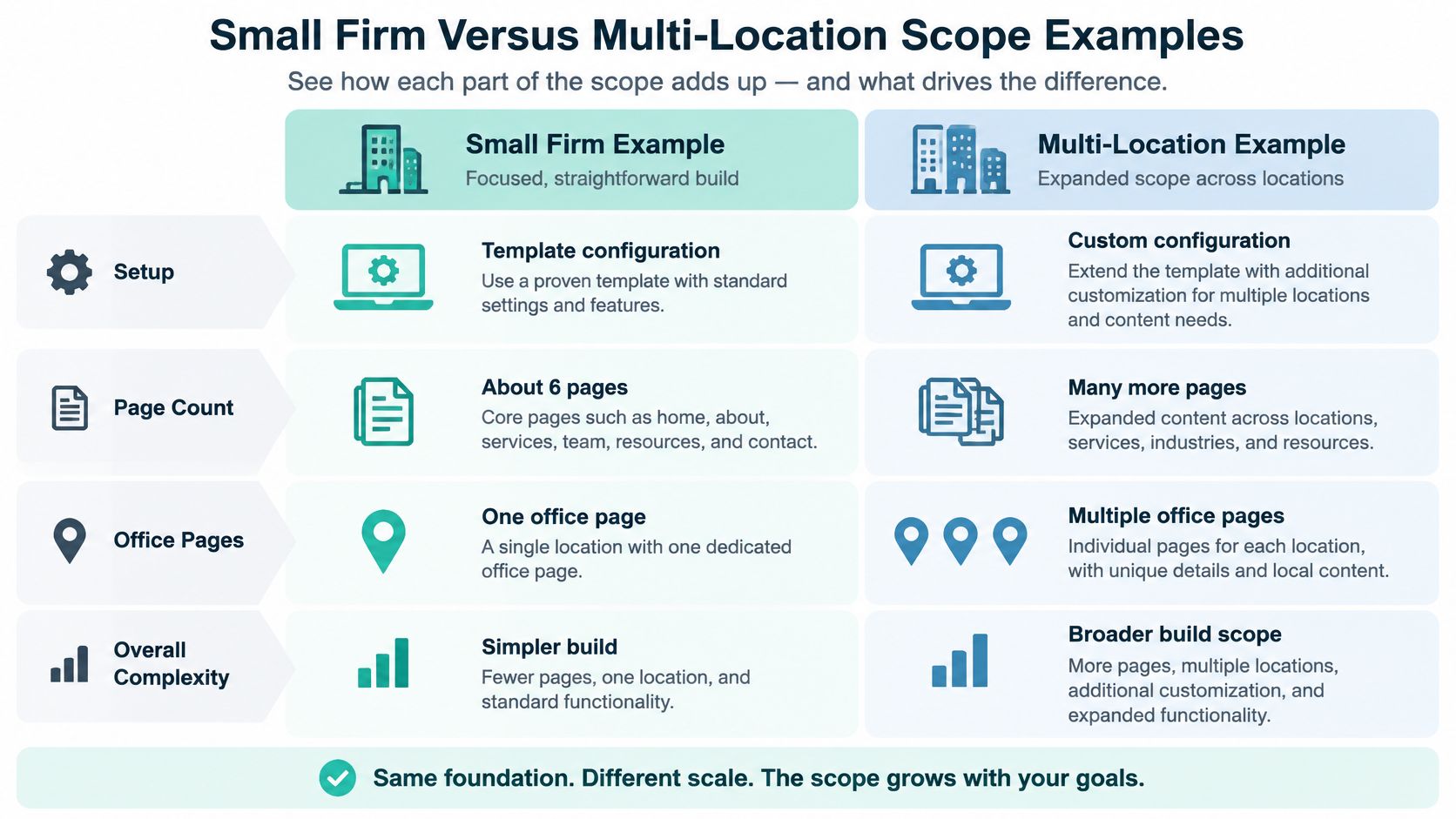
A six-page site and a three-office site are not the same job, even when both quotes use the same category names. Match the line items before you compare the totals. Published estimates place basic or semi-custom sites around $3,000 to $7,000, while custom builds with CRM or case-management integration commonly reach $12,000 to $25,000 or more (web design costs for law firms).
| Scope line | Small single-office firm | Three-location firm |
|---|---|---|
| Base build | Template configuration, about six pages, $2,000–$6,000 | Custom information architecture, $15,000–$30,000 |
| Location pages | One office page, included on the main site | Three office pages, each with its own local details |
| Intake and integrations | Basic secure contact form, included in the base build | Practice-management link, $3,000–$8,000 |
| Accessibility | Basic pass, $600–$1,000 | Build-and-test plus remediation, $2,300–$4,050 |
| Illustrative one-time total | $2,600–$7,000 | $20,300–$42,050 |
| Monthly maintenance | $400–$1,500 per month | $400–$1,500 per month |
The small-firm total is the base plus the accessibility pass: $2,000 + $600 = $2,600 at the low end, and $6,000 + $1,000 = $7,000 at the high end. The office page and the secure form sit inside that base, so they are not added again.
The three-location total adds the three rows that carry a published price. Low end: $15,000 + $3,000 + $2,300 = $20,300. High end: $30,000 + $8,000 + $4,050 = $42,050. The three office pages are real scope, but this table has no separate published price for them, so they are not in that sum. I would not read either band as a market average or a quote. They only show which rows move the number. Base build and the practice-management link move it hardest.
Integration can push a small firm out of the small tier on its own. The same published estimates put custom builds with case-management integration at $12,000 or more, so one connection to intake software can more than double a six-page project.
Location count, practice-area pages, intake systems, and languages are the four variables that change the one-time total. One office and no integration fits the small row. Two or more offices, or any CRM synchronization, belongs in the multi-location row. Monthly maintenance stays on the same published planning range, $400–$1,500, in both columns. Extra offices show up in architecture, location pages, and integration, not as a second maintenance figure.
Before you approve either scope, price the return the same way you priced the build. The law firm marketing budget built from intake numbers starts from qualified inquiries and booked consultations rather than page count. That is the test for whether the higher one-time total is expensive or cheap.
What a Landing Page Design Agency Does and How to Judge Fit
Judge the agency on identical scope, not the headline price. A usable quote splits the one-time build from copy, migration, accessibility, maintenance, and tracking. Discovery sets the goal and the page inventory. Information architecture and the conversion path come next. Then template design, build and configuration, accessibility and performance testing, launch with redirects, and a handoff of access and files. SEO, content, or campaign work can sit on top of that process. Price those lines apart from the build so you can see what each one covers.
Fit is whether the agency measures the same outcome you do. A firm site has to explain the next step, say something useful about fees or how pricing works, and make it obvious how to inquire. Plenty of sites look finished and still leave a first-time visitor guessing. Many people search for a lawyer on their own before a referral warms them up, so the page has to do that work alone.
| Criterion | Strong fit signal | Warning sign |
|---|---|---|
| Goal definition | Agrees on target inquiries, consultations or retained matters before design | Starts with a template and a headline price |
| Scope | Itemizes build, copy, migration, accessibility and tracking | Quotes one lump sum with no line items |
| Measurement | Sets up analytics events, call tracking and form conversions | Reports traffic only |
| Accessibility | Names WCAG target level and test matrix | Relies on an overlay or an ADA-friendly claim |
| Ownership | Confirms domain, hosting, CMS and source file access | Keeps accounts or content files |
| Guarantees | Describes process and measures results over time | Guarantees top rankings |
Score each bidder on all six rows before you compare price. I would set aside any proposal that folds those lines into one number. An agency that fails the scope row will fail the measurement row too, because it never planned what to track.
One page or a full site is a scope question. A single landing page suits one practice area or one campaign: one offer, one next step. A full site suits a firm with several practice areas and offices. If you are evaluating page-level work, these landing page examples show what a focused offer page looks like when it has one job.
Confirm the Quote Checklist Before You Sign
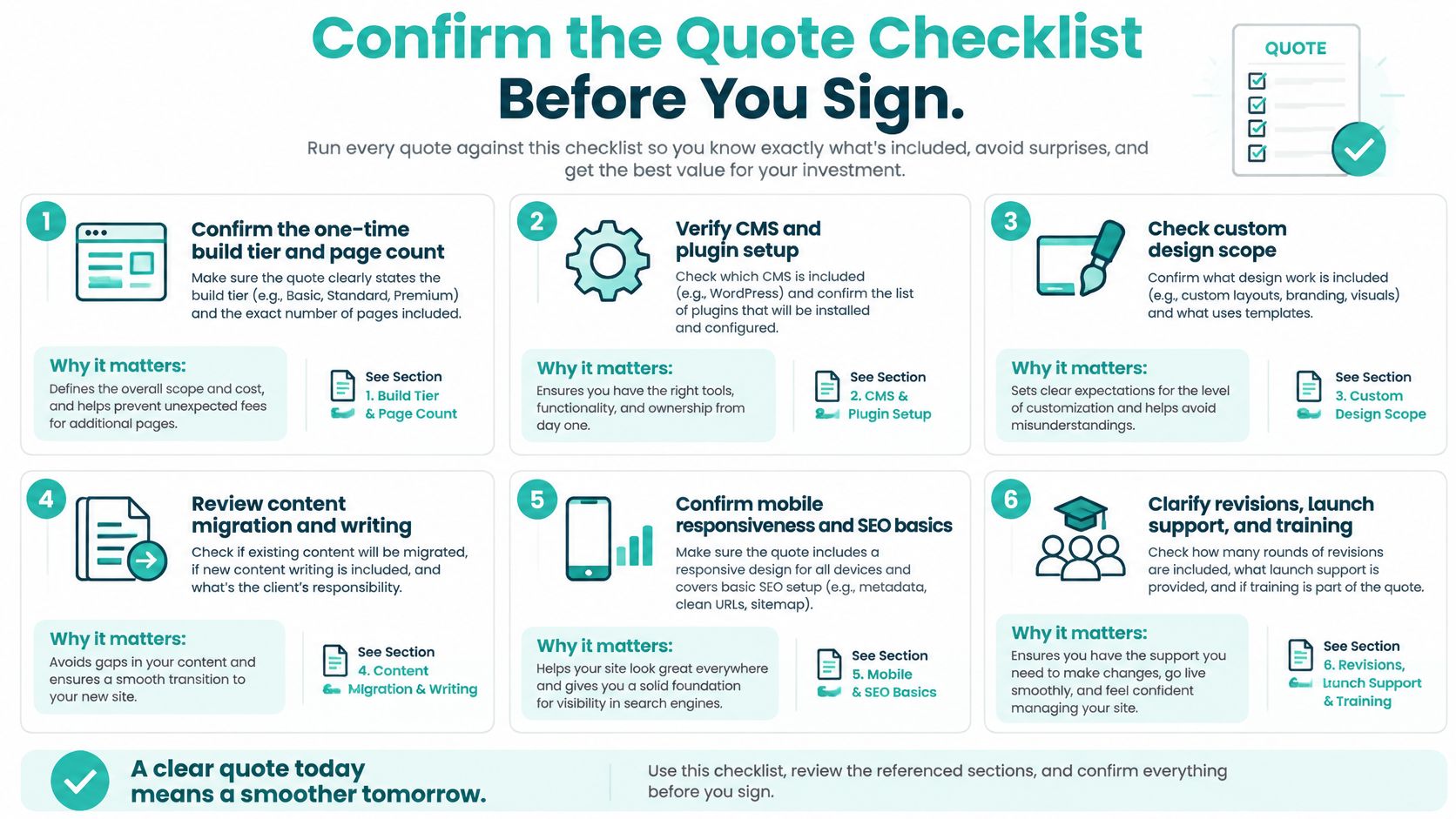
Run every proposal against this list. Each item maps to a line you've already seen, and each one has a failure mode that shows up months after launch.
- Confirm the one-time build tier and page count. Without a page count, you're buying design hours with no defined output.
- Itemize copy and migration, including redirects and the handoff list. Most surprises live here.
- Name the accessibility target level and test matrix. Specific criteria make a mid-range build comparable with a premium proposal.
- Confirm each add-on, such as a portal, integration or multilingual content, and why it's needed. Buy the system you'll use this year, not the one that sounds impressive.
- List hosting, software, backup and security responsibilities. Someone has to own patching, and it should be written down.
- Set the monthly maintenance fee and the pages or hours it covers. An open-ended retainer isn't a scope.
- Confirm tracking for analytics, call tracking and form conversions. If conversions aren't measured, the site can't be evaluated.
- Confirm ownership of the domain, hosting access, CMS, source files and exportable content. Ownership in writing, not in a sales call.
- List third-party costs such as booking tools, chat, PDFs and client portals. These sit outside most package prices and renew on their own schedule.
SimpleLab Digital handles this stage by discussing budget, campaign scope and any required software or platform costs before work begins, then confirming additions and third-party costs before a client subscribes. Firms that want a second opinion on scope can book a call for recommendations built around their goals, budget and current marketing. The law firm marketing services page shows how the build, content and follow-up pieces fit together.
Make one decision this week: request an itemized quote against this checklist, or book a call to compare scope line by line. The firms that do the second one usually spend less and get more.
SimpleLab Digital plans and manages law firm marketing as modular services, from landing pages and SEO/GEO and website maintenance to paid media and follow-up, so the build and the ongoing work are priced separately instead of buried in one number. If you want your current quote reviewed against the scope lines in this article, or a plan built around qualified inquiries and booked consultations, visit SimpleLab Digital and start with a conversation about your goals and budget.