The most repeated advice about a law firm marketing budget is to pick a percentage of revenue and move on. That advice puts the answer before the question. A percentage tells you what other firms spend. It doesn't tell you what a signed matter in your practice area can afford, or whether your attorneys and intake staff can serve the inquiries another few thousand dollars would buy.
I build these budgets with firm owners every month, and the productive conversation always starts with intake arithmetic: average fee per retained matter, inquiry-to-consultation rate, consultation-to-retained rate, and how many new matters the firm can open without wrecking response times. The percentage becomes a sanity check at the end, not the starting input.
Your practical next step is small. Pull the last 90 days of intake records and count three things: qualified inquiries, consultations attended, and matters signed. Those three numbers set your ceiling. Everything below is built on them.
Table of Contents
- The Budget Range That Gives You a Starting Point
- Build the Budget Backward From a Retained Matter
- A Labeled Model for a Solo Attorney and a Three-Lawyer Firm
- Split the Spend Without Blending Your Costs
- How to Calculate Advertising ROI and Read the Result
- Give Intake and Follow-Up Their Own Line
- Reserve Review Time Before Anything Goes Live
- Your Next Step Is One Page of Numbers
The Budget Range That Gives You a Starting Point
A defensible starting range for a law firm marketing budget is 1–5% of annual revenue, and the decision is where inside that band your firm belongs. Firms cluster at the bottom rather than spreading evenly: a 2025 survey of thousands of U.S. law firms found roughly half allocated 1–5% of revenue to marketing, more than one-third allocated 1% or less, and only 14% allocated 6–10%, according to Best Law Firms' reporting on law firm marketing spend and ROI. Choosing 5% is a deliberate growth decision, not the crowd's default.
Four lines, never one
Split the total into four lines and keep them separate: media spend, production and technology (landing pages, call tracking, follow-up tooling), management or internal labour, and compliance review. Blending them hides your acquisition cost, because a month where you rebuilt three service pages looks identical to a month where you bought clicks. Media is also billed by the platform, separately from any management fee, so those two never belong on one line. In our own packages, advertising spend isn't included in the monthly management fee. The ad budget is paid straight to the advertising platform.
Referrals still carry most firms, which is why the low end of the band is legitimate rather than lazy. In that same survey, more than 90% of firms named word of mouth as an important marketing method and 58% said referrals generated more than half of new business. Concentration risk is the argument for adding attributable channels, not the argument for abandoning referrals.
| Firm situation | Share of annual revenue | Monthly at $500K revenue | Monthly at $1.5M revenue | What the money should cover |
|---|---|---|---|---|
| Referral-led solo practice holding steady | 1–2% | $417–$833 | $1,250–$2,500 | Directory listings, website upkeep, review requests, client communication |
| Solo or two-lawyer firm adding paid search | 2–4% | $833–$1,667 | $2,500–$5,000 | Narrow Google Ads set, one landing page per service, call tracking |
| Three to nine lawyers with a growth target | 4–5% | $1,667–$2,083 | $5,000–$6,250 | Paid search and social, content, intake capacity, follow-up |
| Consumer-facing practice in a competitive metro | 5% or more, set by case economics | $2,083 and up | $6,250 and up | Practice-area campaigns, creative testing, fast first response |
| Firm with no tracking in place yet | 1–2%, held for measurement first | $417–$833 | $1,250–$2,500 | Call tracking, CRM source fields and inquiry logging before any scale-up |
If you're comparing what management buys at each level, our 2026 digital marketing agency pricing guide breaks down fee structures, and X8 Web Design's guide to marketing a law practice is a useful companion for mapping channels to practice areas before you assign dollars.
Practical rule: a percentage tells you what peers spend. Only your fee per matter and your close rates tell you what a signed case can afford.
Build the Budget Backward From a Retained Matter
Run this on one spreadsheet tab. Each step produces a number the next step needs, and the output is a monthly ceiling you can defend to a partner.

- Count capacity first. Write down how many new matters per month your attorneys and intake team can open and serve well, by case type. This is a staffing number, not an ambition, and it caps everything downstream.
- Set the actual fee per matter. Divide closed-matter revenue from the last 12 months by matters closed. Use collections, not the fee quoted on your website, and split it by practice area if your mix is broad.
- Subtract direct costs. Estimate contribution margin per matter after filing costs, expert fees, contract staff and any referral or co-counsel split. A contingency matter and a flat-fee estate plan carry very different margins on the same headline fee.
- Pull two rates from intake records. Inquiry to consultation attended, and consultation attended to matter retained. Booked appointments that no-showed don't count in either denominator.
- Choose an acceptable return and divide down. Say a hypothetical firm wants $4 of new-matter revenue per $1 of marketing on an $8,000 average fee. Allowable cost per retained matter is $8,000 ÷ 4 = $2,000. With a 50% booking rate and 40% retention rate, allowable cost per qualified inquiry is $2,000 ÷ (0.50 × 0.40) = $400. Check that $2,000 against contribution margin so you're not buying revenue at a loss.
- Multiply by the inquiries capacity requires. Six matters a month at those rates needs 30 qualified inquiries, so the ceiling is 30 × $400 = $12,000. That's the whole budget, including tracking, pages and management, not just media.
Now the part most budget advice skips. If qualified inquiries already outrun what intake can handle, more spend lowers your return, because unanswered and slowly answered inquiries still cost full price. Fix response time and consultation show rates before you raise the media line. A smaller budget constrained by profitable capacity beats a larger one measured in clicks.
Treat your first rates as estimates
Only about 37% of firms report having systems to track marketing ROI, per LexGro's law firm marketing spend analysis, so your first pass at steps 4 and 5 is probably an educated guess. Label it as one. Write the assumed rate next to the number, then replace it with tracked data after a full quarter.
Two practical guards make the model hold up. Define "qualified" in writing before you count anything, using the criteria in our lead scoring guide for lawyers, so a spam form fill never enters the denominator. And if you plan to add paid social on top of search, read Rapid Ads' guidance on how to scale compliant legal lead generation before you set that channel's allowance, since creative and audience rules change what you can run.
A Labeled Model for a Solo Attorney and a Three-Lawyer Firm
Every figure below is hypothetical and labeled. None of it is a benchmark, an average, or a promised result. The point is the shape of the arithmetic, so you can swap in your own numbers line by line.
Model A, solo family-law attorney
Say a solo attorney collects $40,000 a month and sets a $2,000 total marketing budget, which is 5% of revenue. Working backward from a $3,500 average fee per retained matter, the firm decides it can pay $140 per qualified inquiry. That buys 14 qualified inquiries. At a 45% inquiry-to-booked-consultation rate, that's 6 consultations. At a 35% consultation-to-retained rate, that's 2 retained matters (rounded down from 2.1), producing $7,000 of new-matter revenue, or $3.50 returned per $1 spent.
Model B, three-lawyer estate planning and real estate firm
Now a firm collecting $150,000 a month with a $7,500 budget, also 5%. Its allowable cost per qualified inquiry is $250, buying 30 inquiries. A 40% booking rate gives 12 consultations, and a 40% retention rate gives 5 retained matters (rounded from 4.8). At a $4,200 average fee, that's $21,000 of new-matter revenue, about $2.80 per $1 before any delayed conversions from earlier quarters are credited.
| Line | Solo family-law attorney (hypothetical) | Three-lawyer estate and real estate firm (hypothetical) | Where to find your number |
|---|---|---|---|
| Monthly revenue | $40,000 | $150,000 | Last 12 months of collections divided by 12 |
| Monthly marketing budget | $2,000 | $7,500 | Output of the six-step backward calculation |
| Budget as share of revenue | 5% | 5% | Budget ÷ monthly revenue |
| Allowable cost per qualified inquiry | $140 | $250 | Average fee and contribution margin, ÷ target return, ÷ both conversion rates |
| Qualified inquiries per month | 14 | 30 | Budget ÷ allowable cost per qualified inquiry |
| Inquiry to booked consultation | 45% | 40% | Intake logs for the last 90 days |
| Booked consultations per month | 6 | 12 | Qualified inquiries × booking rate |
| Consultation to retained matter | 35% | 40% | Signed matters ÷ consultations attended |
| Retained matters per month | 2 | 5 | Consultations × retention rate |
| Average fee per retained matter | $3,500 | $4,200 | Closed-matter revenue ÷ matters closed |
| New-matter revenue | $7,000 | $21,000 | Retained matters × average fee |
| Revenue returned per $1 of marketing | $3.50 | $2.80 | New-matter revenue ÷ monthly budget |
What the gap between the two models teaches
The solo earns a higher multiple on far fewer inquiries, because a stronger booking rate and a tighter service focus mean less waste per dollar. The larger firm generates three times the absolute new-matter revenue and more gross profit, but its lower multiple sits on 30 inquiries a month that someone has to contact, qualify and nurture. At that volume, a small slip in follow-up moves the whole result.
Two sensitivities are worth testing on your own copy of this table. Drop the firm's retention rate from 40% to 30% and retained matters fall from 5 to 3.6, which cuts new-matter revenue to roughly $15,100 without a single change in media spend. Lift the solo's booking rate from 45% to 60% and the same 14 inquiries produce 8.4 consultations instead of 6.
Replace every line with your own figures, then re-cut the model after 90 days of tracked data. A model built on guessed conversion rates is a planning device. A model built on logged intake is a budget.
Split the Spend Without Blending Your Costs
Three buckets, kept apart: media, production and technology, management. Media buys attention. Production and technology turn attention into a tracked inquiry. Management is the labour of running and reporting both. Once those are separate, you can allocate the media portion by the job each channel does in the funnel rather than by habit.
Search gets the largest share because it captures demand that already exists. Someone typing "estate planning attorney near me" has decided to hire, and you're bidding for the moment. Paid social does the opposite job: it creates demand and retargets people who visited a service page and left. Organic content and local pages compound slowly and shouldn't be judged in month one, which is why our step-by-step content marketing plan for law firms sequences pages over quarters. Landing pages and call tracking are infrastructure, follow-up converts the undecided, and a small compliance and creative allowance stops approvals from stalling a launch.
| Budget line | Share of total | At a $2,000 monthly budget | At a $7,500 monthly budget | How to judge it |
|---|---|---|---|---|
| Google Ads search | 35–45% | $800 | $3,000 | Cost per qualified inquiry on defined services |
| Meta ads for demand creation and retargeting | 15–25% | $400 | $1,500 | Booked consultations traced to social |
| SEO, content and local service pages | 10–20% | $300 | $1,125 | Organic inquiries over 6–12 months, not week one |
| Landing pages, call tracking and intake tools | 10–15% | $250 | $940 | Speed to first response and completeness of source data |
| Email and SMS follow-up | 5–10% | $150 | $560 | Reactivated inquiries that had gone quiet |
| Compliance review and creative refresh | 5–10% | $100 | $375 | Approvals completed before launch, not after |
| Total | 100% | $2,000 | $7,500 | Re-cut the ranges every 60–90 days |
Why one blended cost per lead misleads you
Published legal-search benchmarks from Lunio's Google Ads legal services data report an average cost per click of $6.84, a 4.21% conversion rate and an $88.20 blended cost per lead, while personal-injury cost per lead runs approximately $2,038. Same industry label, two entirely different businesses.
Apply the average as an illustration and a $2,000 media budget buys roughly 292 clicks, which at 4.21% implies about 12 tracked conversions. That's not 12 qualified inquiries, not 12 booked consultations, and certainly not 12 signed matters. Auction variation, invalid traffic and campaign mix all move the final figures.
Set each channel amount as a range, not a fixed number, and re-cut after 60–90 days of cost-per-qualified-inquiry data by channel and practice area. A blended average across a real estate practice and a personal injury practice describes neither, and it will fund the wrong one.
How to Calculate Advertising ROI and Read the Result
Advertising ROI is the return on every advertising dollar, measured against the new-matter revenue those dollars produced. It isn't cost per lead (what one inquiry costs before anyone qualifies it), isn't cost per retained matter (what it costs to reach a signature), and isn't ROMI, which measures the whole marketing investment including fees, tools and content rather than media alone.

The calculation is plain: attributable new-matter revenue minus marketing cost, divided by marketing cost. The conservative version swaps gross fees for contribution margin, which matters enormously in contingency practices where direct costs and co-counsel splits sit between the fee and your bank account. In the solo model, $7,000 of new-matter revenue against $2,000 of spend reads as 3.5:1. A firm that wants 5:1 has exactly three levers: lower the cost per qualified inquiry, lift the close rate, or raise the fee per matter. There's no fourth lever hidden in a dashboard.
Four readings that matter more than the ratio
Watch the walkthrough below, then read your own result against these four questions rather than against a single number.
- Payback period: how many months until matter revenue covers acquisition cost. A ratio can look healthy while cash arrives after the ad invoice.
- Marketing share of revenue: whether you're inside the band or deliberately outside it, and whether that choice was made on purpose.
- Cost per retained matter: the only figure that ties spend directly to signed work, tracked by channel and case type.
- The 90-day trend in cost per qualified inquiry: direction beats any single month, especially at small volumes.
| Metric | How to calculate it | What it tells you | Where it misleads |
|---|---|---|---|
| Cost per qualified inquiry | Total marketing investment ÷ qualified inquiries | Whether the top of the funnel is affordable | Raw form fills and spam inflate the denominator |
| Cost per consultation | Investment ÷ consultations actually attended | Whether intake converts interest into appointments | No-shows counted as bookings overstate performance |
| Cost per retained matter | Investment ÷ matters retained | The only figure that ties directly to revenue | Long lag between inquiry and signature |
| ROMI | (Tracked new-matter revenue − marketing cost) ÷ marketing cost | Return on each dollar spent | Repeat business and referrals folded into the numerator |
| Average fee per retained matter | Closed-matter revenue ÷ matters closed | Sets the ceiling for allowable acquisition cost | Practice-area averages vary widely inside one firm |
| Payback period | Months until matter revenue covers acquisition cost | Cash-flow fit for a small firm | Payment plans push collection beyond the first invoice |
| Marketing share of revenue | Monthly marketing ÷ monthly revenue | Whether the budget sits inside or deliberately outside the 1–5% band | A percentage ignores case economics and capacity |
Attribution has honest limits. Signatures land weeks or months after the first call, payment plans delay collection, and a referral who first found you through an ad rarely gets credited to it. At two or five matters a month, one bad month isn't a trend. Before you conclude a page is the problem, Web Mage's guide on how to run fair landing-page comparisons explains what a test needs before its result means anything, and our Google Ads compliance and ROI guide for law firms walks the campaign-side numbers.
A cheap lead that never retains isn't cheap. It's the most expensive line in your budget.
Give Intake and Follow-Up Their Own Line
I'd hold 10–20% of the total budget as a conversion reserve, spent on the systems that protect leads you've already paid for. This isn't overhead. It's the part of the budget that determines what the other 80% is worth.
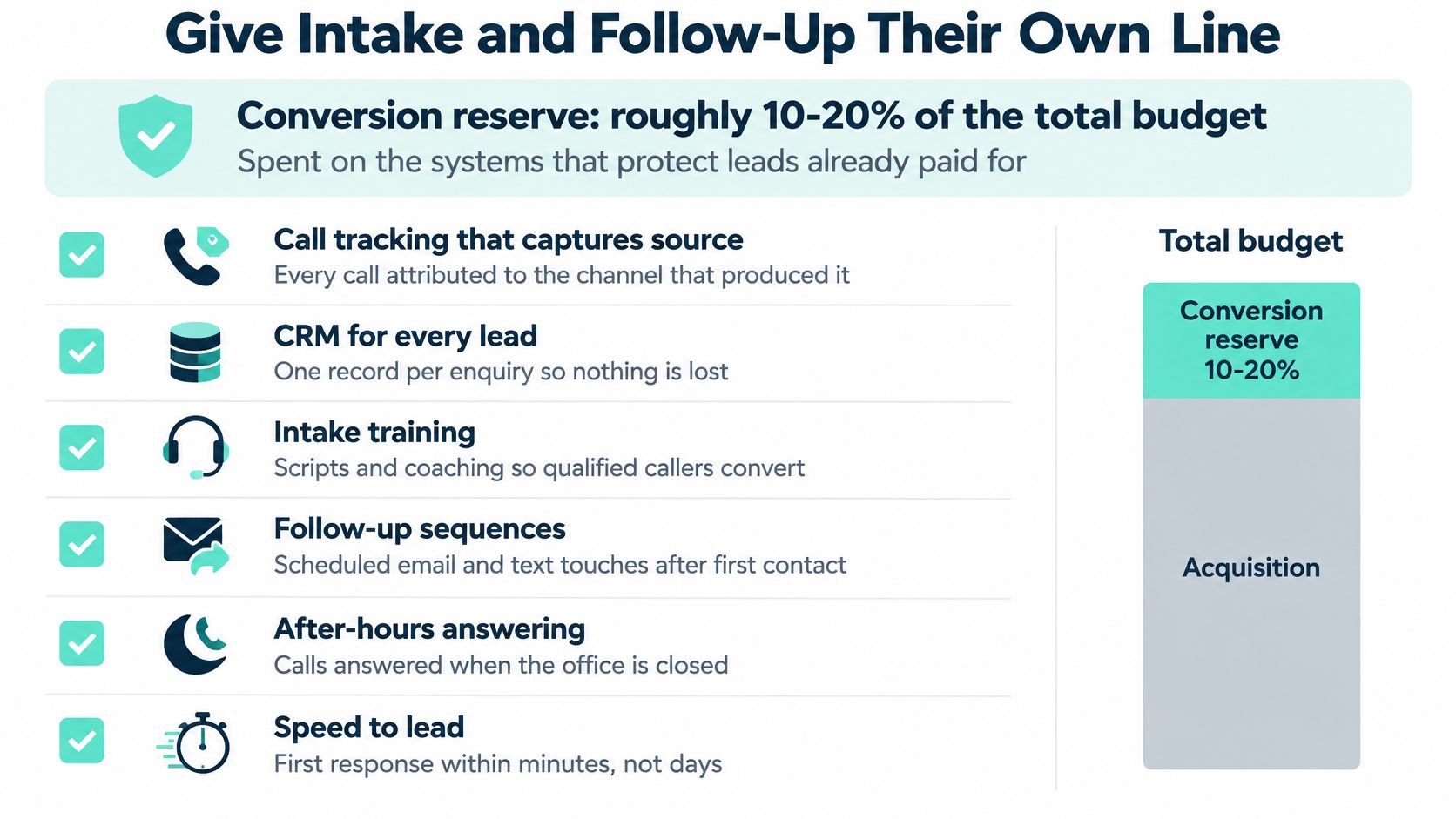
The mechanism is arithmetic. If your inquiry-to-consultation rate slides from 45% to 30% because calls sit in a shared inbox, your cost per retained matter rises by half while the media invoice stays exactly the same. Nothing in the ad account changed. You paid full price for inquiries that nobody contacted in time.
Clio's Legal Trends Report found that firms using client-facing technologies generated twice as many leads and twice as much revenue as firms not using those technologies. The tools and the response workflow are part of acquisition cost, not a separate operations conversation.
What the reserve buys, in build order
- Tracking and logging first. Call tracking that captures source on every inbound call, plus CRM or case-management fields for inquiry origin, channel and first-contact timestamp. Without this you can't compare channels at all.
- Scheduling and a response standard second. Online booking connected to the consultation calendar, and a written standard such as first contact within five minutes during office hours, with a named owner for after-hours coverage. Live phone answering is scoped separately from our marketing packages, so decide who owns it before spend rises.
- Nurture third. Intake scripts with logging, then a 6–12 month email and SMS sequence for people who aren't ready to sign. Our email nurture sequence for legal leads gives the timing and message logic for long-horizon matters like estate planning and immigration.
Tracking belongs in place before media scales up, not after. Scaling spend on top of an unlogged inbox buys you a bigger number you can't explain.
Reserve Review Time Before Anything Goes Live
Compliance review is a budget line and a workflow, not a favour you ask a partner for the night before launch. Every channel you fund creates separate marketing materials subject to the same standards, so the allowance has to cover all of them.
The Law Society of Ontario's Chapter 4 rules of professional conduct require marketing of legal services to be demonstrably true, accurate and verifiable, neither misleading, confusing nor deceptive, in the public interest, and consistent with a high standard of professionalism. The rule reaches advertisements and similar communications across media, plus firm names, trade names, letterhead, business cards and logos. Ontario also requires lawyers marketing legal services to identify in marketing materials that they're licensed as a lawyer.
Run this sequence every cycle:
- Draft the copy.
- Verify every factual claim, including fee statements, results language and testimonials.
- Confirm the responsible lawyer's licence and scope of practice are stated.
- Complete the ethics review against the applicable rules.
- Document who approved what, and when.
- Publish.
U.S. firms should check their own state bar's advertising rules before reusing copy approved in another jurisdiction, including speciality and certification language, disclaimer placement and results claims. Don't assume an approval travels.
The budget mechanic is simple: assign a fixed review allowance or internal staff hours inside every campaign cycle, covering new ads, revised landing pages, social posts, videos and email or SMS sequences. Add a fresh review whenever a campaign crosses into another province or state, because parallel advertising rules can differ in ways that matter. A stalled approval costs you a week of media spend, which is why this line pays for itself.
Your Next Step Is One Page of Numbers
This week, fill one page with five figures: average fee per retained matter, inquiry-to-consultation rate, consultation-to-retained rate, monthly capacity, and the allowable cost per qualified inquiry that follows from them. Set your monthly budget and channel ranges from that page, then check the total against the percentage band as a sanity test rather than a target.
If you want to pressure-test the output, our law firm ROMI calculator models six months across practice areas, services and budget levels, compares three scenarios, requires no email, and returns estimates rather than guarantees. You can review what it produces with a Marketing Guru. Management plans start from USD $990 per month, with advertising spend paid separately to the platforms, and our law firm marketing services cover practice-area planning for estate planning, family, real estate, immigration, criminal defense and more.
The test that replaces percentage anxiety is blunt. If your firm can't state its cost per qualified inquiry and its cost per retained matter, measurement comes before any increase in spend.
We build law firm marketing budgets the way this article describes them: from your fee per matter, your intake rates and your capacity, then across ads, landing pages, content and follow-up as one connected plan with biweekly reporting on qualified inquiries. Bring your one page of numbers and we'll tell you what your ceiling is, including when the right answer is to fix intake instead of spending more. Visit SimpleLab Digital to run the ROMI calculator and book a review with a Marketing Guru.