A qualified lead is an inquiry from a prospective client whose matter fits a practice area the firm accepts, falls within its service area, shows real urgency, and includes contact details the team can use. Score each inquiry against a consistent definition before judging a channel. Six criteria, a 0-to-12 total, and a score-based callback rule help connect intake decisions to retained matters rather than raw form fills.
Phone access can be a weak point for law firms, and the response gaps below show how inquiries can be lost before intake evaluates their fit.
Clio's 2024 Legal Trends research found that only 33% of firms answered an email, down from 40% in 2019. Firms using client-facing digital capabilities such as online intake, electronic signatures, and text messaging received 51% more client leads and generated 52% higher revenues than firms without them.
More inquiries will not solve a process that fails to respond or distinguish good-fit matters. Compare channels by cost per retained matter, then use the scorecard to identify which inquiries merit follow-up.
Jump to the lead scorecard, the ethics checklist, the channel comparison, the response-speed evidence, the worked week of inquiries, or the adoption steps.
Table of Contents
- What a Qualified Lead Is and Why Volume Misleads
- The Six-Factor Lead Scorecard Template
- Ethics Checks Before You Buy or Accept a Lead
- Referrals, Search Ads and Directories Compared
- Why Response Speed Decides Who Becomes a Client
- Scoring a Week of Inquiries in Practice
- Start Scoring Your Inquiries This Week
What a Qualified Lead Is and Why Volume Misleads
Intake logs use four words interchangeably, and each one describes a different stage of the same funnel. An inquiry is any contact at all: a web form, a phone call, a chat message, a walk-in. A qualified inquiry has already cleared the fit and reachability checks. A booked consultation is a scheduled or completed first meeting. A retained matter is a signed engagement letter with money attached to it.
| Stage | What It Means | Metric to Track |
|---|---|---|
| Inquiry | Any form, call, message or walk-in contact | Inquiry volume |
| Qualified inquiry | Matches practice area, location, urgency and contact criteria | Qualified-inquiry rate |
| Booked consultation | A scheduled or completed initial meeting | Consultation-booked rate |
| Retained matter | A signed engagement letter or retainer | Retained-matter rate and revenue |
A form fill is a ticket sold at the door. A qualified lead is a guest who arrived with the right invitation, in the right city, on the right night. Marketing can sell tickets all day. The guest list is what fills the room, and the guest list is built by intake.
Two firms, one hundred inquiries, opposite results
Run the arithmetic on a comparison that plays out in real intake logs. Firm A receives 100 inquiries, qualifies 20 and retains 8. Firm B receives the same 100, qualifies 60 and retains 4. Firm B's dashboard looks three times healthier on qualified volume while Firm A signs twice as many clients for the same spend.
That gap usually comes from fit and reachability, not from marketing talent. Firm B bought broad directory traffic that included matters outside its practice areas and prospects two states away, and its team never reached a third of the rest. When someone asks why inquiries doubled and revenue didn't, this is the answer.
Reporting rule: put qualified inquiries, booked consultations and retained matters in the same monthly table as inquiry volume. A channel that can't show all four numbers is unproven, not cheap.
Firms that close this loop wire the scorecard into digital marketing for lawyers instead of keeping it in a side spreadsheet, so ads, landing pages and follow-up all answer to the same definition of a good lead.
The Six-Factor Lead Scorecard Template
Score each inquiry twice. The first pass happens at intake using only what the caller tells you, and the second happens after the initial conversation, when budget and engagement fit become visible. The six criteria are practice-area fit, geography, urgency, contactability, consultation booked and retained-matter potential, and each one earns 0, 1 or 2 points.
The whole tool fits on a single page that any intake coordinator can apply without a lawyer in the room.
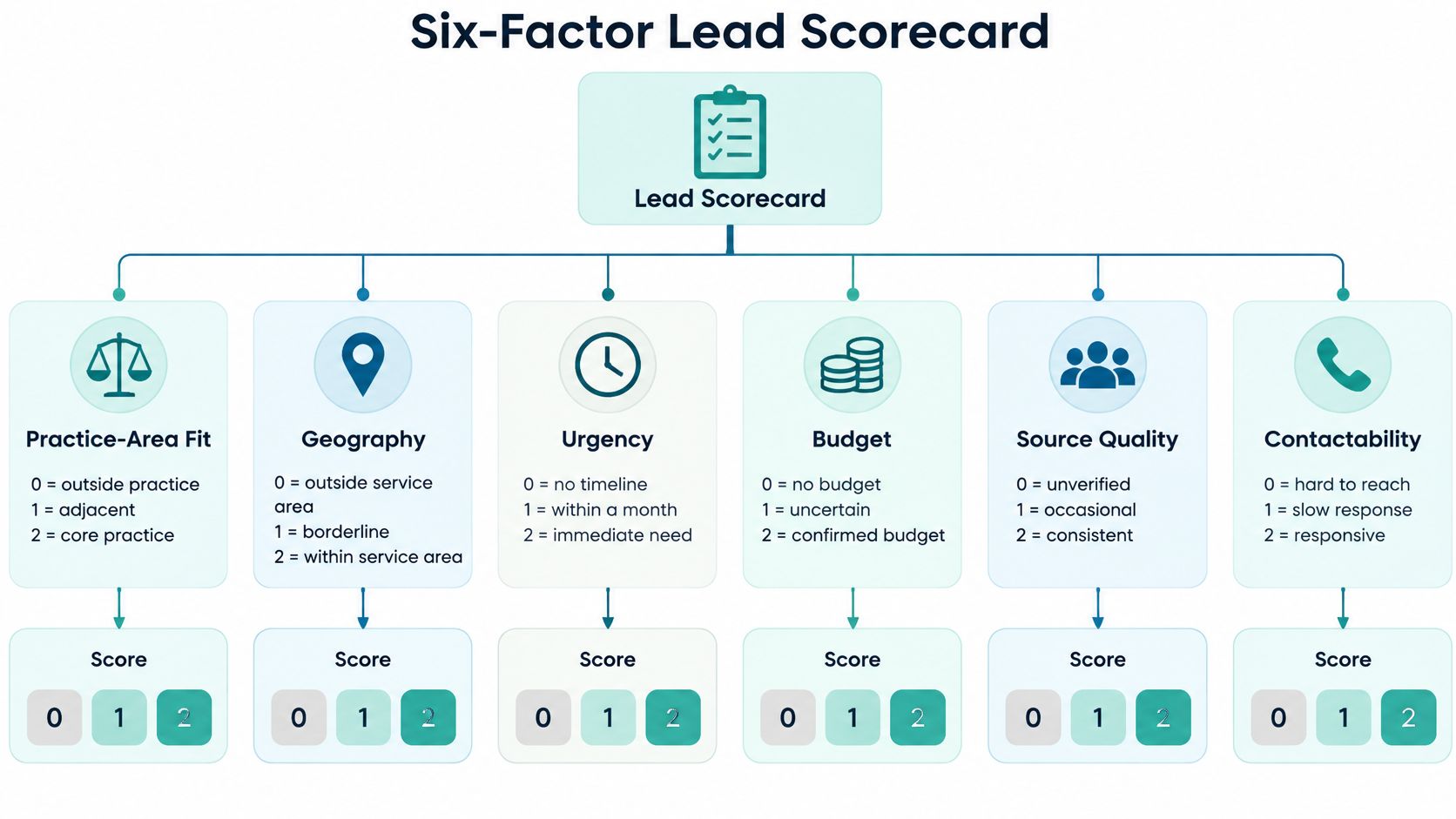
| Criterion | Score 2 | Score 1 | Score 0 |
|---|---|---|---|
| Practice-area fit | Matches a practice area you accept and price | Adjacent matter you take occasionally | Outside your practice areas |
| Geography | In your licensed jurisdiction and service area | Nearby but needs travel or co-counsel | Outside licensed jurisdictions |
| Urgency | Decision or deadline within 30 days | Decision expected in 31 to 90 days | No timeline stated |
| Contactability | Valid phone and email, consent to text | One working channel during business hours | No working contact or no consent |
| Consultation booked | Meeting booked within 48 hours | Booked after follow-up | Not booked after three attempts |
| Retained-matter potential | Expected value fits your engagement model | Value uncertain | Low-value or unsuitable matter |
Turning points into a queue
Twelve points is the ceiling. A workable starting policy routes the top band to a call-back within one business day, sends the middle band into a timed follow-up sequence of calls, texts and email, and declines or refers out the bottom band according to your jurisdiction's conflict and referral rules. Treat those cutoffs as a hypothesis to calibrate against retained matters after 60 to 90 days, not as permanent law.
Worked example: an employment inquiry comes in from a prospect two hours away who leaves a mobile number and says a decision is needed within 30 days. That's 2 for fit, 1 for geography, 2 for urgency and 2 for contactability, which totals 7 before anyone has discussed fees. The score says nurture, not reject.
Which factors you can score, and when
Fit, geography, urgency and contactability are all knowable on the first read of a form. Consultation booked and retained-matter potential usually aren't, because they depend on a conversation and a conflict check. Tell staff to re-score after the first call and to overwrite the intake score rather than average the two, so the report reflects the best information available.
Adoption is deliberately small: one page, one named owner, one monthly review. Print the rubric, tape it beside the intake desk, and review the score distribution alongside the source report so the thresholds move when the data says they should.
Ethics Checks Before You Buy or Accept a Lead
The cheapest lead in the market is often the most expensive one, and the cost doesn't show up in the spreadsheet. Paid lead arrangements carry disciplinary exposure, so each source gets classified before the first dollar goes out, not after the first complaint.
ABA Model Rule 7.2 allows lawyers to communicate information about their services through any media but generally prohibits giving or promising anything of value to someone for recommending the lawyer. The express exceptions cover reasonable advertising costs, usual charges of qualifying legal-service plans or lawyer-referral services, purchase of a law practice, certain nonexclusive reciprocal-referral arrangements with client disclosure, and nominal appreciation gifts that aren't compensation. The rule also requires advertising to identify at least one responsible lawyer or firm by name and contact information.
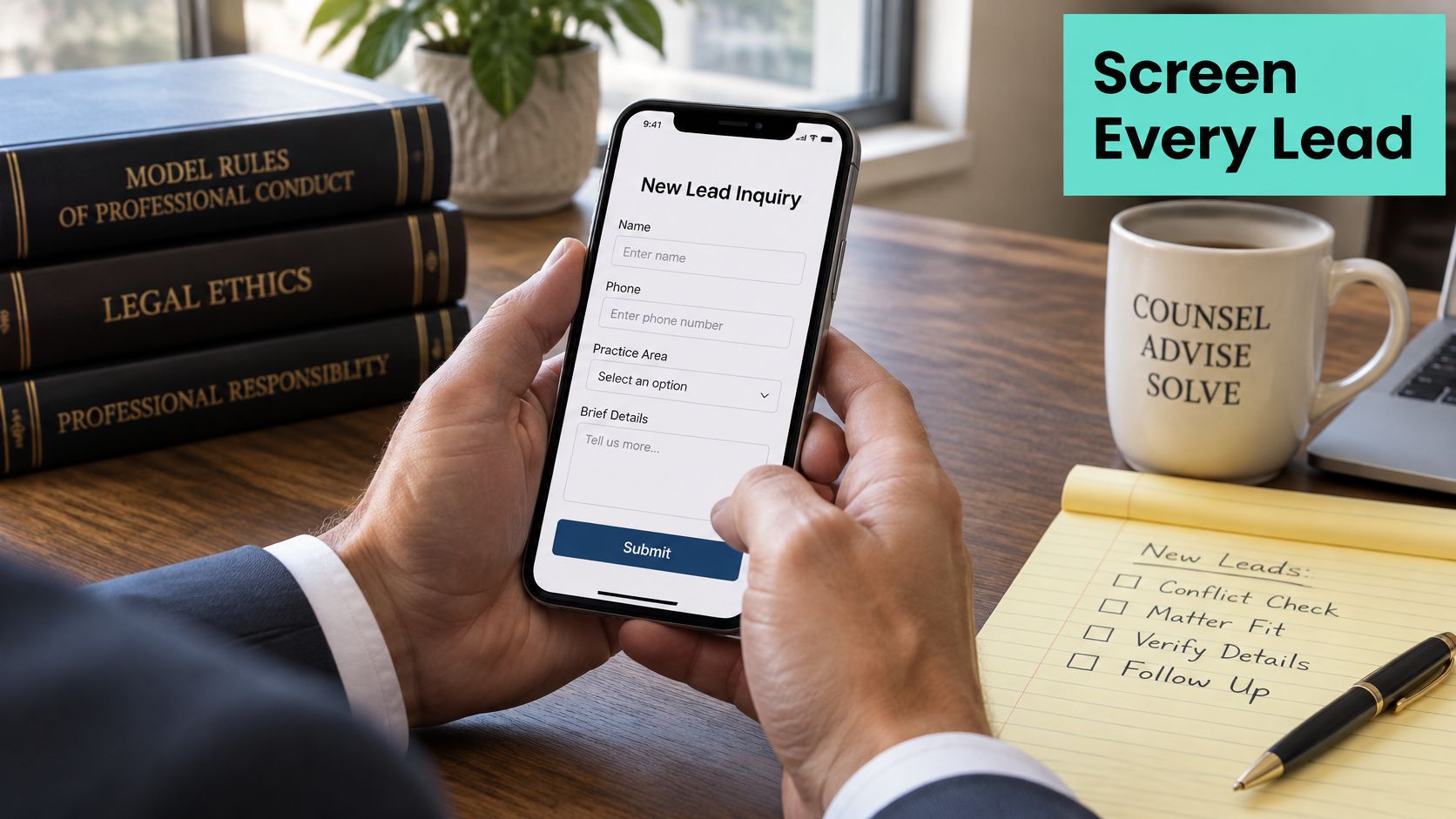
Five questions to ask before you pay for a source
- Control: is this advertising the firm writes and approves?
- Matching: does the service route particular prospects to particular lawyers?
- Payment: does the firm pay per referred client rather than per impression?
- Reciprocity: is there a referral arrangement, and is it disclosed to the client?
- Certification: do any specialist claims rest on certification by an approved organization?
The answers sort each source into permitted, requires registration, or must be restructured. Those answers change with the jurisdiction, which is why national advice has limits.
Ontario adds its own mechanics. The Law Society of Ontario's practice management guidance requires advertised fees to describe services precisely and to state whether disbursements, third-party charges and taxes are extra, and the lawyer must honor the advertised fee where it applies. Referral fees must go to a lawyer or paralegal with expertise in the matter, be documented at or soon after the referral, give the client at least two recommendations unless the reason is disclosed, stay fair and reasonable without raising the client's total fees, and fall within 15% of the first $50,000 billed plus 5% of additional fees, capped at $25,000.
Two mechanical safeguards cover most of this ground. Run every landing page and ad through ethics review before launch, and keep vendor documentation showing who is responsible for what representation. If your follow-up includes outreach to people who never contacted the firm, read a cold email compliance guide before the first send. Paid social carries the same burden, and this walkthrough of Facebook advertising for attorneys that stays bar compliant covers the copy rules that trip firms up.
Referrals, Search Ads and Directories Compared
| Source | Typical Lead Quality | Cost Model |
|---|---|---|
| Referrals | High fit when the referrer knows your work | Relationship time, plus any disclosed reciprocal arrangement |
| Search Ads | Intent-based; depends on keywords and landing page | Pay per click |
| Directories | Mixed fit with many unqualified contacts | Listing or per-lead fee; confirm terms |
The three sources don't compete for the same moment. Clio's 2024 Legal Trends research reports that consumers said they would use internet search to find a lawyer at 55%, narrowly ahead of referrals at 54%, with firm websites at 45% and online reviews at 42%. Those figures describe intended discovery behavior, not conversion rates. What they establish is a blended journey: someone hears a name, then checks the firm online before calling.
Referrals reward fit and cost you hours
Referrals from former clients and professional contacts usually arrive with the best fit, because the referrer already knows the practice area and the geography. The cost isn't a click price, it's the partner hours spent maintaining the relationship, plus any reciprocal arrangement that has to be disclosed and documented. High fit, slow to scale.
Search Ads buy intent for a defined matter
Search captures prospects who type their problem into a browser at the moment they're willing to act. Quality swings on keyword choice and the landing page, since a broad match on a personal injury term will pull in people across three states. Pay per click is the visible number, and it's the wrong one to manage to.
Directories deliver volume with mixed fit
Directory traffic arrives cheap and unfiltered. Expect many contacts outside your practice areas, outside your licensed jurisdiction, or with no working phone number. Read the contract before paying: listing fees, per-lead pricing and exclusivity clauses all change the arithmetic, and shared leads mean you're racing other firms to the same caller.
Firms weighing whether to build their own listing asset can start with this DirectoryEasy directory building walkthrough, which covers structure and submission flow. If you'd rather rent attention, review the Google Ads campaign and compliance guide for law firms before scaling spend.
The connected path is what makes any of it work: ads create the first opportunity, a landing page explains the next step, content gives people more context, and follow-up keeps the conversation moving.
Search behavior also sets the floor for credibility. FindLaw's 2024 consumer legal-needs research found that 97% of respondents reported using a search engine to find the attorney they contacted, and the same survey series found that 82% of consumers who contacted an attorney after finding them online used online reviews in their decision, per FindLaw's 2024 U.S. Consumer Legal Needs Survey. Ads and directory listings get judged against a review profile you may not be managing.
Budget rule: after 90 days of scorecard data, move spend toward the source with the lowest cost per retained matter. A fourth column in the table above, filled from your own intake log, decides it. Industry averages can't.
Why Response Speed Decides Who Becomes a Client
Only 25% of law firms responded to online leads within five minutes in 2025, and 39% took more than two hours or didn't respond at all, according to Hennessey Digital's 2025 Lead Form Response Time Study. That's the gap a competitor closes while your form sits in an inbox.
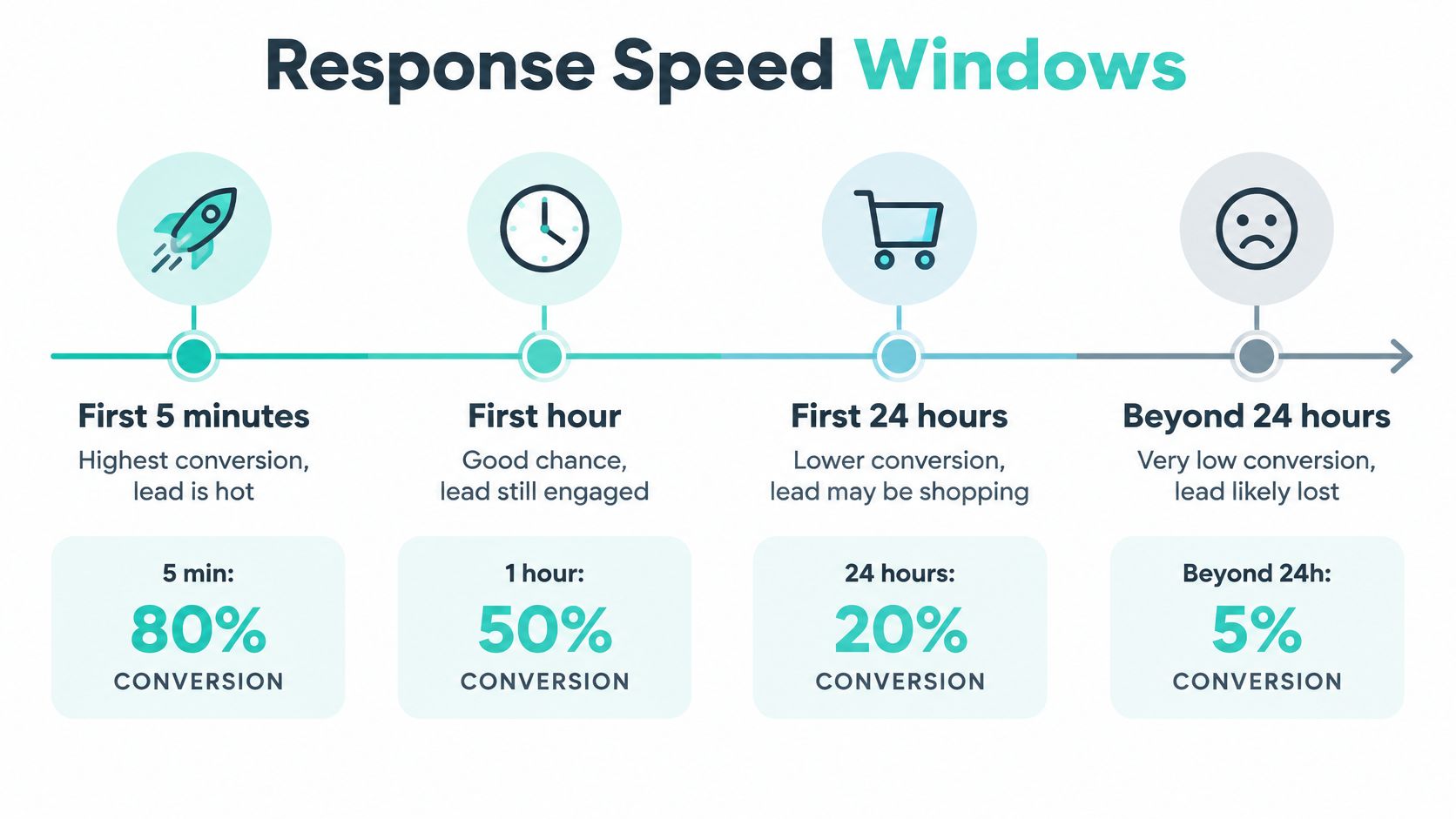
The mechanized version of that finding comes from an audit of 2,241 companies in Clio's 2019 Legal Trends report: organizations that contacted a web lead within one hour were nearly seven times more likely to qualify it than those waiting an additional hour, and more than 60 times more likely than those waiting 24 hours or longer. Qualification rates were eight times higher when the first attempt happened within five minutes rather than after six. The audit covered companies generally, not law firms, but the mechanism lands harder in legal work, where the prospect is often calling three firms in one afternoon.
Clients confirm the pressure. A 2025 survey of 3,000 consumers found that 72% will not wait more than 24 hours for a callback, as reported by Scorpion's consumer research.
The four speed windows
- First five minutes: the prospect is still holding the phone. Highest qualification rate.
- First hour: still recoverable, especially with a text that names a real person.
- First 24 hours: the prospect is comparing firms and may already have booked elsewhere.
- Beyond 24 hours: mostly a voicemail and a wasted click.
Here's how that looks as a working intake flow.
Build the workflow, then measure it
An automatic confirmation message goes out within seconds and tells the prospect what happens next. An alert reaches a named intake owner, not a shared inbox. During staffed hours, someone attempts a live call within five minutes. Unanswered inquiries drop into timed multi-channel follow-up, and an after-hours rule routes urgent matters to whoever is on call.
Then report on median first-response time, the percentage contacted within five minutes, contact rate and consultation-booked rate. For a deeper look at the follow-up layer, these speed to lead resources cover routing patterns, and this guide to SMS follow-up for law firm leads covers consent and sequencing.
The test costs nothing: time your next ten inquiries from submission to the first human contact, and treat the number you get as a conversion metric rather than an administrative detail.
Scoring a Week of Inquiries in Practice
Here's a hypothetical week at a firm running three sources: 40 inquiries, split as 14 from referrals, 18 from Search Ads and 8 from one directory listing. Applying the rubric, 9 land in the 10-12 band, 16 in the 7-9 band and 15 in the 0-6 band. Of the top band, 4 book consultations and 2 retain. Every one of those figures is illustrative arithmetic, not a benchmark.
Read that week two ways. Volume says 40 inquiries, which sounds like a healthy pipeline. Quality says 9 qualified, 4 consultations booked and 2 retained, which tells you whether the pipeline is worth feeding.
| Metric | Formula |
|---|---|
| Qualified-inquiry rate | Qualified inquiries divided by total inquiries |
| Consultation-booked rate | Booked consultations divided by qualified inquiries |
| Retained-matter rate | Retained matters divided by booked consultations |
| Cost per qualified inquiry | Source spend divided by qualified inquiries |
| Cost per retained matter | Source spend divided by retained matters |
| Revenue per source | Fees from retained matters credited to the source of first contact |
Credit the first contact, then check the path
Attribute retained matters to the source of first contact while still recording the full path, so a signed matter isn't automatically handed to the last click. In this example the directory produced 6 inquiries and no retained matters, while referrals produced 14 inquiries and both signed clients. Under last-click attribution with a long consideration window, those credits blur.
Run the monthly source review
Compare rows across the table above, cut or reallocate spend where cost per retained matter is highest, and revisit your score thresholds after 60 to 90 days. Expect attribution lag: a family law matter can take weeks from inquiry to signed retainer, so a source that looks dead in week two may be your best performer by week ten. This is why the family law lead generation and intake checklist separates inquiry dates from signature dates.
Three questions for the team meeting: which source produced our retained matters this month, how many qualified inquiries did we never reach, and does any threshold need to move?
Start Scoring Your Inquiries This Week
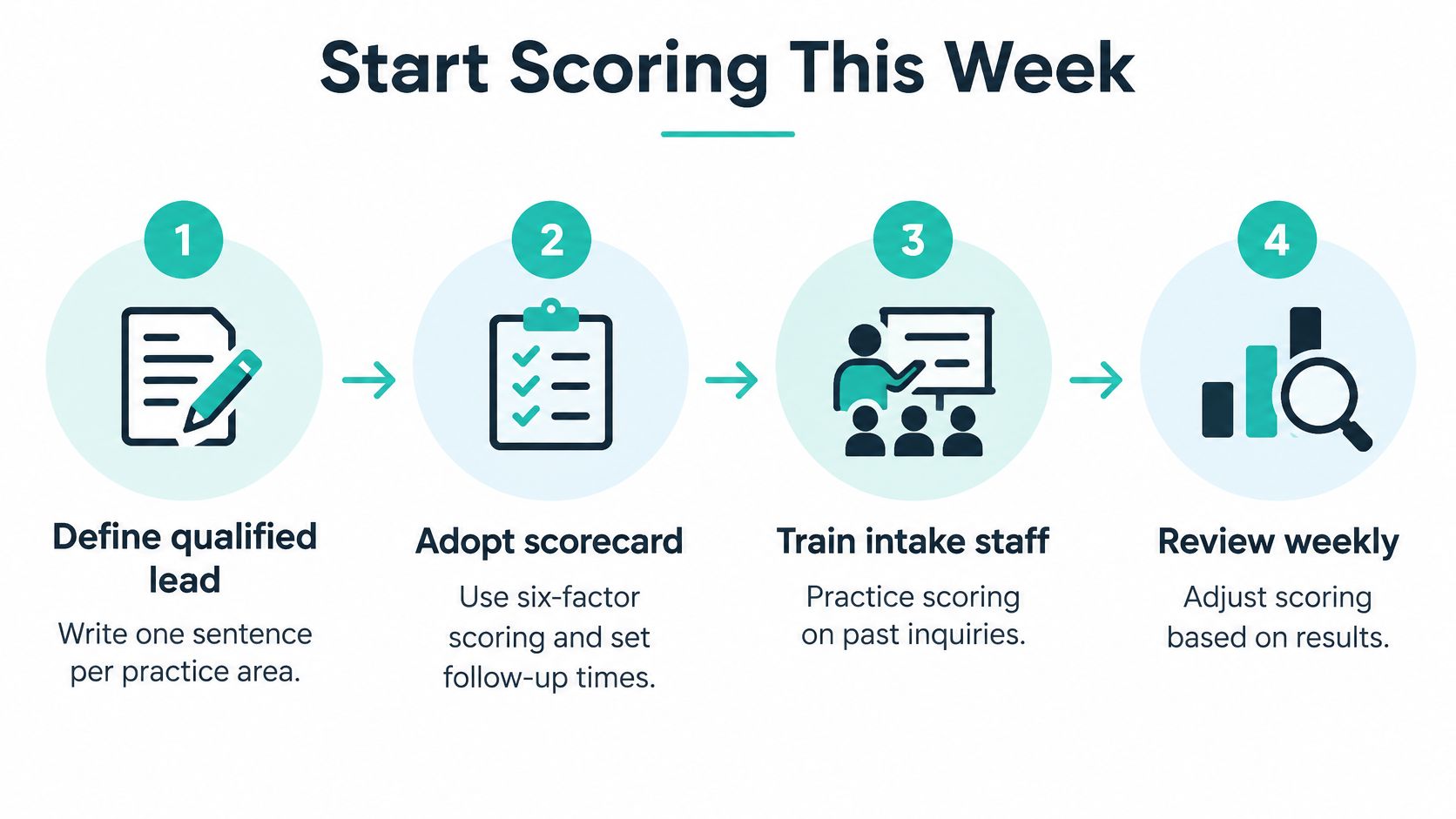
- Define the target. Write one sentence per practice area describing a qualified lead, including the jurisdictions you serve.
- Adopt the rubric. Set your call-back, nurture and decline thresholds on the 0-to-12 scale.
- Add the field. Put a score field in the intake form or log so the number is captured at the source.
- Time the first contact. Ten consecutive inquiries, timed from submission to the first human reply, gives you a baseline the scorecard can't supply.
- Classify your sources. Run each current channel against the five ethics questions and document the answer.
- Review after 30 days. Compare qualified inquiries, booked consultations and retained matters by source, then adjust.
How you'll know it's working
Three signals show up inside a quarter: fewer unqualified contacts reaching a lawyer's calendar, faster first contact on the inquiries that matter, and a consultation-booked rate that climbs while inquiry volume stays flat. If volume drops and retained matters hold, the scorecard is doing its job.
SimpleLab Digital's law firm marketing service connects ads, landing pages and email or SMS follow-up so the same scorecard applies across the whole path rather than to one channel. We ask clients to have someone on the team who responds to inquiries and a way to share lead quality and sales feedback, because that feedback is what refines the campaigns, and this email nurture sequence guide for legal leads shows how the slower-moving inquiries get handled.
One decision to make this month: adopt the scorecard, hold a short review with your intake lead every two weeks, and let the monthly source report tell you where the next dollar goes.
A qualified inquiry is worth more than a form fill, and SimpleLab Digital builds the path that proves it: paid search and social that create the first opportunity, landing pages that explain the next step, and email and SMS follow-up that keeps the conversation moving until someone books. We plan and manage those pieces as monthly packages, review results every two weeks, and measure qualified inquiries, booked consultations and retained matters instead of clicks. Visit SimpleLab Digital to see how the law firm marketing packages fit the practice areas you want.