
Many lawyers now report social media as a source of new inquiries. That supports a controlled test of Facebook ads for lawyers. It does not show those inquiries became retained clients. Name who screens each lead, and define a qualified consultation, before you open Ads Manager. I would hold the form-versus-booking choice until that screen is in place.
Table of Contents
- Is Facebook Worth Testing for Your Firm
- Lead Forms Versus Website Bookings Compared
- Restricted Ad Categories and Practice-Area Checks
- How to Build a Privacy-Safe Intake Form
- Ethics, Confidentiality and Follow-Up Workflow
- Measuring Campaigns by Qualified Consults
- Test Plan and Next Step
Is Facebook Worth Testing for Your Firm
Go ahead if your firm has a defined service area, a specific service to promote, and room to handle consultations. Hold off if intake is already overwhelmed or nobody can connect advertising inquiries to signed engagements. Facebook and Instagram can support client acquisition, but form submissions alone aren't a business case.
Facebook isn't a new experiment for smaller practices: the ABA's 2019 Legal Technology Survey Report, described by the ABA Journal, found it was the most popular advertising channel among firms with two to nine lawyers and second-most popular among solo practitioners. Treat that as historical adoption evidence, not a current performance benchmark. Check the latest ABA survey before using it to describe today's market.
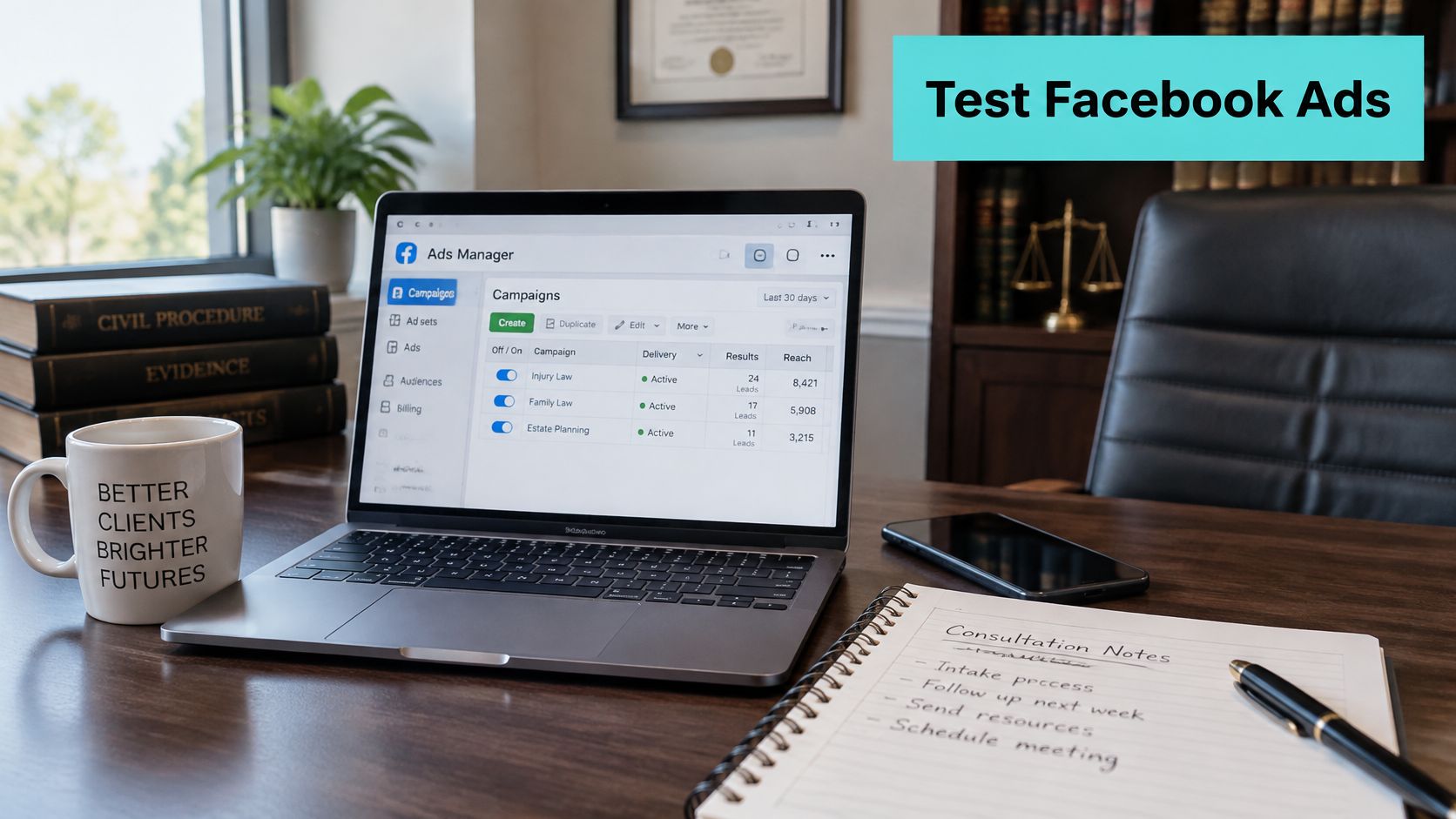
Make the decision before choosing an audience
Gather the operating facts that determine whether a test makes sense:
- Practice area: Choose a service the firm wants more of, not every service on its website.
- Service area: Define where the lawyers can accept matters and practically serve clients.
- Matter economics: Establish average collected fees and the staff effort required to acquire and serve a client.
- Consultation capacity: Confirm who has available appointments and who handles preliminary screening.
Say a family-law firm serves a particular county. It could test neutral educational creative about preparing for a custody consultation, while running a separate estate-planning campaign around understanding wills and planning documents. Don't combine those offers because the same office handles both.
Go or no-go rule: If expected matter contribution can't cover client-acquisition costs and intake labor, fix the economics or workflow before buying traffic.
A strong test starts with an intake choice, then checks campaign classification, form design, follow-up controls, and downstream measurement. Creative comes after those decisions, not instead of them.
Lead Forms Versus Website Bookings Compared
| Factor | Instant lead form | Website booking page |
|---|---|---|
| Setup effort | Built inside Meta Ads Manager | Landing page, booking tool and CRM connection to build |
| Contact details | Prefilled from the Meta profile where available | Typed by the prospect |
| Fields you can ask | Platform-limited, with additional restricted-category rules | Fields justified by consent, privacy obligations and professional rules |
| Privacy-policy requirement | Live privacy-policy webpage linked on the form | Accessible firm website privacy policy |
| Typical drop-off | Less typing friction, but test actual completion | More steps can increase abandonment |
| Lead-quality signal | Screening answers and confirmed contactability | Choosing a time signals intent, not eligibility |
| CRM link | Meta lead ID passed into the CRM | Form data and permitted, non-sensitive measurement events |
| Best use | Testing creative and building inquiry volume | Consultation-heavy practices with screening needs |
Lead forms versus website bookings is a friction decision, not a quality guarantee. Prefilled details make an Instant Form easier to submit, including unintentionally. A booking page asks for more commitment, but a booked slot still doesn't establish jurisdiction, suitability, or conflict clearance.
Under Meta's lead-ad terms, advertisers must use submitted information consistently with their privacy policy and disclosed terms, and an Instant Form's privacy-policy URL cannot point directly to a PDF, image, or download. Publish a readable webpage explaining the use of contact information rather than uploading a policy document.
Choose what happens after submission
For estate planning, a short form might request the planning category and preferred call window, plus a permitted service-area question. A personal-injury booking page might use incident category and a broad date range for routing, without requesting medical records or a narrative of the accident.
A website gives you more control over instructions, but it doesn't automatically prevent oversharing. Remove the invitation to describe everything that happened. Our guide to landing pages for law-firm consultations explains how to align the offer, screening, and next step.
When reviewing contact-page alternatives, the option to get in touch with Bell Law provides a concrete firm contact destination to examine. Evaluate any example against your own practice's obligations rather than treating another firm's page as compliance approval.
I would use a hybrid path for many initial tests: a short routing form followed by conditional scheduling. Offer an unrestricted booking link only when the required screening can happen before booking; otherwise, tell the prospect that intake will arrange the next step.
Use Instant Forms when you need to learn which message generates relevant inquiries. Prefer a screened booking page when every consultation consumes scarce attorney time.
Restricted Ad Categories and Practice-Area Checks
A campaign doesn't need to contain the word loan to require a restricted-category review. Legal services can overlap with the underlying housing, employment, or financial opportunity described in an advertisement. Classify the actual offer and destination, not just the firm's practice label.
Meta's lead-ad guidance applies special restrictions to housing, employment, and financial-products or services opportunities based in or targeted to the United States or Canada; restricted lead forms cannot collect specified fields including age, gender, marital or relationship status, street address, city, postal code, or ZIP code. Confirm the live policy before launch because platform classifications and permitted fields can change.
Match the question to the classification
| Practice area | Check before launch | Safe intake question |
|---|---|---|
| Estate planning | Confirm whether the offer touches financial products or services | Planning-goal category and preferred call window; county only if permitted |
| Family law | Avoid relationship-status and other restricted personal fields | Matter type and whether a court date is set, without requesting the date |
| Real estate law | Check whether the campaign overlaps with housing | Property type and dispute stage; save detailed facts for the call |
| Employment law | Review employment classification and prohibited demographic fields | Issue category and employer-size band, without names or deadlines |
| Immigration | Check classification and keep creative focused on general services | Country of interest and general matter category, without immigration history |
These are routing-question candidates, not blanket platform approvals. Even a useful question should be removed if the campaign's classification, privacy obligations, or local professional rules prohibit it.
An estate-planning offer about preparing for an initial planning conversation isn't automatically equivalent to an advertisement for a financial product. Equally, calling an offer legal education doesn't exempt a landing page that promotes a restricted opportunity.
Don't recreate a prohibited prefilled question as a custom field.
Suppose a real-estate firm wants the prospect's neighborhood to identify service eligibility. If the campaign's restrictions prohibit that collection, move the appropriate location screening to the private intake call rather than asking for a disguised address.
Audience selection also needs to match the permitted campaign configuration. The comparison of original audiences and Advantage audiences on Meta can inform delivery choices, but audience automation doesn't replace classification review. Have a local ethics adviser resolve jurisdictional questions before approving the campaign.
How to Build a Privacy-Safe Intake Form
A good advertising form routes an inquiry; it doesn't take a legal history. Build around decisions the intake team can make safely before substantive discussion. For family law especially, a seemingly helpful text box can invite allegations, children's information, or private financial details.
Use a controlled process rather than adding questions whenever intake encounters an unusual matter.
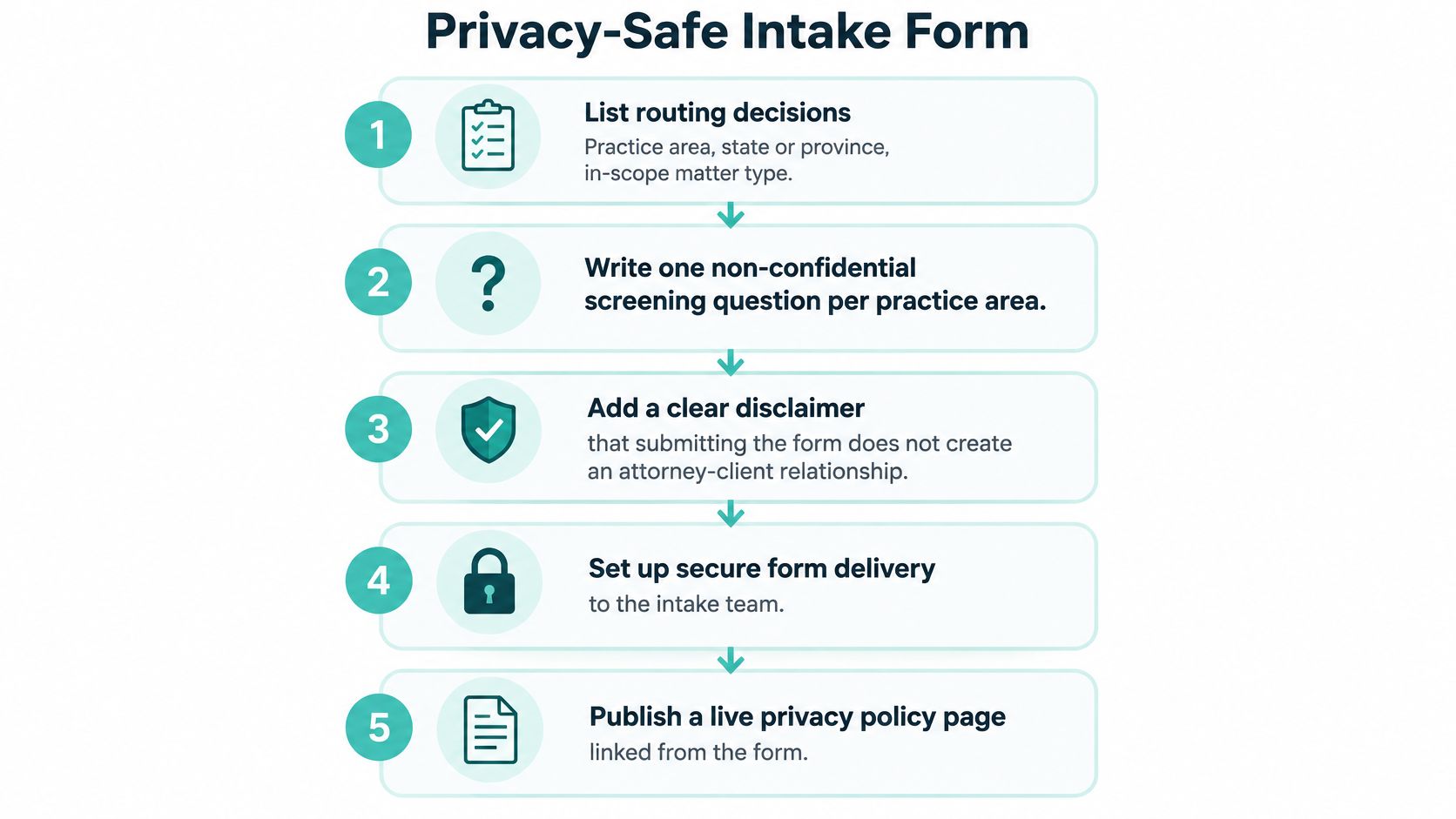
Build only what routing requires
List the routing decisions. Identify practice area, permitted jurisdiction screening, and in-scope matter categories before drafting fields. The common mistake is collecting location automatically without checking whether the campaign permits that question.
Use closed-choice issue categories instead of asking what happened. An estate-planning form could offer creating a plan, reviewing an existing plan, or learning about the process; an open narrative box invites facts the advertising system doesn't need.
Ask how the prospect wants to be contacted, with consent language approved for the intended channel and jurisdiction. Don't treat permission to discuss an inquiry as unrestricted permission for ongoing promotional messages.
Add a clear warning not to submit deadlines, documents, or confidential case details through the advertising form. Explain that the firm will provide an appropriate intake route; don't place the warning beneath the submission button where it's easily missed.
Publish and link the privacy policy. Explain how contact details are used and make the page accessible without a download or login. A generic policy that doesn't describe the actual intake handoff is a poor substitute for documenting that handoff.
Configure a receipt-only automated response that states submission doesn't establish an attorney-client relationship or acceptance of the matter. Warm language is fine, but statements implying that the firm is already protecting someone's rights can mislead.
Test with dummy records from ad click through submission, CRM import, restricted staff access, notification, and the first-response timer. A successful submission screen isn't enough if intake receives no alert or the record reaches the wrong queue.
Review the finished experience
A case-evaluation destination such as Miles Hansford Law Firm's case evaluation can help your team consider how to frame a request for review. Don't assume that a case-evaluation label makes detailed disclosures appropriate inside an advertising form.
For practice-specific preparation, use the family-law lead-generation intake checklist to connect screening with staff responsibilities.
- Minimum collection: Every field supports an identifiable routing decision.
- Clear expectations: The prospect understands what happens next and what not to send.
- Controlled delivery: Authorized intake staff receive the record without exposing it broadly.
- Working handoff: Test records reach the correct queue, owner, and notification channel.
Ethics, Confidentiality and Follow-Up Workflow
The highest-risk communication may happen after the ad is approved. A staff member answering a public comment, an automated direct message, or a reminder text can introduce promises or individualized guidance that never appeared in the creative.
The Canadian Bar Association's advertising toolkit warns that social-media advertising can inadvertently disclose confidential information, including the identity of current, former, or prospective clients. Map advertisements, testimonials, landing pages, messages, audience uses, and staff replies to applicable rules before launch. Canadian firms should check their provincial law society requirements; U.S. firms should check their state's adopted rules.
Assign an owner to each decision
Under ABA Model Rule 7.2, communications must identify a responsible lawyer or firm and provide contact information, and lawyers may pay the reasonable costs of permitted advertising. Review solicitation separately rather than assuming that permission to advertise authorizes every follow-up approach.
| Step | Owner | Trigger | Required action |
|---|---|---|---|
| Ad and copy approval | Managing partner | Before a new ad or variant | Review claims, required disclosures and archive the approved version |
| Comment or message reply | Intake coordinator | New comment or direct message | Offer a private intake route without legal analysis or confirming client status |
| First response | Intake coordinator | New CRM lead | Contact within the agreed response window using the permitted channel |
| Conflict check | Conflicts officer | Lead passes routing criteria | Complete the required check before substantive discussion |
| Escalation | Supervising attorney | Assigned attorney unavailable or deadline mentioned | Notify the designated on-call attorney |
| Records retention | Marketing lead | Ad paused, replaced or ended | Preserve creative, dates and placements under the governing retention rule |
Control the conversation and preserve the record
The ABA's historical Ethics 2000 Rule 7.2 materials contain a two-year retention provision after last dissemination, but that document isn't a universal current requirement. Confirm the operative state or provincial rule, then document the required retention period in the campaign archive.
Include ad text, creative, destination versions, dates, placements, and approval records. Don't rely exclusively on the advertising account to preserve material that your firm may need later.
Keep appointment follow-up limited to scheduling, approved reminders, and general process information. Review SMS follow-up for law-firm leads when assigning consent controls, message ownership, and stop-contact handling.
Escalation rule: When someone mentions a deadline, staff should alert the designated lawyer, not assess the deadline or imply that the firm has accepted responsibility.
If the attorney is unavailable, the workflow needs an actual backup owner. An inbox labeled urgent isn't a substitute for an escalation route.
Measuring Campaigns by Qualified Consults
Cost per form is the starting metric. Cost per retained matter is the commercial decision. Between them, intake must record whether people are reachable, eligible, booked, qualified, and ultimately retained. Otherwise, the firm can't distinguish weak advertising from missed calls or scheduling problems.
Connect each metric to an operational decision
| Metric | Source | Decision it supports |
|---|---|---|
| Cost per form | Meta Ads Manager | Creative response and inquiry volume |
| Reachable and passing criteria | CRM status fields | Whether inquiries fit service area and practice scope |
| Consultation booked | CRM event, with permitted Conversions API feedback | Whether intake and scheduling are working |
| Qualified matter | CRM status set by intake staff | Whether the campaign attracts suitable matters |
| Retained matter | CRM engagement record | Whether inquiries become clients |
| Cost per retained matter | Ad spend divided by retained matters | Whether advertising economics support scaling |
Define qualified before launching. It could mean that a prospect fits the firm's jurisdiction and service scope, passes the required screening, and is suitable for the offered consultation. Keep qualification, booking, and attendance as separate statuses so a scheduled appointment doesn't masquerade as an attended consultation.
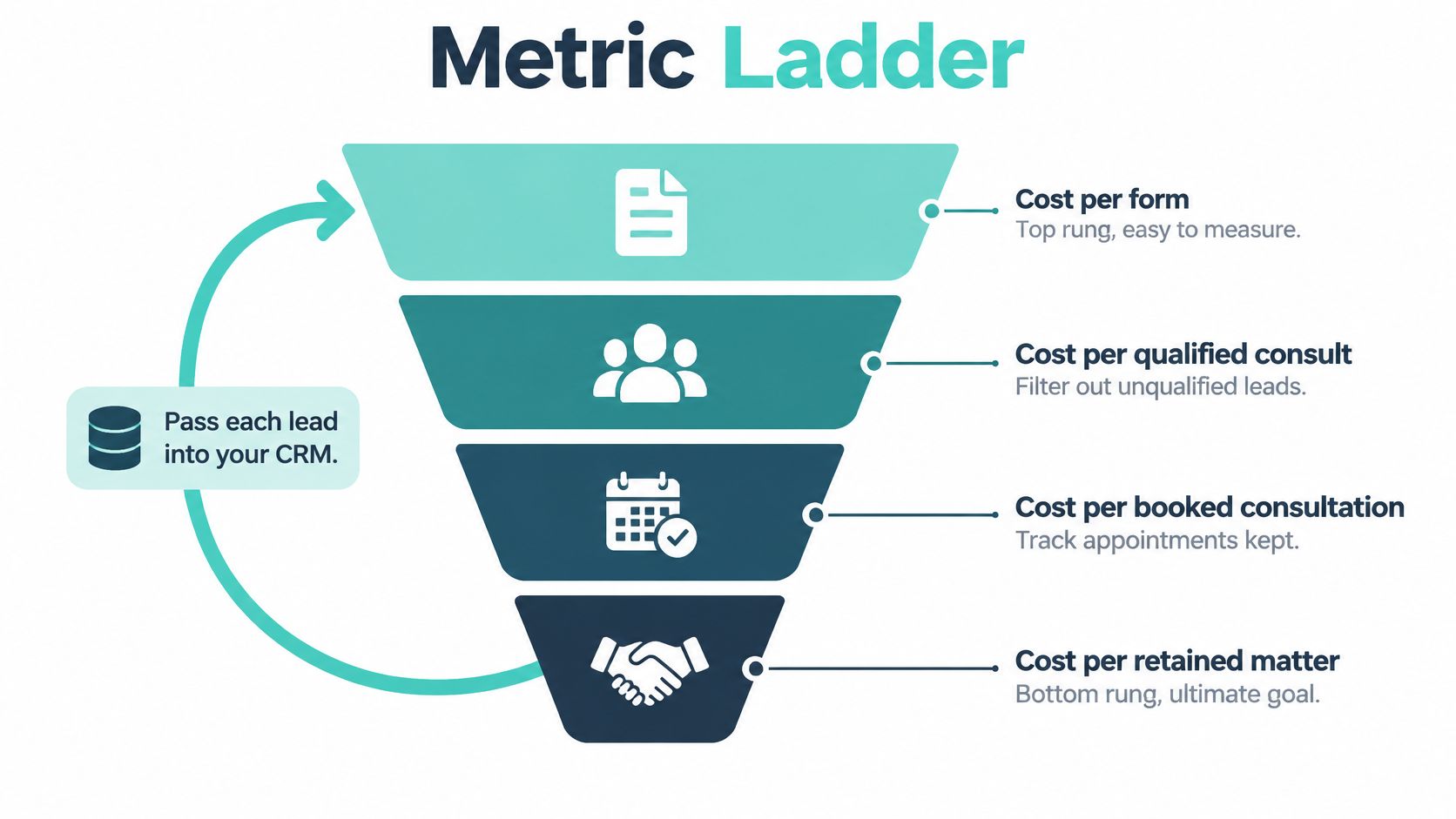
Build a privacy-conscious feedback loop
Pass each Instant Form lead into the CRM with its Meta lead ID and preserve campaign attribution. Website inquiries should retain permitted campaign identifiers too. As intake updates records, use an approved integration to return only permissible, non-sensitive status events, not case narratives, documents, or conflict information.
Meta's conversion-leads integration guidance recommends updates in real time where possible or at least daily, permits batches of up to 1,000 events and backfills of up to seven days, and describes an optimization-stage event occurring within 28 days with an approximate 1% to 40% conversion rate. Those are integration parameters, not promises about legal-advertising performance.
Start with lead-volume optimization while checking field completion and contactability. Move toward an eligible booked-consultation or qualified event only when the integration supplies sufficient reliable feedback. Validate timestamps, deduplication, match quality, and retry handling before blaming campaign delivery.
Not every internal status belongs in an advertising platform. Have the firm approve the event mapping, consent basis, and data fields before enabling transmission.
Judge outcomes across the decision cycle
Say an estate-planning booking page produces more expensive inquiries than an Instant Form, but more of those prospects attend and retain the firm. The booking path can have better economics despite its higher cost per submission. Compare mature groups of inquiries rather than mixing newly submitted leads with matters that have had time to convert.
Track permitted call attribution and ask prospects how they found the firm. Someone may see an ad, later search the firm's name, and call directly, so platform attribution shouldn't be treated as a complete account of influence.
Consultation preparation also affects what happens after booking. Resources such as Lein Law Offices' consultation questions for Wisconsin accident victims illustrate how educational content can help prospects prepare without turning the advertising form into a detailed interview.
Use a consistent law-firm marketing ROI framework to separate advertising spend from total acquisition costs. Report cost per retained matter monthly, labeled with its spend definition and lead cohort, then compare it with collected matter value and delivery costs.
Test Plan and Next Step
Write the test plan before spending. Choose a service, a screening path, and the conditions for continuing or pausing. Don't launch a broad campaign and ask intake to work out the process afterward.
Use a written checklist to make approvals visible.

Prepare, launch, then assess
During the preparation week, complete the intake destination, privacy-policy page, classification review, CRM queue, and response ownership. Once those controls work, begin practice-specific creative tests and assess the inquiries before changing optimization.
For estate planning, test an educational planning offer against a consultation-focused message. For family law, keep the wording discreet and neutral rather than implying knowledge of the viewer's relationship or personal circumstances.
- Scope: Practice area, service area, offer, and weekly consultation capacity.
- Approval: Permitted claims, required disclosures, and campaign classification.
- Ownership: Conflict-check owner, first-response window, and escalation contact.
- Infrastructure: Privacy-policy URL, tested CRM delivery, and outcome reporting.
- Economics: Advertising budget, acquisition-cost ceiling, and review criteria.
Use the following video as a discussion prompt alongside the written plan.
Our Facebook & Instagram Ads service starts at $495 USD per month, including ad creatives, campaign management, and ongoing optimization; advertising spend is separate. We ask for a clear service to promote, a business-information and approval contact, someone to answer inquiries, and a way to share lead-quality and sales feedback.
Our digital marketing for lawyers approach applies practice-specific planning to the broader discipline of digital marketing for small businesses. Request a planning conversation before launch so your firm can resolve capacity, screening, and measurement decisions before committing advertising spend.
SimpleLab Digital offers connected advertising, landing-page, and follow-up support for firms that need a clearer path from inquiry to consultation. Visit SimpleLab Digital to discuss a Facebook and Instagram test built around your practice area, intake capacity, and retained-matter measurement.