Global digital advertising spending was forecast to exceed $950 billion in 2026, roughly 70% of total worldwide advertising investment, according to Statista's internet advertising outlook. That is mainstream operating spend, not a niche line item.
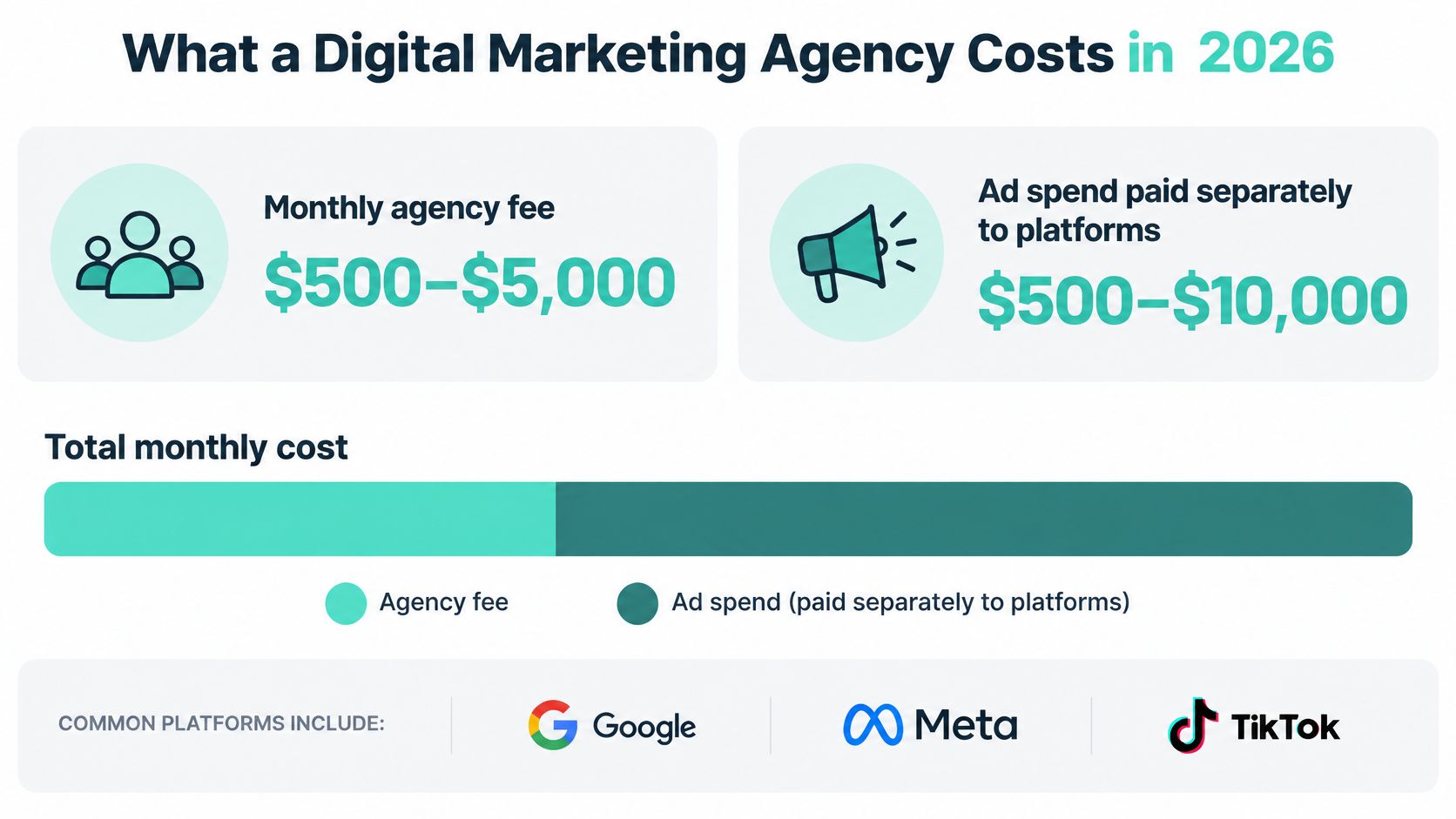
For a small business, a sensible planning range is roughly $500 to $5,000 a month for agency work, plus $500 to $10,000 a month in media paid to Google, Meta or TikTok. Hourly rates vary too widely to budget from; scope is the cleaner unit. Treat fee and media as two lines from day one, or you will not know which half is failing.
The monthly commitment required to produce qualified inquiries is the service fee, ad spend, software or sending costs, and the owner's time. A $990 package covering one ad channel, three videos and a landing page still leaves media and CRM costs outside it. A $2,495 package may cost less per inquiry if it adds a second channel, more content and longer follow-up. Judge the system, not the retainer.
Table of Contents
- What a Digital Marketing Agency Costs in 2026
- Digital Marketing Agency Pricing Models and Typical Rates
- What Drives Digital Marketing Agency Cost Up or Down
- What Agency Fees Cover and What They Leave Out
- Contract Terms, Minimums and Red Flags to Check Before Signing
- Monthly Budget Examples for Small Businesses and Law Firms
- How to Evaluate Monthly Fees and Ad Spend
- Choose an Agency Budget You Can Measure
What a Digital Marketing Agency Costs in 2026
Two proposals at $1,500 a month can buy completely different amounts of work. One covers strategy, creative production, campaign management, landing pages, conversion tracking and reporting. The other covers account management, with every landing page, every video and every follow-up email billed as an extra. Same headline fee, very different delivered capacity.
The structure worth memorizing is a service fee plus a media budget. The fee pays for people and production. The media budget goes straight to Google, Meta or TikTok. Around both sit the smaller lines that quotes often tuck away: software, hosting, CRM and message-sending costs, plus the owner's own hours spent reviewing creative and approving campaigns. I read any proposal that folds these into one blurred number as a warning sign.
Why the fee and the ad budget stay separate
Monthly pricing pays for work that runs whether or not the ad account spends a dollar: keyword and audience research, creative iteration, landing-page testing, conversion tracking, compliance review, reporting and lead-nurture improvements. Most of that planning now happens around phone screens, since mobile behavior shapes where budgets and creative effort go.
The short version: plan on $500 to $5,000 a month for agency execution and $500 to $10,000 a month for media, then add tools and your own time. Measure the total in qualified inquiries.
That math is why the cheapest package is often the most expensive per lead. A low fee that excludes landing pages or follow-up pushes real work back onto you, and each inquiry it produces costs more. Add every line, divide by qualified inquiries, and you get what the agency costs.
Digital Marketing Agency Pricing Models and Typical Rates
There is no single agency price because firms charge in five main ways, and many combine two of them. In 2024, the national average hourly rate for digital marketing agencies in the United States was $82.66, with a median of $84.40, according to MarketingSherpa's pricing data. That number sits in the middle of a wide band, so always ask which model a quote is built on before comparing it with anything else.
| Pricing model | Typical cost | How it works | Best for |
|---|---|---|---|
| Hourly consulting | $50 to $150 per hour (US average $82.66, median $84.40) | You pay for agency time on strategy, setup, audits or fixes | Small projects, audits and short-term help |
| Monthly retainer | $500 to $5,000 per month for small businesses; $10,000+ for larger accounts | A fixed monthly fee for an agreed scope of ongoing work | Businesses that want continuous growth management |
| Project-based | $1,000 to $50,000+ per project | One-off fee for a defined deliverable such as a website or campaign launch | One-time builds and rebrands |
| Performance-based | 10% to 20% of ad spend or a per-lead fee | Fees tied to results such as leads or sales | Lead generation with reliable conversion tracking |
| Subscription package | $990 to $2,995 per month (example: SimpleLab Digital tiers) | A fixed monthly bundle of ad channels, creative, landing pages and follow-up | Small businesses that want predictable monthly costs |
Which model fits which situation
Hourly works for diagnostics. Buy eight hours to audit a stalled Google Ads account or fix conversion tracking, get a written list of findings, then decide whether you need ongoing help at all. Retainers suit continuous growth work and remain the most common small-business arrangement, which is why they dominate every pricing survey you'll read.
Project fees fit defined builds: a new site, a campaign launch, a brand refresh. Performance deals only make sense when conversion tracking is solid and both sides agree on what counts as a lead, because a disputed definition of "qualified" turns a good deal into an argument.
Subscription packages sit closest to how most owners want to buy. If you want to understand why fixed monthly bundles are displacing open-ended retainers, this breakdown of why subscription-based marketing agencies outperform traditional agency models covers the mechanics, including how predictable scope changes the reporting conversation.
I would also read a comparison of how different agency types price their work before you shortlist, because email, paid media and full-service shops describe nearly identical deliverables in very different language. Class A Media's agency comparison guide is a useful cross-check on what each kind of shop owns versus outsources.
Hybrids are everywhere: a reduced retainer plus a percentage of ad spend, or a base fee plus a per-landing-page charge. Match the model to how much ongoing work your business needs, not to the lowest headline number on the page.
What Drives Digital Marketing Agency Cost Up or Down
Two quotes with the same label can differ by thousands a month, and the gap is nearly always scope. The cleanest way to read a proposal is to split the drivers into two groups: what your business and market demand, and what the agency chooses to put inside the fee.
Business-side factors
Industry is the biggest swing. A general local service competing against a dozen nearby providers needs modest creative and standard campaign structure. Law, finance and healthcare need compliance-aware review on every claim and testimonial, and they bid in expensive auctions where a single click can cost more than a coffee. That combination lifts both the fee and the media budget, and it's why law firm marketing is scoped differently from retail.
Ad budget size is the second lever. A media budget under about $2,000 a month needs one optimization pass a week. At $10,000 or more, the account needs constant bid management, new creative to avoid fatigue, audience expansion and deeper reporting, because small percentage improvements now move real money.
Agency-side scope decisions
The rest is what the agency agrees to deliver. Statista's data on global digital advertising spending frames the underlying split that makes this so consequential: third-party media bought from platforms such as Google, Meta and TikTok is one cost, and agency services covering strategy, creative production, campaign management, landing pages, analytics and follow-up are another. A retainer price says nothing about the media it manages, so the honest comparison question is what operational capacity the fee includes.
| Cost factor | Keeps costs lower | Pushes costs higher |
|---|---|---|
| Number of channels | One channel, such as Google Ads only | Three or more channels with retargeting and follow-up |
| Industry | General local services with modest competition | Law, finance and healthcare with compliance review and expensive clicks |
| Monthly ad budget | Under about $2,000 | $10,000 or more, which needs heavier optimization and reporting |
| Creative volume | Two to four assets per month | Eight or more videos and posts per month |
| Landing pages | Edits to a simple template | Custom builds with CRM integration and testing |
| Reporting depth | Monthly summary report | Biweekly reporting tied to qualified inquiries and revenue |
Channel mix deserves its own line because the economics differ. Search captures demand that already exists, so the work is mostly structure, keywords and landing-page relevance. Social platforms require more creative testing and audience development before anything converts, which means a social-heavy mix costs more to run well even when the fee is the same.
Negotiation rule: argue about deliverables, not the headline fee. Cutting a channel or reducing video volume lowers the price; asking for the same scope cheaper just moves the work to a junior.
What Agency Fees Cover and What They Leave Out
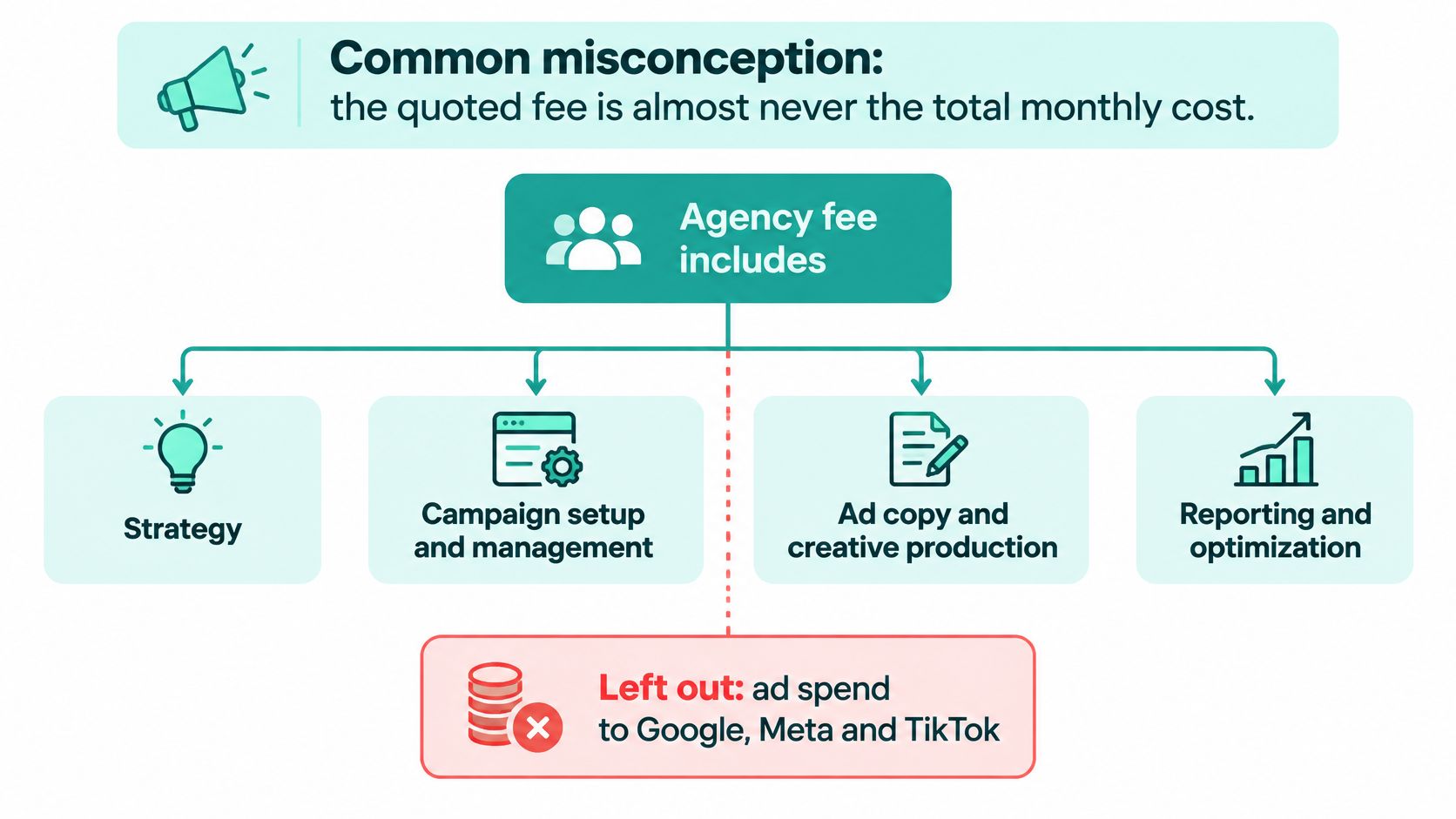
The quoted fee is almost never your total monthly cost. That single misconception causes more bad agency decisions than any other, because it makes a cheap proposal look comparable to a complete one when the two aren't measuring the same thing.
What most fees include
Strategy and channel planning, campaign setup and ongoing management, ad copy and creative production, landing-page work within an agreed count, conversion tracking installation, and reporting. Ask specifically how many creative assets per month, how many landing pages, and how often you'll see numbers. Those three answers separate a real scope from a vague one.
What usually sits outside the fee
- Ad budget: paid to Google, Meta or TikTok, never to the agency as revenue.
- Software: CRM seats, email and SMS sending platforms, hosting, call tracking.
- Advanced attribution: offline conversion imports, multi-touch models, call-recording analysis.
- Full SEO programs: ongoing content and technical work is usually a separate retainer.
- Phone handling: live call answering and intake scripts are their own service.
- Compliance review: creator and endorsement campaigns need FTC-style disclosure work, since the FTC's endorsement guides require material connections to be disclosed clearly when consumers wouldn't expect them.
- Setup and onboarding fees: one-time account builds, tracking installation and audits.
- Your own time: approvals, sales follow-up and compliance sign-off.
Intuit's 2025 Small Business Advertising Trends Report separates non-advertising marketing costs, such as website production and agency fees, from advertising spend outright. That distinction is the difference between a budget and a guess.
| Budget | What it covers | Typical treatment in a quote | Who controls it |
|---|---|---|---|
| Agency execution | Strategy, setup, management, creative, landing pages, reporting | Monthly service fee | Agency |
| Media spend | Ad budget paid to Google, Meta, TikTok | Paid separately to the platform | Business owner |
| Third-party software | CRM, email or SMS sending, hosting, call tracking | Usually billed separately | Business owner |
| Internal time | Approvals, sales follow-up, compliance review | Not billed, but a real cost | Business owner |
The cheapest package can be the most expensive per lead
Say a business pays $500 a month for account management and puts $3,000 into ads. No landing page work, no conversion tracking, no follow-up sequence. Leads arrive as form fills nobody answers within the hour, and the owner concludes paid advertising doesn't work in their industry.
A $1,500 package that includes landing pages, tracking and two automated follow-ups on the same $3,000 of media often produces more signed clients at a higher total cost. Judge on cost per qualified inquiry, not on the fee line. Managing that boundary is part of the job: our packages include advertising, content, landing pages and follow-up, and they don't include full SEO services or phone-call handling, so nobody assumes the fee covers the world. If you need help tracking what sits inside a scope, these agency management software shortlists cover the tooling that keeps deliverables and time visible.
For the media side of the same boundary, this walkthrough of Google Ads PPC management pricing, scope and metrics shows how management fees scale against spend.
Contract Terms, Minimums and Red Flags to Check Before Signing
The terms around the fee change your real monthly cost more than the fee itself. Work through these seven checks in order, and get each answer in writing before the first payment.
- Minimum commitment and notice period. A 60 to 90 day test on month-to-month terms beats a 12-month lock-in. Confirm how much notice you give to stop.
- Setup or onboarding fees. One-time charges for account builds, tracking and audits. Ask whether any part is refundable if you replace the agency.
- Ad-account ownership. Google Ads, Meta and TikTok accounts should be opened in your business's own name. Spend history, audiences and conversion data then stay with you when the relationship ends.
- Minimum ad spend rules and percentage fees. Some agencies set a media floor or charge a share of spend. A percentage fee rises automatically as your budget grows, so ask for a cap.
- Overage rates. The hourly rate for work outside the package, and the specific triggers that create an extra charge.
- Data access. Direct login to dashboards, call recordings and CRM records, not a monthly PDF.
- Price escalators. Any annual increase written into the agreement, and the date it applies.
Red flags: guaranteed rankings or guaranteed lead counts, no written scope, a fee that excludes ad spend without saying so, and refusal to explain how results are measured. Any one of those is a reason to keep looking.
Monthly Budget Examples for Small Businesses and Law Firms
Ranges become useful once you attach them to a scenario. Three typical profiles show how the fee and the media budget move together, and where a small business can realistically start.
A local home-services business running Google Ads to a single landing page typically pairs a $500 to $1,500 fee with $1,000 to $3,000 of ad spend, for $1,500 to $4,500 total. One channel, one offer, tight geography. The work is mostly search structure and speed to lead, which is the pattern behind most successful digital marketing for small businesses programs.
A solo attorney or two-partner law firm faces expensive legal clicks, so ad spend runs $2,000 to $7,500 against a $1,000 to $3,000 fee, totaling $3,000 to $10,500. Practice-area targeting, compliance-aware copy and inquiry qualification matter more than volume here. The digital marketing for lawyers approach differs by practice area for exactly that reason: estate planning and immigration generate very different inquiry quality at very different click prices.
A growing e-commerce brand running Meta and Google together usually lands at a $1,500 to $5,000 fee with $5,000 to $20,000 of media, so $6,500 to $25,000 total. Creative volume, feed management and retention email drive the fee upward.
| Business scenario | Typical agency fee | Typical ad spend | Total monthly cost |
|---|---|---|---|
| Local home-services business (one or two channels) | $500 to $1,500 | $1,000 to $3,000 | $1,500 to $4,500 |
| Solo attorney or small law firm | $1,000 to $3,000 | $2,000 to $7,500 | $3,000 to $10,500 |
| Growing e-commerce brand (Meta plus Google) | $1,500 to $5,000 | $5,000 to $20,000 | $6,500 to $25,000 |
| Subscription package for a small business | $990 to $2,995 | Paid separately to the ad platform | Package fee plus your chosen ad budget |
The subscription option, priced out
Bundled subscriptions take the guesswork out of the fee line. Our Essentials package starts at $990 a month with one ad channel, three short videos, one landing page and two automated email or SMS follow-ups. Booster runs $1,695 a month with two channels, eight videos and/or 16 posts, a landing page and four weeks of automated follow-up, and rises to $1,995 with the full eight videos plus 16 posts. Rocket is $2,495 a month, or $2,995 with eight videos and 16 posts, adding four email newsletters and six to twelve months of agreed nurture logic. Ad spend is always paid separately to the platform.
Most small businesses can run a credible program at $1,500 to $3,000 total per month and should review that number quarterly against qualified inquiries. If you're still setting the figure, this guide to a marketing budget for a small business in 2026 helps you size it against revenue rather than guesswork.
How to Evaluate Monthly Fees and Ad Spend
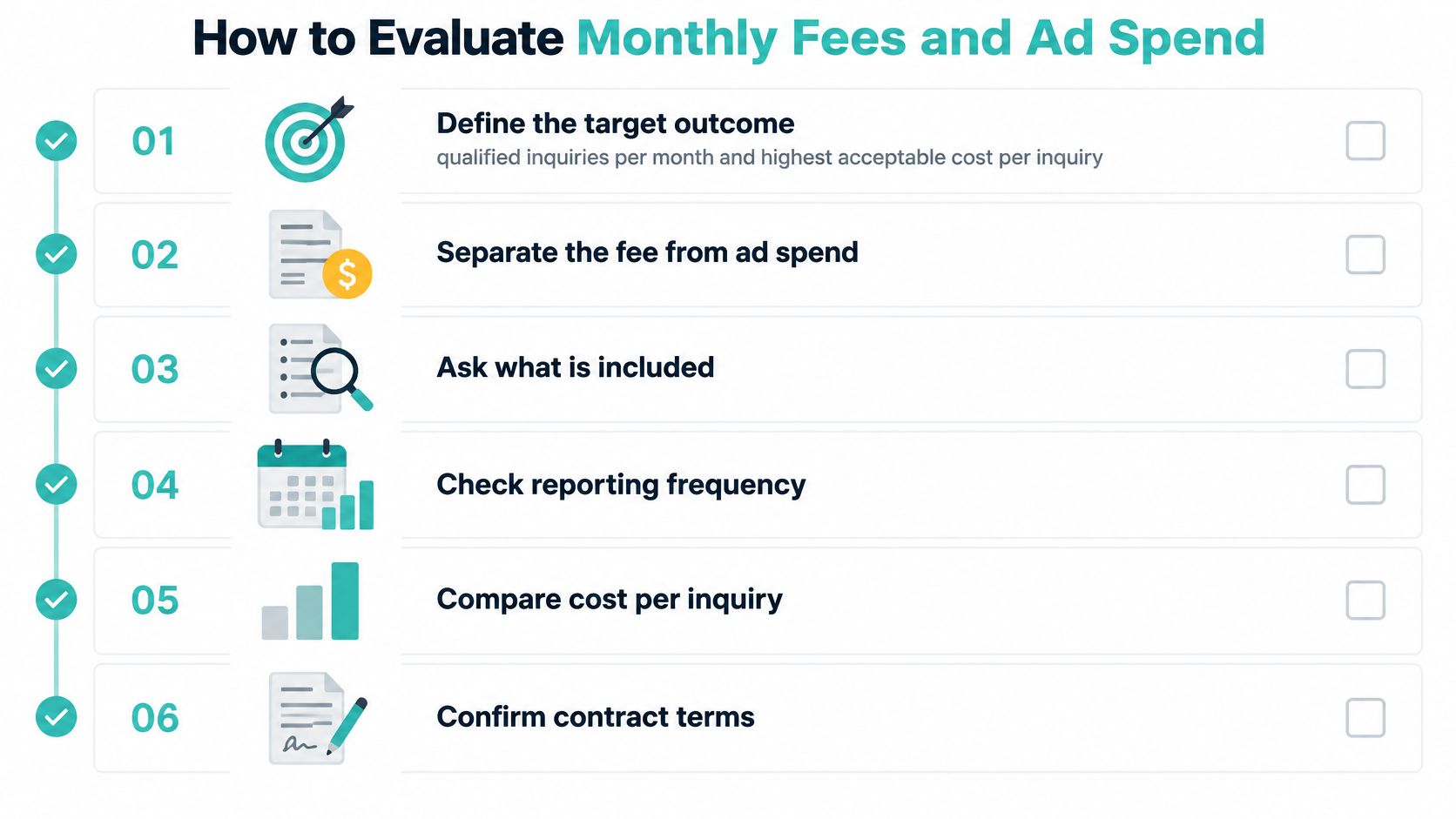
Run the same six checks on every proposal you receive and the comparison stops being about who sounds more confident.
Measurement capability decides whether the price is even judgeable. Only 4% of small and midsize businesses use full revenue attribution with CRM integration, while 27% use no formal measurement and 18% track spend without return, according to Stealth Agents' SMB marketing budget statistics. If you can't tie a dollar of spend to a signed client, a cheap quote and an expensive quote look identical.
- Define the outcome first. Decide how many qualified inquiries or consultations per month you need, and the highest cost per inquiry you'll accept. Everything else is arithmetic.
- Separate three numbers. Service fee, ad spend and software. Our management fee and the advertising budget are always separate, the ad budget goes to the platform, and prices are in USD with hosting, software, CRM and sending costs confirmed before work starts.
- Compare scope line by line. Channel count, creative volume, landing pages, follow-up sequences, reporting cadence. Two proposals at the same price rarely match on more than one of those.
- Ask which measurement tier you're buying. Campaign-level reporting, qualified-inquiry tracking, or closed-revenue reporting with CRM or offline conversion imports. Then ask whether that integration work is inside the fee.
- Model the payback before you sign. Do the math on paper, with your own close rate.
- Start with a 90-day test. Review biweekly reports and scale only the channels and assets producing qualified inquiries.
Here's the evaluation process walked through in video form, which is useful to watch before your first agency call.
The payback math, worked out
Take a $5,000 monthly total (fee plus media plus software). Say it produces 25 qualified inquiries, you close 20%, and your average sale is $4,000. That's 5 clients and about $20,000 in revenue, a 4x gross return before delivery costs.
Build those four cells in a spreadsheet: inquiries, close rate, average sale, monthly total. Change the close rate to 10% and the return halves. That sensitivity is the key argument for tracking consultations and signed matters rather than counting clicks, and it's why the reporting cadence matters as much as the channel mix. Our Booster package, for instance, includes onboarding, a named Marketing Guru and results reports every two weeks, so the review loop is fixed rather than occasional.
If you want the underlying mechanics of incrementality and payback, this explanation of advertising on Google cost and what it really means goes deeper into what you're paying for in the auction.
Choose an Agency Budget You Can Measure
Three moves turn this guide into a decision. First, fix one total monthly number that includes service fee, ad spend and software, and treat it as an operating investment rather than a one-off purchase. Second, pick the pricing model that fits your stage, using the rate table above as the reference point instead of the lowest headline fee on a proposal. Third, require qualified-inquiry measurement before you sign anything, because connected execution across ads, landing pages and follow-up beats a fragmented cheap option in almost every case where revenue is tracked at all.
SimpleLab Digital is one example of the subscription model: packages from $990 USD per month, ad spend kept separate, transparent USD pricing, monthly terms, and a named contact who reports every two weeks. If you want a recommendation mapped to your goals and current marketing, you can book a call and compare options against your budget line by line. If you'd rather build the business case first, this guide to calculating marketing return on investment in 2026 gives you the spreadsheet structure.
One action this week: write down your total monthly budget, your target cost per qualified inquiry, and the date you'll review results. Three numbers on one line beat a twelve-page proposal you never check again.
If you'd rather stop guessing at scope, SimpleLab Digital builds digital marketing around qualified inquiries with packages starting at $990 USD per month, ad spend separate, and clear line items for what's included and what isn't. We plan, build and manage the ads, content, landing pages and follow-up as one connected system, then report on it every two weeks. Visit SimpleLab Digital to see the packages and book a call about your goals and budget.