The most popular advice on Google Ads PPC management is to chase the lowest cost per lead and the cheapest manager. That's backwards. A cheap inquiry that never becomes a client isn't a saving, it's wasted spend, and a low fee that only buys bid changes won't fix weak tracking, vague landing pages or unqualified traffic. You're better off judging management by qualified revenue, then checking whether the pricing model, bidding choices and reporting all point toward that outcome.
Table of Contents
What Google Ads PPC Management Costs by Model
Google Ads PPC management means someone plans, builds, bids on, tests and reports on paid search campaigns for you. The fee structure decides what that person is paid to do. A manager rewarded only when spend rises will think differently from one paid a fixed fee to protect efficiency, so compare incentives before you compare headlines.
The scope normally covers keyword and search intent research, campaign structure, ad copy, bid and budget control, conversion tracking and monthly reporting. It doesn't automatically include a rebuilt website, a new CRM or the ads themselves. Confirm those boundaries in writing.
Fee versus media budget
Advertising spend is not included in the monthly management fee. The ad budget is paid separately to the advertising platform. Your true monthly cost is therefore management fee plus media budget. If a quote blends the two, you can't tell how much reach you're buying or whether a fee increase reflects more work. Our guide to what advertising on Google really costs separates those two lines so you can budget cleanly.
| Model | How it is billed | What to watch | Best fit |
|---|---|---|---|
| Monthly retainer | Fixed fee each month for an agreed scope | Manager is paid the same whatever the spend, so confirm reporting and testing are included | Stable accounts with clear scope |
| Percentage of ad spend | Fee calculated as a share of media spend, commonly 10-20%, often with a minimum | Fee rises with spend, so check that the manager is rewarded for qualified results, not budget growth | Large, steady budgets |
| Hybrid | Base retainer plus a smaller percentage of spend | Balances a fixed workload with scaling; confirm how the percentage is capped | Growing budgets that will change over time |
| Project or setup fee | One-time fee for an audit, rebuild or tracking setup | Covers the fix, not ongoing management; ask what happens after handover | Accounts that need repair before ongoing work |
Paid search is a crowded auction, not a quiet noticeboard. Alphabet reported $294.691 billion in Google advertising revenue in 2025, and Search and other properties generated $224.532 billion in 2025, according to Alphabet's 2025 annual filing with the SEC. You don't need to memorize those totals. They explain why valuable queries attract many bidders and why small efficiency gains on a recurring budget compound month after month.
Compare models by how they reward qualified outcomes, not by the lowest headline fee.
Ask a simple question for each model. If qualified leads fall but spend rises, does the manager earn more, the same or less? The answer tells you where attention will go when results get difficult.
Bidding Logic Behind Ad Rank and Quality Score
Think of Quality Score as a thermometer and the auction as a thermostat. The thermometer reports a reading. The thermostat controls what happens. Many advertisers polish the reading while ignoring the settings that drive delivery, cost and lead quality.
This manager's view shows the auction inputs behind that reading.

Ad Rank decides whether your ad can show and where it sits. Google states that Ad Rank is recalculated when an ad is eligible and again when it enters an auction, incorporating bid, ad and landing page quality, Ad Rank thresholds, auction context and the expected impact of assets, in Google's explanation of Ad Rank and Quality Score. Context includes the query, location, device, time, competing results and other user signals.
What that means on a normal search
Say two firms bid for the same phrase at lunch on a phone. One sends searchers to a slow homepage with a generic headline. The other sends them to a fast page naming the exact service, location and next step. The second advertiser gives Google stronger relevance signals before money enters the discussion.
Google also states that higher quality ads can face a lower minimum bid to show. Relevance therefore affects eligibility and efficiency, not just position. Raising bids on a weak page can buy visibility, but it pays a premium for a problem you could fix once.
Three actions that move auction inputs
- Segment by tight intent: Keep closely related searches together so each ad answers one need instead of five.
- Match ad to page offer: Use the same service, place and promise in both places, then give one clear next step.
- Improve mobile use and assets: Make the page readable and tappable on a phone, and add assets that carry useful information such as services, location and calls.
Manual bidding suits small volumes where you want tight oversight and can inspect almost every term. Automated strategies need steady conversion history before they can learn patterns, so they work poorly when tracking is thin or broken. Our practical notes on Quality Score and better cost per click show how to read that diagnostic without treating it as a target.
The visible 1 to 10 score isn't your bidding goal. Optimize search term relevance, click quality, conversion rate and cost per qualified lead. Those measures connect the auction to money.
Connecting Conversions to Qualified Revenue
Say a family law firm reports 60 form fills at $70 each. The dashboard looks healthy. Intake then reviews the names and finds only nine consultations booked and two retained clients. Some inquiries concern matters the firm doesn't handle, some sit outside its area, and others never reply. The campaign didn't produce 60 equal opportunities. It produced a funnel with sharp drop off.
| Stage | Count |
|---|---|
| Form fills | 60 |
| Consultations booked | 9 |
| Retained clients | 2 |
If the firm counts every form as its primary conversion, automated bidding learns to find more form fillers. It can't tell a retained client from a wrong practice inquiry unless you send that information back. That's why lead stages need plain definitions your intake team uses the same way every day.
Choose stages that mean something
A workable set is new inquiry, qualified, consultation booked and retained. Qualified should mean the person fits your service, location and basic intake criteria. It shouldn't mean someone merely submitted a name. Teams mapping those handoffs in more detail may find a funnel playbook for B2B teams useful for naming stages before they touch bidding settings.
Enhanced Conversions helps connect those later outcomes to the click. Google says Enhanced Conversions for web supplements existing conversion tags with hashed first party data, such as email addresses, using SHA-256 before transmission, and Enhanced Conversions for leads can combine hashed lead data with imported offline conversion events, in Google's Enhanced Conversions guidance. Hashing turns the email into a coded value before sending, and Google matches it with signed in accounts to improve attribution.
A minimum viable workflow
- Pass a consistent identifier: Store the click and lead identifiers in your CRM so the retained outcome can travel back to the original inquiry.
- Import downstream outcomes: Send qualified, consultation and retained stages regularly, ideally daily, with revenue values where you have them.
- Validate consent and hashing: Test a real submission from form to CRM to import before you trust reported return.
- Allow learning time: Don't judge the setup in the first few days.
Google says impact reporting may take up to 30 days to appear after implementation. Plan for that lag in monthly reviews. If you're weighing whether retained revenue covers the spend required to win it, our method for calculating break even return on ad spend gives you the arithmetic before budgets rise.
Volume matters too. Below roughly 15 conversions in 30 days, automated bidding has little to learn from, so judge progress by weekly counts of qualified leads and use a simpler strategy until volume grows. Don't force an algorithm to guess from crumbs.
Practical rule: A lower cost per lead can still be worse economics if those leads never become clients.
The firm's real question isn't how to get form fills below $70. It's how to get more retained clients from the same budget. That changes keyword choices, ad wording, page questions and bidding targets all at once.
How a Google Ads PPC Management Cycle Runs, Step by Step
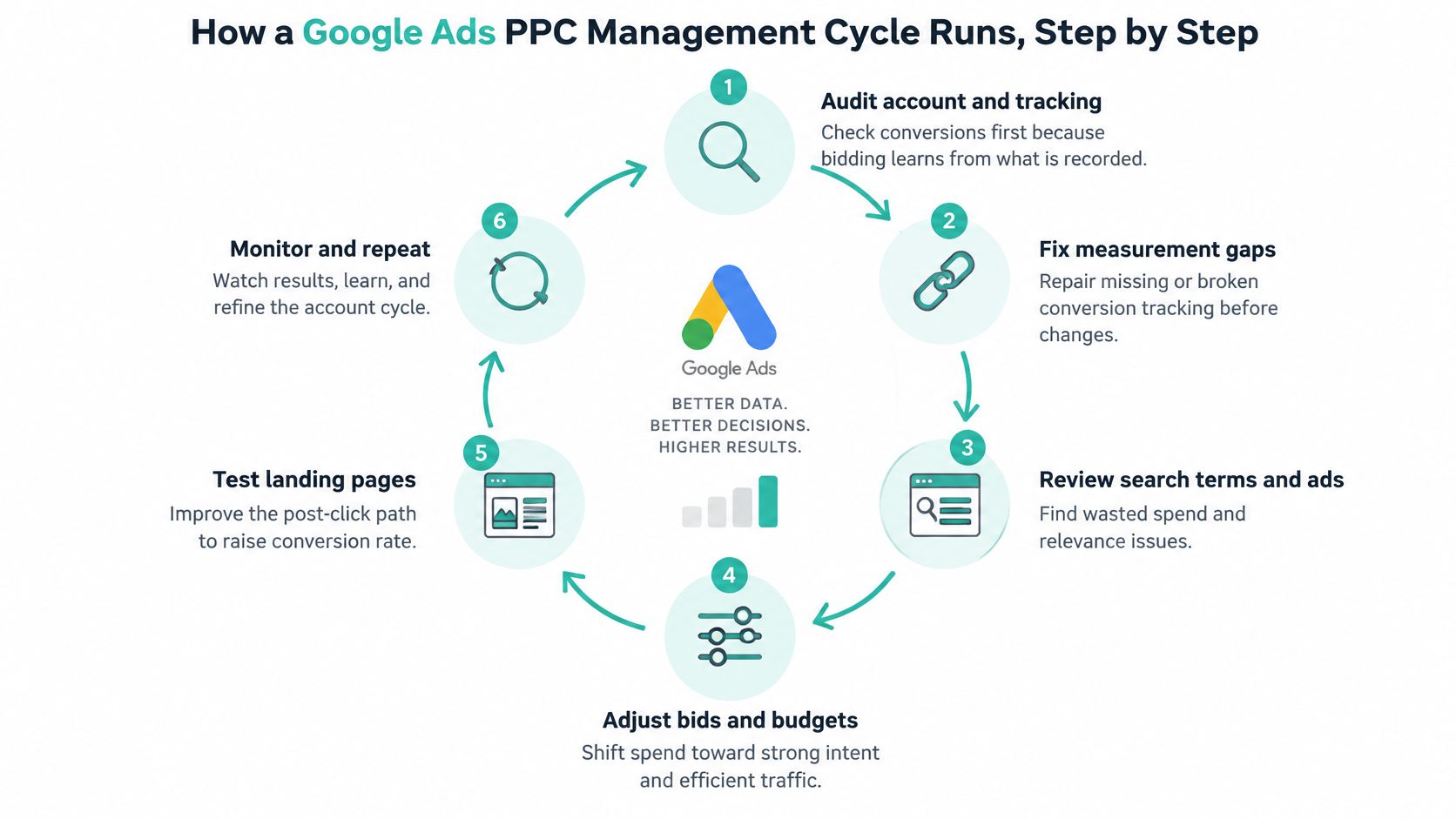
Good management repeats a short cycle. You check measurement, tighten intent, spend carefully, review actual searches and report on qualified outcomes. Skipping early steps doesn't save time. It makes later decisions guesswork.
The cycle below shows the order managers repeat after launch.
The eight step cycle
- Audit the account and conversion tracking first. Bidding learns from whatever you record. A missing form event trains the system on nothing, while a duplicate event teaches it that one inquiry counts twice.
- Group keywords by tight search intent. Put one theme in each ad group so the ad speaks to one need. Mixing research phrases with ready to hire phrases blurs copy and budget decisions.
- Build a negative keyword list from day one. Block irrelevant queries, free seeking language, job searches and unsuitable locations before they consume test budget. Waiting a month means paying tuition for searches you already know you don't want.
- Write ads that echo the landing page offer. Name the service, audience and next step in the same language on both. A clever ad that promises a different offer earns clicks and loses trust after the click.
- Set bidding and daily budget once conversion data exists. A new account often starts with simpler settings so it can collect clean evidence. Switching strategy every few days resets learning and leaves you with noise.
- Launch and allow a learning period. Paid campaigns begin collecting data quickly, but efficiency takes testing. Judge early delivery for broken tracking and irrelevant queries, not final profitability.
- Review search terms weekly. Pause wasted spend, add negatives and move strong terms into tighter groups. Our routine for optimizing with the search terms report shows what to keep, block and promote.
- Report monthly on qualified outcomes and pacing. Show spend against budget, qualified leads, retained outcomes where available and the next tests. A report that lists clicks without intake results hides the decision you need to make.
This walkthrough demonstrates the review rhythm in an account interface.
Run a short owner check each month. Is spend pacing to budget without a late month surge? Are qualified leads rising, even if raw form fills are flat? Are wasted search terms shrinking as negatives grow? Three yes answers suggest the cycle is working. A no tells you where to inspect first.
Avoid the common reset trap. Owners often demand a new offer, new keywords and new bidding in the same week, then can't tell which change helped. Change one major variable at a time unless tracking is broken. Fix measurement immediately, test strategy sequentially.
Metrics That Show Whether Management Is Working
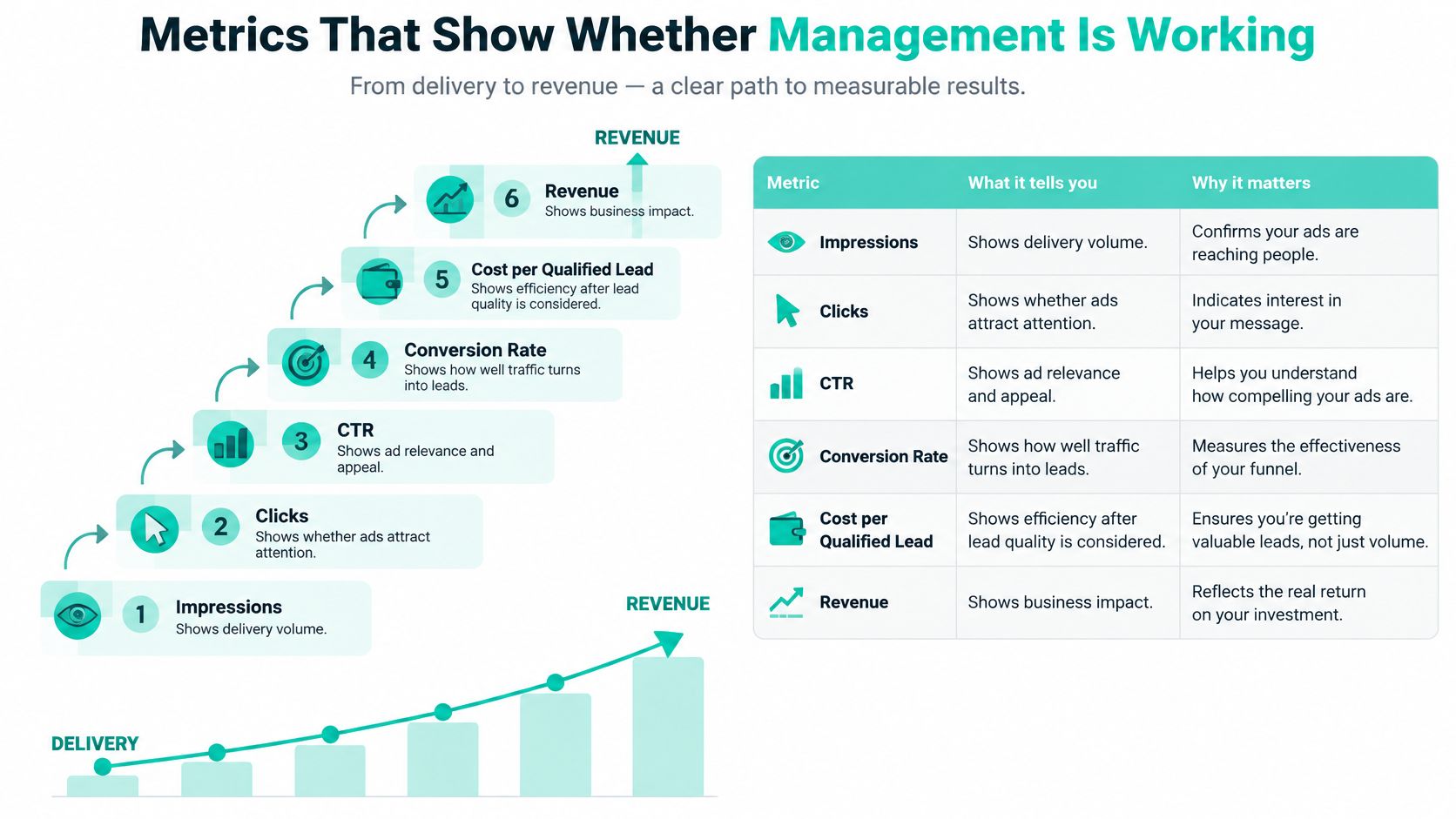
Read metrics as a ladder. Delivery metrics tell you whether ads appeared, click metrics tell you whether the message earned attention, and qualified lead and revenue metrics tell you whether the business gained anything. Owners get confused when they judge the top rung by a bottom rung number.
The ladder below moves from delivery to revenue in the order you should read it.
| Metric | What it tells you | Read it carefully because |
|---|---|---|
| Cost per click | Price paid for each click | Rising cost with flat conversions usually signals competition or weak relevance |
| Click-through rate | Share of impressions that earn a click | A high rate with low conversions means the ad promises more than the landing page delivers |
| Conversion rate | Share of clicks that become a tracked conversion | Compare against the same offer over time, not against a generic benchmark |
| Cost per lead | Average spend for each form, call or inquiry | The 2025 cross-industry average was $70.11, but a cheap lead can still be a poor one |
| Cost per qualified lead | Spend for each inquiry that meets intake criteria | The metric managers should steer by once qualification is defined |
| Search impression share | Share of eligible searches the account appeared for | Low share with strong return on ad spend suggests budget is limiting growth |
| Return on ad spend | Revenue returned per dollar of ad spend | Only meaningful when imported offline revenue is tied to conversions |
For rough context only, Google Ads average cost per lead was $70.11 across all industries in 2025, based on WordStream's analysis of 16,446 U.S. based campaigns running from April 2024 through March 2025, as reported by SHNO's paid lead generation statistics. Your market, offer and intake criteria can sit far from that average, so don't use it as a pass or fail line. Teams working through qualification economics in more depth can optimize lead qualification costs by costing each stage rather than stopping at the form.
Read combinations, not single numbers
Rising cost per click with flat conversions points to stronger competition or weakening relevance. High click through rate with low conversion rate usually means the ad sells a page experience the visitor doesn't find. Low impression share beside strong return suggests budget, not demand, is capping growth.
Insist on a monthly report that places cost per qualified lead beside revenue per lead. Read both as 30 day trends. Daily swings will tempt you into changes before enough inquiries have moved through intake to mean anything.
Choosing an Owner and Vetting the Offer Before You Sign
Start with ownership, not vendor names. Who will watch search terms, protect budget and connect intake outcomes back to bidding each week? The right answer changes with volume, speed of change and the reporting discipline you need.
| Option | Typical cost | Strategic control | Reporting depth | Best fit |
|---|---|---|---|---|
| In-house specialist | Salary plus tools as ongoing payroll cost | High, with daily access | Set by the hire's reporting system | Large budgets with frequent changes |
| Freelance PPC manager | Monthly retainer paid to one specialist | Medium, built around one person | Set in the individual agreement | One campaign with a narrow goal |
| Specialist agency | Monthly fee, sometimes plus a share of spend | Shared, defined in the contract | Usually scheduled reports | Multi-channel plans or teams without bandwidth |
An in house hire gives you deep business context and daily control. You also carry salary, tools, cover for leave and the risk that one person has narrow platform experience. Choose this route when budget and change volume justify a dedicated role.
A freelancer suits one campaign with a narrow goal, such as a single practice area in one city. You gain focus and lower overhead, but availability rests on one person. Ask who checks the account during holidays and what happens if that person stops replying. An agency brings a wider team, documented scope and scheduled reporting at retainer cost. That's useful for multi channel plans or owners without bandwidth, provided scope names who does the work rather than hiding behind account management layers.
Questions to settle in writing
- Fee and billing: State the management fee, billing date and any percentage or cap in plain numbers.
- Separate ad budget: Set the monthly media budget separately because that money is paid to the platform.
- Account and data ownership: Confirm who owns the ad account, audiences and conversion data, and how access is handed back.
- Conversion definitions: Name which stages count as primary and how CRM outcomes flow back into the account.
- Reporting cadence: Agree the report date, the qualified metrics shown and who attends the review.
- Outside costs: List whether software, tracking, call recording or CRM costs sit outside the quote.
- Cancellation and handover: Confirm notice terms and the files, lists and documentation you receive at exit.
If you're scoring providers side by side, Digital Skyrocket's SEO scorecard offers a structured way to compare claims, process and reporting before sales language blurs the differences. Use the same discipline here. Score evidence, ownership and reporting before you score promises.
Our own Google Ads service is offered as a standalone solution with monthly management from $495 USD, putting a relevant offer in front of people searching for your products or services, with ad spend paid separately. Advertising spend and any required hosting, software, CRM or sending costs are confirmed separately from package prices. Our comparison of subscription and traditional agency models explains how monthly terms change commitment and handover questions.
Judge the first quarter on qualified leads, not day one cost per click. Early clicks buy information, but only if tracking and intake feedback are clean enough to use it. By the end of that period you should see tighter search terms, clearer stage reporting and a defensible cost per qualified lead.
Request one written scope listing the fee, ad budget, conversion definitions and reporting schedule before any contract is signed.
Don't sign a proposal that only promises traffic, impressions or a set number of optimizations. Those activities don't tell you who owns the data or which business outcome the manager must improve. A clear scope protects both sides because it turns arguments about effort into checks against agreed work and qualified results.
If you want Google Ads managed around qualified inquiries rather than raw form fills, we at SimpleLab Digital build the campaign, landing page path, and reporting as a standalone monthly service with ad spend kept separate. Visit SimpleLab Digital to review the Google Ads option, confirm scope and ownership before launch, and start with conversion definitions your intake team can use.