You pulled the report expecting good news. Revenue was up, the platform showed a healthy return, and the obvious next move looked like more budget. Then you checked the bank account, the product costs, and the fees that never appear in the ad dashboard. That's usually when the conversation changes from how ROAS performed to a harder question: what return do you need before a campaign stops losing money.
Table of Contents
The Campaign That Looked Great Until It Did Not
A skincare founder I debriefed had this exact pattern. Ads were bringing in orders, revenue ROAS looked respectable, and the team wanted to scale before a seasonal push. Nobody had subtracted the full cost of each order. Product cost was in one spreadsheet, fulfillment in another, payment processing came off the payout, and returns were treated as an operations issue rather than a media issue.
Once those costs sat in the same view, the campaign wasn't a winner. It was buying revenue and keeping too little of it. Scaling would've produced more orders, more support tickets, and a larger loss, just faster.
Where the headline number misleads you
Platform ROAS answers a narrow question about attributed revenue versus ad spend. It doesn't tell you whether that revenue covers the costs that move with every sale. Those usually include:
- Product and packaging: What the item costs you before it leaves the building.
- Fulfillment and shipping: Picking, packing, postage, and the shipping subsidy hidden inside free delivery.
- Payment and platform fees: Charges deducted per transaction, whether you notice them or not.
- Returns and refunds: Revenue the platform counted that you later gave back.
This is why break-even ROAS is a margin question first and an advertising question second. Get the margin wrong and every bidding decision downstream inherits the error. It's also why improving basket economics can matter as much as improving ads, which is where this ServeApps guide to AOV is useful reading alongside media optimization, since a larger order can carry fixed per-order costs more comfortably.
If you're setting up paid search without this groundwork, work through this practical guide to pay-per-click for small businesses and pin down your margin before you set budgets. Don't ask what ROAS you got. Ask what ROAS makes the campaign safe to keep running.
What ROAS Actually Measures in Google Ads and Meta
ROAS has a precise definition, and it's narrower than most owners assume. Google explains that ROAS equals conversion value divided by advertising cost, expressed as a percentage, so $5 in sales from $1 of ad spend produces a 500% ROAS, or 5.0x as a multiple. Same result, two formats. Confusion starts when one person quotes the percentage and another quotes the multiple in the same meeting.
The diagram below separates the two inputs so you can see what the platforms count and what they leave out.
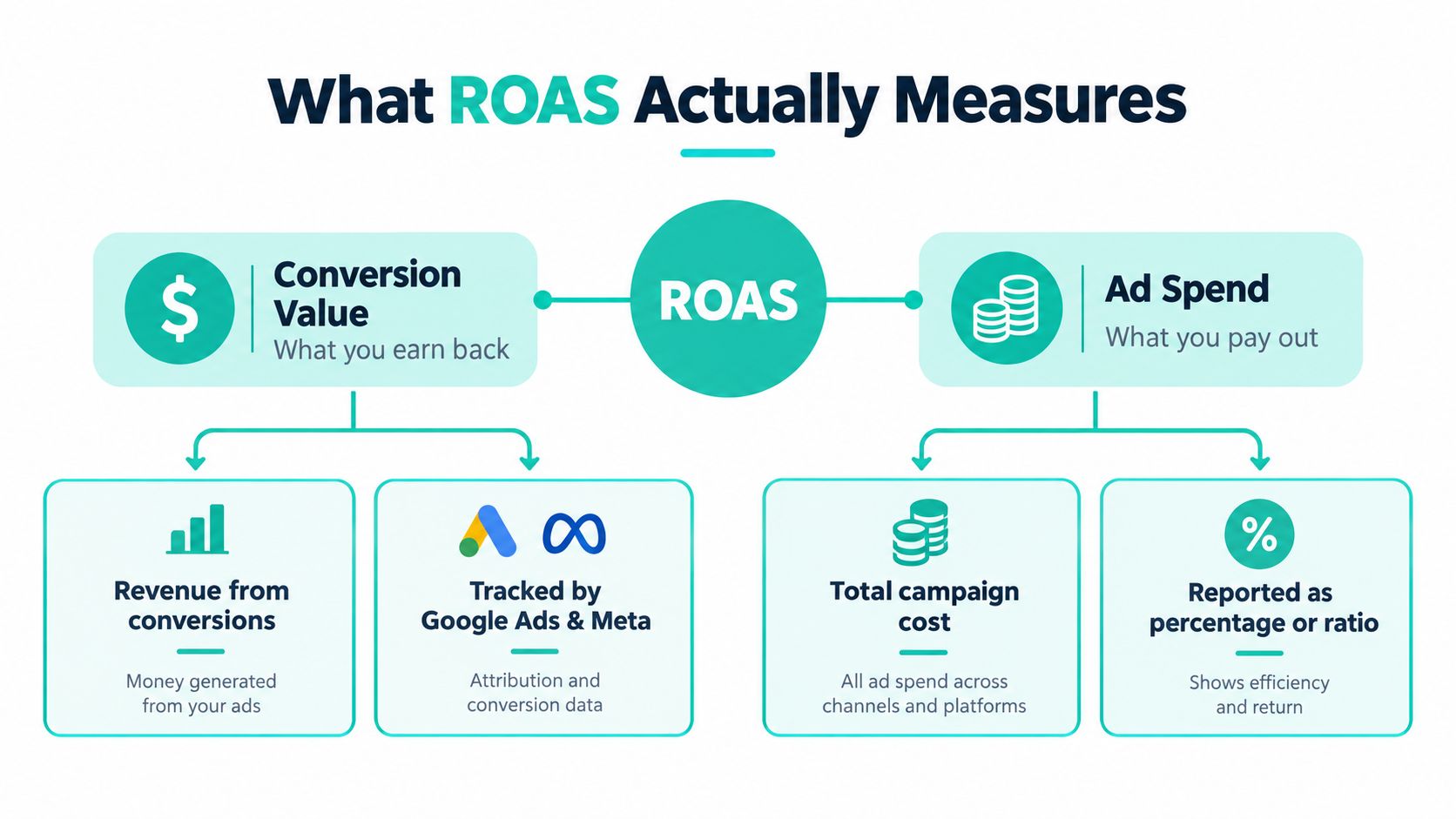
The two inputs and what they hide
Conversion value is the revenue or assigned value attached to a tracked conversion. For an online store that's usually order revenue. For a lead campaign it's whatever value you've told the platform a lead is worth, which makes the output only as honest as that input. If your tracking passes gross order value including tax and shipping charged to the customer, your ROAS will look better than a competitor passing net revenue, even with identical performance.
Ad spend is the media cost inside the platform. It doesn't include your management fee, creative production, or the landing page tool you pay for monthly. Those costs are real, but they sit outside the reported number unless you deliberately build them into your own calculation.
Practical rule: Treat in-platform ROAS as a relative signal for comparing ads against each other, not as proof that any of them made money.
That distinction matters before you spend more. Reading this breakdown of what advertising on Google really costs helps separate media spend from the surrounding costs owners tend to forget. And because conversion value depends on people completing an action on your site, this guide to boosting website enquiries is worth reviewing if traffic arrives but the tracked value stays thin. Weak pages depress conversion value long before bidding becomes the problem.
The Break Even ROAS Formula and Two Worked Examples
Start with contribution margin, because everything else hangs off it. Contribution margin is what's left from each sale after the costs that vary with that sale, measured before advertising. Product cost, fulfillment, shipping, payment fees, and expected returns belong in it. Rent and salaries don't, because they don't change when one more order ships.
Once you have that margin as a decimal, the math is short. The break-even formula is the reciprocal of the contribution margin ratio, written as break-even ROAS = 1 ÷ contribution margin. At a 40% contribution margin, the threshold is 1 ÷ 0.40 = 2.5x, or 250%, and at a 30% margin it rises to approximately 3.33x, or 333%, per that same source. Anything reported below your threshold loses money on the sale itself. Anything above it contributes toward fixed costs and profit.
Example one, a direct-to-consumer skincare brand
Take a skincare brand that keeps 40% of each net sale after product, packaging, fulfillment, payment fees, and returns. Using the formula above, the brand needs 2.5x just to stand still. A campaign reporting below that figure isn't nearly profitable. It's subsidized by the business. A campaign sitting exactly on it covers its variable costs and its ad spend, and contributes nothing toward rent, staff, or the owner's time.
That's a useful reality check for founders who've been told a certain ROAS is good in their category. Category chatter doesn't know your shipping contract.
Example two, a solo estate planning attorney
Now take a solo estate planning attorney whose delivery costs per matter are low relative to fees, leaving a much higher contribution margin, illustrated here at 70%. The reciprocal gives roughly 1.43x. The attorney can afford to buy demand at returns that would sink the skincare brand, because there's no inventory, no postage, and no returns shelf. The trade-off sits elsewhere. Capacity is the constraint, since the attorney's own hours cap how much won work can be delivered.
| Contribution Margin | Break Even ROAS (multiple) | Break Even ROAS (percent) |
|---|---|---|
| 30% | 3.33x | 333% |
| 40% | 2.5x | 250% |
| 70% | 1.43x | 143% |
Two businesses, same formula, completely different safety lines. That's why borrowing a target from a peer in another model is unreliable.
Before you trust your own inputs, sanity-check the traffic side too. This walkthrough of what a conversion rate is and how to calculate it helps you verify that the conversions feeding your value figures are counted consistently. If you want to model returns more broadly, these marketing ROI measurement tools cover approaches that sit alongside break-even work rather than replacing it. When you understand how to calculate break even ROAS from your own margin, the number becomes a decision tool instead of a vanity target.
How Break Even ROAS Changes Your Bidding Strategy
Knowing your threshold doesn't finish the job. You still have to express it inside Google Ads or Meta, and each bidding mode expresses it differently. The comparison below shows the same margin constraint translated three ways.
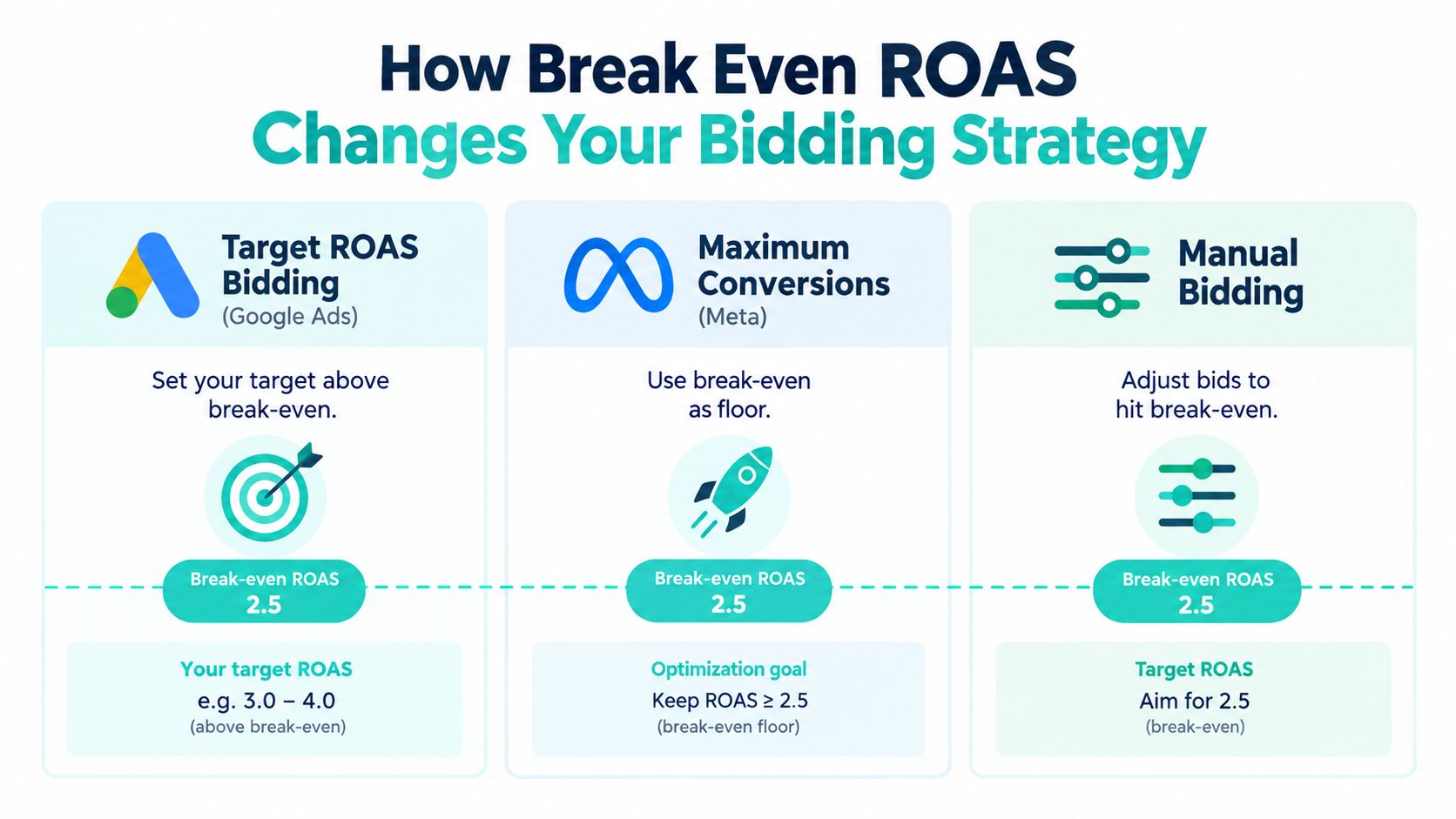
Target ROAS bidding in Google Ads
With target ROAS, you're handing the platform your constraint and asking it to bid toward that return. The mistake is setting the target exactly at break even. Attribution is noisy, conversion values arrive late, and some tracked revenue will refund. A target set at the threshold aims for zero contribution on a good day and a loss on a bad one. Set it above break even by a buffer that reflects your refund pattern and how much you trust your tracking, then loosen it only when volume starves.
For campaign structure that supports this, these best practices for Google Search Ads campaigns cover the account hygiene that keeps automated bidding fed with clean signals.
Value-based bidding in Meta
Meta's value optimization works from the purchase values you send it. If those values are gross and your margin math is net, the platform will happily chase orders that look valuable and contribute little, particularly heavy discount orders or items with expensive fulfillment. Use your break-even figure as the floor in your own reporting view, with custom columns comparing reported return against your threshold, so a campaign can't drift below the line unnoticed while the interface celebrates cheap purchases.
Manual bidding as a baseline
Manual cost-per-click bidding still earns its place when conversion volume is thin, which describes many law firm and local service campaigns. Automated strategies need signal density they won't get from a handful of enquiries. With manual bids you work backward from what a click can cost, given your conversion rate and the contribution behind each won matter. It's slower and it caps your reach, but it keeps you honest while data accumulates.
A bidding strategy can't rescue a margin you calculated wrong. It'll just hit the wrong target more efficiently.
The short video below walks through how these bidding choices behave in practice, which is worth watching before you change targets mid-flight.
Whichever mode you pick, review performance against your threshold over a rolling window rather than reacting to a single day. One expensive day inside an otherwise sound week is noise. A steady slide toward the line is a decision waiting to happen.
A Simple Monthly Break Even ROAS Calculator Template
You don't need specialist software to run this monthly. A four-row spreadsheet does the job if you update it with real figures instead of estimates you made six months ago. The flow below mirrors the worksheet layout.
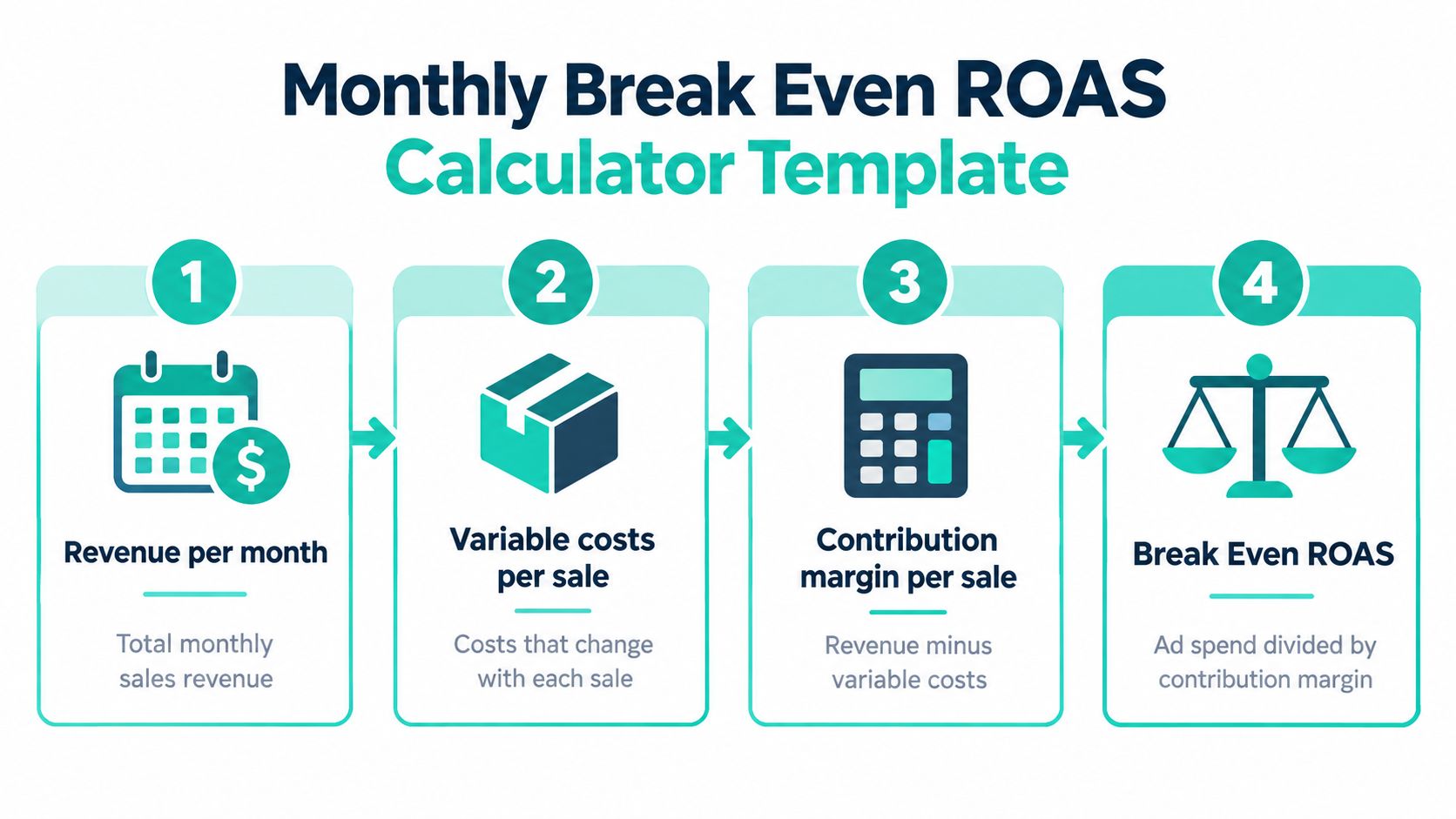
Build the four rows
Set up one row each and keep the definitions pinned where whoever updates the sheet can see them.
- Revenue for the month: Use net sales after refunds, not gross orders, so returned revenue doesn't flatter the margin.
- Variable costs per sale: Product, packaging, fulfillment, shipping, payment processing, and return handling. For services, use the direct delivery cost per matter or job.
- Contribution margin per sale: Revenue per sale minus the variable costs above, then expressed as a share of revenue.
- Break-even ROAS: Apply the reciprocal formula from the earlier section to that margin figure.
If you'd rather model scenarios interactively, the ROMI calculator lets you test how returns shift as spend and revenue assumptions move, which pairs well with the static sheet.
Run three scenarios before you commit budget
Take the same business and flex the margin three ways: a low-margin case where a discount period and pricier shipping squeeze what's left per order, a middle case reflecting normal trading, and a stronger case where a supplier renegotiation or a richer product mix lifts the margin. Watch what happens to the ad budget you're willing to risk. In the low case, the allowable spend per sale shrinks sharply, and campaigns that were fine last month suddenly sit underwater. In the stronger case, the same campaigns gain headroom and you can bid into auctions you'd previously avoided.
That exercise changes budget conversations. Instead of arguing about whether ads feel expensive, you're looking at how much contribution each sale produces and what share of it you can spend acquiring the next one.
Inputs people forget
Run this checklist before you lock the month's figure:
- Payment processing: Include the full per-transaction take, including any cross-border or premium card charges you absorb.
- Returns cost: Count reverse shipping and inspection time, not just the refunded revenue.
- Discounts: Model the price customers pay during promotions, not list price.
- Management fees: If an agency or freelancer fee scales with spend, decide deliberately whether it sits inside the margin or alongside ad spend, and apply that choice consistently.
Recalculate whenever a supplier price, shipping rate, or fee schedule changes. A threshold built on last quarter's costs will mislead you with complete confidence.
Why a Higher ROAS Than Break Even Is Not Always Better
Owners love a towering ROAS. It feels like discipline. Often it's a sign the campaign is only harvesting the easiest demand, people already searching your name or a small retargeting pool, while qualified buyers one step further out never see an ad. You've optimized the ratio and shrunk the business opportunity underneath it.
Think about what the number rewards. ROAS improves when you spend less to capture the same revenue. Taken to its limit, the best ROAS comes from barely advertising at all. That's not a growth strategy, it's a rounding error with good PR.
Signals that your return is artificially constrained
Look past the ratio and check whether the campaign has room it's refusing to use:
- Impression share losses: You're absent from auctions you could afford to enter given your margin.
- Narrow search term coverage: Ads trigger only on exact, high-intent phrases while adjacent queries with real demand go unanswered.
- Audience saturation in a tiny pool: Frequency climbs inside a small retargeting audience instead of expanding to new buyers.
- Targets set far above break even without a reason: A buffer is sensible. A target chosen because a bigger number feels safer usually just throttles volume.
The uncomfortable version: A campaign comfortably above break even at low volume can contribute less total profit than a campaign running modestly above break even at real scale.
The goal isn't the highest ratio. It's the most contribution dollars after ad spend, which is a different calculation and sometimes a less flattering screenshot.
There's an opposite trap worth naming. A campaign can beat break even today on assumptions that won't survive the next quarter. Holiday return rates climb, auction prices rise when competitors pile in, and a discount you introduce to chase volume lowers the margin your threshold depends on. If you scaled aggressively against the old number, you'll discover the new reality through the bank balance instead of the spreadsheet.
Hold both ideas at once. Push spend while you're above the line and there's demonstrable demand left, and recheck the line whenever costs, pricing, or seasonality move. Break even is a floor for safety, not a ceiling for ambition.
Frequently Asked Questions About Break Even ROAS
Should I use gross margin or contribution margin? Use contribution margin. Gross margin usually stops at product cost, which leaves fulfillment, payment fees, and returns outside the calculation and sets your threshold too low.
How does this work for lead generation without a direct sale value? Work backward from won business. Estimate the contribution from an average closed matter or job, factor in how many leads typically become clients, and derive what a lead can cost. Your threshold then governs cost per lead rather than a revenue multiple.
Why does the platform report a different ROAS than my spreadsheet? Usually the inputs differ. Platforms may count gross order value, use their own attribution windows, or miss refunds you've already processed. Reconcile definitions before arguing about performance.
How often should I revisit the number? Monthly at a minimum, and immediately after any change to pricing, supplier costs, shipping rates, or fee schedules.
Before your next budget increase, verify four things: net revenue in row one, every variable cost accounted for, tracking values matching your definitions, and bidding targets sitting above the threshold rather than on it.
If your campaigns report strong returns but the profit never shows up, SimpleLab Digital can rebuild the numbers with you, from margin inputs to bidding targets, across Google Ads, Meta, and the landing pages behind them. Visit SimpleLab Digital to see how the subscription packages work and book a conversation about your next campaign.