You've probably stared at a PPC dashboard that looked busy, expensive, and oddly disconnected from the phone calls you care about. The clicks are there, the ad spend is moving, but the key question is whether any of it turned into booked consultations, service calls, or sales you'd take to the bank. That gap is where pay per click for small businesses either becomes a growth channel or a money pit.
For most owners, the channel feels intimidating because it mixes budget, bidding, keywords, landing pages, and tracking in one place. The good news is that PPC doesn't have to be mysterious to be useful. Used well, it gives small businesses a direct line to people who are already looking for a solution, and it works best when the ad, page, and follow-up process all pull in the same direction. For a useful companion on broader promotion planning, marketing tips that convert can help you think beyond the ad itself.
If you're already working with a digital partner, the right starting point is often a simple, connected setup rather than a bigger spend. SimpleLab Digital's digital marketing solutions for small businesses reflect that same logic, because paid media only earns its keep when the lead path is clean from click to follow-up.
Table of Contents
When Pay Per Click Fits the Small Business Puzzle
A local owner usually reaches PPC after trying to make referrals, social posts, and word of mouth do more than they can reasonably do. The ads look expensive at first glance, so it's natural to hesitate. But PPC has become mainstream, not niche, and industry reporting says about 65% of small and medium-sized businesses run PPC campaigns while about 45% of small businesses maintain a paid-search strategy. That same reporting also places paid search at roughly 15% of average website traffic, compared with about 5% from paid social. WordStream's digital marketing statistics show why search deserves serious attention.
For a law firm, clinic, or home-service business, that matters because search doesn't interrupt people, it catches them mid-intent. Someone typing a service into Google is usually closer to action than someone scrolling through a feed. That's why PPC often fits businesses that sell appointments, consultations, estimates, or other high-intent inquiries.
A quick fit test
If you can answer yes to most of these, search ads probably belong in the mix:
- You know your target service area. Local targeting keeps spend focused on places you can serve.
- You can respond quickly to leads. Speed matters when a prospect is comparing options.
- You have enough margin for paid acquisition. Ads should be measured against revenue, not vanity traffic.
- You can separate qualified and unqualified inquiries. That distinction is where real performance shows up.
Practical rule: if a lead can become a client only after a call, a consultation, or a vetting step, PPC should be judged on downstream value, not form volume.
PPC fits best when you treat it as one part of a broader acquisition system, not a standalone trick. That's especially true for small firms that also need landing pages, tracking, and follow-up to work in sync with the ads themselves.
How Search Auctions Work
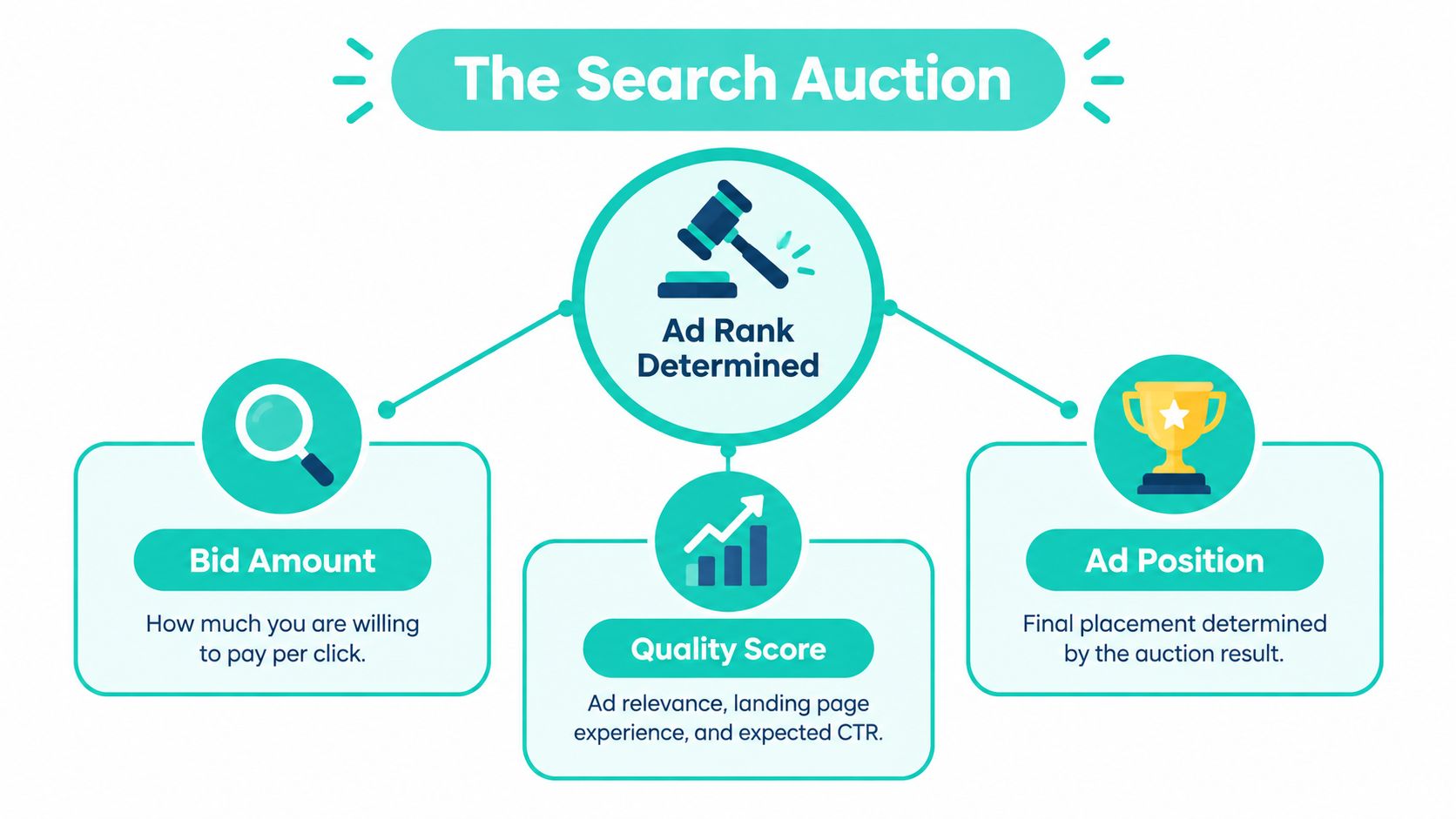
A lot of owners assume the highest bidder wins every time. Search is more specific than that. Ad Rank decides whether your ad is eligible and where it appears, and Google calculates it for each auction using the bid, ad quality, landing-page quality, thresholds, competitiveness, the searcher's location and device, time of search, query context, other ads and organic results, and the expected impact of assets such as sitelinks. Google's Ad Rank guidance gives the clearest public outline of that process.
Why quality changes the math
The visible Quality Score runs from 1 to 10 and reflects three components, expected CTR, ad relevance, and landing-page experience. Google rates each component as below average, average, or above average compared with ads shown for the same searches during the prior 90 days. Google's Quality Score documentation helps you spot where the account needs work. A weak ad group usually needs tighter keyword themes and a page that matches the search more closely.
Higher bids still matter, but they are only part of the equation. Google's auction uses real-time quality assessments in Ad Rank calculations, and the actual CPC is generally the minimum amount needed to clear the relevant threshold and beat the advertiser below you. Google's auction pricing explanation explains why two advertisers can target the same keyword and pay different amounts for the click.
Don't chase position for its own sake. Chase relevance, because relevance affects both visibility and cost.
For service businesses, the practical sequence is simple. Tighten the keyword theme, write ad copy that mirrors the search, and send the click to a page that looks like the obvious next step. For law firms and other service-based businesses, that usually means a page built to turn interest into a call, consultation, or other qualified inquiry. When those three pieces line up, the auction tends to reward you with more efficient traffic than a bigger bid alone can buy.
Choosing the Right Platform for Your Business
Google Search is the clearest fit when demand already exists and the buyer is actively looking. A person searching for a lawyer, plumber, dentist, or accountant is telling you what they need in real time. Social platforms work differently. Facebook, Instagram, and TikTok are useful when you need attention, recall, or retargeting, but they usually catch people earlier in the decision process.
That difference in intent changes how you should spend. Search is usually the first place to test if the offer is specific and the service has clear commercial intent. Paid social is often better when you need to introduce a service, educate a market, or stay visible to people who haven't started searching yet.
Platform fit by business type
- Law firms: Start with search for practice-area terms and local intent. The lead may come through a call or consultation rather than a quick form.
- Local service businesses: Search is usually the strongest starting point because people often need help now and want nearby providers.
- E-commerce stores: Search can capture bottom-funnel demand, while paid social can support discovery and remarketing.
- Brands with long sales cycles: Social can keep the offer in front of prospects between search sessions.
The cleanest decision rule is this, if someone already knows they need what you sell, lead with search. If they don't yet know they need it, use social to build familiarity, then bring them back with search or remarketing later. That approach keeps budgets from being spread too thin across channels that do very different jobs.
Setting Up Your First Campaign Correctly
A weak campaign structure creates noise before it creates results. Start with one business objective, then build the account around that goal instead of around every keyword idea that comes to mind. For a small business, that usually means one service line, one geography, and one conversion action to begin with.
A campaign should feel plain in the right way. Clear themes, clear offers, clear pages. That is how you avoid paying for clicks that had little chance of becoming qualified inquiries.
Build the campaign in the right order
- Choose the conversion you want. A booked consultation, qualified call, or submitted estimate request is better than a vague “contact us” goal.
- Group keywords by intent. Keep closely related phrases together so the ad copy and page stay focused.
- Write ads that match the search term. If the search is service-specific, the headline should be too.
- Send traffic to one relevant landing page. Google recommends choosing a page that closely matches the ad and keywords because that alignment supports ad relevance and landing page experience.
If you want a practical launch checklist, this guide to creating a successful search ads campaign on Google is a useful reference point.
The fastest way to waste budget is to send every ad to a generic homepage. A better setup gives each service its own message, its own promise, and its own next step. That matters even more for law firms and service businesses, where the first lead touch often happens by phone and the caller expects a real answer quickly. If you need help making sure those calls are handled well, an AI receptionist for Google Ads leads can reduce missed opportunities when the office is busy.
For firms that depend on consultations, the campaign structure should also support the call experience after the click. The ad may win the search, but the phone call closes the loop only if someone answers promptly and routes the caller well.
Later, once the structure is stable, you can layer in automation, call extensions, and other features. The account has to earn complexity. Start narrow, prove the conversion path, then expand with purpose.
Here is a simple rule for launch day.
Launch rule: if the keyword, ad, and landing page would not feel obviously connected to a prospect, the campaign is not ready yet.
Tracking the Metrics That Matter
Clicks are easy to count and easy to misread. A campaign can drive traffic and still miss the mark if the leads are poor, unreachable, or outside your service area. For law firms and service businesses, the question that matters is whether those clicks turn into qualified inquiries and revenue, not just activity.
Start with conversion tracking, not impressions or raw click totals. Google Ads counts conversions as actions you define as valuable, such as a purchase, form submission, phone-related action, or application. It also supports offline conversion import, so outcomes that happen after the website, including signed contracts or completed cases, can still be tied back to the ad path. Google's conversion tracking overview is useful for firms that need to connect ad spend to real client work.
Read the account like an operator
The key relationship is straightforward. CTR shows whether the ad earns attention. CPC shows what that attention costs. CPA shows what a real outcome costs. If you only watch the first two, you can spend on traffic that never pays back.
Attribution matters too. Google's default for most conversion actions is data-driven attribution, which assigns credit across interactions based on historical data and estimated contribution, while last-click gives all credit to the final click. Google's attribution model guidance affects reported conversions and the data used by bid strategies that rely on the Conversions column. If you want to see how multi-touch attribution for startups works in practice, this overview is a good starting point.
A practical reporting rhythm looks like this:
- Check conversion actions first. Confirm the right forms, calls, or purchase events are counted.
- Review qualified inquiries, not just lead count. A lead that never answers the phone is not equal to one that books.
- Look at downstream revenue when you can. That is the cleanest test of value.
- Use CRM or offline imports if the sale closes later. That closes the loop between ad and outcome.
Before you scale, model the math with this ROMI calculator. It keeps the conversation on return, not just spend. The habit that matters is simple, measure the outcome that pays the bill, then adjust bids and budgets around that outcome instead of around vanity activity.
Why Qualified Inquiries Beat Raw Leads
More leads aren't always better. A law firm can get a steady stream of form fills and still lose money if most submissions are wrong practice area, outside the service region, or not serious enough to retain. That's why qualified inquiries matter more than raw lead volume for service businesses.
The right question is not “How many leads came in?” It's “How many of those leads could realistically become clients?” If the answer is unclear, the campaign is probably optimized for the wrong thing. A lower lead count can outperform a high-volume campaign if the leads are answerable, relevant, and closer to revenue.
What qualified means in practice
For a small service business, a qualified inquiry is usually one that fits the service area, matches the offer, and reaches the right contact channel. That might be a booked consult, a phone call that gets answered, or a form with enough detail to vet quickly.
Practical rule: a more expensive lead can still be the better lead if it closes at a higher rate or carries more value.
Landing pages matter here. The page has to pre-qualify the visitor before the lead ever reaches your inbox. Strong service pages do that by naming the offer clearly, explaining who it's for, and asking for a next step that filters out casual clicks. SimpleLab Digital's landing page creation page sits in exactly that part of the funnel.
The point isn't to make the form harder for the sake of it. The point is to align expectations so your sales team, intake process, or front desk spends time on better opportunities. For law firms and clinics especially, that alignment usually improves the quality of the conversation before the first call even happens.
Building a Sustainable PPC Strategy
A sustainable PPC account is managed, not abandoned. The businesses that get steady value from search ads keep tightening the connection between keyword, landing page, lead handling, and revenue. That's much closer to an operating system than a one-time campaign launch.
A simple monthly checklist is usually enough to keep the account healthy. Review search terms, pause waste, check conversion paths, compare qualified inquiries against raw lead volume, and confirm that the landing page still matches what the ad promises. If the calls are going unanswered or the intake process is slow, the media plan won't save the account.
What to keep doing
- Refresh search terms. Irrelevant queries leak budget quickly.
- Audit landing pages. The page should still match the service, offer, and audience.
- Check attribution settings. Reported performance changes when the model changes.
- Feed offline outcomes back into the system. Closed revenue is the cleanest signal you can give the platform.
- Review budget against real value. Spend should follow qualified demand, not habit.
The strongest PPC accounts don't rely on one metric. They connect ad data, intake quality, and revenue in the same reporting story.
If you want a long-term structure for pairing paid media with other marketing work, this small business marketing subscription guide is a sensible next read. The broader lesson is straightforward. PPC is not a “set it and forget it” channel, and it's not supposed to be. It works when someone keeps the whole path in view, from search intent to follow-up.
SimpleLab Digital builds and manages Google Ads, landing pages, and follow-up workflows for small businesses that need more than just clicks. If you want PPC to produce qualified inquiries instead of noisy traffic, visit SimpleLab Digital and see how a connected setup can fit your business.