A law firm can win the referral and still lose the client. In a 2025 survey of 3,000 U.S. consumers, 72% said they would move on if a firm didn't respond within 24 hours, while nearly 60% considered online reviews more influential than word of mouth and over half wouldn't consider a firm rated below four stars (consumer survey findings). The problem often isn't generating interest. It's failing to convert interest into confidence, contact, consultation, and a retained matter.
Effective law firm marketing therefore starts with the client's journey, not a list of channels. Search, referrals, reviews, content, advertising, landing pages, and intake systems should each answer a practical question: how does this help a prospective client find, evaluate, trust, and hire the firm?
Table of Contents
Why Clients Find and Hire Lawyers Differently Now
Law firm growth used to depend heavily on relationships. A former client, accountant, colleague, or friend recommended an attorney, and that recommendation carried much of the decision. Referrals still matter, but they rarely end the research process.
A 2017 Legal Trends consumer study of 2,002 people found that 59% used a referral from someone they knew, while 57% searched independently and 16% used both routes. Those figures describe complementary behaviors, not competing ones. A referral can prompt a prospect to search the firm's name, inspect its website, read reviews, compare practice-area pages, and decide whether the recommendation still feels credible.
That shift changes the job of marketing. A firm doesn't need to choose between professional relationships and online visibility. It needs to make both work together.
Practical rule: Treat a referral as the beginning of digital due diligence, not as a guaranteed consultation.
Map spend to the hiring journey
A prospective client normally moves through several questions:
- Recognition: Do I have a legal problem that requires help?
- Discovery: Which firms handle this type of matter?
- Evaluation: Does this attorney understand my situation and location?
- Trust: Do reviews, credentials, content, and communication feel credible?
- Action: Can I reach someone easily, and what happens next?
Each marketing dollar should support one of those questions. A practice-area page supports discovery and evaluation. A review process supports trust. A properly staffed phone line supports action. A paid campaign without a clear landing page and response workflow supports none of these stages reliably.
This is why a firm can receive impressions and clicks without meaningful growth. Visibility creates an opportunity, but the website, proof, and intake process determine whether the opportunity survives.
For small firms, the practical implication is straightforward. Maintain referral relationships, but build enough online clarity that a referred prospect can independently verify relevance, responsiveness, credibility, and next steps. The same principle applies to legal digital marketing for lawyers, where the strongest strategy connects relationship-driven demand to measurable digital actions.
How Clients Actually Search for a Lawyer
A client rarely experiences marketing as a campaign. They experience a sequence of decisions under pressure.
Consider someone who realizes they need help with estate planning. They may ask a family member for a recommendation, search the attorney's name, look for estate-planning services in their area, read reviews, compare the firm's process with other options, and then call or submit a form. A family-law prospect may follow the same path after receiving a recommendation from a colleague.
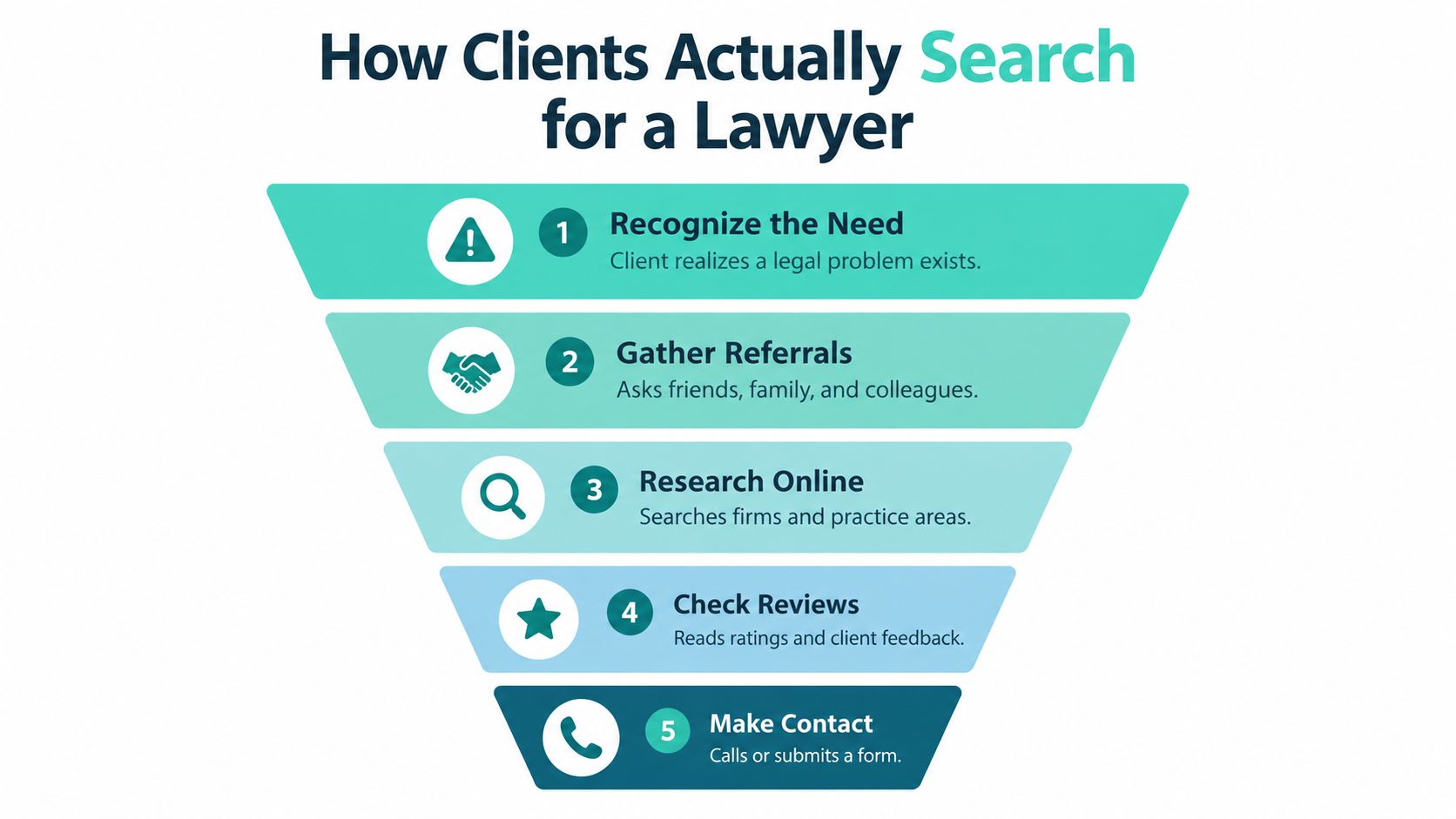
The five decision points
Recognize the need. The client may search a problem rather than a legal practice area. They might use language such as “what happens after a divorce filing” or “how to create a will,” not the terminology used inside the firm.
Gather referrals. Personal recommendations remain a strong trust signal. But the recommended firm still has to pass the prospect's independent checks.
Research online. The visitor wants immediate answers about services, location, attorney experience, accessibility, and whether the firm handles matters like theirs. A vague homepage forces them to keep searching.
Check reviews and fit. Reviews help a prospect assess communication and client experience. Practice-area pages help them decide whether the firm is relevant. Missing, outdated, or inconsistent information creates uncertainty.
Make contact. The prospect needs a visible phone number, a focused form, clear consultation instructions, and a realistic expectation for response timing. A contact button without a next step adds friction rather than removing it.
Diagnose the failed handoff
The funnel can break at different points. Low search visibility indicates a discovery problem. Strong traffic with short visits may indicate a relevance or clarity problem. Completed forms with few consultations may indicate weak follow-up, unclear qualification, or an intake bottleneck.
The survey cited above found that response speed and review credibility strongly affect consumer decisions. That means a firm shouldn't automatically buy more traffic when inquiries aren't becoming consultations. It should first identify whether the loss occurs before contact, during trust evaluation, or after the inquiry reaches the firm.
A practical GEO approach for law firms should support this same journey. Content must answer real client questions clearly enough for search systems and people to understand the firm's relevance, while the conversion path must make the next action obvious.
Where Your Firm Needs to Show Up
Visibility begins with accurate information. A prospective client can't evaluate a firm confidently when the address, phone number, practice areas, or service locations differ across listings.
Google states that local rankings are primarily shaped by relevance, distance, and prominence (Google's local ranking guidance). Relevance concerns how closely the Business Profile matches the query. Distance concerns proximity to the searcher or the location named in the search. Prominence reflects how well known the firm is, with links from other websites, review quantity, and positive ratings identified as related signals.
Keyword placement alone won't solve a weak local presence.
Prioritize the visibility foundation
Start with a complete Google Business Profile. Confirm the firm's real name, address, phone number, hours, website, service areas, categories, and description. Use actual information, not keyword-stuffed variations.
Then build pages around the problems clients search for. A page titled “Family Law” may be too broad for someone looking for help with custody, a divorce consultation, or a property division issue. Each page should explain who the firm helps, what the matter involves, where the firm serves clients, what the first step looks like, and how to make contact.
Use this checklist:
- Match client language: Write headings around recognizable legal problems and questions.
- Keep location data consistent: Use the same legitimate business details across the website and directories.
- Earn reviews deliberately: Ask appropriate clients for honest feedback through a documented process.
- Build relevant authority: Seek legitimate links from local organizations, professional associations, and useful community resources.
- Review the profile regularly: Correct outdated services, hours, phone numbers, and location details.
Law firms that want a deeper technical framework can find SEO for law firms, especially when local visibility needs to connect with broader content planning.
Social content can reinforce recognition, but it shouldn't replace the foundational assets that capture active demand. A focused social media management strategy for law firms works best when posts lead people toward useful practice-area information, credible attorney profiles, or a clear consultation path.
Building Credibility Before the First Call
Visibility earns attention. Credibility earns the call.
A prospect wants evidence that the firm understands the matter, serves the right location, communicates clearly, and won't create unrealistic expectations. That evidence can come from review profiles, attorney biographies, educational content, testimonials, case-result explanations, and a website that explains the process.

Design trust signals clients can verify
Review profiles should be current and consistent with the firm identity. Testimonials should describe the client experience without implying that every future matter will produce the same result. Educational articles should answer practical questions, explain relevant limitations, and make clear when a reader needs advice based on their own facts.
The website also needs operational transparency. State what happens after a form submission, whether consultations are available, which locations and matters the firm serves, and what information a prospective client should prepare. If fees or fee structures can be explained accurately, explain them without creating a misleading promise.
The compliance boundary is important. ABA Model Rule 7.1 applies to all communications about a lawyer's services and requires truthful statements, but a technically truthful statement can still mislead if it omits information needed to prevent a materially misleading impression or creates an unsupported expectation about likely results (ABA Model Rule 7.1 commentary).
Use a pre-publication review habit
Before publishing an advertisement, landing page, testimonial, or case-result article, ask:
- Can the firm substantiate every factual claim?
- Could a reasonable reader infer a guaranteed result?
- Does the page omit context that changes the overall impression?
- Are jurisdiction-specific rules and disclaimers addressed?
- Has an attorney reviewed the final wording?
A review-collection workflow can help teams document requests and maintain consistency. For example, firms evaluating tools can examine an integration overview for review collection while keeping attorney oversight over timing, wording, and client eligibility.
A focused landing page for law firm consultations should make the next action clear without turning credibility into hype. The aim is not to promise an outcome. It's to help the right prospect understand why a conversation with the firm is relevant.
Turning Inquiries Into Consultations
More leads won't fix an intake system that loses the leads it already receives.
In a Clio secret-shopper study, only 40% of firms answered phone calls, 39% routed callers to voicemail, and more than half failed to return voicemail messages within 72 hours. Among consumers, 82% said response timeliness mattered and 79% expected a response within 24 hours (Clio's inquiry response findings).
That gap turns acquisition into waste. A campaign may target the right query, generate a qualified call, and still fail because nobody owns the next step.
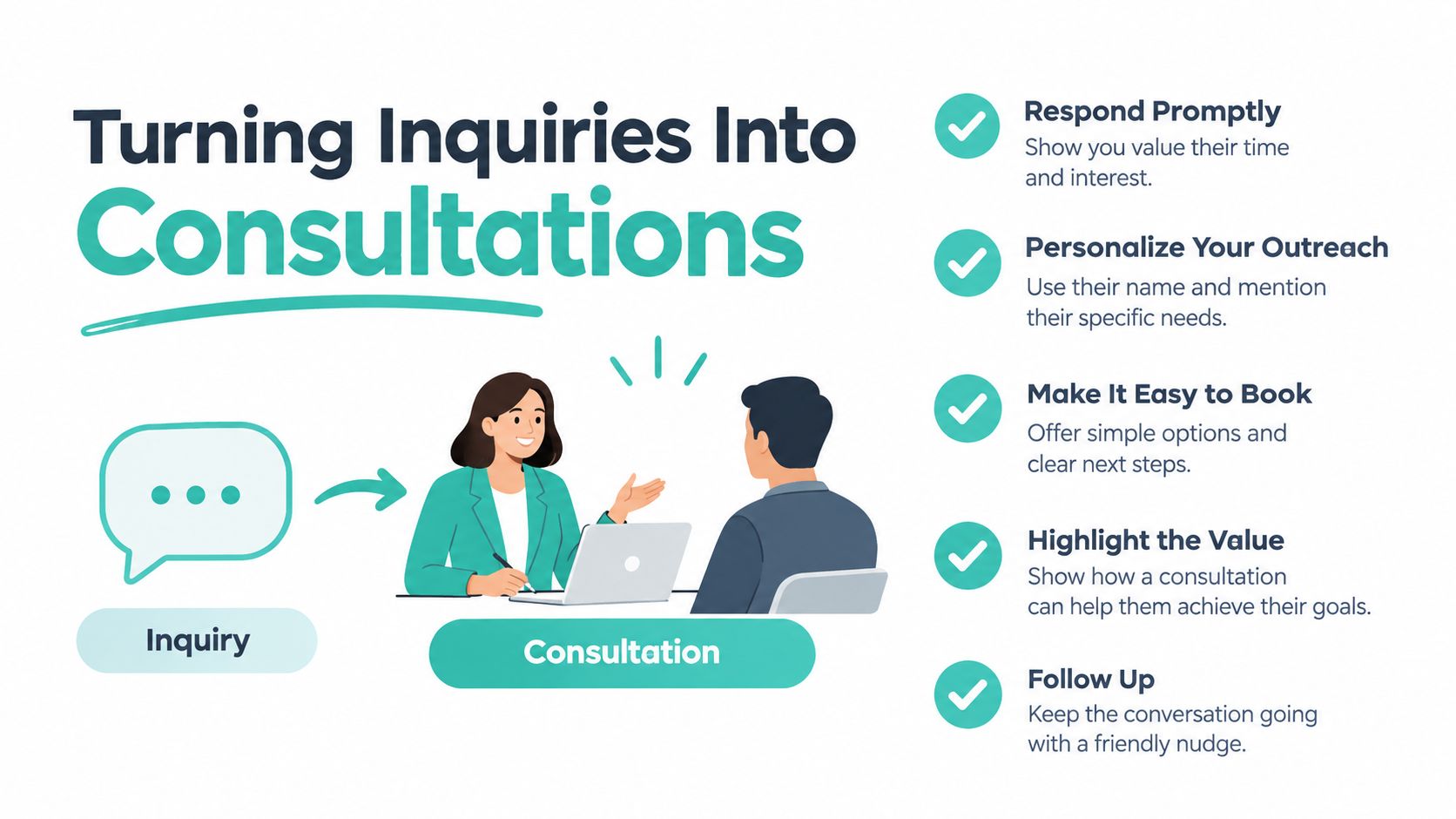
Install an intake service level agreement
The firm needs a written operating standard, not an informal hope that someone will notice the notification.
- Monitor the phone line: Route calls to a person or service that can identify the inquiry and record the source.
- Confirm receipt immediately: Send a clear SMS or email stating that the inquiry arrived and explaining the next step.
- Assign after-hours ownership: Decide who handles evenings, weekends, holidays, and attorney absences.
- Offer scheduling: Let qualified prospects book an appropriate consultation slot before human follow-up.
- Record timestamps: Log inquiry receipt, first response, consultation booking, attendance, qualification, and disposition.
- Separate lead types: Distinguish a new inquiry from a reached lead, a booked consultation, and a retained matter.
The workflow should also protect confidentiality. A form or chatbot shouldn't invite detailed facts that the firm can't safely handle before conflicts screening and attorney review. Automation can route, acknowledge, and schedule. It shouldn't imply that a lawyer has evaluated the facts when nobody has.
Find the actual bottleneck
If calls aren't answered, improve coverage before increasing ad spend. If forms arrive but don't book, inspect the page promise, qualification questions, and scheduling experience. If consultations happen but matters aren't retained, review fit, expectations, pricing communication, and the consultation process.
Firms working in competitive practice areas may also benefit from reviewing website performance metrics for criminal defense as a way to think about measurement, while avoiding the mistake of treating any benchmark as a substitute for the firm's own intake data.
The operating question is simple: where did the prospect stop moving, and who owned that moment?
What to Spend and How to Measure It
Marketing deserves a budget, but spending should follow operational capacity. A firm that can't answer inquiries, maintain accurate pages, or provide consultations shouldn't scale demand faster than it can serve it.
The 2024 Legal Trends research surveyed 1,028 U.S. legal professionals and reported that firms with above-average productivity spent 41% more on marketing than comparison firms and achieved 21% higher profitability. The same research reported an industry-average utilization rate of 37% (2024 Legal Trends findings).
Those figures show an association, not a causal formula. Better-organized or better-capitalized firms may be able to invest more in marketing, software, staffing, and process improvement at the same time. The useful lesson isn't “spend 41% more.” It's to treat marketing as an operating investment connected to intake capacity and profitable matters.
Replace surface reporting with funnel reporting
Impressions and clicks can diagnose visibility, but they don't prove economic value. A stronger report follows the prospect through the business process.
| Surface Metric | Downstream Outcome | Why It Matters |
|---|---|---|
| Impressions | Relevant searches reached | Shows potential visibility, but not intent or fit |
| Clicks | Qualified inquiries | Reveals whether the page and offer attract the right prospects |
| Cost per inquiry | Cost per reached lead | Separates cheap form submissions from people the firm actually contacts |
| Form submissions | Booked consultations | Tests clarity, qualification, scheduling, and follow-up |
| Consultation bookings | Attended consultations | Shows whether expectations and reminders are working |
| Consultations | Qualified matters | Connects marketing to practice-area fit and conflicts processes |
| Qualified matters | Retained clients and revenue | Measures economic performance rather than attention |
Track each practice area separately where possible. A campaign can appear efficient overall while attracting the wrong matter type for one attorney or location. Source data should travel with the inquiry into the CRM, where the firm can compare channel, response time, consultation status, qualification, and disposition.
Use the law firm marketing ROI measurement framework to make reporting a management tool rather than a monthly collection of vanity metrics.
Budget decisions should then follow evidence. Protect the pages and campaigns that generate qualified consultations. Repair the intake stages that lose reachable prospects. Pause channels that produce activity without suitable matters, unless they serve a clearly defined long-term credibility purpose.
Your Next Steps for Law Firm Marketing
Start with the assets that help clients verify the firm. Confirm the Business Profile, correct name-address-phone details, clarify practice areas and locations, and build pages around the problems prospective clients describe. A firm can't measure conversion reliably when its information is incomplete or its message is too broad to establish relevance.
Next, build credibility deliberately. Maintain review profiles, request honest feedback through a compliant process, publish useful educational content, and review testimonials, advertisements, and case-result language under the standards that apply to the jurisdiction. Avoid claims that create expectations the firm can't support.
Then install the intake SLA before increasing paid demand. Decide who answers calls, who owns after-hours inquiries, how immediate confirmations work, how consultations are scheduled, and which CRM timestamps the team reviews. Test the full journey yourself, from ad or search result to landing page, phone call, form submission, confirmation, scheduling, and follow-up.
A practical starting checklist
- Visibility: Verify the Business Profile and location information.
- Relevance: Create or improve practice-area pages for real client problems.
- Credibility: Review ratings, testimonials, attorney biographies, and educational content.
- Responsiveness: Set a response standard and assign ownership for every inquiry.
- Measurement: Track contact, booking, attendance, qualification, retention, and revenue.
- Scaling: Increase content or advertising only after the firm converts inquiries consistently.
A smaller budget paired with fast, credible follow-up can outperform a larger budget that sends prospects to voicemail and vague next steps. Every channel decision should trace back to the same question: how do this firm's actual clients find, vet, contact, and hire a lawyer?
SimpleLab Digital helps small law firms connect paid media, SEO and GEO, practice-area landing pages, content, and email and SMS follow-up into measurable acquisition workflows. Visit SimpleLab Digital to review its modular marketing services and plan a law firm funnel around qualified inquiries and downstream revenue.