Most advice about lawyer email marketing starts with open rates, subject-line tests, and a polished unsubscribe footer. That order is backwards. A law firm's email program should first define what information may enter a marketing platform, how consent and suppression work, and where a prospective client must move before discussing substantive facts. Only then should the firm optimize engagement or revenue.
Email can support client education, intake follow-up, appointment preparation, referrals, and long-term relationships. It can also expose a firm to deliverability failures, regulatory problems, and unnecessary privacy risk when every message is treated as a promotional blast. The practical standard is simple: build a controlled communication system, not a louder mailing list.
Table of Contents
What Lawyer Email Marketing Actually Means
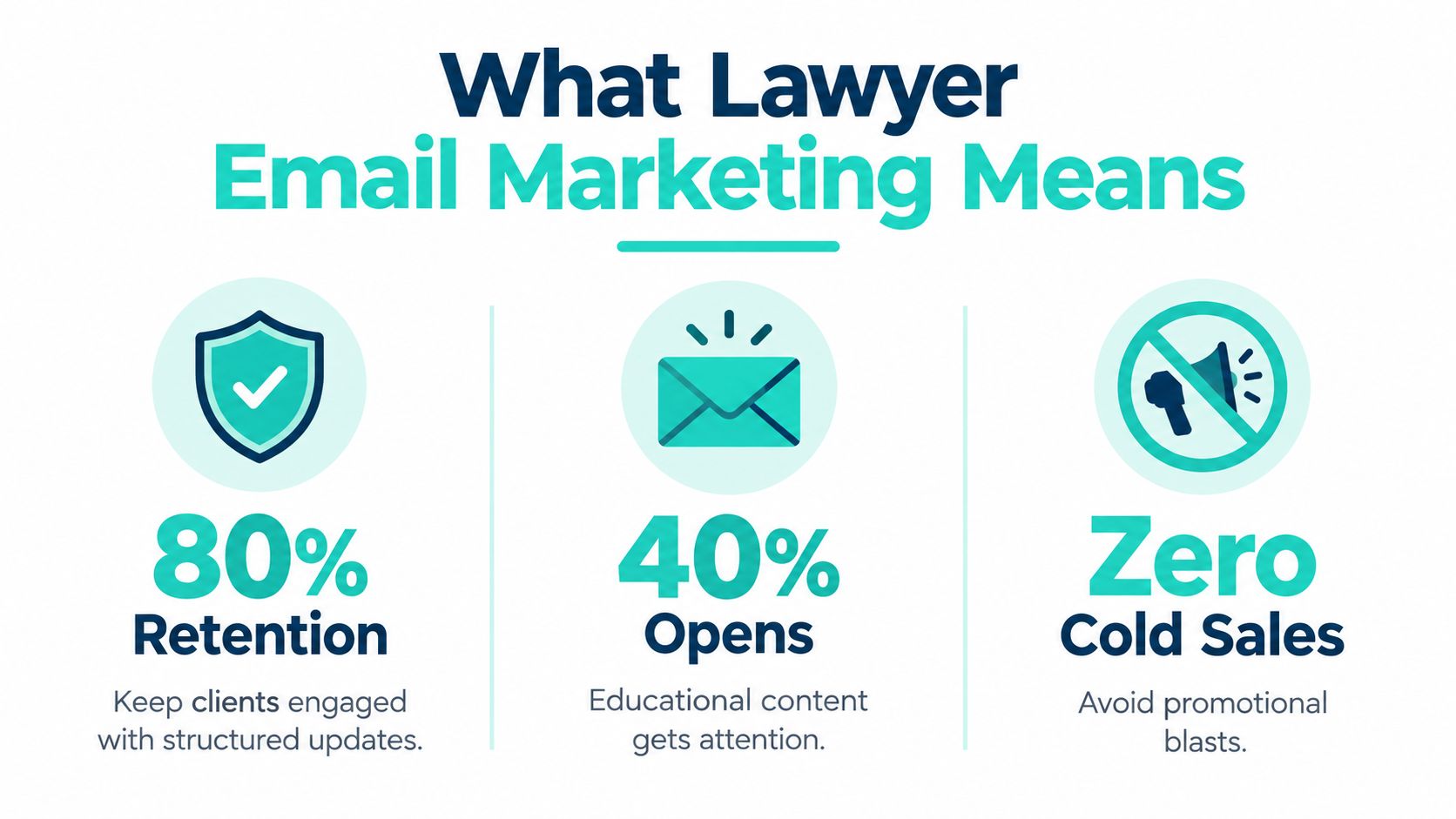
Lawyer email marketing is structured legal communication first and promotion second. A client alert, practice-area newsletter, consultation reminder, educational sequence, or relationship message can all support growth without sounding like an advertisement. The strongest programs help recipients understand what happens next, recognize when they need counsel, and reach the right intake path.
The American Bar Association's 2022 Legal Technology Survey found that 40% of respondents' firms used email marketing. Among those firms, 73% distributed client alerts by email, 50% used email newsletters, and 31% sent individualized, personalized messages to clients. Those figures point to a practical pattern: firms use email most reliably for organized legal communication, not only for promotional campaigns.
The website already supplies the foundation
Email programs don't always begin with an advanced CRM. The ABA survey found that 94% of firms collected visitors' email addresses through their websites, the same share that collected names, while 74% collected telephone numbers. That gives many firms a usable foundation for permission-based education, segmented newsletters, intake reminders, and longer-term nurturing.
Firm size changes the operational picture. Client-alert usage reached at least 85% among firms with 50 or more lawyers, while smaller practices often have fewer dedicated marketing resources. The same survey found that 57% of respondents reported an annual marketing budget, and attorneys performed marketing activities at 59% of firms, compared with 43% using internal marketing staff. These figures explain why a solo attorney needs a program that can be maintained between consultations, not a campaign architecture requiring a full-time operator.
Practical rule: If an email workflow isn't connected to a practice area, an intake stage, or a client-service purpose, it probably hasn't earned its place in a small firm's stack.
A workable program starts with one audience and one clear job. An estate-planning newsletter might answer common planning questions and invite a consultation. A family-law nurture sequence might explain the consultation process without collecting case facts. Firms building a broader acquisition system can connect these emails with law firm marketing services, landing pages, and intake workflows, but the email itself should remain clear about whether it educates, follows up, or communicates with an existing client.
Building Deliverability Before You Build Sequences
A consultation invitation that lands in spam has no chance to produce a consultation. Deliverability is a technical prerequisite, so creative work should wait until the firm knows which system sends messages, which domain appears in the From field, and where replies and intake events go.
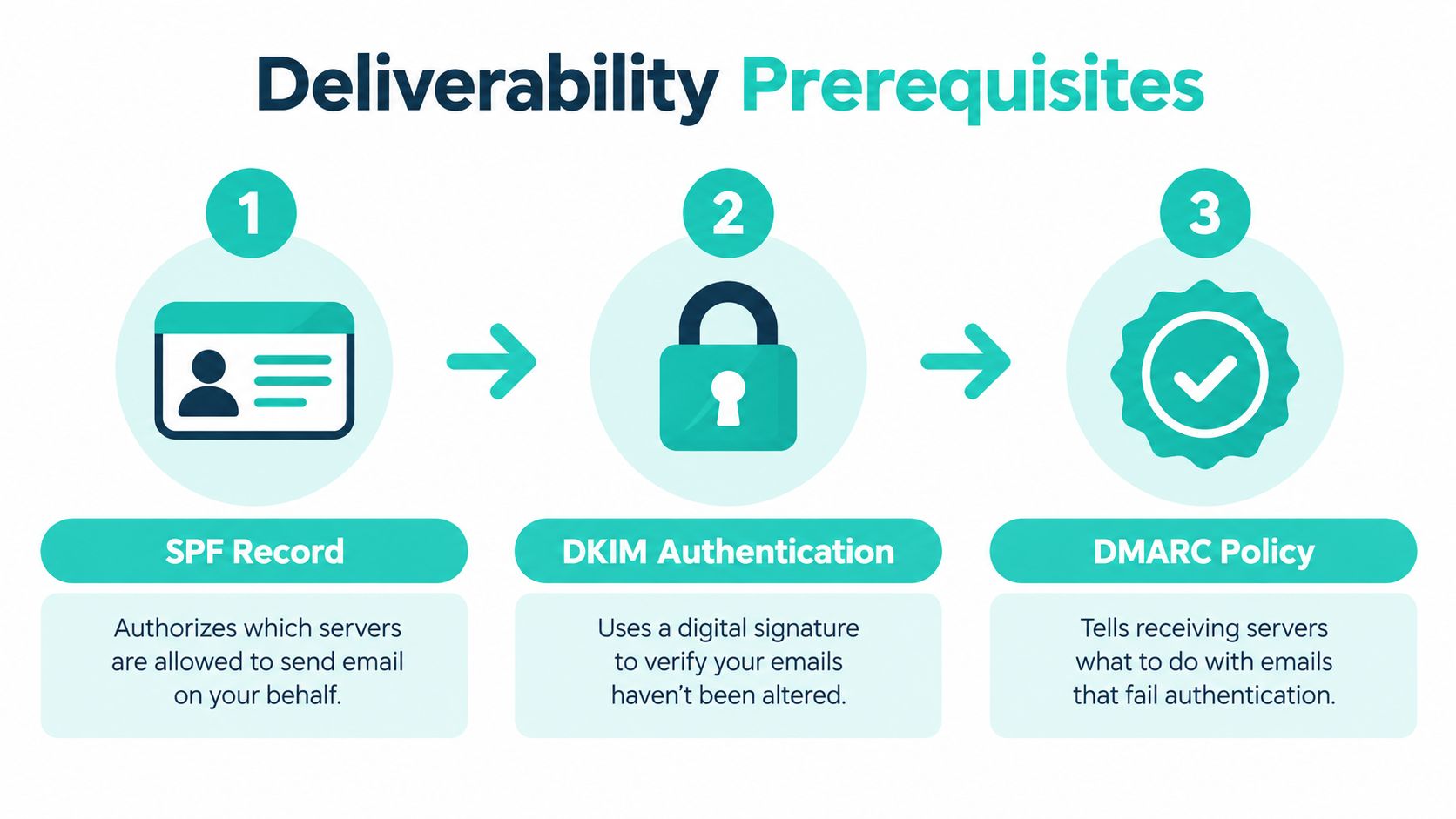
Google requires senders to authenticate domains with SPF or DKIM, while bulk senders must implement SPF, DKIM, and DMARC. Direct-mail domains must align the visible From domain with either the SPF- or DKIM-authenticated domain so DMARC alignment passes. Google also requires valid forward and reverse DNS records and recommends DKIM keys of at least 1,024 bits, preferably 2,048 bits where supported, as described in its email sender guidelines for Gmail.
Map the sending path first
Before launch, document the relationship between:
- Marketing platform: The system that sends newsletters and nurture emails.
- CRM or intake system: The place that records source, stage, appointment activity, and suppression status.
- Firm domain: The visible identity recipients recognize.
- Reply destination: The monitored mailbox or intake route that receives responses.
- Client-communication system: The secure environment used when substantive information is appropriate.
A dedicated authenticated subdomain such as updates.examplelaw.com can separate newsletter reputation from transactional client communications. Publish SPF and DKIM records for the sending service, deploy DMARC initially with monitoring, and review authentication results before increasing volume. Firms that want a plain-language technical reference can use SPF, DKIM and DMARC explained to understand how the three controls work together.
Monitor reputation by audience
Track complaints, bounces, and authentication failures separately by practice area where the platform allows it. A family-law list may behave differently from an estate-planning list because the audiences have different expectations, acquisition sources, and message sensitivity. Don't combine every address into one reputation pool and then guess which workflow caused the problem.
The same principle applies to implementation. Email marketing services for law firms can sit alongside a firm's existing CRM and intake tools, but the data map still needs an owner. Someone must know which platform controls consent, which system receives replies, and how an unsubscribe reaches every promotional workflow.
Designing Email Architecture Around Compliance Rules
Compliance belongs in the message architecture, not in a footer added after the copy is approved. A firm should know whether an email is promotional, transactional, educational, or part of a client relationship before it chooses the audience, automation trigger, data fields, and suppression behavior.
Under the U.S. CAN-SPAM framework, commercial email includes messages whose primary purpose is advertising or promoting a product or service, and there is no business-to-business exception. The Federal Trade Commission's CAN-SPAM compliance guide requires accurate From, To, Reply-To, and routing information, non-deceptive subject lines, clear identification of advertising, a valid physical postal address, and a conspicuous opt-out mechanism. Firms must honor unsubscribe requests within 10 business days, and the opt-out mechanism must remain operational for 30 days after the message is sent.
Build suppression into the data model
Every contact record should carry enough information to explain why the person is receiving a message and whether the person should receive it. Useful fields include:
- Acquisition source: The form, consultation request, referral, or other origin.
- Consent record: The wording, date, channel, and purpose captured at sign-up.
- Campaign purpose: Newsletter, consultation follow-up, reactivation, or another defined use.
- Suppression status: A global indicator that blocks promotional sends.
- Unsubscribe timestamp: The event time used for auditing and workflow control.
Suppression should operate globally across newsletters and nurture workflows. A contact who opts out of a promotional sequence shouldn't continue receiving a different practice-area campaign because the records live in separate lists. Client-service or transaction-related messages should be classified separately from promotional content, with staff able to identify which category applies before sending.
Treat U.K. contacts differently
For marketing emails sent to individuals in the United Kingdom, PECR generally requires specific consent before unsolicited electronic-mail marketing. The ICO guidance on electronic-mail marketing says valid consent must be freely given, specific, informed, and based on a clear affirmative action. Pre-ticked boxes, silence, and inactivity don't establish consent.
A limited soft-opt-in exception may apply when an existing customer bought or negotiated to buy a similar service, the firm collected the contact details during that relationship, and the customer received an opt-out opportunity when the details were collected and in every later message. Consent should therefore be recorded by organization, communication type, channel, wording, and date. The essential disclaimer for emails can help teams review disclaimer language, but a disclaimer can't replace accurate classification, consent controls, or suppression logic.
| Message Type | Primary Purpose | Consent Basis | Suppression Handling | Authentication Priority |
|---|---|---|---|---|
| Educational newsletter | General practice-area education | Permission for marketing communication | Global promotional suppression | High |
| Consultation nurture | Help an inquiry understand next steps | Recorded marketing permission where required | Stop on opt-out, conversion, or secure handoff | High |
| Client-service message | Transaction or representation-related communication | Relationship or service necessity | Separate from promotional suppression | High |
| Reactivation campaign | Renew a relationship or invite new work | Consent or applicable legal basis | Global suppression and preference check | High |
A firm can also review related messaging through its Facebook advertising approach for attorneys, because the same discipline applies: truthful claims, clear purpose, and careful separation between general information and individualized advice.
Separating Public Education from Confidential Communications
Personalization feels helpful until it causes a firm to place sensitive legal facts in a marketing database. In legal marketing, more personalization isn't always better. A message that uses a recipient's practice-area interest can be useful, while a campaign field containing details about a dispute, immigration history, medical condition, family conflict, or potential claim can create unnecessary ethical and cybersecurity exposure.
The American Bar Association's ethics guidance emphasizes reasonable efforts to prevent unauthorized disclosure of information relating to a representation, understand where information is transmitted and stored, assess technology vendors, and train lawyers and non-lawyers. That makes the boundary between a newsletter tool and a secure client-communication system an operational decision, not merely a software preference.
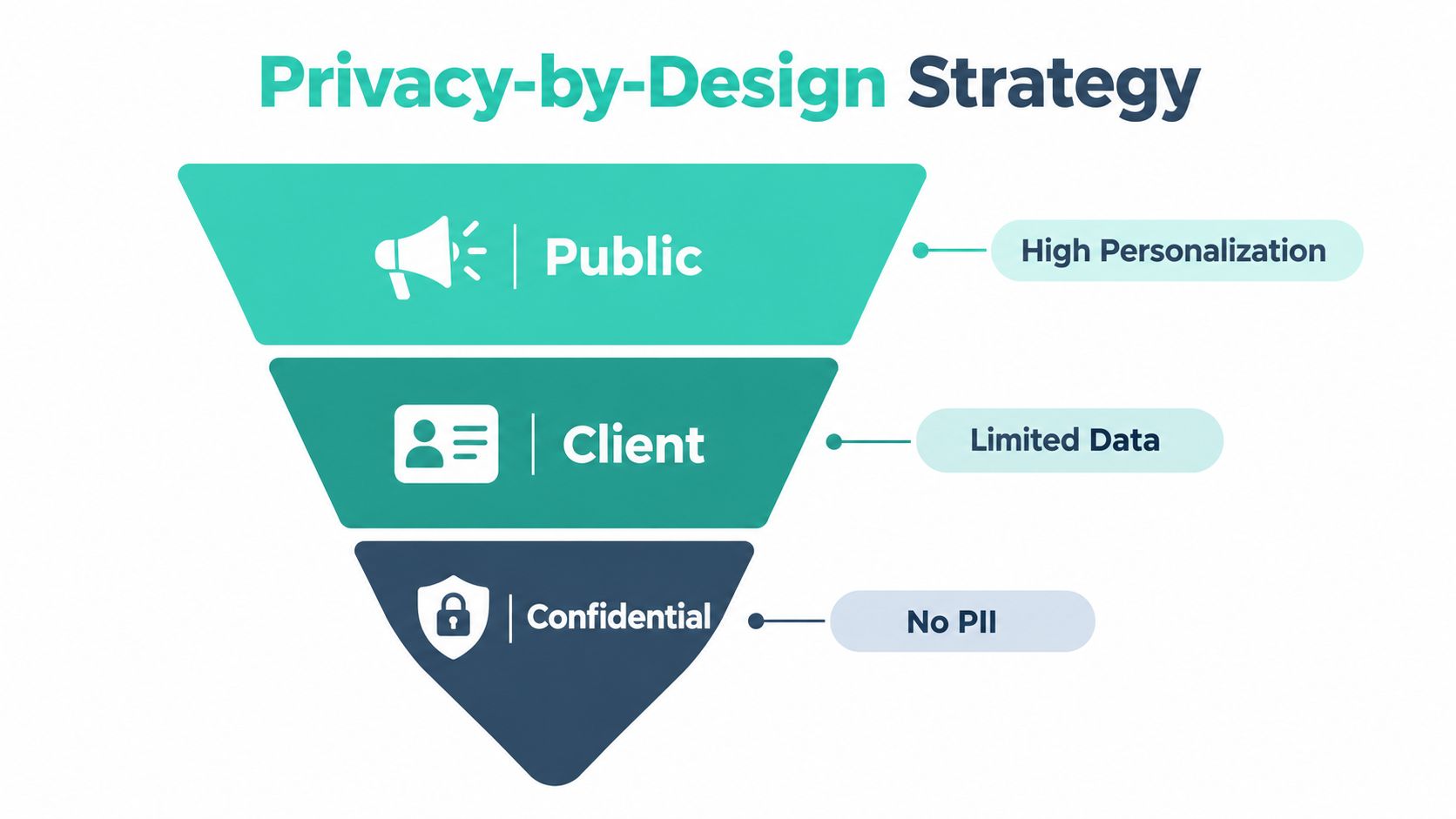
Use a three-tier boundary
At the top of the funnel, public education can cover general questions, legal-process explanations, checklists, and practice-area developments. Keep the content useful without inviting the recipient to describe a matter in an ordinary reply.
The middle tier manages consent, preferences, practice-area interest, language preference, and intake stage. Those fields can support relevant nurturing while keeping substantive facts out of the marketing system.
The bottom tier begins when the person needs to discuss a specific matter, upload documents, or receive individualized guidance. At that point, the email should direct the person to a secure intake or client-communication system. The marketing platform should retain only the minimum routing information needed to complete the handoff.
Privacy boundary: Ask a marketing system to remember what a person wants to learn, not the confidential facts of why they need a lawyer.
A newsletter platform may safely store limited prospective-client information when the firm has assessed vendor controls, restricted staff access, documented the data flow, and minimized the fields collected. It shouldn't become a substitute for a secure portal. Avoid legal facts in campaign fields, don't copy substantive case discussions into ordinary email notes, and train staff to recognize when a reply requires a controlled handoff.
This architecture also improves clarity. The recipient sees a difference between general legal education, scheduling support, and confidential communication. The firm can nurture interest without implying that an automated email is legal advice or that a result is guaranteed.
Email Workflows for Common Practice Areas
Practice-area specificity matters because the useful next step differs by service. A generic “book a consultation” sequence may technically function, but it forces every recipient through the same assumptions. A better workflow reflects the decision the person is trying to make while keeping sensitive facts out of campaign fields.
Estate planning
A new subscriber might receive an educational message about documents people commonly review, followed by a message explaining how to prepare for an initial planning conversation. The call to action can invite a consultation and list the information the person should have ready without asking them to disclose family or asset details by reply.
After an appointment is booked, the marketing sequence should stop and the intake or client-service system should take over. A client newsletter can later provide general reminders about reviewing plans after major life changes, but it shouldn't request confidential updates through a bulk-email reply.
Family law
A family-law nurture sequence should explain what a consultation covers, how the firm handles scheduling, and what general documents may be useful. It must avoid language that implies a guaranteed custody, financial, or procedural result, and it shouldn't create artificial urgency around a recipient's personal situation.
If the recipient replies with substantive facts, staff should acknowledge receipt without continuing the discussion in the marketing platform. The next action is a controlled intake handoff, not a more personalized automation.
Real estate and immigration
A real-estate workflow can segment educational content by transaction interest, such as buying, selling, leasing, or reviewing an agreement. An immigration workflow might organize general education by service category and invite a structured consultation. In both cases, the system should record the category and stage, not a detailed legal history.
SMS can support reminders when the firm has the appropriate permission and channel controls. A coordinated SMS follow-up workflow for law firm leads should complement email rather than bypass its consent and suppression rules. Every channel needs its own preference record where the law requires channel-specific permission.
The common pattern is simple: educate publicly, capture limited intent, invite a defined next step, and hand off before sensitive details enter the marketing system.
Measuring Email by Qualified Inquiries and Revenue
Open and click activity can help diagnose delivery and message relevance, but neither metric proves that a firm received a qualified inquiry or retained a matter. A recipient may click out of curiosity, while another may read several educational messages over time and contact the firm only when the need becomes immediate.
Measurement principle: Optimize for the business event the firm can defend, not the activity the email platform makes easiest to display.
A privacy-preserving attribution model can use a pseudonymous lead ID, service category, acquisition source, consent status, appointment event, intake stage, and revenue band. Sensitive case facts remain in the case-management system. The marketing platform needs enough information to connect a campaign with a later event, not enough information to reconstruct the matter.
Create a defensible reporting chain
Start with the question the report must answer. For example, did an email recipient schedule an appointment, attend it, become a qualified inquiry, or enter a retained-matter stage? Each event should have a defined source and a responsible system.
A small firm can report the chain without exposing protected information:
- Campaign interaction: Record the message and the pseudonymous lead ID.
- Intake activity: Record practice area, stage, and appointment event.
- Qualification: Mark whether the inquiry met the firm's internal qualification criteria.
- Downstream value: Connect a revenue band or retained-matter event without copying confidential facts.
- Risk review: Check consent, suppression, vendor access, and data retention.
Delayed conversion needs a fair reading. A recipient may not be ready when the first email arrives, so the firm should evaluate the sequence over an appropriate relationship window rather than treating immediate clicks as the only valuable behavior. Avoid turning this into an excuse for vague reporting. Define the events before launch and review them consistently.
The CRM-to-email map belongs in the measurement design. Review which vendors can access each field, who can export records, how suppression travels between systems, and whether staff can distinguish general education from individualized communication. The law firm marketing ROI measurement framework can support that broader reporting discipline.
A revenue report should answer practical questions: which practice area generated qualified inquiries, which source produced appointments, which workflow supported retained matters, and where prospects stalled. Surface metrics remain useful diagnostics, but they shouldn't be the final definition of success.
Launching a Simple Practice-Area Email Program
A solo attorney or small firm doesn't need a sprawling automation system to begin. Start with one practice area, one authenticated sending subdomain, one consent-captured newsletter, one nurture sequence, and one defined intake handoff.
Use this launch checklist:
- Choose the boundary: Decide which content is public education, which messages support intake, and which communication must move to a secure system.
- Map the systems: Identify the marketing platform, CRM, intake tool, reply mailbox, and client-communication environment.
- Capture permission: Store the source, wording, date, channel, and purpose of each marketing permission.
- Build suppression first: Make unsubscribe status global across promotional newsletters and nurture workflows.
- Write useful sequences: Answer common questions, explain next steps, and avoid promises, misleading urgency, or individualized advice.
- Define outcome fields: Track practice area, stage, appointment, qualified inquiry, and downstream revenue band through a pseudonymous ID.
- Review on a fixed cadence: Use biweekly reporting to inspect delivery, complaints, bounces, appointments, suppression behavior, and qualified inquiries.
A sustainable cadence beats a heroic launch followed by silence. Keep the first program narrow enough for attorneys and staff to maintain, then add practice areas only after the firm can explain what each workflow sends, who receives it, and what happens when someone replies.
SimpleLab Digital plans and manages email and SMS marketing, including newsletters, automated follow-up sequences, CRM setup, and long-horizon nurturing for small firms. Visit SimpleLab Digital to discuss a practice-area program that connects compliant messaging with landing pages, intake, and qualified-inquiry reporting.
Created with Outrank