You're probably here because Instagram has started to feel expensive in all the wrong ways. The account is active, the posts look fine, maybe even a little polished, but the leads are inconsistent, the reporting is vague, and nobody can explain which part of the work created revenue. That's usually the moment a buyer starts looking for an Instagram marketing agency, not for more content, but for a system that connects discovery, conversion, and follow-up.
The right way to judge an agency is simple. Don't start with posts, templates, or “growth.” Start with the business outcome you need, then test whether the agency can build a measurable path to it, explain its pricing without games, and show how it handles attribution, compliance, and lead quality. If you want a practical way to compare their process to your own, use quackr for verifications and check the discipline behind the workflow, not just the polish.
For businesses that want a modular setup, SimpleLab Digital's process is a useful reference point because it treats Instagram as one piece of a larger revenue system, not a standalone vanity channel.
Table of Contents
What Decides Whether You Hire an Instagram Marketing Agency
Most owners hire help after a stretch of scattered posting, weak handoffs, and reports that never connect to booked calls or signed work. The account looks active, but revenue stays flat. The usual failure point is plain enough. Nobody can tell whether the problem sits in creative, the landing page, the offer, or the follow-up.
That is the decision in front of you. An Instagram marketing agency should build a repeatable path from attention to inquiry and show exactly where that path breaks. A team that can't explain how it connects discovery, conversion, and follow-up is selling activity. If you want a practical way to compare process discipline, use quackr for verifications and look at how carefully the workflow is run, not just how polished the presentation is.
What to judge before you sign
Pressure-test three things. Ask what the agency does each day, how it prices the work and what it excludes, and whether it reports business outcomes or only platform activity. Those questions expose weak vendors quickly.
Small businesses and law firms should expect plain language about leads, calls, inquiries, and revenue. Weak agencies drift toward reach, likes, and follower growth. That difference matters because visibility without lead quality just adds noise.
Practical rule: If an agency cannot describe how it turns attention into qualified inquiries, it does not have a marketing system, it has a posting habit.
Ask for the onboarding flow, reporting cadence, and ownership rules before you discuss creative ideas. That is where you see whether the team runs a disciplined process or improvises from account to account. For businesses that want a modular setup, SimpleLab Digital's process overview is a useful reference because it treats Instagram as one piece of a wider revenue system. If they cannot answer clearly, you already know what the engagement will feel like.
What an Instagram Marketing Agency Does Day to Day
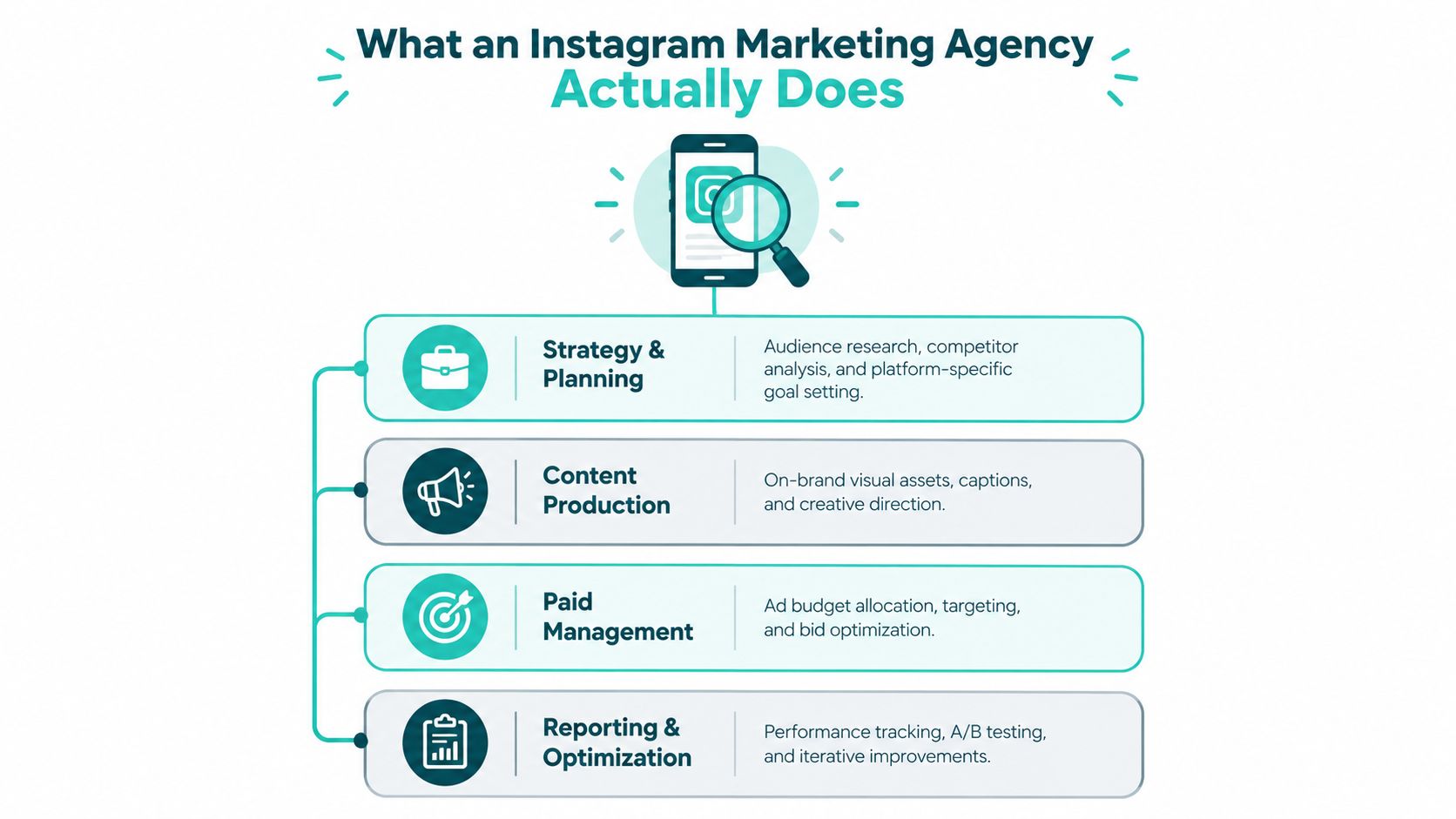
The useful version of an Instagram marketing agency owns four connected layers, strategy, content production, paid management, and reporting with optimization. If one layer is weak, the result is usually pretty posts with no pipeline impact or ads that never get enough conversion support.
The four layers that matter
Strategy and planning starts with audience research, offer positioning, and channel fit. The agency needs to know who the work is for and what action it should drive, or everything downstream gets blurry. At this stage, the team decides whether the account should focus on local awareness, direct-response leads, or creator-style trust building.
Content production covers the assets, captions, and creative direction. That includes short-form video, static posts, story sequences, and the message framing that ties them together. If you want a practical production workflow, ShortGenius AI UGC video ads show how teams can turn one idea into reusable creative without pretending the asset itself is the strategy.
Paid management is where many owners misread the work. It is not just turning on ads. It is budget allocation, targeting, bid decisions, and testing. If an agency says paid and organic are separate, be cautious. In practice, one should inform the other.
Reporting and optimization is where judgment shows up. Good reporting does not stop at impressions or engagement. It should show what produced qualified inquiries, what led to booked meetings, and what clearly did not work.
Owners also need to know what the agency does not do. It does not replace your offer, your sales follow-up, or your operational responsiveness. It also does not guarantee that every post becomes a lead. For businesses that want a modular execution model, SimpleLab Digital's social media management service is one example of how content support can sit alongside other revenue tasks instead of being treated as a one-off service.
The agency's job is to reduce uncertainty. If it increases uncertainty, it is probably the wrong fit.
The Core Service Areas That Drive Qualified Inquiries

The services matter less than the sequence. Paid social, organic content, short-form video, landing pages, and follow-up are not separate projects. They're one chain. When one link is weak, the whole system underperforms, even if the posts look good.
Ads and content have to point to a real next step
Paid campaigns should exist to drive a measurable action, not to create a nice dashboard. That means the ad should match the landing page, and the landing page should match the offer. If the creative is broad but the page is specific, people bounce. If the page is vague, the click was wasted before the lead form loaded.
Organic content plays a different role. It builds familiarity, gives people a reason to trust you, and makes the paid work feel less abrupt. For a law firm or a local service business, practice-area-specific messaging matters more than generic brand content because buyers care about relevance before they care about style.
Short-form video is usually the fastest way to make the account feel human. It gives prospects a voice, a face, and a reason to believe there's a real operator behind the brand. But video volume without clarity is still noise. The message has to answer the question the buyer is already asking.
Follow-up is where most agencies drop the ball
Lead forms are not the finish line. The follow-up sequence is where a lot of deals are won or lost, especially for businesses with longer consideration cycles. If the agency doesn't coordinate email or SMS follow-up, it's leaving value on the table and making reporting look weaker than it should.
For teams wanting a lead-generation benchmark, lead gen Instagram strategies that convert can be a useful comparison point for how agencies think about campaign structure. It's not enough to generate clicks. The better question is whether those clicks become conversations.
SimpleLab Digital's Facebook and Instagram ads service is built around that connected logic, ads, creative, audience selection, and reporting tied back to inquiry quality instead of isolated engagement.
Direct advice: Buy the whole chain or don't buy it at all. A weak landing page can ruin a strong ad. A slow follow-up can ruin a good lead.
How Instagram Marketing Agency Pricing Works
Pricing is where buyers get trapped. The headline number looks manageable, then ad spend, creative production, software, revisions, and landing pages show up later. If you do not ask what is included, you will compare quotes that do not mean the same thing.
Here is the cleanest way to judge it.
| Model | Typical Range (USD) | What Is Usually Included | Main Risk |
|---|---|---|---|
| Monthly retainer | Commonly $1,500–$5,000+/month for small-business scopes | Ongoing management, planning, reporting, meetings, and light creative support | Scope creep and unclear exclusions |
| Subscription bundle | Transparent monthly pricing with modular options | Defined services, set deliverables, and clearer ownership rules | Less custom work if your needs are unusually complex |
| Project-based | One-off pricing for a launch, audit, or campaign build | Specific deliverables with a defined end date | Breaks easily if you need ongoing optimization |
What usually gets excluded
The common exclusions are ad spend, third-party tools, and creative production beyond a narrow scope. That is where buyers get surprised. A quote can look affordable until you realize the agency priced management only, not the assets, the landing page, or the follow-up workflow.
SimpleLab Digital's digital marketing packages are worth reviewing if you want a model that keeps scope visible from the start. The point of a subscription structure is not that it is automatically cheaper. It is that monthly terms, modular options, and separate cost lines make the buy easier to evaluate.
How to judge fairness
A fair price has explicit scope, deliverables, and reporting cadence. If the agency cannot say where the work starts and stops, the quote is incomplete. If it can explain that clearly, the price may still be high, but you know what you are buying.
For growing small businesses and solo practices, transparency usually beats complexity. Long retainers can work, but only if the account needs a deep, custom operating rhythm. If you are early or still testing fit, a clear subscription is usually the cleaner trade.
Whether Instagram Is Even the Right Platform for Your Business

Instagram has scale, but scale alone doesn't justify spend. Meta advertising-planning data analyzed by DataReportal puts Instagram's measurable ad-reach audience at approximately 1.74 billion people in January 2025, equal to 21.3% of the world's population and 26.9% of people aged 13 and older. That's real reach, but reach doesn't tell you whether your business category belongs there DataReportal's Instagram stats.
Start with audience fit, not platform hype
For local firms, the question isn't whether Instagram is huge. It's whether your likely buyer uses it in a way that supports discovery and trust. Pew found that 47% of U.S. adults used Instagram in its 2023 survey, with higher use among Hispanic adults at 58% and Asian adults at 57%, compared with 46% of Black adults and 43% of White adults Pew's social media use report. That kind of variation is why geography and audience composition matter.
Some law firms, especially in estate planning, family law, and immigration, can do well on the platform because the service is trust-heavy and explanation-heavy. Home services, clinics, and professional practices can also fit if the creative shows proof, process, and responsiveness. Generic B2B offers, dull commodity services, and businesses with no visual or trust-building angle usually struggle harder.
Use Instagram when the business can support it
The filter is simple. If your offer benefits from repeated exposure, education, and direct conversation, Instagram can work. If your sales cycle depends almost entirely on urgency or comparison shopping, it may still be useful, but only as one channel in a larger mix.
SimpleLab Digital's small-business marketing guide is worth reading if you need to decide whether Instagram should sit inside a broader plan or stay secondary. A good agency will tell you when the platform is a fit and when it isn't.
Practical rule: Don't ask whether Instagram is popular. Ask whether your buyer would trust you more after seeing you there.
Why Reporting Style Matters More Than the Tools Used
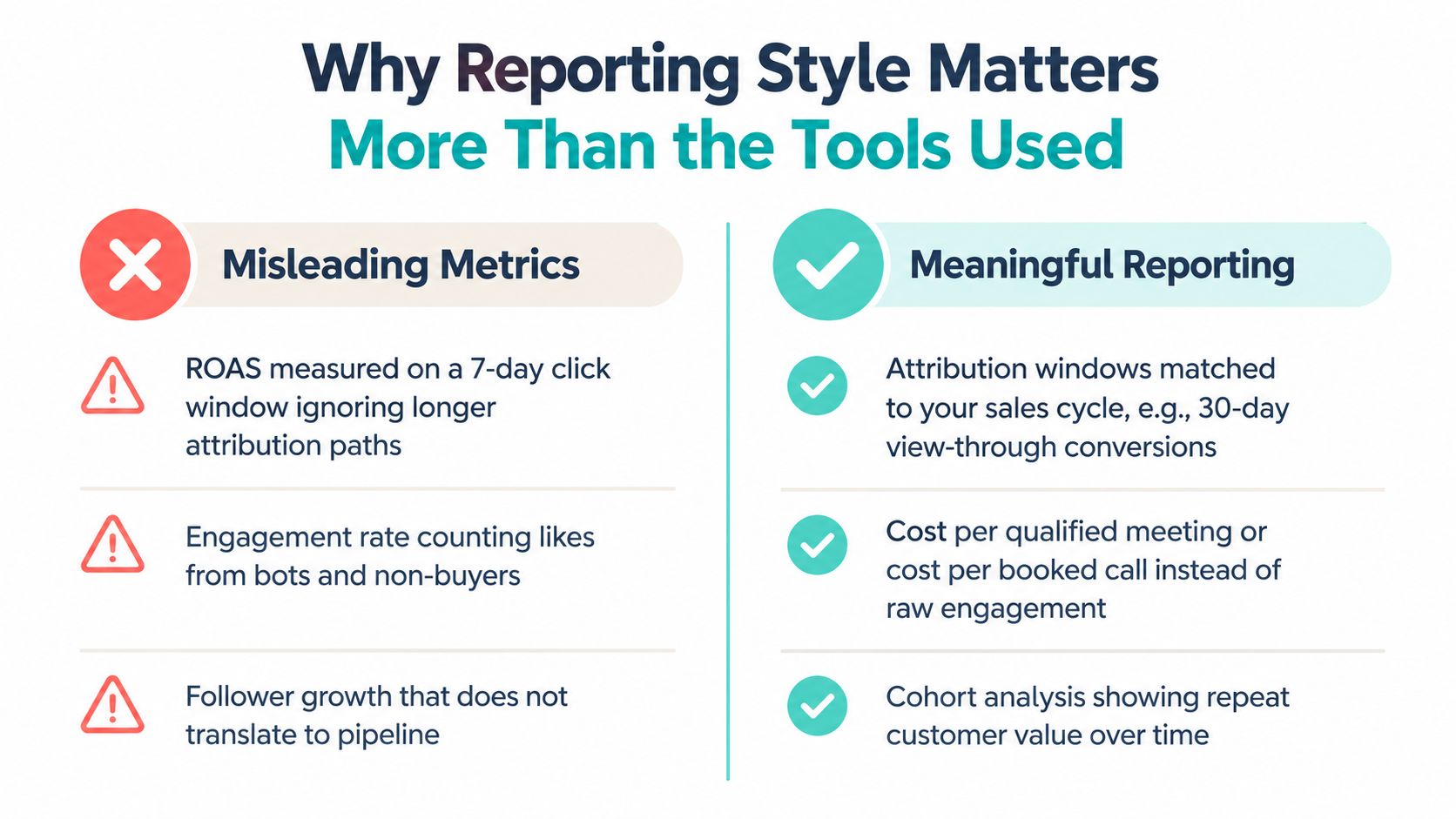
Most agency reports stay at the surface. They list reach, likes, and maybe a ROAS figure, then expect you to connect those numbers to revenue. A report that stops at reach and likes is decoration. The true test is whether the report helps you make budget calls without guessing.
Attribution is never as clean as people want
Meta reporting relies on attribution windows, so the platform's credit assignment will not always match the actual path to a sale. A prospect can watch a video, search later, call the office, and still never appear as a clean Instagram conversion. That gap matters for small businesses and law firms, where one lead often takes several steps before booking.
The fix is not a perfect number. It is a reporting system that combines UTMs, CRM source fields, call tracking, unique landing pages, and direct intake questions like, “How did you hear about us?” SimpleLab Digital's process page structures reporting that way by design. That gives you a better read on whether Instagram shaped demand or only captured the final click.
What good reporting should show
Good reporting puts qualified inquiries ahead of vanity activity. It should show cost per qualified lead, booked appointments, lead-to-client movement, and revenue by campaign where the data exists. If an agency cannot speak in those terms, it is optimizing for the wrong outcome.
Engagement still matters, but only as a diagnostic. It can tell you whether creative is landing or falling flat. It should never be the main business metric. If a campaign drives cheap clicks and weak inquiries, the report should say so plainly and force a change.
The reporting test: Ask for a report that shows what the campaign did to the pipeline, not just what it did to the feed.
For businesses that want reporting tied to inquiry quality and downstream revenue, SimpleLab Digital uses that model in its subscription, modular setup. That approach changes how an agency spends because every report has to point back to business outcomes.
Questions to Screen Any Instagram Marketing Agency Before You Sign
The easiest way to avoid a bad fit is to ask uncomfortable questions early. Most agencies can talk beautifully about creative. Fewer can explain ownership, compliance, onboarding, and what happens when performance stalls. That's the filter.
Ask these questions before you commit
- Who owns the ad account and creative assets? If the answer is vague, you don't own the system. You're renting it.
- What does onboarding look like in the first month? A mature agency has a defined intake, access setup, and launch sequence.
- How often do you report, and what do you report on? If they say “monthly” but can't explain the format, expect hand-wavy updates.
- How do you handle compliance for law or other regulated categories? This matters for claims, disclosures, client stories, and review moderation.
- What happens if results are weak after launch? Weak agencies defend the work. Strong ones explain the data, change the test, and tighten the offer.
If you're evaluating creator or UGC support, remember that one 2025 report found that 42% of surveyed influencer campaigns ran on Instagram in 2024, but agency work often under-explains licensing duration, paid-usage rights, disclosure requirements, and brand-safety screening, which are especially important for regulated businesses KIRO 7's report coverage.
What strong answers sound like
Strong agencies answer in specifics. They can tell you who your point of contact is, what gets documented, how often you'll hear from them, and what data they need from your side. For a subscription setup, that should feel clean, not improvised.
SimpleLab Digital's approach is built around standardized onboarding, a single point of contact, biweekly reporting, and documented ownership and scope. That's the kind of operational clarity buyers should expect before they sign anything.
Making the Final Call and What to Do in the First 30 Days
Choose the agency that can explain exactly how Instagram activity connects to revenue. Ask who owns the accounts, what the reporting format looks like, how compliance is handled, and what happens if the first test falls short. If those answers are vague, keep looking.
For law firm marketing, the right agency should sound disciplined. For subscription versus traditional retainer decisions, the difference is clarity, flexibility, and whether the work stays tied to qualified inquiries instead of loose activity. In the first 30 days, watch for three things, clean onboarding, reporting you can use, and honest adjustments when early results need work.
A partner worth hiring should also be clear about scope. If you want a straightforward setup that connects Instagram ads, social content, landing pages, and follow-up into one monthly system, SimpleLab Digital structures its subscription model that way. Visit SimpleLab Digital to review it and decide whether it fits your business.