Most law firm SEO advice still oversells rankings and undersells trust. A firm can sit near the top of search results and still lose the client if the website, reviews, bio pages, and intake path don't survive a skeptical comparison. The modern buyer doesn't just find a lawyer, they verify one.
Table of Contents
The Post-Referral Verification Reality
The old assumption is that law firm SEO works like a billboard, rank high and calls follow. That's outdated. A 2025 survey of 3,000 U.S. consumers reported that 74% researched a firm online after a referral, nearly 60% gave online reviews more weight than word-of-mouth, and more than half would not consider a firm rated below four stars, which makes the website part of the verification process, not just the discovery process. Those findings line up with the way legal consumers now move between Google, review sites, and firm pages before they ever speak to intake. SimpleLab Digital's law firm marketing perspective fits that shift because the actual competition happens after first contact, not just at first impression.
Search has become proof, not just reach
A referral no longer ends the buying journey. It starts a cross-check. That means practice-area pages need to do more than mention services, they need to answer the question, “Why should I trust this firm with my problem?”
Practical rule: every public page should help a prospect confirm competence, geography, responsiveness, and credibility in under a minute.
The strongest firms treat organic visibility as a trust system. Their homepage, attorney bios, location pages, and review assets all tell the same story, so the visitor doesn't have to resolve contradictions on their own. If one source says one thing and another says something else, the prospect often walks.
What this changes in practice
The shift is especially important for firms that depend on referrals. A referred prospect may still search the firm's name, scan third-party reviews, and compare the website against what they heard from a friend or professional contact. That means SEO has to support the post-referral check, not only the first click.
- Practice-area clarity: state the problem the firm solves, who it serves, and where it works.
- Attorney credibility: show admissions, focus areas, and real professional background.
- Review consistency: align the reputation signal across the website and third-party platforms.
- Intake friction: make calling, booking, and messaging obvious on every high-intent page.
Simple advice fails here because it treats visibility as the end goal. In legal marketing, visibility is only useful when it survives verification.
Optimizing for the Compressed Decision Window
Legal consumers don't browse leisurely. The UK Legal Services Consumer Panel reported that 41% of consumers shopped around before choosing a legal-service provider in 2024, with 67% making their decision within one week, and 46% of people who received a referral still went online to research the recommended lawyer. That compressed window changes what a law firm page has to do. It must answer comparison questions quickly, without forcing the visitor to piece together basics from scattered pages. Mapping keywords to legal content is useful here because a keyword map only matters when it lines up with the way prospects compare firms.
Build pages for comparison, not decoration
Practice-area pages should read like decision tools. Attorney bios should explain who handles what, and location pages should prove the firm is genuinely present in the market. Pricing and fee language, where appropriate under local rules, should be clear enough to reduce uncertainty rather than increase it.
The strongest pages usually answer four things fast, who handles the matter, what kinds of clients the firm takes, where the firm works, and how someone starts. That sounds basic, but many pages bury the answers under generic branding copy. People don't hire on branding alone. They hire when they feel the firm understands their issue and looks easy to contact.
What selection looks like on the page
Reviews matter because they compress social proof into a skimmable format. Pricing and responsiveness matter because they reduce the fear of wasted time. Reputation matters because legal matters feel high stakes. Those signals should show up in the page structure, not just in a footer badge.
| Legal Consumer Selection Factors | Consumer Priority |
|---|---|
| Reviews | Most helpful selection factor |
| Pricing and fees | High priority |
| Responsiveness | High priority |
| Overall reputation | High priority |
A good content architecture makes those factors easy to verify. That usually means short intros, clear subheads, visible contact paths, FAQ blocks, and bios that sound like actual people wrote them. In this environment, a page that's well organized will usually outperform a page that repeats a keyword.
Local Visibility and Entity Disambiguation
Local SEO for law firms is still about being found near the right searcher, but the mechanics are stricter now. Google's LocalBusiness documentation says structured data can communicate business hours, departments, and related business details, and recommends validating implementations with the Rich Results Test. For a firm with multiple offices or overlapping practice areas, that's not a nice-to-have. It's how you reduce ambiguity about who you are and where you serve.
Make the firm legible to search engines
Structured data should reinforce visible facts, not invent them. Use the same name, address, phone number, URL, service area, and hours across the website, Google Business Profile, and major legal directories. If those values drift, entity recognition gets messy and the user experience suffers.
A practical deployment sequence is straightforward. Mark up a small set of location and contact pages first. Validate critical errors. Inspect the rendered pages in Search Console. Then submit or refresh the sitemap and monitor the pages that drive calls and forms. Boost local visibility in AI answers matters because local visibility now extends beyond the map pack into answer surfaces that depend on clean, machine-readable business facts.
If the website, profile, and directories don't agree, the prospect notices before the algorithm does.
Keep the location story consistent
The internal link between locality and intake is easy to miss on small firm sites. A city page that doesn't match the office listing, or a bio that claims service in a jurisdiction the firm doesn't handle, creates confusion. The fix is boring but effective, consistent office names, consistent geography, and clear practice-area assignment.
A useful resource for firms with multi-location complexity is local SEO for immigration lawyers, because the same consistency rules apply when a firm serves multiple regions or languages. The point is not to stuff more local terms into the page. The point is to remove uncertainty so the right prospect keeps moving toward contact.
Technical Performance as a Conversion Requirement
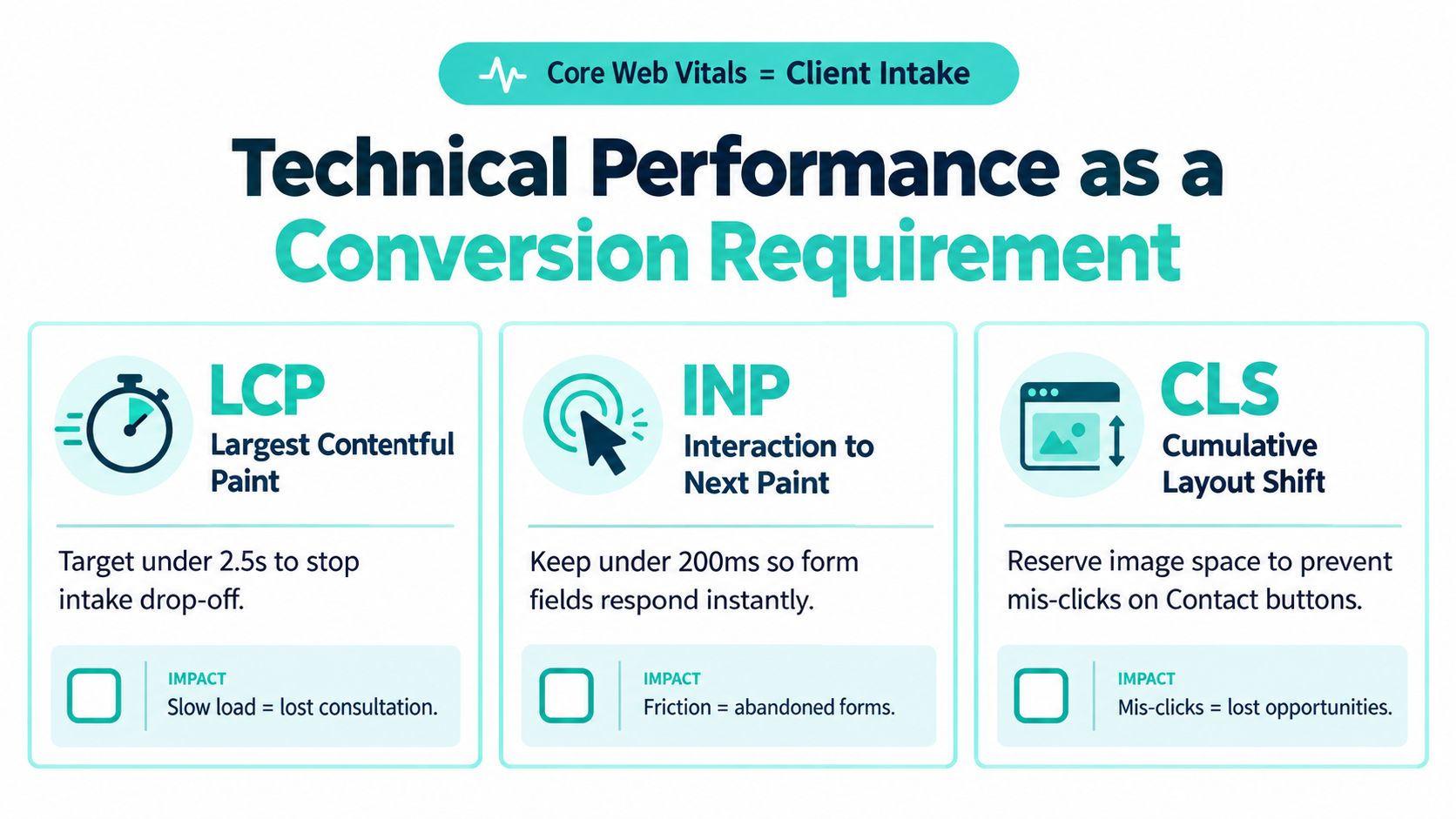
Slow pages are intake leaks. Google defines strong page experience thresholds as Largest Contentful Paint at or below 2.5 seconds, Interaction to Next Paint below 200 milliseconds, and Cumulative Layout Shift below 0.1, and slow rendering can delay access to critical conversion elements. For a law firm, that means the phone number, consultation form, or case summary may arrive too late to matter. Website maintenance for law firms belongs in the same conversation because technical upkeep is part of lead generation, not a separate IT chore.
Prioritize the pages that create inquiries
The homepage usually gets too much attention compared with the pages that convert. Practice-area pages, location pages, attorney bios, and contact pages deserve the first round of performance work because those templates carry the highest intake intent. If those pages load slowly or shift during rendering, the cost shows up in fewer consultations.
The technical fixes are familiar, but the order matters. Compress hero images. Serve modern formats. Reduce JavaScript execution. Reserve space for images and embeds. Remove layout-shifting banners. Test mobile performance on real cellular connections, not just office Wi-Fi.
Fix the barriers before you polish the design
A polished page that lags on mobile loses the very people it was built to convince. If the contact button shifts as the page loads, users tap the wrong element. If the form lags, they abandon it. If the explanation content loads too late, they never reach the point of trust.
Conversion rule: optimize the template that drives the phone call before you optimize the page that only builds awareness.
That's why performance work should start with field data in Search Console and then move to the templates with the highest business value. Rankings matter, but they don't compensate for a page that can't be used at the moment of intent.
Content Strategy for AI Search and Human Trust
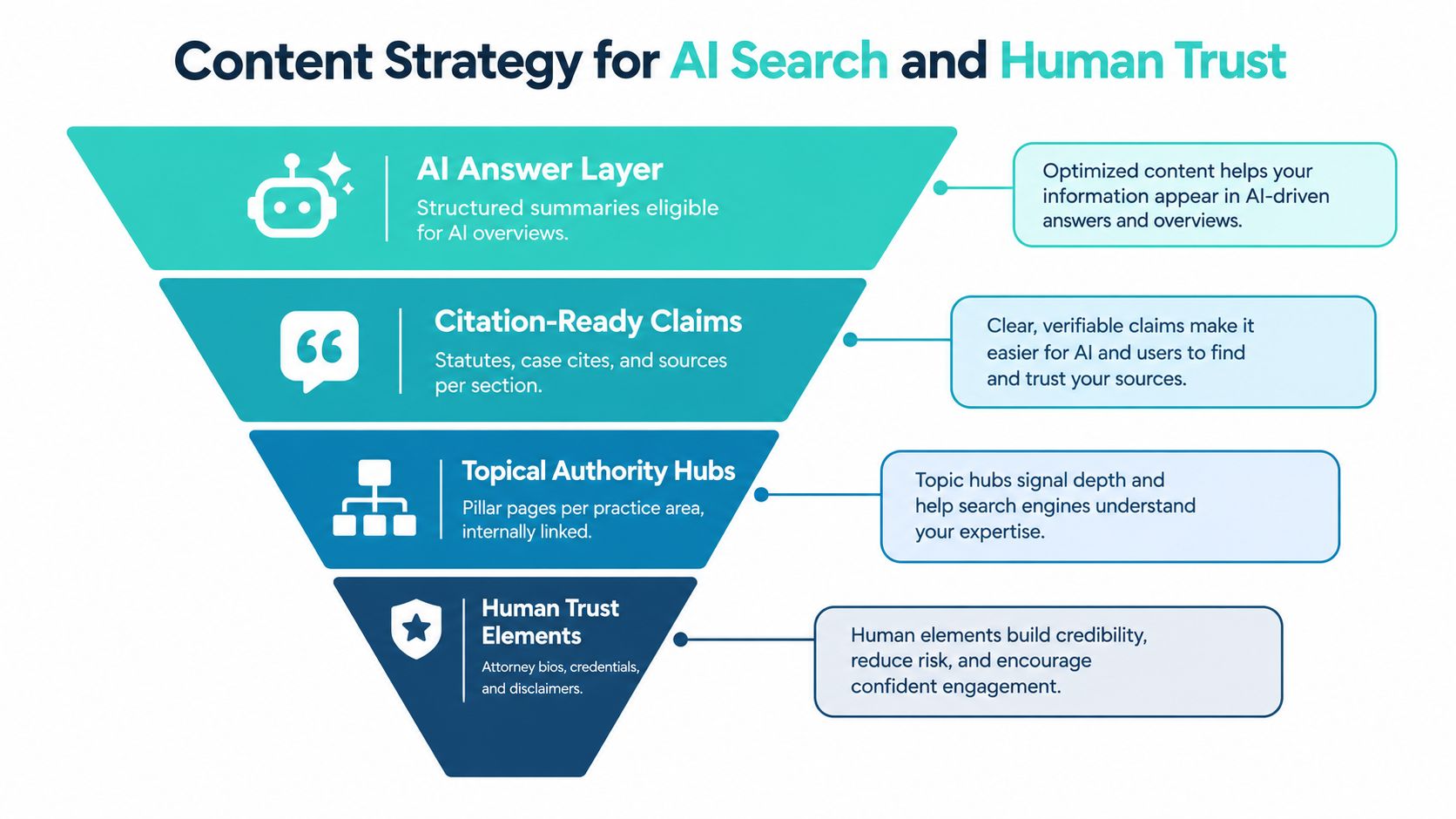
AI-generated summaries have changed distribution, but they haven't changed the need for accuracy. A 2025 study of 60,000 local-business queries found Google AI Overviews appearing in 40.2% of searches, and those summaries placed less emphasis on proximity than traditional local packs. That means strong local relevance alone isn't enough. Content has to be structured, specific, and jurisdiction-aware if it's going to be interpreted correctly. Generative engine optimization for law firms is relevant here because AI visibility only works when it's built on content a human lawyer would still stand behind.
Write for authority without creating risk
Attorney-authored explanations are the safest foundation. They should describe the legal issue, define the jurisdiction, and avoid unsupported promises. Clear date references, transparent credentials, and careful qualifiers matter because legal content can't sound like generic marketing without raising ethics and trust problems.
Structured FAQ blocks help because they organize answer-ready content for both humans and search systems. So do explicit service-area statements, attorney bios, and source-cited explanations of legal concepts. If a page covers a statute, deadline, or procedural issue, the claim should be visible, readable, and reviewable. Hidden authority doesn't help anyone.
Keep AI-facing content reviewable
The best structure is simple and disciplined. Each major topic should have a clear heading, a short answer-first paragraph, and supporting detail that stays grounded in what the firm can state. That makes the page easier for people to trust and easier for search systems to parse.
A firm that tries to force AI visibility through hype usually creates the opposite effect. The pages that last are the ones that read like an informed lawyer wrote them, then got them reviewed with the same care used for client-facing work.
Navigating Attorney Advertising Ethics in SEO
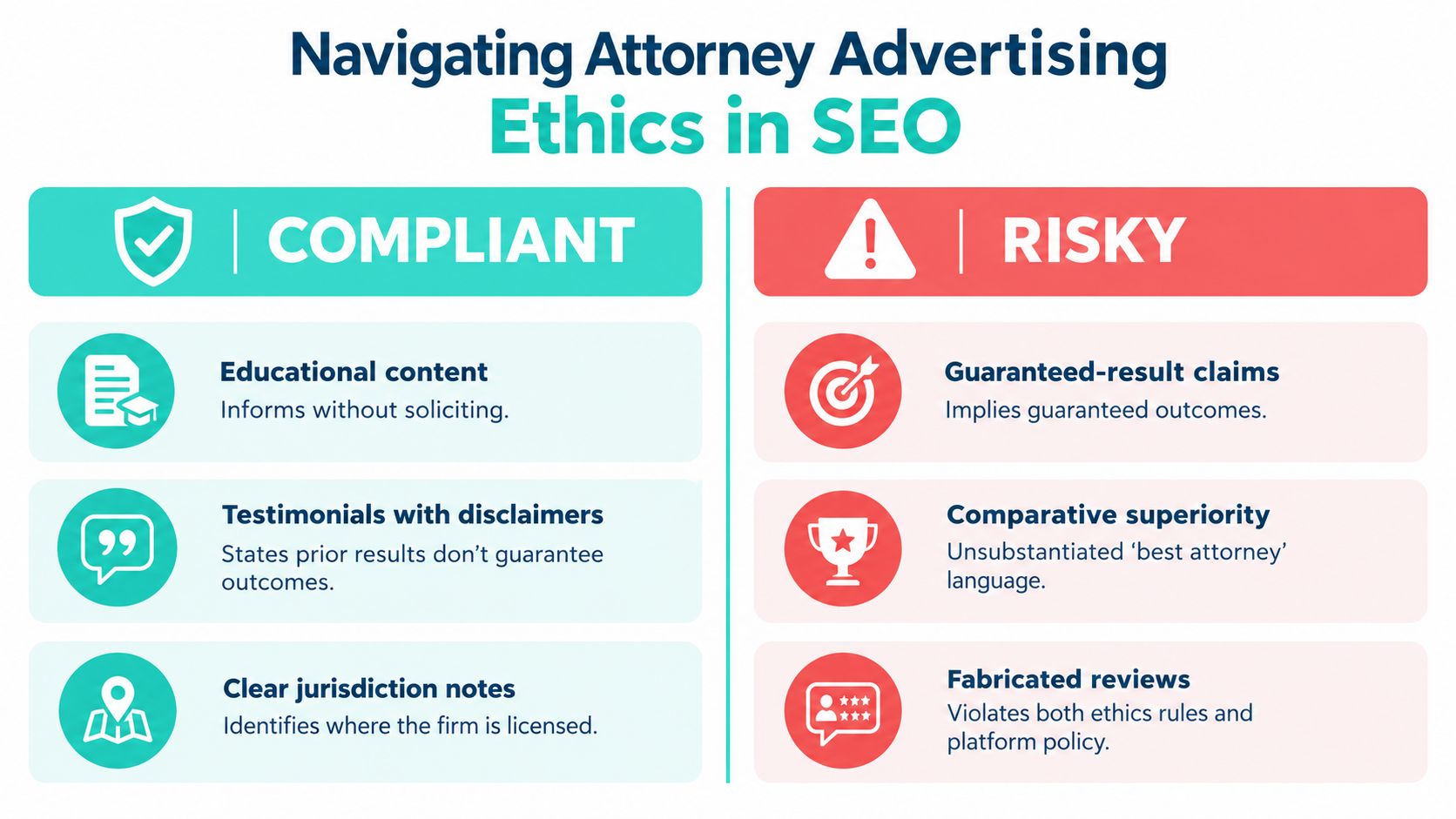
SEO copy for a law firm isn't ordinary promotional writing. The American Bar Association says Model Rules 7.1 and 7.2 permit attorney advertising only when it is not false or misleading, require substantiation for claims like “best” or “specialist,” and prohibit paid referrals while allowing reasonable advertising costs. That means the content team can't treat a headline as just a headline. It has to survive professional-conduct review. ABA guidance on attorney advertising ethics belongs in every editorial workflow for legal marketing.
Audit every claim before it goes live
Start with superlatives. “Best,” “top,” and “leading” are only safe if they're supported in the way the relevant jurisdiction allows, and even then they can create more risk than value. The same caution applies to outcomes, testimonials, awards, and practice labels that suggest specialization without support.
That doesn't mean legal websites should be bland. It means they should be precise. If a firm wants to talk about experience, it should identify what that experience is. If it wants to discuss results, it should qualify them clearly. If it mentions a testimonial, the testimonial should not imply guaranteed outcomes.
Build a defensible publishing process
A disciplined review process works better than post-publication cleanup. Drafts should be checked for misleading omissions, unsupported comparisons, and statements that could be read as promises. Then they should be reviewed for jurisdictional accuracy, because a page that's fine in one state can be problematic in another.
- Substantiate credentials: verify every award, certification, and experience claim.
- Qualify results: make clear that prior outcomes don't guarantee future results.
- Avoid referral language: do not frame paid relationships as client recommendations.
- Match the venue: keep location claims and service claims tied to what the firm can deliver.
The point is simple. Ethical SEO content is durable content. It's easier to scale, safer to publish, and more credible when a prospect compares it against review sites and referral comments.
Measuring Qualified Matters and Intake ROI
If reporting stops at impressions and rankings, it misses the business question. Legal consumers rarely decide after one search result. They check AI summaries, reviews, and the firm's own pages before they contact anyone, and that makes post-referral verification part of the funnel. A lead only matters if it becomes a qualified matter, which is why Measure law firm marketing ROI should guide the report, not vanity traffic totals.
Track the signals that matter to partners
Branded-search behavior shows whether people are looking for the firm by name. Referral-to-website journeys show whether offline reputation is holding up online. Consultation-request conversion shows whether the site is doing intake work. Those are the numbers managing partners should review first.
Firms that connect search data to intake can better attract and convert high-intent traffic and see which topics produce retained matters. That is more useful than a raw traffic spike, because the goal is a repeatable path to qualified inquiries, not a larger audience that never calls.
Tie SEO to the CRM, not just the dashboard
The cleanest setup connects search performance to intake outcomes. Match source data with form fills, call logs, consult bookings, and matter status in the CRM or case-management system. Once those pieces are linked, the firm can see which pages, topics, and locations lead to retained work.
Useful test: if a page gets traffic but no consultations, it is not a performance asset yet.
That framing changes budget decisions quickly. It shows a managing partner which pages need rewriting, which templates need performance fixes, and which local signals need cleanup. It also keeps the conversation on revenue and intake quality, where it belongs.
If your firm wants law firm SEO that connects search visibility to real intake, SimpleLab Digital builds and maintains the pages, local signals, and tracking that support that outcome. Visit SimpleLab Digital to review how its SEO, content, and website maintenance services can be shaped around your practice areas and consultation goals.