Most law firm marketing fails for a simple reason. It treats digital marketing for lawyers like a traffic problem, but the underlying problem is a system problem. More clicks don't help if the site is weak, the ad copy is risky, the intake team replies late, or the firm can't tell which matters converted into revenue.
That's why the smartest firms stop chasing vanity metrics and start building a compliant acquisition engine. The work has to connect discovery, website conversion, intake speed, and downstream measurement. On top of that, legal advertising has real ethics constraints, so the campaign can't just be effective, it has to be defensible too. For teams exploring AI-assisted workflow support, a useful starting point is legal AI for lawyers, especially when the goal is to keep research and drafting aligned with practice constraints.
Table of Contents
- Write for the question behind the search
- Use LinkedIn for professional credibility, not volume
- AI discovery is an extra layer, not a replacement
Why Legal Client Acquisition Is a System Problem
More leads do not automatically mean more revenue. A firm can buy traffic, publish content, and run social posts all month, then lose the work because nobody answers fast enough or because the prospects were never a fit in the first place. The ABA's 2024 Websites and Marketing TechReport shows why the basic digital foundation still matters, 90% of responding firms reported having a website, but smaller firms still lag, with only 70% of solo practitioners reporting websites compared with 100% of firms with 100 or more attorneys (ABA 2024 Websites and Marketing TechReport).
Discovery is only the first step
Legal consumers do not usually hire on first contact. They research the issue, the lawyer, and often the referral before they reach out. The Avvo legal-consumer report found that 85% of respondents went online weekly to resolve a legal issue, including 40% daily, and 53% of people who went online to resolve a legal issue also researched lawyers online (Avvo legal-consumer report).
That changes the job of the website and the rest of the acquisition stack. Practice-area pages, bios, reviews, and intake paths have to answer the client's question, reduce uncertainty, and make the next step obvious. If the presence is fragmented, the prospect does the comparison elsewhere, usually on a competitor's site.
Practical rule: if a page does not help a caller decide whether to contact the firm today, it is decoration, not marketing.
The system has to hold together
The firms that perform well treat acquisition as connected work. Search visibility brings the visit, the site earns trust, the intake team responds, and reporting ties the lead back to retained work. Compliance sits inside that chain, because every promise in an ad or landing page can become an ethics issue if it is overstated or misleading.
Rapid follow-up matters just as much as traffic quality. A clean intake process, clear ownership, and a measurable handoff from marketing to case evaluation keep the firm from paying for inquiries that never become matters. That is also why legal AI for lawyers is relevant here, it can support research and drafting workflows when teams need speed without drifting away from practice constraints.
SimpleLab Digital's landing-page guidance for consultations fits the same logic. The page between the ad click and the intake conversation is where many firms lose demand, and the fix is tighter alignment between intent, message, and follow-up.
Building a Compliant and Conversion-Focused Website
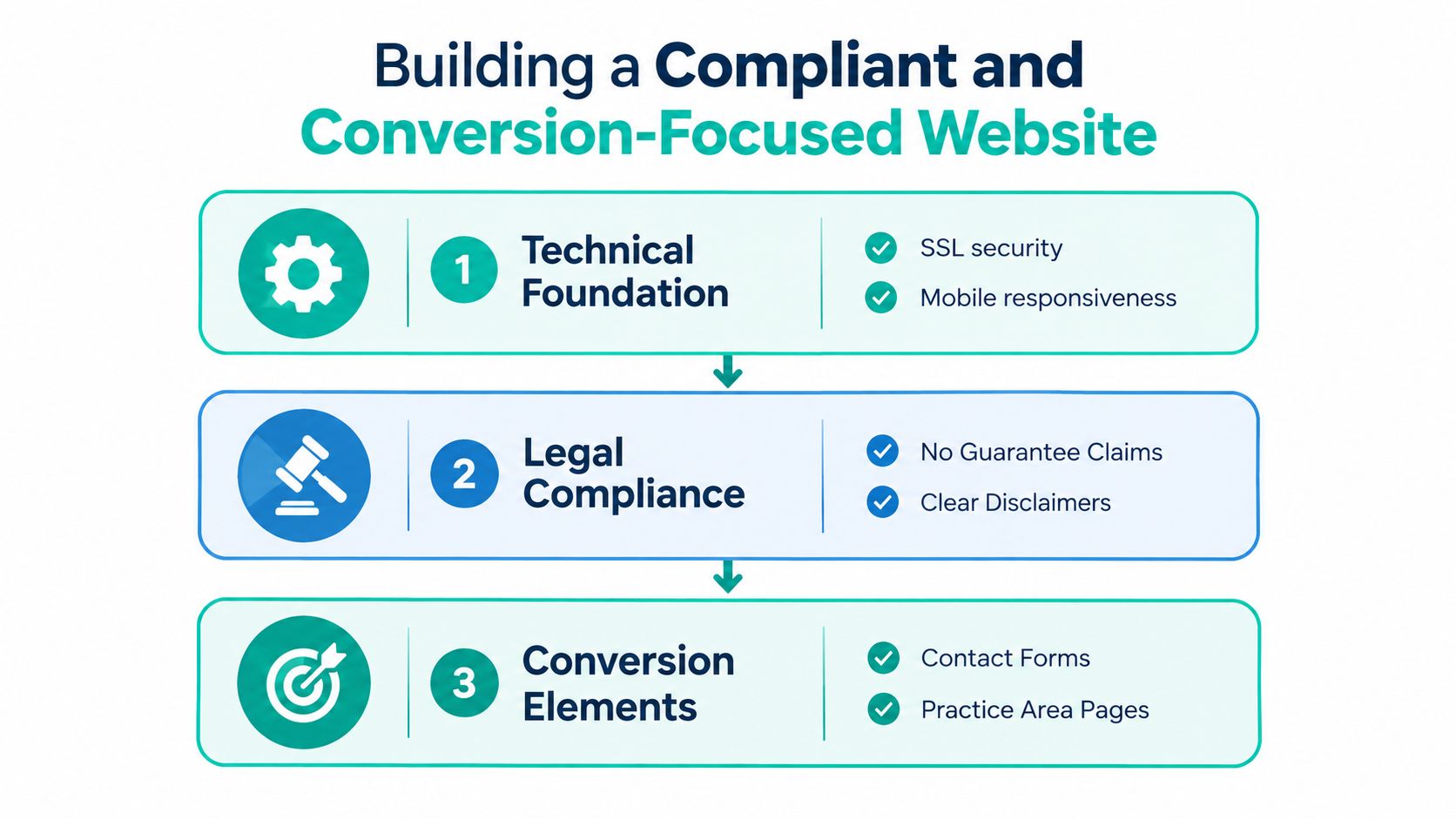
A law firm website has two jobs. It has to help the firm get found, and it has to help the visitor decide to reach out. Google's local ranking guidance makes the first job concrete, local results rely mainly on relevance, distance, and prominence (Google Business Profile help). That means the site and Business Profile need to match the services people search for, the firm's location details need to be accurate, and the firm needs legitimate reputation signals, not gimmicks.
Start with the technical base
The technical layer sounds basic, but it's where trust starts. A mobile-ready site, a secure connection, and clean navigation aren't optional if you want prospects to stay long enough to read the practice page. The ABA's 2022 report noted that 77% of firms with websites said their sites were mobile-friendly, while only 43% reported using SSL/HTTPS, which shows how uneven the baseline used to be (ABA 2022 Websites and Marketing TechReport).
That history still matters because many firms built sites to exist, not to convert. The homepage should point visitors to the right practice area fast. Each practice page should answer the question behind the search, what the issue is, what the firm handles, what jurisdiction it serves, and what the next step looks like.
Keep the legal copy honest
Model Rule 7.1 applies to every communication about legal services, including websites, testimonials, fee statements, and firm branding. It requires truthful communications and prohibits statements that are misleading because they leave out material context or create a false impression (ABA Model Rule 7.1 commentary). That means “best,” “guaranteed,” or unsupported superiority claims don't belong on a law firm site unless there's actual factual grounding.
A cleaner approach is to build pages around intent and jurisdiction. If the firm serves one state or one metro area, say so clearly. If a page discusses a result, it needs context. If a testimonial appears, it shouldn't imply a universal outcome. Compliance doesn't weaken conversion, it makes the page believable.
For creative teams also working with visual assets and short-form campaign content, scaling creative with AI-powered UGC is useful as a reminder that even high-volume content still needs a clear message hierarchy. The same logic applies on a law firm site. Every element should reduce confusion, not create it.
Use pages built for search and action
Practice-area pages should not read like brochures. They should answer client-intent questions, explain who the service is for, and give a direct path to contact. That's why the most useful site structure usually includes separate pages for each core service, a visible contact path, and supporting content that helps the user self-qualify before the call.
A homepage can introduce the firm. A practice page should convert. If both pages try to do everything, neither one does enough.
Capturing High-Intent Inquiries with Paid Media
Paid media works best when it respects intent. Search ads catch people who are already looking for help, while social ads are usually better at local awareness, retargeting, and staying visible between visits. A firm that treats them the same wastes budget and blurs the message.
Match channel to intent
| Channel | User Intent | Best Practice Areas | Key Compliance Focus |
|---|---|---|---|
| Google Ads | High intent, immediate need | Personal injury, family law, criminal defense, immigration | Tight claims language, jurisdiction-specific landing pages, no unsupported promises |
| Facebook Ads | Low to medium intent, awareness and remarketing | Family law, estate planning, local service visibility | Avoid misleading targeting language, keep creative conservative |
| Instagram Ads | Visual awareness, remarketing, trust building | Consumer-facing practices with simple offers | Make sure visuals and captions match the actual service scope |
| Retargeting | Re-engagement after site visit | Any practice with a longer decision cycle | Keep frequency controlled, and avoid implying urgency that isn't there |
Build campaigns around landing pages, not the homepage
The homepage is too broad for most paid traffic. A dedicated landing page can carry one message, one offer, and one action. That's why campaign structure and page structure have to be designed together. If the ad says “consultation,” the page should reinforce that. If the ad targets a narrow practice area, the page should stay narrow too.
For search, the goal is high-intent clicks that go to a focused page. For social, the goal is usually familiarity, then retargeting. A firm can use ads to create demand, but the true value comes from what happens after the click.
The operational discipline matters just as much as the media buy. Every ad set should be versioned, reviewed before launch, tied to the landing page it supports, and stored with its approval record. That's how a firm stays ready for internal review and jurisdiction-specific scrutiny.
If a team wants a practical benchmark for campaign structure, this Google Ads best-practices guide for law firms is a good reference point because it keeps the focus on search intent rather than broad awareness alone.
Establishing Authority Through Content and Social Media
Content builds confidence before a sales conversation starts. Social media reinforces that confidence in public. Together, they give a firm a presence that paid clicks alone cannot create.
Write for the question behind the search
Legal content works when it answers the prospect's immediate worry. People are not looking for “thought leadership” in the abstract. They want to know what happens next, what the risks are, and how the lawyer handles cases like theirs. The Avvo consumer research referenced in the acquisition section showed that many people research the issue itself and the lawyer separately, so content has to serve both needs.
That is why generic firm blogs underperform. A better approach is practice-area content that answers narrow questions, explains local rules where relevant, and shows real experience without unsupported superiority claims. An immigration firm needs different content from a family law practice, and both need pages that point the reader toward a consultation.
Useful test: if the article would not help a nervous prospect decide whether to call the firm, it probably will not help search or conversion either.
Use LinkedIn for professional credibility, not volume
The ABA's 2024 TechReport data cited earlier found that social media marketing was reported by many respondents, with LinkedIn leading and Facebook following behind. That makes the platform choice fairly straightforward for most firms. LinkedIn fits professional authority, referral relationships, and attorney credibility. Facebook still has a place, especially for local visibility and community familiarity.
The point is not to post everywhere. It is to stay consistent where the audience checks. A steady cadence of useful posts, case-type education, and firm updates does more for trust than a burst of generic content followed by silence.
For firms that want a more operational view of social execution, social media management for law firms is worth reviewing because it treats posting as part of a larger lead and reputation system.
AI discovery is an extra layer, not a replacement
AI search is getting attention, but the useful strategy has not changed. Answer real questions clearly, identify jurisdiction, and connect every page to a measurable consultation path. AI tools can surface content, but they do not replace local SEO, review signals, or a site that earns trust.
The firms that win this layer will not be the loudest. They will be the ones with the clearest answers and the cleanest site structure.
Turning Leads into Retained Clients with Rapid Follow-Up
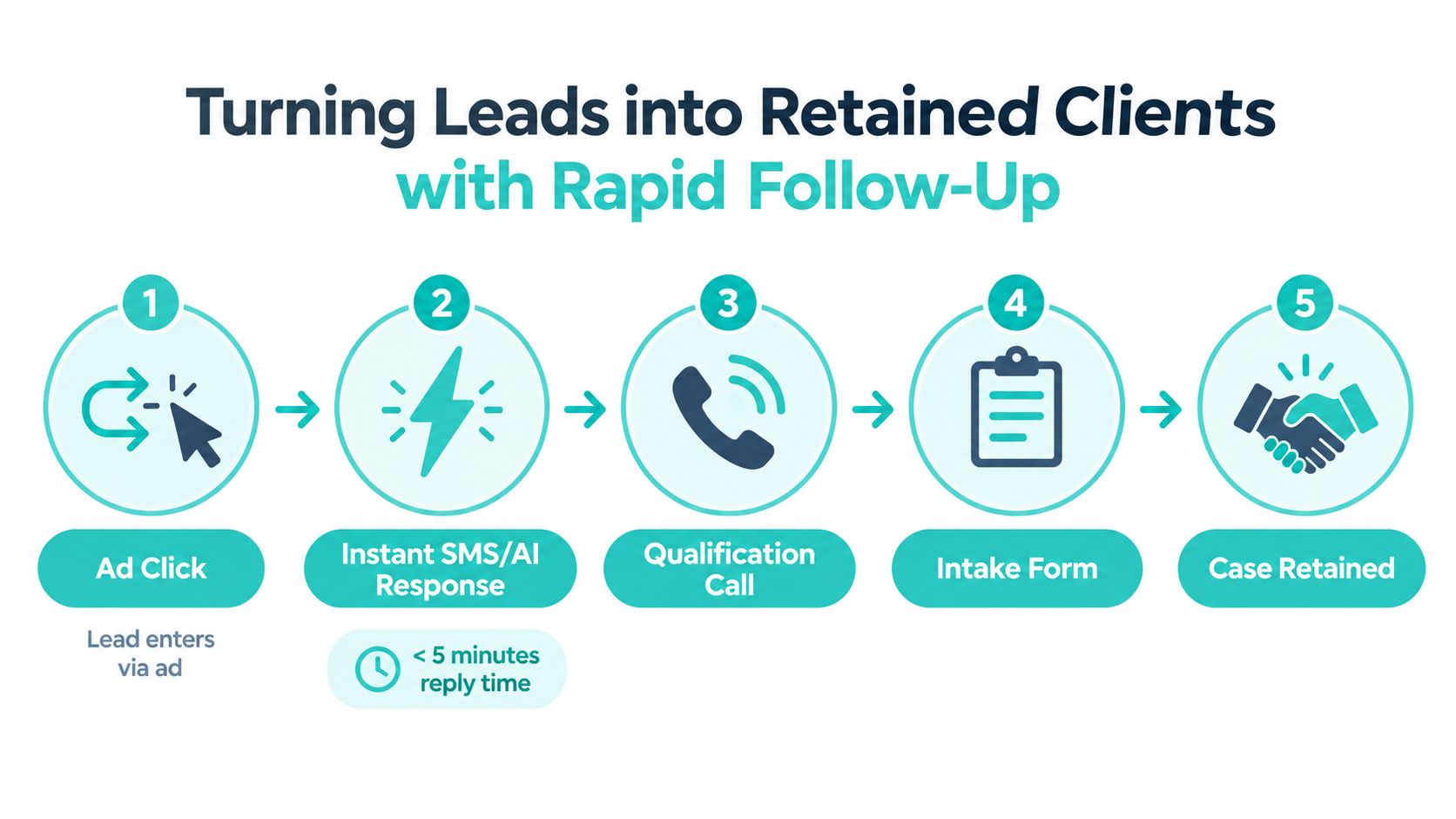
Many campaigns fail at the intake desk. A firm can buy visibility, collect inquiries, and still lose the matter because no one responds quickly enough or because every lead gets treated the same. Hennessey Digital's 2024 study found that only 73% of law firms responded to online leads, 28% responded within five minutes, 35% within ten minutes, and 56% within two hours (Hennessey Digital lead response study).
Speed changes the economics
Fast response is a conversion control, not a courtesy. Harvard Business Review's lead-response research found that companies contacting a prospect within one hour were nearly seven times more likely to have a meaningful conversation with a decision-maker than companies that waited an additional hour, and more than 60 times more likely than companies that waited 24 hours or longer (HBR lead response analysis). Legal intake does not behave identically in every practice area, but delay still carries a real cost.
The intake workflow should treat every form fill or call as a timed event. Assign ownership immediately, send an acknowledgment by SMS or email, create a call task, and log each step. Measure response by bucket, not just by lead volume.
Operational rule: if the intake team cannot tell you who replied first, when they replied, and what happened next, the marketing stack is incomplete.
For teams that want a practical starting point for response timing and routing, SMS follow-up for law firm leads gives a useful baseline. The same logic applies to any fast-response workflow.
Compliance still matters in the reply
Speed does not excuse sloppy intake. A quick acknowledgment should never imply an attorney-client relationship or expose sensitive details. The same Hennessey Digital study found phone, text, and email are the most common response methods, so the process needs to support all three while preserving consent and communication records. If the firm uses AI or automated messages, those tools should reduce delay, not replace human judgment.
Phone response remains a core operational issue, which is why handling 557 million law firm calls matters here. The point is not to add more tools. It is to route the right lead to the right person fast enough to matter.
Qualify before you celebrate
Raw lead count can flatter a campaign that does not produce retained work. A strong system separates raw leads from qualified inquiries, and qualified inquiries from signed matters. That means tracking consultation booking, signed matter rate, and disqualification reasons, then using those notes to improve targeting and intake scripts.
Measuring What Matters for Law Firms
Clicks do not pay salaries. Lead counts can make a campaign look busy while producing little retained work. The metric that matters is whether the firm brought in clients at a cost that supports the practice.
Track revenue, not just activity
A firm should measure Return on Marketing Investment by source, not just by month. Connect forms, call tracking, and intake records to the matter management system so the team can see which channel produced which case and what that case was worth. If paid search generates fewer leads but better clients, it can still be the better investment. For a deeper walkthrough, see a guide to measuring law firm marketing ROI.
The cleaner view is to measure:
- Response time, because delay changes conversion odds.
- Contact rate, because some leads never become conversations.
- Consultation-booking rate, because booked calls are closer to revenue than raw inquiries.
- Signed-matter rate, because only retained work pays the overhead.
- Source-level revenue, because cheap leads can be expensive if they never close.
Use the funnel to cut waste
If a channel produces fast but unqualified leads, it needs different targeting, not more budget. If another source generates fewer but better inquiries, the firm should understand why before cutting spend. That discipline keeps campaign optimization tied to retained revenue, not vanity metrics.
The HBR and law-firm response-time studies cited earlier point in the same direction. Speed changes outcomes, and intake quality changes the value of those outcomes. The measurement stack has to reflect both. A dashboard that stops at form fills is not a management tool. It is a report card for activity.

Keep the data linked to action
Measurement only matters if someone uses it. Partners should review which practice areas close fastest, which sources bring in the right clients, and where the intake team loses momentum. That is the difference between marketing as spend and marketing as an operating system.
If the firm cannot see source-to-matter performance, every budget discussion turns into guesswork.
Choosing the Right Marketing Partnership Model
Most law firms don't have the internal bandwidth to run paid media, content, landing pages, SEO, and intake follow-up at a high level all at once. That leaves three common paths, a traditional retainer agency, a pay-per-lead vendor, or a modular subscription model that ties execution together.
Compare the trade-offs
Traditional retainers can work, but they often separate strategy from execution and make it easy for reporting to drift toward impressions and clicks. Pay-per-lead vendors promise convenience, but they can also encourage volume over fit, which is a bad trade if the firm needs qualified matters rather than raw contact forms. A modular subscription approach is usually easier to manage because it keeps ads, pages, content, and follow-up in one operating rhythm.
The best structure depends on what the firm can supervise. Small and mid-sized firms usually need a single point of contact, clearer scope, and ongoing compliance review more than they need a pile of disconnected specialists. If the team can't monitor every moving part, the vendor model should reduce complexity, not add it.
Choose a model that matches the intake reality
A firm that gets leads from several channels needs one place to see them, route them, and measure what happens next. That's where connected execution matters. A budget that covers only ads but not landing pages or follow-up is usually incomplete. Likewise, a content-only engagement won't fix a weak intake process.
SimpleLab Digital fits into that modular model because it offers paid media, SEO/GEO, landing pages, email and SMS, and reporting as connected services rather than isolated tasks. For firms that want one team to manage the full path from discovery to retained matter, that structure is often easier to operate than piecing together separate vendors.
If you want a marketing system built for legal intake, not just traffic, SimpleLab Digital can help you connect paid media, landing pages, content, and follow-up into one measurable workflow. Visit the site to see how the subscription model is structured and decide whether it fits your firm's growth and compliance needs.