Google Ads Quality Score is a 1 to 10 keyword-level diagnostic made up of expected CTR, ad relevance, and landing-page experience, and Google judges it against other advertisers on the same search over the prior 90 days. That means the number you see is a comparison signal, not a universal grade, and it's a mistake to chase a perfect score before fixing the parts of the campaign that shape auction outcomes.
Most advice on this topic gets the order backwards. People obsess over the visible score, then wonder why CPC barely moves, or why one keyword with a better score still costs more than another. The essential work is to read the score as a diagnostic, then change the ad, the keyword theme, or the landing page based on which component is weak.
Table of Contents
Why the Score You See Is Not the Same as What Lowers Your CPC
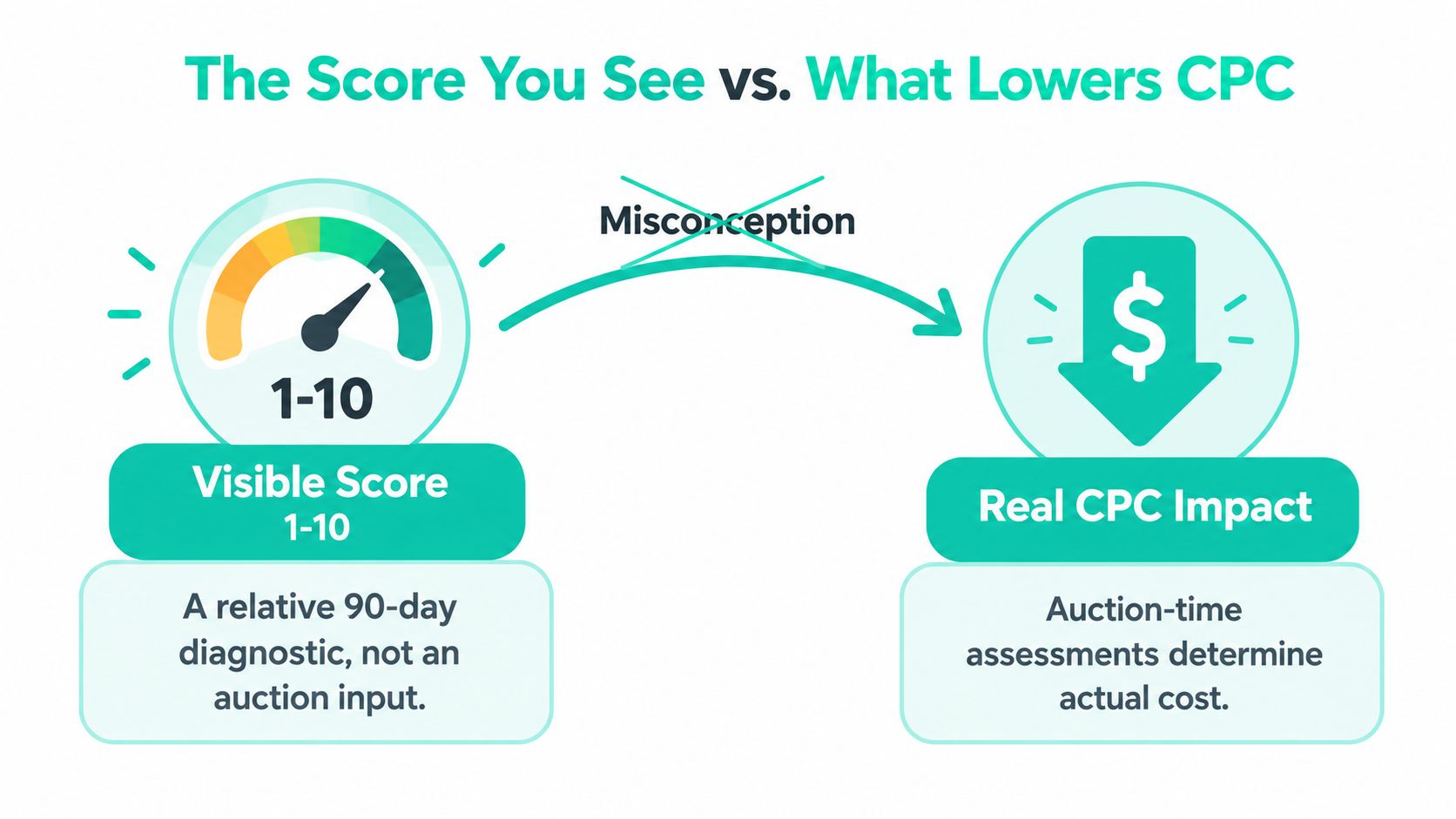
The most common mistake is treating Quality Score like a direct pricing lever. It isn't. The visible 1 to 10 score is a keyword-level diagnostic that Google classifies relative to other advertisers who showed for the same exact search during the prior 90 days, while the auction uses real-time quality signals to decide eligibility and position.
Stop optimizing for the number alone
A lot of small-business owners and law firms fixate on getting every keyword to 10/10 because it feels clean and reportable. That can waste time if the core issue is weaker message match or a landing page that doesn't reflect the ad promise. Google explicitly describes the score as a diagnostic tool, not a direct input used to determine Ad Rank.
Practical rule: if a keyword's visible score looks weak, ask which component is dragging it down before you change bids or pause the term.
That matters because two advertisers can show the same visible score and still pay very different CPCs. Bids, competition, thresholds, and auction context all still shape what happens after the score is displayed. For a clearer PPC foundation, the broader small-business framework in this practical Google Ads guide for small businesses helps connect the quality discussion to account structure.
Read the score as a diagnosis, not a verdict
For a local service business, a low visible score on one keyword might mean the ad text doesn't mirror the searcher's intent closely enough. For a law firm, it might mean the page says "free consultation" in the ad but lands on a generic homepage with too many competing paths. The number is useful because it points you to the mismatch, not because it tells you what your CPC will be tomorrow.
That's the mindset shift. Stop asking, “How do I get a 10?” Start asking, “What is this keyword telling me about relevance, engagement, or the post-click experience?” Once you do that, the score stops being vanity reporting and starts functioning like a triage tool.
The Three Components That Make Up Quality Score
Quality Score is built from three assessments, expected CTR, ad relevance, and landing-page experience. Google rates each one as Below average, Average, or Above average, based on comparison with other advertisers on the same exact search over the prior 90 days. That makes the score comparative and time-bound, not a permanent label on the account.
A useful way to think about it is this. Each component answers a different question about the journey from search to click to page.
What each component is really asking
For a family law firm targeting “divorce lawyer near me,” expected CTR asks whether the ad itself is likely to get clicked compared with competing ads. If the headline is generic, the ad assets are thin, or the promise is vague, the click prediction weakens.
Ad relevance asks whether the ad message matches the intent behind the keyword theme. If the user searched for “estate planning attorney” and the ad talks broadly about “legal services,” the connection gets muddy fast. For a simple calculator-style refresher on CTR math, the guide to calculate click through rate is a useful companion when you're auditing ad engagement.
Landing-page experience asks whether the destination page delivers on the promise and helps the user take the next step. A strong ad that leads to a generic homepage creates friction. A focused service page with a visible call button and short form usually does better than a page that makes people hunt.
Quality Score Components at a Glance
| Component | What it measures | Below average usually signals | First place to inspect |
|---|---|---|---|
| Expected CTR | Likelihood the ad gets clicked for that search | Weak headline, bland offer, poor asset mix | Search ad copy and assets |
| Ad relevance | Match between keyword intent and ad message | Broad themes or message mismatch | Ad group structure and keyword theme |
| Landing-page experience | Usefulness and relevance of the post-click page | Generic destination, slow clarity, weak CTA | Landing page content and layout |
A Below average rating is usually a clue about structure, not a reason to panic. If a keyword is underperforming, inspect the campaign element that corresponds to the weak component first.
The right reading level is the keyword, not the whole account. A campaign can look fine on the surface while one practice area or service line is dragging down the score for a very specific search intent. If you manage pages by service, the landing-page build process at this landing page creation resource shows why tightly matched destinations tend to support better diagnostics.
How Quality Score Connects to Ad Rank and Your Real CPC
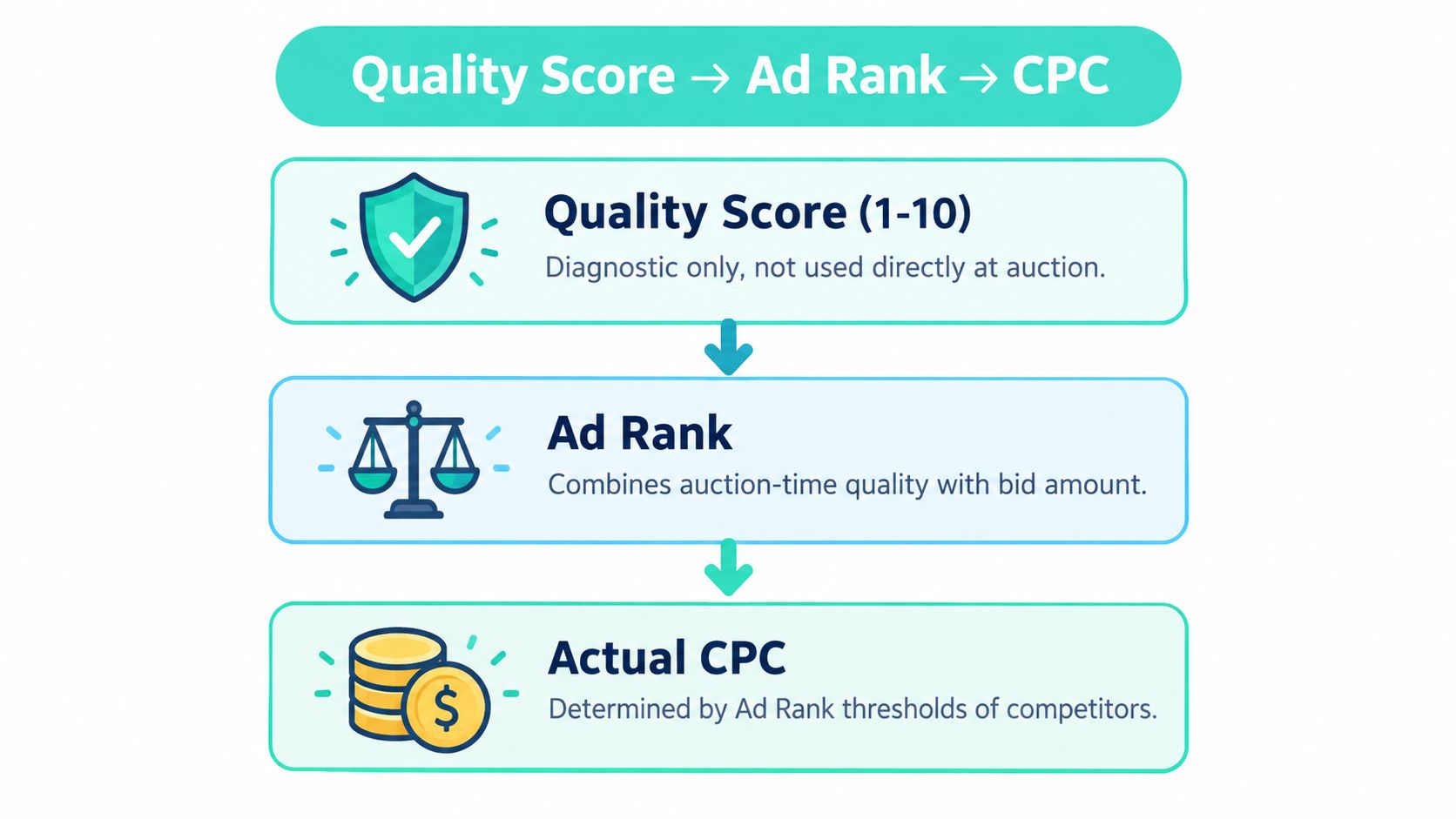
The visible Quality Score is only part of the story. Google separates the 1 to 10 diagnostic from the real-time auction signals that feed Ad Rank, and that distinction is where a lot of bad advice falls apart. The score is useful, but it's not the auction input itself.
What matters at auction time
Google says auction-time assessments include expected CTR, ad relevance, landing-page experience, ad assets, context, and other signals. Context can include the search term, user location, device, time, competing ads, and other user signals. That means the same keyword can face different auction outcomes depending on where and how the search happens.
For a plumber, a mobile search from across town at 7 a.m. may trigger a different result than the same phrase typed on desktop from a different ZIP code. For a law firm, “probate attorney” can behave differently by device and location even when the keyword looks identical in the account.
Better quality helps, but it doesn't promise cheaper clicks
Improving the quality drivers can support better eligibility and more efficient position outcomes. It can also improve the likelihood that your click costs are more efficient for qualified traffic. But it does not guarantee lower CPC, because bids, competition, thresholds, and context still matter in the auction.
Better relevance improves your odds. It doesn't erase the auction.
That's why a campaign shouldn't “chase” the displayed number as if it were the lever. The better move is to make the ad promise clearer, use assets that clarify the next step, and make the page easier to understand fast. For a campaign-building workflow that sits on top of those basics, this Google Search Ads campaign guide is a solid companion reference.
The practical takeaway is simple. When CPC feels off, look first at the components behind quality and the context around the auction, not just the visible score in the interface.
Reading Historical Quality Score Without Overreacting
Google added historical Quality Score reporting on May 15, 2017, with four extra columns, historical Quality Score, historical landing-page experience, historical ad relevance, and historical expected CTR. Google also made historical data available back to January 22, 2016, which gave advertisers a defined lookback window instead of just the current snapshot.
Use the historical columns to separate trend from noise
The main value of historical reporting is direction. A current score can hide whether a keyword is improving, slipping, or bouncing around after changes to ads or pages. For monthly retainers, that's especially useful when you need to tell whether a rewrite or landing-page update helped.
Daily segmentation and period-level reporting behave differently. When a report is segmented by day, the historical columns show the score known at the end of each day. Without daily segmentation, the report shows the last known score for the selected period.
Don't react to one-day movement
A single movement in score is rarely enough to justify a rewrite, a structure change, or a bid shift. Treat that as noise unless the movement continues. A sustained directional change is what matters, especially when it lines up with a recent ad or landing-page update.
Practical rule: use historical Quality Score to confirm a trend, not to celebrate or panic over a snapshot.
That rule keeps monthly reporting honest. If ad copy changed on the first of the month and the historical ad relevance column improves across the month, that's a far stronger signal than one keyword flashing a better score on a random day. The same logic applies to page updates, practice-area pages, and targeting changes.
For teams that want a deeper best-practices baseline before interpreting those trends, this Google Ads best-practices guide is a useful companion when reviewing monthly account shifts.
Improving Each Component with Concrete Campaign Changes
The fastest gains usually come from fixing the weakest component first. That means the change depends on what Google marked as Below average, not on a generic “improve Quality Score” checklist. Small businesses and law firms usually see the cleanest progress when they align one keyword theme, one ad promise, and one page.
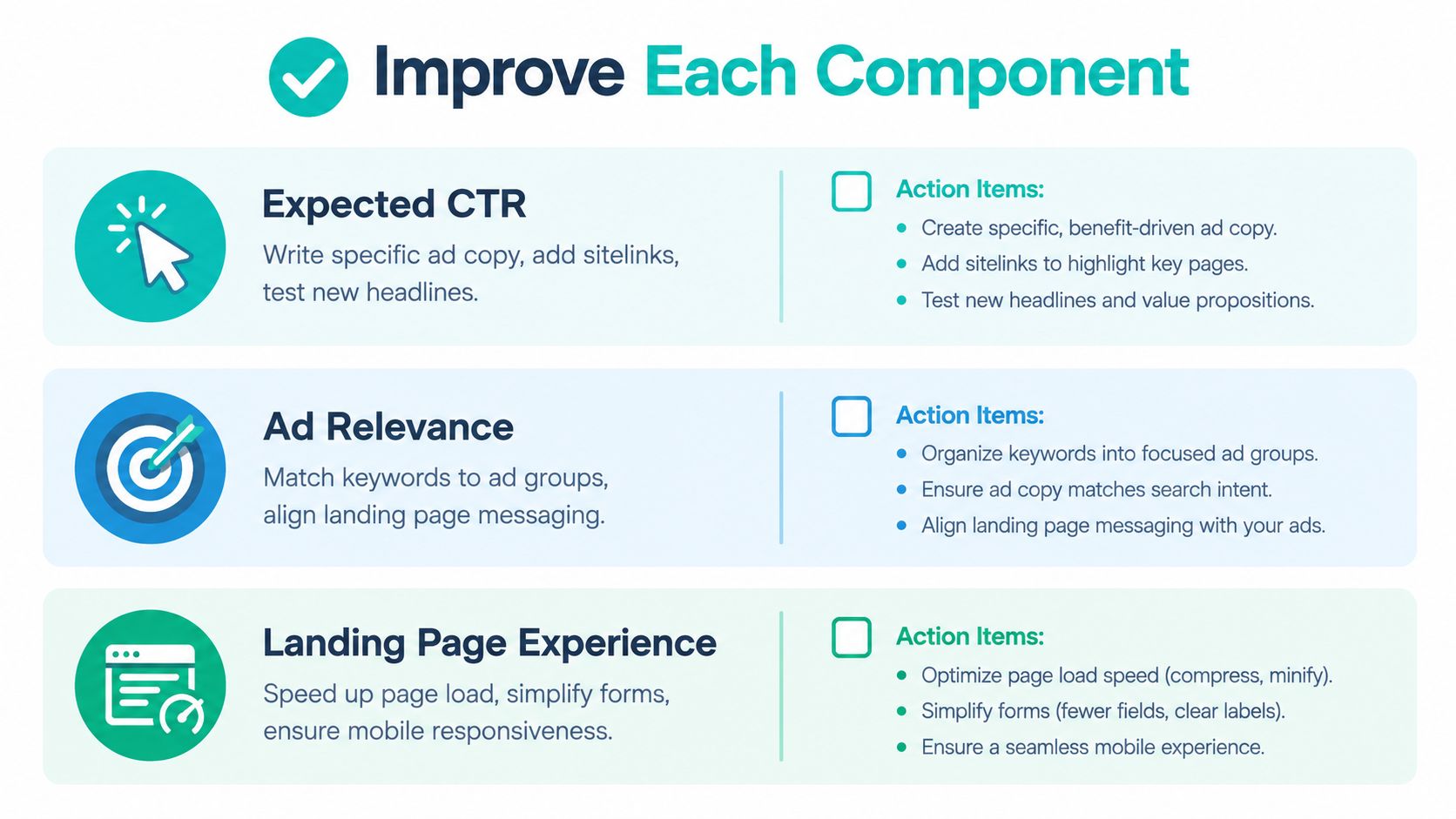
If expected CTR is weak
Start with the headline. If the user searched for “estate planning lawyer,” that phrase needs to show up in the ad copy in a way that feels natural, not stuffed. The point is to reduce the gap between the search query and the promise they see in the ad.
Ad assets matter too. A clear sitelink that points to consultation, fees, or a service page can give the searcher a better reason to click. For a home service company, that might mean “same-day service” or “book online” instead of vague brand messaging.
Check your account by opening the search term, ad, and asset view for one weak keyword theme. If the ad looks interchangeable with every competitor ad in the results, the problem is probably not the bid, it's the message.
If ad relevance is weak
This is usually a structure problem. The ad group is too broad, the keywords are too loosely themed, or the ad copy tries to speak to too many intents at once. Tight themes work better because they let the ad match the search more precisely.
For a law firm, “divorce lawyer,” “child custody lawyer,” and “prenup attorney” deserve different messaging if they live in the same account. For a local clinic or contractor, service-area and service-type themes should be separated so the ad doesn't sound generic.
Practical rule: if you can't describe the ad group in one specific sentence, the theme is probably too broad.
A useful hour-long check is to review one ad group and ask whether every keyword shares the same intent. If the answer is no, split the group and write a message that fits the narrower theme.
If landing-page experience is weak
The landing page needs to continue the ad's promise, not restart the conversation. A keyword for “estate planning consultation” should not land on a homepage with six competing service blocks and no obvious next step. The service page should say exactly what the user searched for, then make it easy to call, form-fill, or book.
Separate pages by service or practice area when the account covers multiple intents. That reduces message mismatch and gives the user one clear action. A page that loads cleanly, explains the offer fast, and shows the conversion action above the fold usually gives you a much better shot at a stronger landing-page assessment.
A practical same-day check is to open the ad, the search term, and the landing page together. If the page doesn't echo the query and the offer within seconds, the mismatch is obvious and fixable.
If you want a second opinion on how PPC teams prioritize these fixes, this quality score advice for PPC teams is worth reading alongside your own account review.
What Better Quality Actually Does for Your Campaign
Better quality drivers tend to improve the things that matter most in a search account, eligibility to appear, position efficiency, and the cost of qualified clicks. That's the practical reason to care. The score itself is not the outcome, but the underlying relevance usually shapes the experience that follows.
Use the score as a business signal, not a trophy
A cleaner quality profile can help a keyword compete more efficiently, but it still has to survive competition, bids, and auction context. A law firm with better relevance may still lose impressions to another advertiser with stronger bidding or a different location setup. That's normal.
The more useful question is whether the account is attracting the right traffic and converting it into inquiries that matter. For that reason, Quality Score work should sit next to conversion review and revenue review, not replace them.
If the score improves but the lead quality gets worse, the campaign got prettier, not better.
That's especially important for small businesses with limited budgets. The goal is not to win a dashboard contest. The goal is to create a tighter path from search to inquiry so your spend goes toward qualified demand. A helpful way to connect those economics is with the SimpleLab Digital ROMI calculator, which keeps the focus on downstream value instead of only surface metrics.
A Practical Diagnostic Sequence to Run This Week
Start with the worst keywords, not the whole account. Sort by component rating and find the terms marked Below average in expected CTR, ad relevance, or landing-page experience. That gives you a short list of the actual friction points instead of a broad, unfocused cleanup.

Work from the ad to the page
For any keyword with weak expected CTR, inspect the ad copy first. Ask whether the user's phrase appears in the headline and whether the next step is obvious. If the ad sounds broad or generic, rewrite it before touching the bid.
For any keyword with weak ad relevance, look at the ad group structure and the query theme. If one ad group covers too many intents, split it and give each theme its own message. That's usually faster than trying to make one ad speak to everyone.
For any keyword with weak landing-page experience, review the destination page on desktop and mobile. If the promise doesn't carry through, or if the conversion action is buried, fix the page before worrying about score movement.
Recheck after enough time for the comparison window to matter
Once the changes are live, leave enough time for the comparison window to absorb the new behavior. The score is built from comparisons over the prior 90 days, so instant judgment creates bad decisions. Monthly accounts should use the next reporting cycle to see whether the change is trending in the right direction.
If you only have one afternoon, you can still complete the first three checks and make the highest-value changes. If you manage accounts for clients, use the same sequence monthly so the review process stays consistent and the trends stay visible.
Key Takeaways and Misconceptions Worth Retiring
Google Ads Quality Score is a diagnostic, not a direct bidding input. The visible 1 to 10 number matters because it reveals where relevance is weak, but the auction still runs on real-time signals, bids, thresholds, and context. If you only chase the score, you'll miss the actual fix.
A 10/10 does not eliminate CPC. It can support better efficiency, but it doesn't override competition or auction conditions. A low score does not kill a campaign either, especially when conversion quality and revenue are healthy.
Read it at keyword level, not as a universal account grade. Wait for enough traffic, watch for sustained trends, and connect score work to conversion data and downstream value. If you want a quick external sanity check before your next review, this Google Ads audit guide can help you spot obvious setup gaps before you spend more.
If you want a tighter Google Ads account built around the actual drivers of relevance, SimpleLab Digital can help with search campaigns, landing pages, and monthly management built for small businesses and law firms. Visit SimpleLab Digital to see how a focused PPC setup can improve the path from search to qualified inquiry.