There's no universal marketing-budget percentage: SBA-cited advertising averages are 1.08% of revenue, while dated total-marketing benchmarks range from 6.3% to 11.8% across B2B and B2C products and services. Use a percentage as a starting ceiling, then reduce it to what your cash flow can support.
The useful question isn't just how much you should spend. It's how much you can commit before customers pay you, what that commitment includes, and what evidence you'll require before spending more. A workable marketing budget for small business separates essential activity, controlled experiments, and money held back for proven opportunities.
On this page
- Revenue benchmarks
- Cash-safe funding
- Measurement before media
- Channel allocation
- Monthly budget examples
- Prelaunch approval
Table of Contents
- Search captures demand while social introduces the offer
- Protect local discovery and the next conversation
Revenue Benchmarks That Set the Monthly Cap
Marketing and advertising shares of revenue
The U.S. Small Business Administration's marketing-budget guide cites the following advertising averages and 2018 total-marketing benchmarks, while explaining that no universal percentage fits every business.
| Business type | Share of revenue | What the share covers |
|---|---|---|
| All industries, advertising average | 1.08% | Advertising only |
| Retailers | About 4% | Advertising only |
| Restaurants | About 1.93% | Advertising only |
| All companies, 2018 total marketing | 7.9% | Full marketing budget |
| B2B product companies | 6.3% | Full marketing budget |
| B2B services | 6.9% | Full marketing budget |
| B2C products | 9.6% | Full marketing budget |
| B2C services | 11.8% | Full marketing budget |
Treat the total-marketing rows as dated planning references, not current spending targets. They're older than the survey findings used elsewhere in this guide, and they don't account for your margins, local competition, or available working capital.
For a hypothetical business generating $500,000 annually, choosing a 7% planning rate produces $35,000 a year, or approximately $2,900 a month. That's the whole envelope in this example, not an invitation to spend that amount on Google Ads and find extra money for everything else.
Separate the advertising line from the full budget
An advertising-only percentage doesn't establish an allowance for your website, creative production, landing pages, email, SEO, or agency management. Those costs still need explicit lines. Otherwise, a seemingly affordable media plan becomes unaffordable once someone quotes the work needed to launch it.
A full marketing budget should show:
- Distribution: Payments to advertising platforms and other paid placements.
- Production: Copy, videos, photographs, design, and landing pages.
- Owned channels: Website maintenance, search visibility, and email workflows.
- Execution and measurement: Staff time, management, tracking, and reporting.
Don't count the same labor twice. If a service agreement includes landing-page production, remove that work from your separate production estimate before adding the totals.
For paid search, use cost-per-click benchmarks and estimates to check whether the remaining media allowance can support a meaningful test. Cheap clicks don't automatically produce affordable customers, but expensive clicks can make a thinly funded campaign impractical.
Turn the benchmark into an approval limit
Circle the row closest to how you sell, then label it ads only or full marketing. An established B2B service business can start with trailing revenue; a startup needs a conservative revenue projection rather than its most optimistic sales forecast.
Carry the resulting monthly dollar amount into your cash forecast. Don't approve it only because the percentage looks normal.
Practical rule: A benchmark helps you ask better questions. It doesn't authorize a payment.
Track the approved amount against actual invoices and platform charges. Bookkeeping and Accounting of Florida Inc.’s budget performance guidance for Florida SMBs is a useful resource for organizing that budget-versus-actual review, especially when production invoices and advertising charges arrive separately.
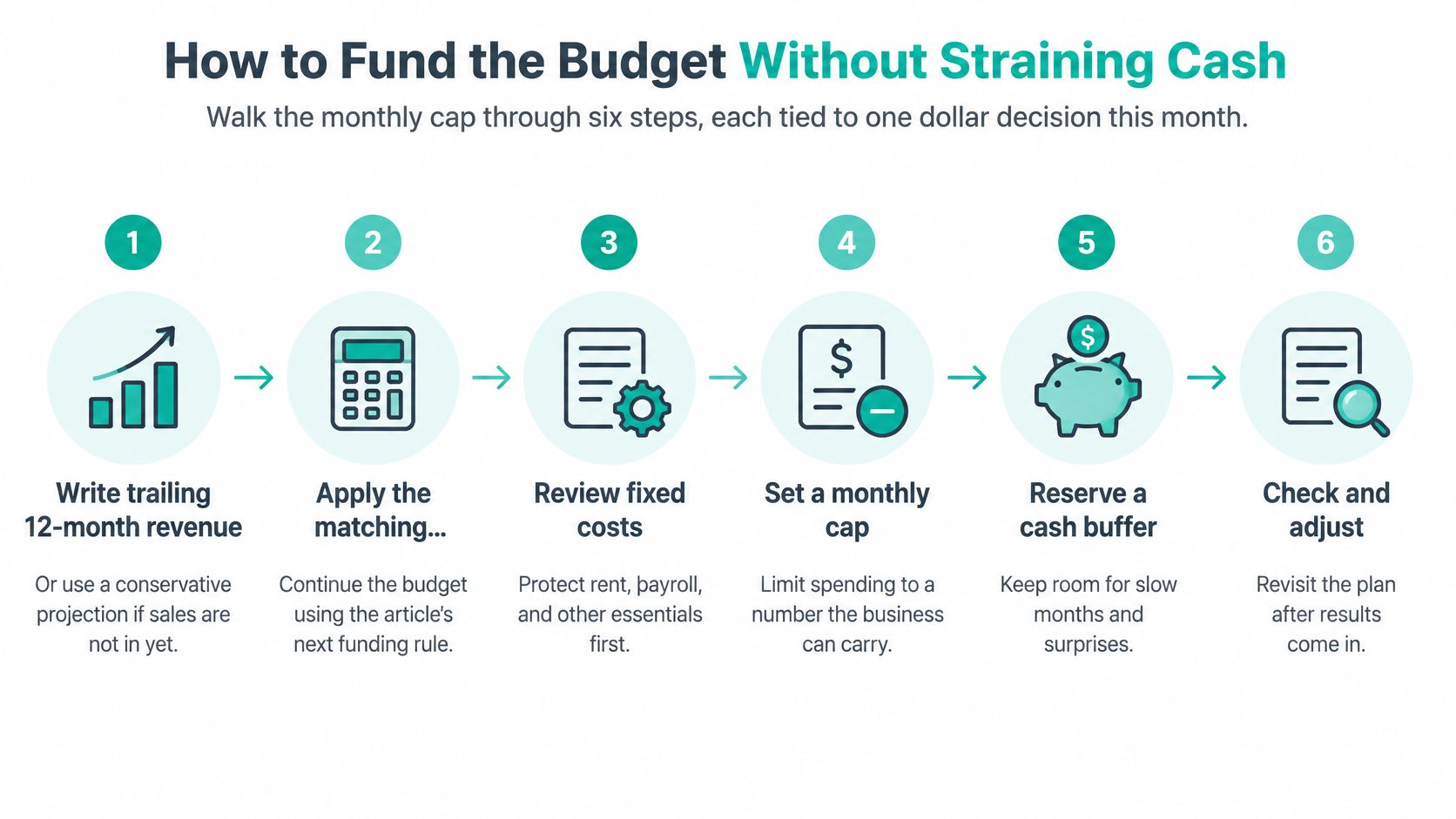
How to Fund the Budget Without Straining Cash
Set the budget around when cash leaves and when customers pay, not just annual revenue. A profitable campaign can still strain the business if you pay for acquisition well before collecting the sale.
Use this funding sequence to protect operations while leaving room to learn.
Make each funding decision explicit
Write trailing revenue before authorizing another commitment. Use the trailing year for an operating business, or a conservative projection if sales haven't started. Exclude hoped-for contracts that aren't signed. This month's decision is which revenue base you're willing to stand behind.
Convert the planning rate into a monthly ceiling. Multiply annual revenue by the matching percentage, then divide across the year. For seasonal businesses, save part of peak-season receipts to fund essential visibility during slow periods. Don't let a strong trading month turn into a permanently higher recurring bill.
Split the ceiling into always-on, test, and scale pots. The always-on pot protects useful existing activity. The test pot buys a defined experiment, while the scale pot remains unspent until results qualify. As a hypothetical starting policy, reserve 10% to 20% for testing a single offer or channel, rather than treating that range as a research-backed requirement.
Calculate a channel-specific break-even limit. Gross profit per closed sale sets the outer acquisition limit before overhead and desired profit. Multiply that amount by your lead-to-sale close rate to estimate break-even cost per lead. If you measure qualified inquiries instead, use the qualified-inquiry-to-sale close rate. Subtract an allowance for profit and nonmedia acquisition work before setting the amount you'll approve.
Compare the essential pot with working capital. Include rent, payroll, taxes, supplier payments, and debt commitments in the cash forecast. A hypothetical 90-day legal or home-project sales cycle shouldn't be funded with cash needed for next month's payroll. I would use roughly two months of operating cash as an initial pause trigger, then adjust that owner-selected buffer to the business's risk.
Review the pots monthly and release money conditionally. Compare qualified inquiries, acquisition costs, collected revenue, and available cash. Approve additional spending only when both campaign economics and cash timing support it. Unspent scale money is a reserve, not a failure to execute.
AI2Fin's guidance on how to forecast business receipts and payments can help you place campaign payments beside expected collections. Use actual collection dates where possible, not invoice dates.
Write the pause rule before launch
In Intuit's small-business advertising trends report, 23% of surveyed U.S. small businesses cited limited budgets as their biggest marketing challenge, while 17% reported reducing marketing and promotional budgets. A written stop rule keeps that pressure from turning into hurried, inconsistent decisions.
If cash falls below your chosen reserve, stop new acquisition commitments first. Maintain customer communication and work the inquiries you've already paid to generate.
Use free business advertising tactics selectively while paid expansion is paused, recognizing that staff time still has a cost. Fund follow-up, referrals, retention, and conversion fixes before restarting acquisition.
Fund Measurement Before Adding Media
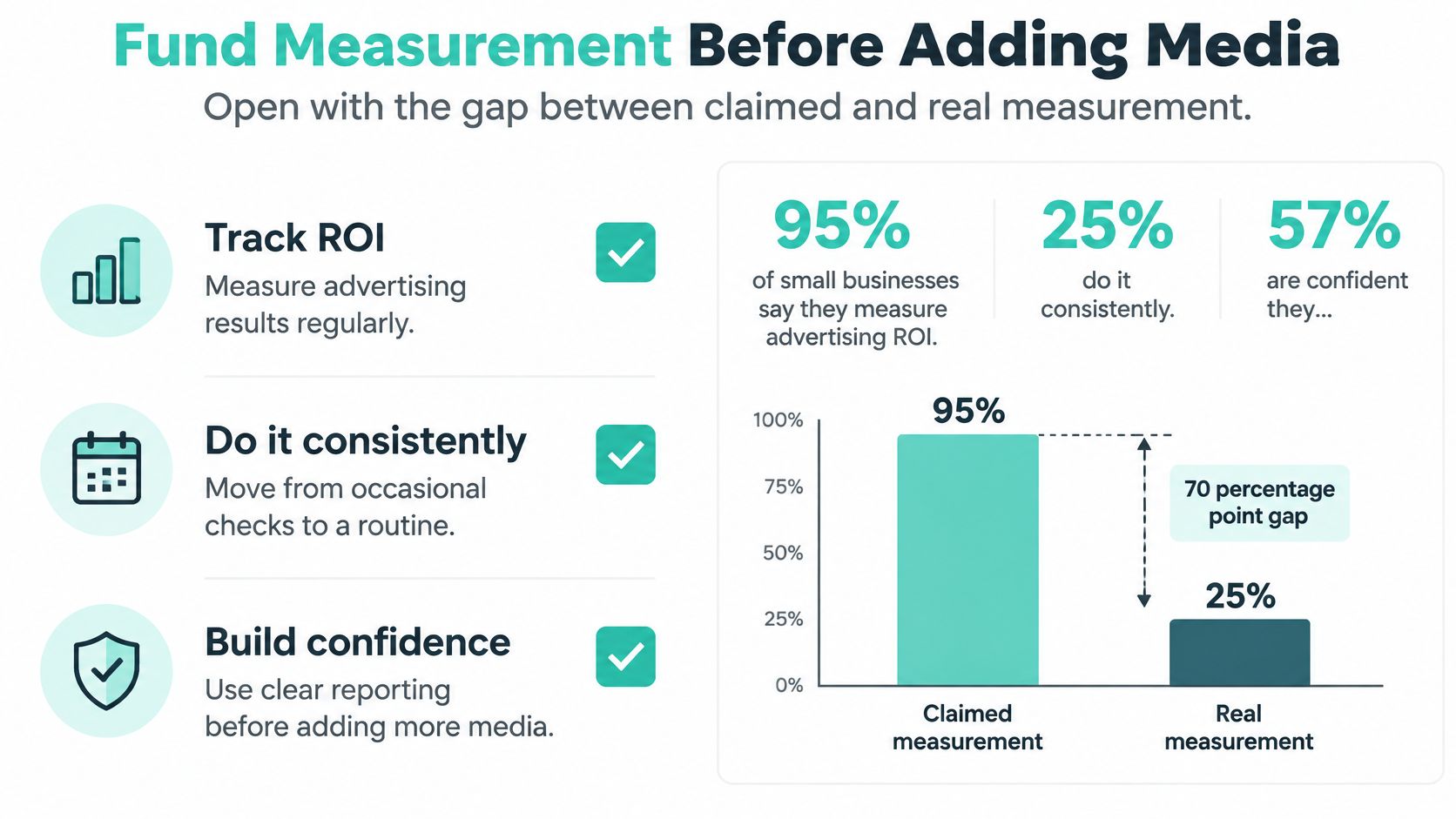
95% of small businesses say they measure advertising ROI, but only 25% do so consistently, according to Intuit's Small Business Insights; 57% are confident they reach their target audience. That gap matters more than whether your advertising dashboard looks busy.
The same survey findings put social advertising first in budget share for 44% of respondents, compared with 17% for Google Ads and 10% for SEO. Those are shares of respondents choosing a leading channel, not recommended allocations for your business.
Buy the minimum useful measurement layer
You don't need an elaborate analytics installation before launching. You do need a dependable route from an inquiry to its outcome.
Fund these items from the tools, production, or management allowance before increasing media:
- Call tracking: Record the campaign source and whether the caller was a genuine prospect, using privacy-appropriate settings.
- CRM source fields: Preserve the original source and campaign in your CRM, rather than overwriting them after later interactions.
- Form qualification: Ask enough to establish service fit, location, and the nature of the request.
- A focused landing page: Match the advertised offer and provide a clear next action.
- Response monitoring: Record when an inquiry arrived, when someone replied, and whether contact succeeded.
- Revenue reconciliation: Match inquiries to booked conversations, accepted work, and closed revenue.
The minimum viable measurement budget is the quoted cost of configuring those essentials, plus the staff time required to maintain them. Avoid buying overlapping software just to produce more reports. Start with your existing CRM or a controlled spreadsheet if it can preserve source and outcome reliably.
For a law firm, a phone call isn't automatically a qualified matter, and a qualified matter isn't automatically an accepted client. Define those stages with the person handling intake, and leave time for ethical review of advertising claims.
Reallocate when activity fails to become business
If form fills rise and qualified inquiries or revenue don't, move money from the weakest ad set into the page, the offer, or follow-up.
Check the denominator before celebrating a cheaper lead. A campaign that attracts unsuitable inquiries can make the platform report look better while adding work for your receptionist.
Use the break-even ROAS calculation guide to distinguish sales revenue from the margin available to fund acquisition. Include relevant production and management costs when judging the overall program, not just platform spend.
Keep a single meaningful test live rather than fragmenting the allowance across tiny experiments. Don't judge a long-cycle service solely on a short platform attribution window.
I would hold the scale pot until the campaign beats its allowable cost per qualified inquiry across two consecutive review periods, with enough closed outcomes to support the decision. That's an operating rule to adopt deliberately, not a guarantee that an early result will continue.
Channel Shares for Search Social and Follow-Up
Allocate the full monthly marketing cap, not just the money paid to advertising platforms. Otherwise, you can fund traffic without funding the page, message, or follow-up needed to convert it.
Starter split of the full marketing budget
These are editorial planning ranges, not survey findings or mandatory allocations. Choose a mix that totals the whole cap; don't add every range's upper limit together.
| Channel job | Share of monthly cap | Primary use |
|---|---|---|
| Paid search | 25–35% | Capture existing demand and local intent |
| Paid social | 15–25% | Offers, prospecting, and retargeting |
| Website, local listings, and SEO | 15–20% | Findability, hours, and appointment paths |
| Creative and landing pages | 10–15% | Offers and conversion |
| Email and SMS follow-up | 10–15% | Nurture until the buyer is ready |
| Tools, time, or management | 10–20% | Reporting, production, and coordination |
For example, selecting the lower end of most ranges and a middle allowance for tools can produce a balanced starting mix. Moving money between rows is legitimate; ignoring a required job isn't.

Search captures demand while social introduces the offer
The CMO Survey figures summarized in LocaliQ's marketing-budget guide show digital marketing spending growing 7.3%, versus 3.3% for overall marketing during the preceding year; respondents forecast 11.9% digital growth over the following year. Social media represented 11.3% of marketing budgets, with respondents expecting 13.3% within a year, which supports treating social as a meaningful component rather than the entire plan.
Those social figures include social media broadly, whereas the table's paid-social row is an editorial allocation. Don't treat the measures as interchangeable.
Search deserves more weight when buyers already know the service they need. Paid social deserves a test when the offer needs explanation or buyers aren't actively searching for it. Compare targeting and creative requirements using the online advertising platform guide before opening another account.
Protect local discovery and the next conversation
Historical Google research on local-search behavior found 4 in 5 consumers used search engines for local information; 50% of smartphone local searchers visited a store within a day, compared with 34% on a computer or tablet. It also found 18% of smartphone local searches led to a purchase within a day, versus 7% of non-local searches.
That supports practical work: correct opening hours, accurate location information, service-area clarity, and contact buttons that work on a phone. It doesn't justify applying retail purchase behavior directly to legal consultations.
Follow-up deserves its own allowance. Before sending a campaign, use MailGenius's email tester to check delivery-related issues, then verify that replies reach someone who can act on them.
Move allocation toward search when demand already exists. Move toward social when you need to introduce the offer, without removing the conversion support that makes either channel useful.
Sample Monthly Budgets by Business Type
Averages rarely tell an owner what to approve. These hypothetical planning illustrations apply the benchmark categories to assumed revenues; they are not survey results or service quotes. Use them to see how business type and scope can change a monthly cap, then adjust the figures to fit your cash flow and needs.
Monthly marketing caps by business type
| Business | Planning rate | What is included |
|---|---|---|
| Home services, assumed $480,000 annual revenue | About 7% total, approximately $2,800 monthly | Search, social, site, creative, follow-up, tools |
| Professional practice or small law firm, assumed $600,000 revenue | 6.9% B2B services, $3,450 monthly | Same stack with heavier follow-up |
| Retailer, assumed $900,000 revenue | About 4% advertising, $3,000 monthly | Ads only; add site and creative |
| Restaurant, assumed $800,000 revenue | 1.93% advertising, approximately $1,290 monthly | Ads only; add listings, photos, offers |
| Ecommerce brand, assumed $1.2 million revenue | 9.6% B2C products, $9,600 monthly | Full marketing with room for a test pot |
Service businesses need different monthly stacks
For the hypothetical home-services business, a possible monthly stack is $1,100 search, $500 social and retargeting, $450 site and local SEO, $350 landing-page creative, $250 follow-up, and $150 tools. The allocation gives more to active search demand while leaving room for the work that supports conversion.
This assumes someone can manage campaigns and produce the listed work. If you need to buy management separately, reduce another line or narrow the scope. Don't treat the tools allowance as payment for specialist labor.
For the hypothetical professional practice, a possible $3,450 stack is $1,100 search, $400 social, $500 website and SEO, $450 creative, $600 follow-up, and $400 tools or coordination. That follow-up allocation can support consultation reminders, intake coordination, and appropriate nurturing while prospects decide.
A small law firm shouldn't choose the B2B services row because it sells expertise. A practice serving individual consumers should also consider the consumer-services category and its own matter economics before settling on a planning rate.
Advertising-only examples need another subtotal
The retailer's hypothetical $3,000 media allowance could split into $1,800 search or shopping campaigns and $1,200 social advertising. That is an advertising subtotal, not a complete marketing budget. Website upkeep, product photography, creative production, and management need separate funding.
The restaurant's hypothetical $1,290 advertising allowance could assign $700 to location-focused search and $590 to social offers. Listings, menu updates, photographs, and offer production also need separate approval.
For the hypothetical ecommerce brand, a $9,600 full budget could allocate $2,400 search, $2,400 social, $1,440 website and SEO, $1,200 creative, $1,200 email and SMS, and $960 tools or management. Keep any test spending inside these channel lines so it does not push costs above the cap.
Match the scope before comparing dollars. An ads-only subtotal and a full marketing program do not cover the same work.
Choose the closest business model, substitute your revenue, and resize each line to fit the cash available. Then check whether the resulting amounts can fund the work you need.
Confirm Your Monthly Cap Before You Launch
A launch should start with an approved spending sheet and a named owner for incoming inquiries. Access to an advertising account isn't enough.
Write these commitments before authorizing work:
- Monthly cap: The total amount the business can carry, with advertising-only subtotals clearly identified.
- Funding pots: The always-on commitment, the test allowance, and the scale reserve that remains unspent.
- Channel split: The amount assigned to distribution, production, owned channels, follow-up, and execution.
- Allowable inquiry cost: The acquisition threshold tied to qualification, close rate, margin, and collection timing.
Use the ROMI calculator to compare a conservative scenario with a stronger one. Enter the costs you'll pay, not just the platform budget, and resist using an optimistic close rate to make an uncomfortable commitment look affordable.
Price the complete launch
Money paid to Google, Meta, or TikTok is a different line from production, landing pages, and management. At SimpleLab Digital, our management fee and advertising budget are separate, and the advertising budget is paid to the platform.
Our Essentials package starts at $990 USD per month and includes one advertising channel, Meta, Google, or TikTok, three short videos per month, one landing page, and two automated email or SMS follow-up messages. Advertising spend is separate, and any required hosting, software, CRM, or sending costs are confirmed separately.
That distinction lets you compare the actual service scope with the remaining cash available for media. If the combined commitment exceeds your cap, narrow the launch rather than pretending production or follow-up will happen without funding.
Assign responsibility before approving payment
Someone on your team needs to supply accurate business information and approve the work. Someone also needs to answer inquiries and return lead-quality and sales feedback, otherwise campaign decisions will depend on incomplete outcomes.
If you're unsure which scope fits, you can book a call with us for recommendations around your goals, budget, and current marketing. Bring the approved ceiling, your existing commitments, and a clear service or product to promote.
Approve the cap only if the always-on pot survives the cash check and a named team member will answer inquiries and report which leads became revenue.
SimpleLab Digital offers connected support across advertising, creative, landing pages, and follow-up, with service fees separated from advertising spend. Visit SimpleLab Digital to book a call and match your goals and current marketing to a monthly scope your business can afford.