You're a solo attorney or a local operator refreshing Ads Manager between client calls. Last month's campaign spent the budget. Meta reported leads. Your CRM shows two consultations and one no-show. The instinct is to raise the daily budget or narrow the audience again. That instinct usually burns the next month the same way.
The offer doesn't need more money first. It needs the Facebook format that matches the job. Awareness and education want full-screen video. A multi-service firm wants cards people can choose from. A mobile inquiry wants an instant form or a message thread. A stalled visitor wants a short sequence, not another cold ad that repeats the first pitch.
This roundup ranks eight of the most effective Facebook ads by the job they do, with the trade-off, a replication pattern, and the compliance line law firms can't skip. Before you brief the next shoot, explore creative options for Meta ads so the asset list matches the placement instead of a generic brand reel.
Pick one cold format and one warm follow-up. Then spend.
Table of Contents
- 1. Short-Form Vertical Video and Stories Ads
- 2. Carousel Ads
- 3. Lead Ads (Instant Forms)
- 4. Click-to-Message Ads
- 5. User-Generated and Testimonial-Style Video Ads
- 6. Single-Image Ads with Problem-Solution Copy
- 7. Advantage+ Creative and Dynamic Creative Testing
- 8. Retargeting Sequence Ads for Warm Audiences
- Most Effective Facebook Ads: 8-Strategy Comparison
- Turn Winning Formats Into Booked Consultations
1. Short-Form Vertical Video and Stories Ads
Full-screen 9:16 video is what people already watch in Reels and Stories. Use it when the job is awareness, a service explainer, a time-sensitive offer, or a mid-funnel answer. It fails when the first seconds are a logo and the offer arrives after the swipe.
An estate planning attorney can answer "Do I need a will if I own a home?" in a captioned 30-second clip linked to a free checklist. A home services company can show a 15-second repair before-and-after with on-screen text for same-week appointments in a named city. A clinic can explain a first visit in about 20 seconds with a Book online button. A short Stories ad can push a seasonal tune-up or a webinar registration, with the button near the end.
This chart is the practical split between vertical video and a static image.
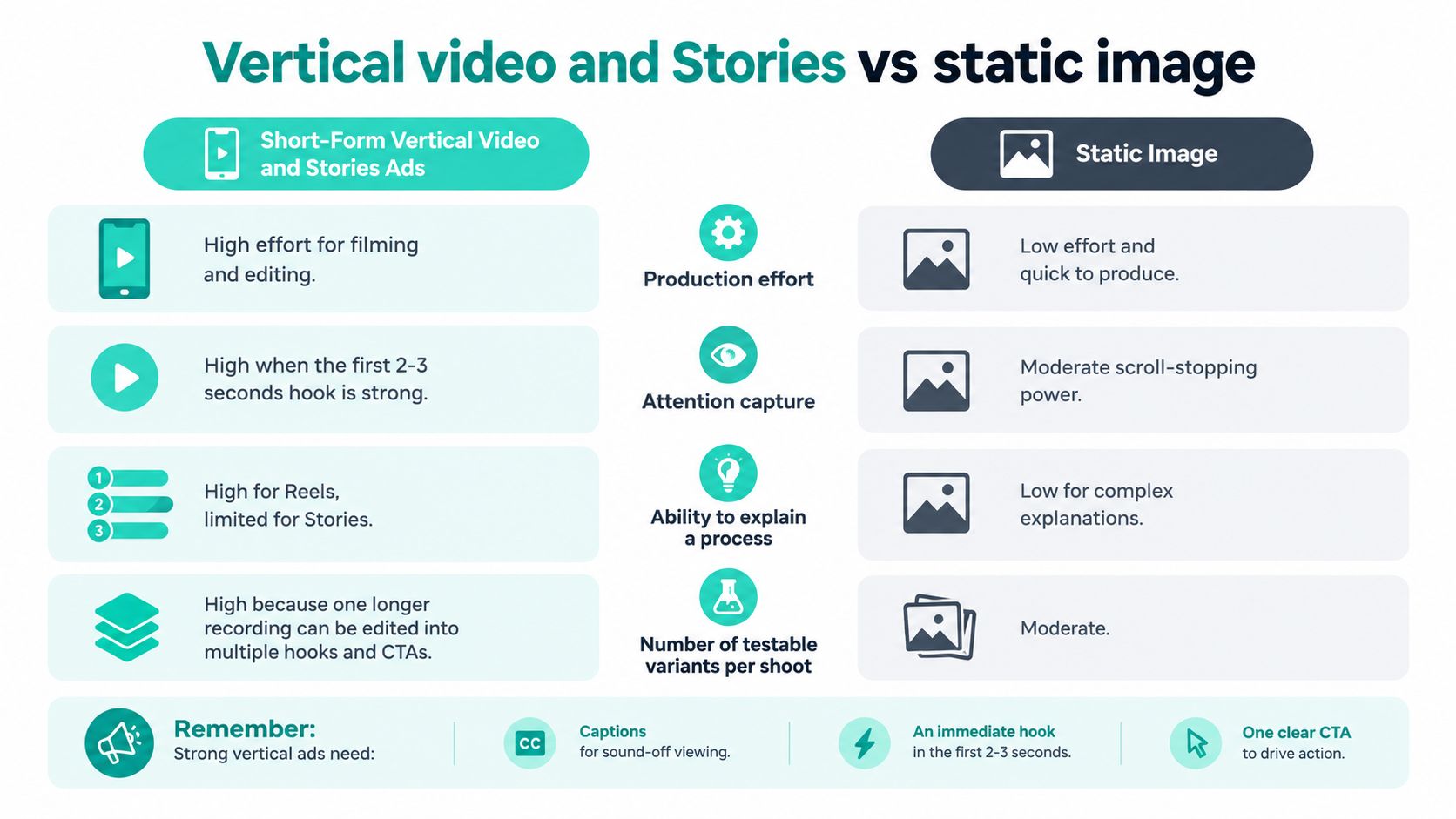
Hook in two to three seconds. Put the specific question or benefit on screen immediately.
Design for mute. Captions and high-contrast text stay inside safe margins.
Hold the body, change the hook. Test three to five openings before you change the offer.
One CTA. Match the button to the destination. Use urgency only when the deadline is real.
Law firms. Review the script for accuracy and skip outcome promises.
We cut and caption these clips through short video production. For pacing and safe zones, social video advertising tips from RemotionAI are a useful production check.
2. Carousel Ads
A carousel is one ad with two to ten cards. Each card has its own image or video, headline, and link. The job is choice or sequence, not a single punchline. People who never swipe still have to understand card one.
A family law firm can run five cards for divorce, custody, support, mediation, and prenups, each linking to its own practice page. An e-commerce brand can feature its top four products on product pages. A build team can use three cards, Audit, Build, and Measure, to show a 7 to 10 day path without stuffing the primary text.
Static photos still earn their place when the swipe is the point. A single product shot won't carry a five-service menu.

Make card one standalone. Many people never swipe, so the first card has to sell the click by itself.
One idea per card. A short benefit line beats a paragraph squeezed into the headline.
Separate destinations. Give each card its own landing page or UTM so you can see which service pulls.
Keep the look consistent. Mixed fonts and random stock photos read as five unrelated ads.
Practice-area carousels. Follow the state bar rules that apply to your ads, including required disclosures.
What doesn't work is ten cards of the same vague promise. If you can't name a distinct next page, use a single image instead.
3. Lead Ads (Instant Forms)
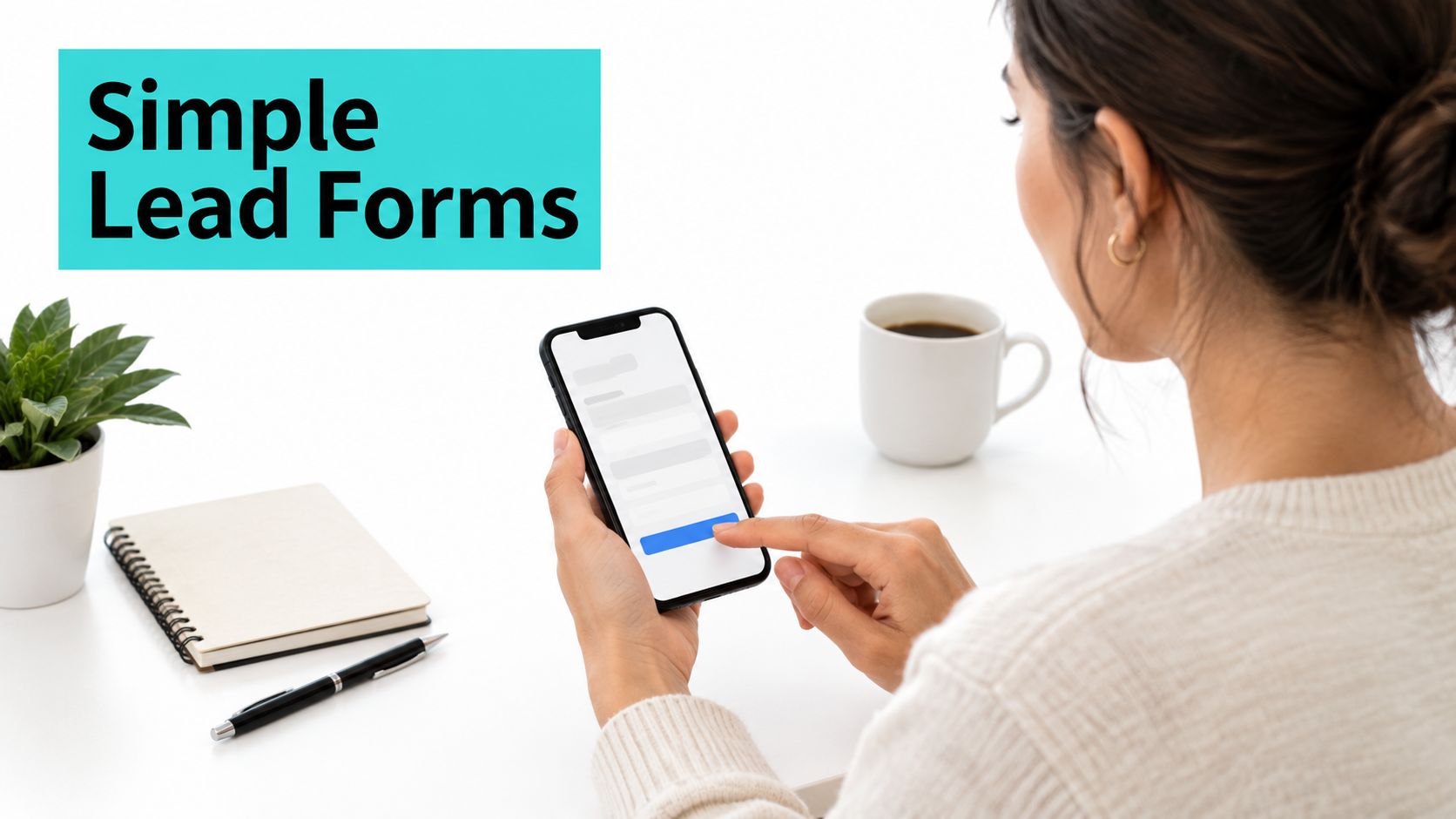
Instant forms keep the inquiry on Facebook or Instagram. Meta can prefill name, email, and phone, and you can send the lead to a CRM. That speed is the point, and it's also the trap. A cheap form fill isn't a client.
Across 726 U.S. lead campaigns measured from April 2024 through June 2025, the median click-through rate was 2.59%, the median cost per click was $1.92, and the median conversion rate was 7.72%. Traffic campaigns in the same dataset, 554 of them, sat at a 1.71% median CTR and $0.70 median CPC, so don't grade a lead form with a traffic benchmark (U.S. Meta campaign medians). Treat those figures as diagnostics, not promises.
An immigration attorney can ask visa type, country of origin, and preferred consult time. A home services form can ask service type and ZIP, then push the lead to scheduling. A clinic can collect preferred day and insurance type before anyone calls.
You accept Meta's Lead Ads Terms, and both Meta and the advertiser are data controllers. Forms must follow Advertising Standards. For housing, employment, or financial-product offers based in or targeted to the United States or Canada, you can't collect age, gender, relationship status, street address, city, or postal code on the form (Meta advertising policies). Law firms should keep case facts off the ad form and move them to a secure intake step.
Ask two to four qualifiers beyond contact details, such as practice area, location, or urgency.
Say what happens next and when someone will reply.
Follow up in minutes by email or SMS.
Score quality by booked consultations or revenue, not raw lead count.
If you're setting this up for the first time, this walkthrough on Facebook and Instagram lead campaigns covers the objective and the form handoff.
4. Click-to-Message Ads
These ads open Messenger, Instagram Direct, or WhatsApp instead of a form. They fit businesses that close in conversation: local services, clinics, and consultative practices. The person can ask a question before they commit. The failure mode is an unstaffed inbox.
A home services greeting can ask ZIP code and service type, then route the chat to a scheduler. A dental clinic can offer quick replies for new patient, insurance, and appointment change. A small law firm can collect practice area and location, and state that a message doesn't create an attorney-client relationship.
Platform-attributed chats overstate impact when the same people were already likely to inquire. In half of 15 U.S. Facebook field experiments, observational estimates of purchase lift differed from randomized results by a factor of three (Facebook measurement comparison). A busy thread can coexist with weak revenue if nobody qualified the chat.

Practical rule: Count booked consultations that started in chat, not conversations opened.
Set a response standard during business hours. A next-day reply kills the format.
Structure the first message with quick replies so staff aren't improvising legal or medical answers.
Add the disclaimer before any substantive legal or clinical reply.
Log the thread in the CRM so follow-up isn't trapped in a personal phone.
Pair the ad with a written follow-up path. SMS follow-up for law firm leads is the piece that keeps a chat from dying after the first reply.
5. User-Generated and Testimonial-Style Video Ads
These ads look like something a customer filmed, not a brand film. Phone footage, a real kitchen, a founder at a desk. The job is trust. Polished motion graphics often lose that job because they look like an interruption.
Glossier built recognition on real customers in ordinary settings. Gymshark leans on creator and athlete video. A home services company can run a homeowner's 20-second account of the appointment, with a signed release on file. That last example is the one a local firm can copy this month.
A 2025 survey of 500 Facebook and Instagram users found that persuasion knowledge raised perceived intrusiveness and privacy concern, which raised ad avoidance (ad avoidance study). Louder claims and heavier retargeting can buy delivery without buying intent. For regulated services, clarity and a real person often beat a harder direct-response line, even with fewer clicks.
Get the release first. Confirm paid-placement rights before you edit.
Talk about the process. Don't guarantee a result, a verdict, or a medical outcome.
Check bar rules. Testimonials may need disclaimers or may be limited in your state.
Caption it. Many viewers never turn sound on.
Shoot three to five hooks on the same story so you can test the opening, not the whole concept.
Lawyers who need safe on-camera ideas can start with short-form video ideas for lawyers and keep client stories inside what the rules allow.
6. Single-Image Ads with Problem-Solution Copy
A static image plus tight copy is the fastest test in the account. The image stops the scroll. The primary text names a problem, states the fix, and asks for one action. Video can wait until this message proves it can earn a qualified click.
An attorney can offer a free estate planning checklist with a plain visual and a Learn more button. A cleaning company can use a real kitchen photo and a headline about same-week booking in a named city. An e-commerce brand can show the product, one benefit, and a code. If the landing-page headline doesn't repeat that line, the click leaks.
You are not your reader. Write three versions of the problem and let the account tell you which one people finish.
Keep text off the image. Put the argument in the primary text so placements don't crop it away.
Match the page. The ad promise and the landing headline should be the same sentence.
Use a real photo of the team or the office for local work. Stock handshakes read as generic.
Skip superiority claims. Law firms shouldn't promise results or unsupported "best" language.
This format loses when the image tries to be the whole ad. One clear picture, one problem, one next step. If you need five services on screen, go back to the carousel.
7. Advantage+ Creative and Dynamic Creative Testing
Meta can mix images, videos, headlines, and text inside an ad set and serve combinations that fit different people. Advantage+ creative can add enhancements such as text variations or music. Dynamic creative rotates the assets you upload. The tool saves setup time. It doesn't fix a weak offer, and it can publish a line you never approved.
You choose the objective, such as traffic, video views, or leads, then set audience, placements, schedule, and budget at the ad set. Meta's auction weighs your bid and expected performance, so the highest bidder doesn't automatically win the impression. Campaign budget lets Meta shift spend across ad sets. Ad set budget keeps that control with you (how Meta delivers ads).
An e-commerce brand might load five images, three videos, and four headlines, then read which mixes drive purchases. A family law firm should test only three approved headlines and two approved images. A home services company can test service-specific headlines, not a new legal claim every day.
Feed approved lines only. If a variation isn't compliance-reviewed, it doesn't go in the asset pool.
Read the generated text for accuracy and tone before you scale it.
Use asset reporting to plan the next round instead of guessing from CTR alone.
Give the learning phase time and budget before you kill a combination.
Judge qualified inquiries, not the prettiest click.
If you want help turning a page into testable clips, create UGC video ads from URLs. For who should see those tests, compare original audiences and Advantage+ audiences before you hand targeting to the system.
8. Retargeting Sequence Ads for Warm Audiences
Retargeting is a sequence for people who already watched, visited, opened a form, or inquired. Step one reminds them of the problem. Step two shows proof or the process. Step three makes the direct offer. One warm ad repeated all week isn't a sequence. It's fatigue.
A law firm can show a video explainer to video viewers, a process carousel to landing-page visitors, and a consult offer only to people who opened the form and didn't submit. A clinic can remind booking-page visitors that new-patient slots exist. An e-commerce brand can show a bestseller carousel to cart abandoners, then a discount after seven days if the cart is still open.
Privacy limits and ad load both distort what the dashboard calls success. Research on Apple's App Tracking Transparency policy found weaker targeting efficiency for Facebook, with relative ad prices down and overall prices up. In a separate field experiment with 53,083 Facebook users, people who saw news-feed ads spent 9.4% less time on Facebook than a no-ads group, without a significant welfare difference (ATT and ad-exposure evidence). More impressions aren't more value when the sale happens offline weeks later.
This walkthrough shows how a warm sequence is built in the account.
Build three steps and don't collapse them into one evergreen ad.
Exclude people who already converted from acquisition ads.
Cap frequency and watch rising costs or a falling click-through rate.
Match the next email or SMS so the ad and the message say the same thing.
Review every two weeks next to qualified inquiries, not next to reach alone.
Auction buying stays the flexible choice for leads and purchases across Facebook, Instagram, Messenger, WhatsApp, and Audience Network. Reservation buying is the other path when you need a fixed cost per impression and a forecast of reach and frequency, and it requires a lifetime budget (auction and reservation buying).
Most Effective Facebook Ads: 8-Strategy Comparison
| Ad format | 🔄 Implementation complexity | ⚡ Resource requirements | 📊 Expected outcomes | ⭐ Key advantage | 💡 Ideal use cases |
|---|---|---|---|---|---|
| Short-Form Vertical Video and Stories Ads | Medium–high; needs a strong hook, captions, and clear CTA | Filming and editing; one shoot can yield multiple variants | Strong attention and service explanation when creative is concise | Full-screen mobile format; Stories may support interactive elements | Awareness, service explainers, events, and time-sensitive offers |
| Carousel Ads | Medium; requires coordinated cards, links, and tracking | Multiple consistent images or videos and headlines | Showcases several offers or explains steps; later cards may get fewer views | Each card can link to a relevant page | Practice areas, service bundles, catalogs, and processes |
| Lead Ads (Instant Forms) | Low–medium; form setup and lead routing required | Few creative assets; CRM or follow-up workflow recommended | Can increase mobile submissions; qualifying questions may improve lead quality | In-app form with potentially prefilled contact details | Structured inquiries, consultation requests, and mobile lead generation |
| Click-to-Message Ads | Medium; requires reply workflows and routing | Staff availability, quick replies, and ideally CRM logging | Encourages low-friction conversations; results depend on timely follow-up | Captures questions and context before a formal inquiry | Local services, clinics, and businesses that convert through conversation |
| User-Generated and Testimonial-Style Video Ads | Medium; requires production coordination and compliance review | Speakers, filming, written releases, and captions | Can build trust through relatable experiences; performance depends on speaker and claims | Natural, personal presentation can feel native to social feeds | Trust-based services and customer experience stories |
| Single-Image Ads with Problem-Solution Copy | Low; simple creative and copy setup | One relevant image and concise copy | Fast to produce and test; less suited to complex explanations | Low-cost, straightforward creative iteration | Quick offers, checklists, and consultation invitations |
| Advantage+ Creative and Dynamic Creative Testing | Low–medium; automated setup with ongoing review | Multiple approved assets and sufficient budget and learning time | Tests asset combinations; outcomes depend on input quality and review | Reduces manual testing setup and provides asset-level insights | Creative testing for teams with several approved images, videos, or headlines |
| Retargeting Sequence Ads for Warm Audiences | Medium; requires audience setup, sequencing, and exclusions | Multiple ads, audience volume, and frequency monitoring | Can re-engage prior visitors and support consideration through conversion | Tailors messages to previous interactions | Recovering stalled inquiries, long decision cycles, and coordinated nurturing |
Turn Winning Formats Into Booked Consultations
Formats don't book the consult. The path does. Pick one cold format from this list and one retargeting step. Point both at a landing page that repeats the same offer, the same next step, and a form or scheduler a person can finish on a phone. If the ad says checklist and the page says "contact us," you paid for a mismatch.
Judge the work against a counterfactual, not a vanity ratio. Large-scale experimental analysis of Meta advertising found that, on average, each ad dollar generated $3.31 in revenue, purchases rose 25%, unique purchasers rose 13%, and conversions rose 73% (NBER working paper on Meta ads). That average isn't a guarantee for a law firm or a local service. It's a reason to tie the campaign to incremental customers and revenue, then connect the pixel and CRM so a qualified consult counts even when Meta never sees the signed engagement.
Watch the invoice, too. On a strong day Meta may spend up to 75% over your stated daily budget and pull back on quieter days. A $20 daily budget can show $35 on a single day while still respecting the overall limit (Meta daily budget delivery). If you need a hard ceiling, use a lifetime budget or an account spending limit.
Our plans run the same way the sequence above does. Ads create the first opportunity, the landing page explains the next step, content gives context, and email or SMS keeps the conversation moving after the click. Paid data starts after launch. Efficiency still takes testing, and a lower reported return can be the better campaign if the clients it brings are ones you can serve.
If you want that system built and managed, SimpleLab Digital can handle the creative, the campaigns, the page, and the follow-up as one monthly engagement for small businesses and law firms.
SimpleLab Digital plans and manages Facebook and Instagram campaigns for small businesses and law firms, including the creatives, audiences, landing pages, and follow-up that turn a format into a booked consultation. If you want that path built around your offer instead of another isolated ad test, visit SimpleLab Digital.