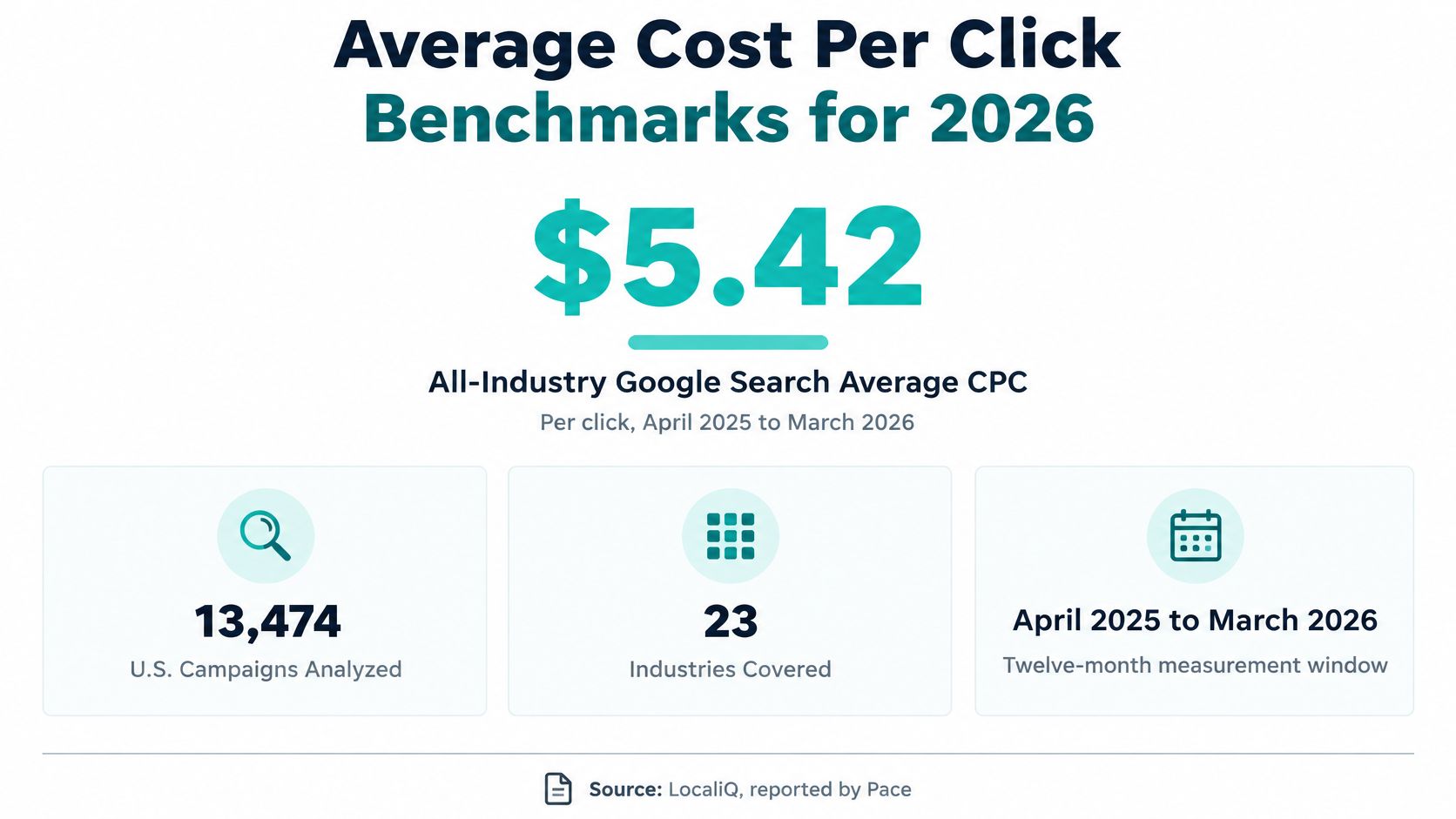
The average Google search CPC was $5.42 from April 2025 to March 2026, based on 13,474 U.S. campaigns across 23 industries. Treat that figure as a planning baseline, not a price your business is guaranteed to pay.
The same headline average can buy very different numbers of clicks, and those clicks can produce very different numbers of qualified leads. A small business should use benchmarks to frame a budget, then judge affordability by what it can pay for an inquiry that fits its services and can become a customer.
Table of Contents
Average Cost Per Click Benchmarks for 2026
Google search CPC averaged $4.66 in 2024, $5.26 in 2025, and $5.42 from April 2025 to March 2026. The latest figure covers 13,474 U.S. campaigns across 23 industries, according to Pace's coverage of the LocaliQ benchmark. These benchmarks provide context for planning, though the average does not predict what an individual advertiser will pay.
A decade-long comparison also shows the rise in search costs. One benchmark series puts Google search CPC at $2.32 in 2016 and $4.66 in 2024, an increase of about 101%. The 2025 benchmark reported a 12.88% year-over-year increase. A separate 2016 benchmark cited below gives a search CPC of $2.69, so the historical comparison depends on which benchmark series is used. These are campaign averages, shaped by auction competition, geography, industry, keyword intent, and advertiser quality. The decade-long CPC trend provides further context for updating planning assumptions.
Average CPC by channel and year
| Channel and benchmark | Year | Average CPC | Source |
|---|---|---|---|
| Google Search, all industries | 2024 | $4.66 | WordStream and LocaliQ |
| Google Search, all industries | 2025 | $5.26 | 2025 Google Ads benchmark |
| Google Search, all industries | 2026 (April 2025 to March 2026) | $5.42 | LocaliQ, 13,474 U.S. campaigns |
| Google Display, all industries | 2016 | $0.63 | Google Ads benchmark |
| Facebook Ads, traffic campaigns | 2026 | $0.60 | Coupler.io |
The display figure is historical, not a current comparison between platforms. In the same 2016 benchmark, search CPC was $2.69 and display CPC was $0.63. That comparison shows why an average needs its channel and campaign context. The Facebook figure applies to traffic campaigns, so it is not directly comparable to Google search CPC.
Google search average CPC, listed benchmark years
Average CPC$5.50 | ● $5.42 (2026)$5.00 | ● $5.26 (2025)$4.50 | ● $4.66 (2024)$4.00 |$3.50 |$3.00 |$2.50 |$2.00 | ● $2.32 (2016)+------------------------------------------------2016 2024 2025 2026Use a benchmark that matches the channel and campaign type as an initial planning reference, then compare it with your account's CPC once campaigns have run. For a wider channel comparison, see this overview of online advertising platforms to know in 2026.
What Cost Per Click Means and How It Is Charged
Buying a click is like bidding for a parking space at a busy event. If several drivers want the same space, the auction can become more competitive; if fewer do, the price may be lower. An advertising platform runs a different kind of auction, but the analogy helps explain why the same keyword can cost different amounts at different times.
Cost per click (CPC) is total ad spend divided by the number of clicks. Spend $1,000 and receive 250 clicks, and the average CPC is $4.00. That's an account-level average, not necessarily the price of every individual click.

Three auction prices to keep separate
- Maximum CPC is the most you're willing to pay for a click. It's a bid ceiling, not a promised charge.
- Actual CPC is the amount the platform charges for a click. In Google Ads, the actual amount is often below the maximum bid.
- Reserve price is the minimum needed to meet the platform's relevant auction threshold. When no competing ad clears that threshold, the advertiser may pay only the reserve price.
Google calculates Ad Rank using factors such as the bid, auction-time ad quality, expected click-through rate, ad relevance, landing-page experience, search context, competition, and the expected impact of assets. It typically charges the amount needed to clear applicable Ad Rank thresholds and beat the next competing ad. That's why a $10 maximum CPC doesn't automatically mean a $10 average CPC. Google's explanation of actual CPC and Ad Rank describes the distinction between a bid and the final price.
More advertisers competing for the same searches can affect auction conditions, but a rising benchmark doesn't tell you what one specific click will cost. The useful question is not only how much attention costs, but whether that attention becomes a qualified inquiry or a sale. For a practical overview of pay-per-click advertising for small businesses, keep that distinction in view.
Average CPC by Industry and What the Gap Means
The difference between a $1.60 click and an $8.58 click changes both how many visits a budget buys and how much each qualified lead may cost. The 2025 search benchmarks below compare industry averages with the $5.26 cross-industry average. The percentages are comparisons with that overall figure.
| Industry | 2025 average CPC | Versus $5.26 average |
|---|---|---|
| Attorneys and Legal Services | $8.58 | 63% higher |
| Dentists and Dental Services | $7.85 | About 49% higher |
| Home and Home Improvement | $7.85 | About 49% higher |
| Personal Services | $5.81 | 10% higher |
| Business Services | $5.58 | 6% higher |
| Real Estate | $2.53 | About 52% lower |
| Travel | $2.12 | About 60% lower |
| Restaurants and Food | $2.05 | About 61% lower |
| Arts and Entertainment | $1.60 | About 70% lower |
These are industry averages, not quotes for a specific keyword, location, or campaign. Averages help set a starting range, but a business's actual costs depend on the searches it targets and whether those clicks produce qualified inquiries.
Intent changes the comparison
The channel also changes what a click represents. In a 2016 benchmark, search CPC averaged $2.69, compared with $0.63 for display. Search can reach people actively looking for a service; display can reach audiences who are not searching at that moment. A lower CPC may therefore buy more visits without delivering the same level of buying intent. The industry and channel comparisons put those differences in context.
Another benchmark covering April 2025 to March 2026 reported industry medians from $1.63 to $9.87. Legal services sat at the high end, nearly six times the lowest reported category. These are medians, so they should not be treated as directly equivalent to the 2025 averages in the table.
The budget effect is concrete. At the listed 2025 average CPCs, 100 clicks cost about $160 in arts and entertainment, $785 in home services, and $858 in legal services, before taxes, fees, or other campaign expenses. The same media budget will buy very different click volumes across those industries.
Clicks alone do not determine lead cost. To estimate an affordable CPC for a particular business, start with the maximum acceptable cost per qualified lead and multiply it by the share of clicks that become qualified leads. For example, if one in ten clicks becomes a qualified lead, the affordable CPC is one-tenth of the acceptable cost per qualified lead. Use the business's own conversion data where available, then compare that ceiling with the relevant industry benchmark.
Compare CPC with your industry and campaign intent first. The all-industry average is context, not a target.
Factors That Push Your CPC Up or Down
Three layers shape the auction: what the searcher wants, how many advertisers compete for that search, and how well your ad matches the query. Google sets actual CPC dynamically, considering the bid, ad quality, Ad Rank thresholds, competition, search context, and the expected impact of ad assets. That means two businesses bidding on a similar term may pay differently if their ads and landing pages perform differently.
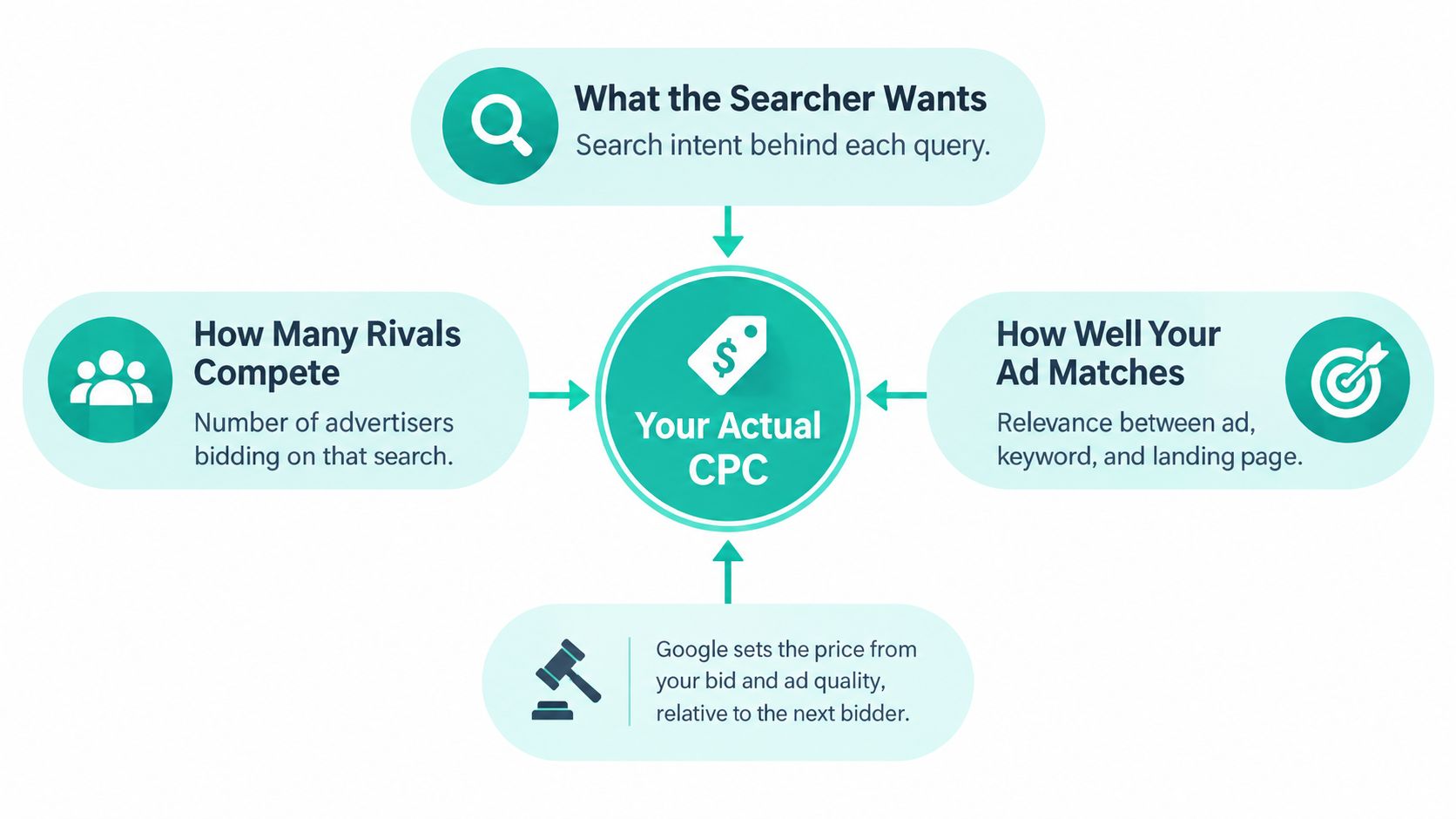
Google's Quality Score, reported on a diagnostic scale of 1 to 10, reflects expected click-through rate, ad relevance, and landing-page experience. It isn't itself the auction price, but it can help diagnose the quality signals related to a campaign. Google notes that stronger ad quality can reduce actual CPC, while weak quality can push the price closer to the maximum bid, even where competition is limited. Google's Quality Score guidance explains these diagnostic components.
| Factor | Pushes CPC up when | Can support lower CPC when |
|---|---|---|
| Keyword intent | Broad, high-value terms draw many interested buyers | Specific service-level queries express clear intent |
| Competition | Many advertisers bid on the same query | A narrow query attracts fewer bidders |
| Location | The target market has dense advertiser demand | The target market has less competition |
| Match type | Broad matching brings in loosely related searches | Exact or phrase matching keeps spend closer to relevant searches |
| Ad quality | Expected click-through rate, relevance, or landing-page experience is weak | The ad and landing page closely match the query |
| Bid strategy | Aggressive bids pursue top positions | Bids are set near the amount needed to clear the auction threshold |
| Device and time of day | Bids rise where competition is heavier | Bids are reduced where clicks produce few qualified leads |
Device and time-of-day effects aren't universal. They vary by industry and should be tested against your own campaign's lead quality rather than assumed in advance.
The most direct improvement is message-to-query alignment: group closely related keywords, write ad copy that answers the search, and send the click to a landing page that fulfills that same intent. Those changes can improve ad quality and reduce the price needed for competitive placement. For a more detailed method, see this guide to Google Ads Quality Score and CPC.
Start with two checks in Google Ads: the Quality Score column for keyword-level diagnostics and the search terms report to see which actual queries triggered the ads. If the terms don't fit your service, lowering a bid alone won't fix the underlying mismatch.
How to Estimate Your Expected CPC Step by Step
A benchmark helps you sanity-check a forecast, but the sustainable CPC for your business comes from downstream economics. A useful formula is:
Allowable CPC = target cost per qualified lead × landing-page conversion rate × qualified-lead rate
For example, a business targeting a $150 cost per qualified lead, with an 8% landing-page conversion rate and a 50% qualified-lead rate, can support a CPC of $6.00. That amount isn't universal; it follows from those assumptions about the business's lead economics.
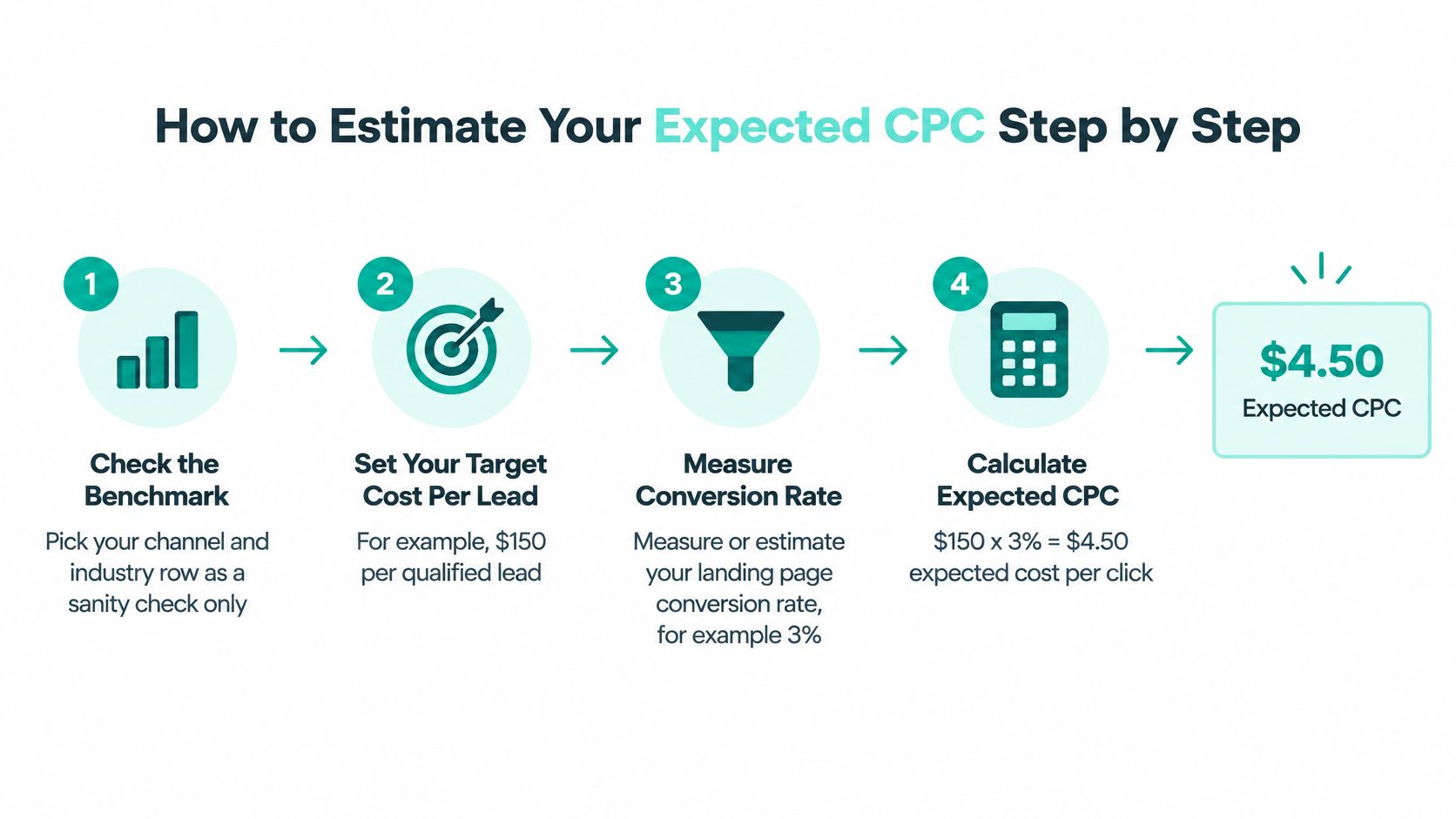
Choose a comparison point. Pick the channel and industry row that most closely matches your campaign, and use it as a sanity check rather than a bid promise. Separate assumptions by service and geography where those markets differ.
Set the target cost per qualified lead. Decide what you can afford for an inquiry that fits your services. For this example, use $150.
Estimate both conversion rates. Measure the landing-page conversion rate, then find what share of inquiries qualifies. With an 8% page conversion rate and 50% qualification rate, half of the form submissions or calls count toward qualified lead volume.
Calculate allowable CPC. Multiply $150 × 8% × 50% = $6.00. If the relevant benchmark is below that figure, there may be room to compete; if it's above, improve the page or qualification process before raising bids.
Translate the result into a budget. To generate 10 qualified leads at those conversion and qualification rates requires 250 clicks. At $6.00 per click, that's $1,500 in media spend, before management fees or other costs.
Keep non-media costs separate. Include the management fee and any applicable hosting or software charges in the full marketing budget. For example, Google Ads management starts at $495 USD per month, and Facebook and Instagram Ads management also starts at $495 USD per month; in both cases, advertising spend is paid separately to the platform, and software or platform costs are confirmed before starting.
In Google Ads, add the Avg. CPC and Conversions columns to the Campaigns report. For the same date range, use your CRM or intake log to calculate the qualified-lead rate; platform conversions alone won't tell you which inquiries fit your services. For help defining the page-side calculation, see how to calculate a conversion rate.
The downstream numbers also matter after an inquiry arrives. Intake speed, lead quality, close rate, and customer value influence what a business can reasonably afford, particularly when one retained client can support a higher acquisition cost than a low-intent inquiry. A useful break-even ROAS calculation should account for those economics rather than treat CPC as the final measure of success.
What a $5,000 Budget Buys in Each Industry
A $5,000 monthly media budget buys very different search-click volumes across industries. The estimates below divide the budget by each listed search CPC. They are planning calculations, not forecasts, and exclude fees, impression losses, and invalid traffic.
| Search benchmark | Average CPC | Clicks from $5,000 |
|---|---|---|
| Arts and Entertainment search (2025) | $1.60 | About 3,125 |
| Google Search, all industries (2026) | $5.42 | About 923 |
| Home and Home Improvement search (2025) | $7.85 | About 637 |
| Attorneys and Legal Services search (2025) | $8.58 | About 583 |
| Legal services median (April 2025 to March 2026) | $9.87 | About 507 |
The Facebook Ads traffic-campaign CPC of $0.60 is not included: it measures a different campaign type and is not directly comparable with search CPCs.
Clicks alone do not show how many inquiries or qualified leads a budget can produce. At a $9.87 legal-services median, about 507 clicks would generate roughly 41 inquiries if the landing page converted at an illustrative 8%. If half of those inquiries qualified, the result would be about 20 qualified leads, or approximately $250 per qualified lead from the $5,000 media budget. These assumptions demonstrate the calculation; they are not a forecast for every law firm.
For home services, a $7.85 CPC yields about 637 clicks from the same budget. Applying the same illustrative page conversion and qualification rates gives about 25 qualified leads, at roughly $200 per qualified lead. The comparison shows why a lower CPC does not automatically mean a lower cost per qualified lead.
A separate legal-services conversion-rate and cost-per-lead figure is omitted here because no source is provided for it. Judge each industry's click volume alongside the likelihood that those clicks become suitable inquiries, rather than treating CPC as a measure of campaign value.
Set Your Target CPC Before You Launch
Set a bid ceiling from the cost per qualified lead your business can support. Then compare actual campaign results with that limit, using qualified-lead volume and quality rather than the average CPC alone.
If the CPC is below your allowable amount and qualified leads arrive on schedule, consider increasing the budget gradually. A proposed increase of 10% to 20% is a test, not a guaranteed path to more leads at the same cost.
If CPC exceeds your allowable amount but qualified-lead quality is strong, review the weakest keywords first. Lower bids on terms that are costly or less relevant before raising the overall budget.
If CPC is high and the qualified-lead rate is weak, inspect the search terms and landing page before spending more. The problem may be a mismatch between the query, the offer, and the page, not a bid that is too low.
Review cost per qualified lead weekly for four weeks, then set your bid ceiling from the allowable CPC calculation. The review gives you a consistent window to spot whether the campaign is attracting suitable inquiries at a sustainable cost.
This is a more useful way to judge a campaign than comparing your account with a headline average. For businesses that also measure revenue generated from marketing investment, break-even ROAS planning can help connect acquisition costs to sales economics.
SimpleLab Digital offers marketing packages starting at $990 USD per month. The management fee doesn't include advertising spend, which is paid separately to the advertising platform; confirm current package scope and separate advertising costs before committing.
This week, calculate your allowable CPC from your target cost per qualified lead, landing-page conversion rate, and qualified-lead rate, then compare it with the Avg. CPC in your account. SimpleLab Digital manages paid media and related services for small businesses, with campaign measurement centered on qualified inquiries and downstream revenue. Visit SimpleLab Digital to explore its marketing support and discuss a plan that fits your acquisition targets.