A law firm doesn't need to be on every channel. It needs a clear way for the right person to find it, a responsible lawyer to stand behind its claims, and someone ready to respond when an inquiry arrives. More advertising won't fix a process that leaves prospective clients waiting.
That's the practical test for law firm marketing: can a channel produce a qualified inquiry, and can your team move that person toward a consultation? The answer depends less on how many profiles you've opened than on who owns each step.
Table of Contents
Why Most Law Firm Marketing Never Reaches a Client
More advertising can produce more inquiries and still leave a firm with no new clients. The gap is often staffing: a small team may publish regularly or buy traffic, but inquiries go unanswered or arrive after the prospective client has moved on.
The American Bar Association's 2024 Practice Management TechReport found that 90% of responding U.S. law firms had a website, compared with 94% in 2022. The share ranged from 70% of solo practitioners to 100% of firms with 100 or more attorneys. The report also found that social media use as a marketing tool was 80%, down from 89% in 2022. Internal marketing staff were reported by 1% of solo practices and 90% of firms with more than 100 attorneys.
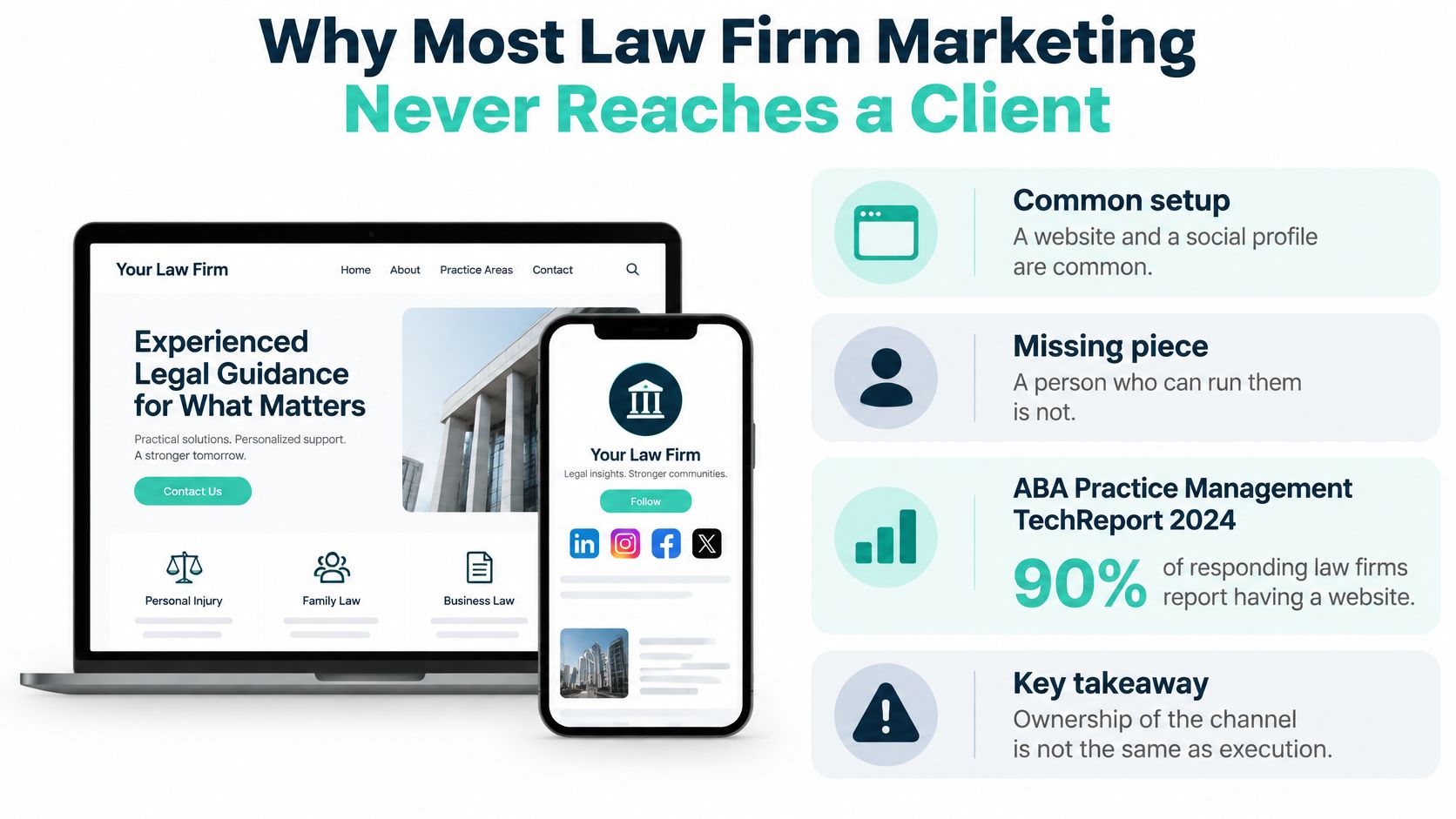
A channel only creates an opportunity to speak with a prospective client. An outdated phone number, an unmonitored inbox, or a promise of a quick response that the team cannot meet can cut off that opportunity before a consultation is booked. More ad spend will not repair a slow intake process.
Give each channel an owner
Small firms may not have a marketing employee to handle every task. Assign responsibility anyway: someone must approve claims, check contact details, and respond to inquiries. That person might be an attorney, an intake coordinator, or an outside partner. The role needs a clear owner and a realistic response standard.
If client reviews are part of the firm's visibility plan, RecensioAI's review software for law firms can help organize review-management work. A tool does not replace the person responsible for keeping public information accurate and directing prospective clients to a clear next step.
Before increasing spend, check that the firm can support the marketing it already has. Tie public claims to a responsible lawyer, make sure someone can respond to inquiries, and assess performance by consultations and retained matters rather than channel count.
Channels That Match How Clients Actually Hire
| Channel | Primary job | Fits best when | Watch-out |
|---|---|---|---|
| Website and local SEO | Be found for a named service and show who is responsible | The firm wants inquiries that don't depend on a daily ad budget | Stale pages or a hidden contact path waste the visit |
| Google Ads | Capture people already searching a defined matter | There's a clear service and an ad budget separate from management fees | Broad keywords buy clicks that aren't that matter |
| Facebook and Instagram ads | Reach people who aren't searching yet | Life events drive the work, such as estate, family, or injury matters | Creative can imply a typical outcome even without saying so |
| Stay visible to professional referrers and business clients | The practice is employment, business, or referral-led | Weak as the only consumer lead source, and daily posting is hard to staff | |
| Email and SMS | Move an existing inquiry toward a consultation | People inquire before they're ready to hire | Every message still needs a responsible lawyer's name and contact details |
| Short video and organic social | Explain a process and stay visible between ads | The firm can approve a small, repeating content cadence | Views without a landing step don't book a consultation |
| Directories and referrals | Appear where comparison shoppers and colleagues already look | The listing is accurate and someone monitors inquiries | Paying for a recommendation can fall outside allowed advertising costs |
Clients generally find legal help in one of two modes: they search for a service after naming a problem, or they notice a firm while a life event is still unfolding. Match the channel to that moment instead of treating every platform as mandatory. The ABA report found LinkedIn was used by 76% of respondents and Facebook by 53%, but a platform's reach doesn't make it a fit for every firm.
A website and local search can support discovery for a defined service, provided the page is current and makes the next step obvious. Google Ads can put a firm in front of people searching for that service, but broad keywords can spend the budget on visitors who aren't looking for the matter the firm handles. For a practical approach to aligning search visibility with client acquisition, use this law firm SEO strategy guide.
Facebook and Instagram can put a firm in front of people who aren't actively searching. That can suit matters tied to major life events, but the creative still needs careful review: an image or testimonial can imply a result even when the caption avoids a promise. For business, employment, and referral-led practices, LinkedIn may be a better fit than consumer-focused social channels. It's a poor primary lead source if nobody can post consistently or build professional relationships there.
Email and SMS help move someone who has already inquired toward a consultation; they don't create the first visit. Short video can explain a process between ads, but it should point to a page with one clear next step. Directories and referral sources also need upkeep: keep profiles accurate, monitor inquiries, and make sure any payment is for allowed advertising rather than a disguised fee for a recommendation. For more context on managing attorney reputation carefully, see this ethics-aware reputation guidance for attorneys.
Drop any row from your channel plan if no one on the team can answer what it produced this week. A channel that generates attention but has no owner is a recurring task without a reliable business outcome.
Rules That Apply Before Any Ad Goes Live
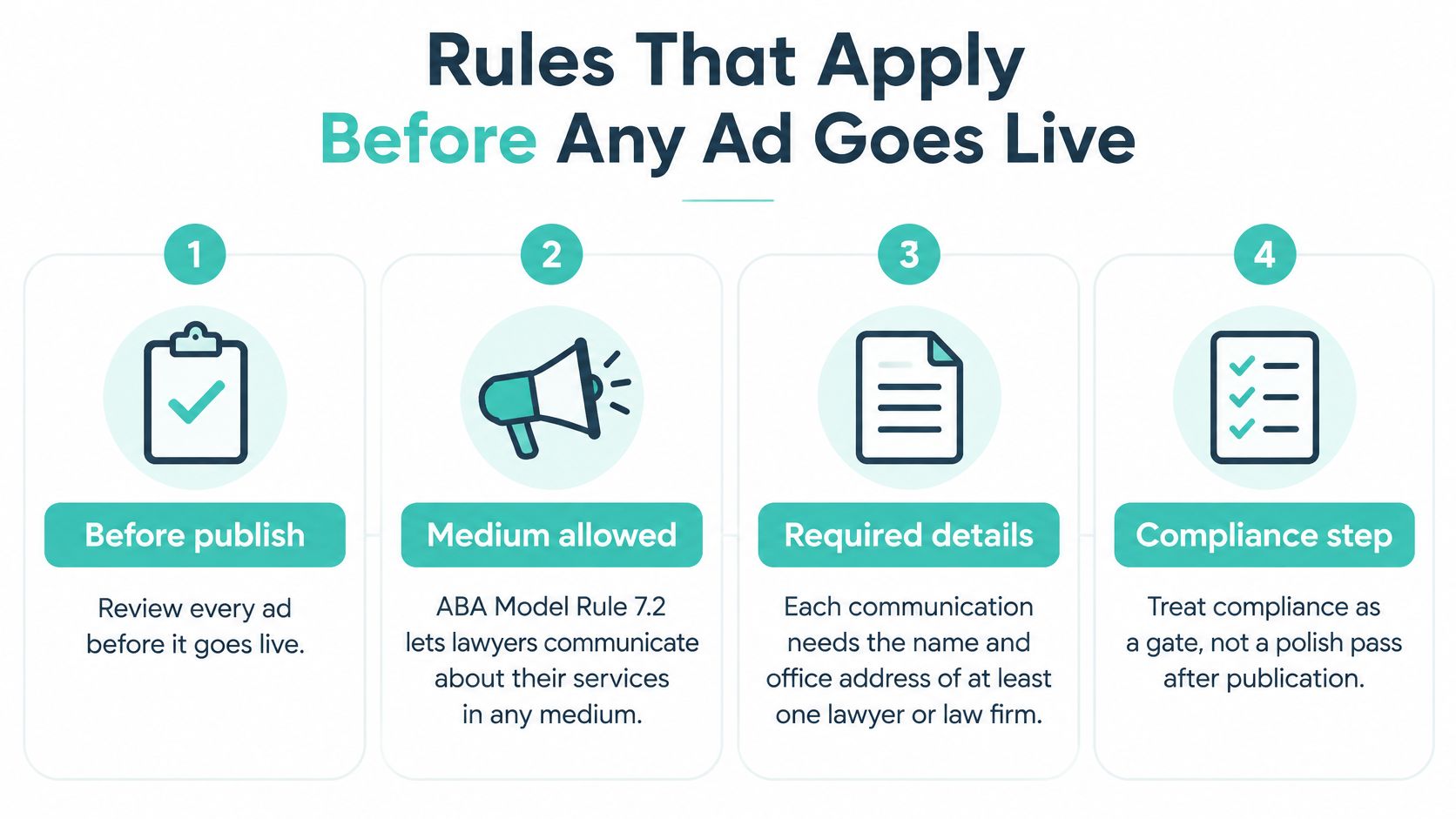
Compliance belongs before publication, not after an ad has collected clicks. ABA Model Rule 7.2 permits lawyers to communicate information about their services through any medium, but requires each communication to include the name and contact information of at least one responsible lawyer or law firm. It also generally restricts giving anything of value for a recommendation, with defined exceptions such as reasonable advertising costs and qualified lawyer-referral services. The rule's text is a starting point, not a substitute for reviewing the rules in each relevant jurisdiction.
Use a pre-publish matrix for every asset. Record the responsible attorney, contact details, practice-area claim, testimonial or specialization wording, geography, and whether the message is advertising or a solicitation. Give each approved claim an owner, an approval date, and a review trigger. A sentence approved for a website shouldn't automatically be copied into an SMS or a paid social ad without checking how the new format and audience affect compliance.
| Asset | Pre-publish check |
|---|---|
| Paid-search ad | Responsible lawyer or firm name and contact; jurisdiction-approved practice-area claim |
| Social creative | Same contact line; no implied typical result; endorsement disclosure when a client or influencer appears |
| Landing page | Visible text matches any structured data; one named next step; testimonial context |
| Email or SMS sequence | Contact line in every message; stop rule when the person books, declines, or falls outside the jurisdiction |
| Directory profile | Accurate listing; any payment is an allowed advertising cost, not a fee for a recommendation |
| Testimonial or review | FTC disclosure of any material connection; context on what clients can generally expect |
| AI-drafted copy | Human review before use; no confidential client facts in the tool; prompt and output logged |
Review endorsements and AI separately
A review, photo, or video can communicate an endorsement when consumers would understand it as someone else's opinion. The FTC says an unexpected material connection, such as payment, employment, family ties, or free services, must be disclosed clearly and conspicuously. Compensated promoters can't make unsupported claims, and a dramatic testimonial may mislead if it doesn't explain what clients can generally expect. Review the content itself, including what the visuals imply, using the FTC's endorsement guidance and its answers about endorsement guides.
AI can assist with low-risk tasks such as topic clustering, transcription, or draft metadata. It shouldn't be allowed to publish legal conclusions, evaluate a case, invent a testimonial, or conduct unsupervised client intake. A 2025 survey of nearly 100 legal marketing and business-development decision-makers found that 70% were taking on greater roles in legal technology; separate 2026 survey reporting found that 61% of attorneys were concerned about AI accuracy, 59% about ethics and client trust, and 26% were unfamiliar with AI marketing technologies. The cited AI marketing discussion underscores why a human should verify client-facing claims and why confidential facts don't belong in an unapproved tool. If AI helps draft, retain the prompt and output and require a lawyer to review the result.
If the claim would be risky on the website, it's riskier in an ad.
For a channel-specific example, use this guide to Facebook advertising for attorneys that stays bar-compliant.
The Path from Inquiry to a Booked Consultation
A quick acknowledgment and a useful human response do different jobs. A published benchmark reports that 26% of surveyed U.S. law firms didn't respond to online leads, while firms that did respond had a median response time of 13 minutes. The same benchmark reports lead-to-opportunity conversion by response time; treat the figures as directional, not universal. The benchmark and intake discussion supports building a closed loop rather than assuming a form submission will turn into a client.
| First response | Lead-to-opportunity conversion | What to do with it |
|---|---|---|
| Within 5 minutes | 21% | Page a person and offer a booking slot the same hour |
| 5–30 minutes | 13% | Still worth a live reply; don't wait for the end of the day |
| 30–60 minutes | 8% | Treat as a leak; check who was supposed to be on intake |
| 1–24 hours | 5% | Fix coverage before raising ad spend |
| After 24 hours | 2.3% | Count as a missed inquiry, not a nurture success |

Build the intake path in six steps:
- Confirm receipt. Send an immediate acknowledgment and include the name and contact information of at least one responsible lawyer or firm.
- Route the inquiry. Sort by practice area and jurisdiction so the right person sees it.
- Escalate to a human. A person needs to handle conflict checks, issue spotting, and after-hours coverage. An automated message can't do that work.
- Offer a real appointment. Put a calendar slot in front of the prospect instead of promising a later call.
- Follow up, then stop appropriately. If nobody books, send a short email or SMS sequence. Stop it when the person books, declines, or falls outside the firm's jurisdiction.
- Record what happened. Track the source, time to the first human reply, whether the consultation was qualified, and whether the matter was retained.
Steps three and four need a person behind them. Automation can handle confirmation and reminders, but it shouldn't make legal judgments. If staffing is the constraint, legal intake specialists may help a firm assess how to cover the response path; focused landing pages for law firm consultations can help make the next step clearer. If current inquiries go unanswered, buying more clicks adds cost before it adds clients.
Numbers That Show Whether Marketing Is Working
Higher marketing spend does not automatically produce more profitable work. Clio's 2024 Legal Trends research found that firms with above-average productivity spent 41% more on marketing and achieved 21% higher profitability. The survey included 1,028 U.S. legal professionals, alongside aggregated and anonymized data from tens of thousands of legal professionals. Clio also reported higher software spending and utilization above the industry average. These findings show an association, not a guarantee that added spending will produce the same result for every firm. Clio's 2024 findings provide context, but your own intake and revenue records should guide decisions.
The practical test is whether marketing produces qualified inquiries that become retained matters, and whether the firm can respond in time. Track each step by source. A channel can bring in the right inquiries and still waste spend if nobody follows up.
| Measure | Question it answers | Decision it supports |
|---|---|---|
| Qualified inquiries by source | Did this channel attract the right matters? | Shift budget toward sources that produce qualified inquiries, not raw forms |
| Median first response and share within 5 minutes | Did someone reply while the inquiry was still active? | Fix response coverage before buying more traffic |
| Consultation booking rate | Did inquiries become scheduled conversations? | Review the page or next step if response is prompt but bookings stay low |
| Retention rate | Did consultations become matters? | Judge results by retained work, not bookings alone |
| Revenue per qualified inquiry | What revenue did qualified inquiries produce? | Set acquisition limits using business outcomes, not cost per click alone |
| Utilization against the 37% industry average | Does the firm have capacity for more work? | Pause lead buying if the team cannot absorb additional matters |
Diagnose the failure before changing the budget
Read the measures as a sequence. Qualified inquiries indicate whether the audience fits. Response time shows whether the team follows up. Booking and retention rates help distinguish a page or intake issue from a poor-fit audience. Revenue per qualified inquiry connects marketing activity to the firm's financial results.
Use the guide to measuring law firm marketing ROI to keep reporting tied to business outcomes. Review where prospects drop out before changing spend. The issue may be audience fit, unclear next steps, or an unanswered inquiry. Fix the constraint the numbers identify.

How Much to Budget Before Buying Leads
Set a budget from what a qualified inquiry is worth, not from a generic monthly figure. Use this formula:
Revenue per qualified inquiry = retained matters from a source × average fee ÷ qualified inquiries from that source.
Use a consistent review period for each number. Then decide what share of that value you're willing to spend on acquiring an inquiry while still covering delivery costs and staff time.
Price the response standard before the media. Name who answers, how after-hours inquiries are covered, and which tools the intake path needs. Keep advertising spend separate from any management fee so you can see what the ads cost and judge each invoice against its own purpose.
Before increasing spend, check whether the firm has room to accept and handle more work. If the calendar is full, pause lead buying. If there's capacity, test a single practice area and review revenue per qualified inquiry after a full review cycle. Increase spend only when that figure holds up and the team can still respond. For planning, compare your assumptions with this guide to average cost per click in 2026, rather than treating a click price as proof that a campaign is affordable.
What Connected Marketing Looked Like in Practice
SimpleLab Digital supplied the revenue figures for Gomez Law, Legacy Law Group Colorado, and Marcus Law Offices. These are firm-wide outcomes, not results attributed to the service alone, and individual outcomes vary.
Gomez Law, a real estate law firm, grew from $340K a month to $550K a month within 12 months, a reported 62% increase. Its mix included Meta and Google Ads, social media, newsletters, email and SMS nurturing over six to twelve months, tracking, and retargeting. Legacy Law Group Colorado moved from $30K a month to $110K a month within one year using a similar connected mix.
Marcus Law Offices grew from $20K a month to $150K a month within one year using a Booster-style bundle of ads, social content, a landing page, and a four-week email and SMS follow-up. That shorter sequence illustrates a different possibility: when the offer and the page are already clear, a focused follow-up period can keep a prospect moving toward a decision.
Copy the connection, not the revenue figures
The structural pattern is more useful than any one firm's reported growth. Ads create an opportunity, a landing page explains the next step, content answers questions a prospective client still has, and follow-up stays present while that person decides whether to book. Some matters need longer-term nurturing; a single reminder won't suit every decision.
Don't import another firm's revenue multiple into a forecast. Instead, test whether each active channel points to a page a reviewer has approved and whether each inquiry enters a named follow-up sequence. Someone on the team should be able to say whether the lead was a fit, whether it booked, and whether it became a matter.
Set a Response Standard Before You Spend More
Before the next advertising invoice, write down four lines:
- Who answers a new inquiry?
- What's the maximum wait for a human reply, including after hours?
- Which lawyer approves claims for each jurisdiction?
- How will the firm report which inquiries were qualified and which became revenue?
If any answer is missing, more ad spend is the wrong next purchase. Fill the gaps first, then decide whether internal staff can build and maintain the pages, ads, and follow-up.
If the response system is ready but the firm lacks execution time, outside support can be reasonable. SimpleLab Digital offers monthly law-firm marketing packages starting at $990 USD per month, with advertising spend separate. Its ROMI Calculator is built for law firms and doesn't require an email, so you can test assumptions about fees and close rates before booking a conversation.
A useful planning call should match your goals and budget to what's already running. Come prepared with a clear service to promote, a separate ad budget, someone who can approve the work, someone who can answer inquiries, and a way to share lead quality. The working sequence is straightforward: choose a starting point, meet a Marketing Guru, approve the build, launch, and review results every two weeks. Keep the same standard whether you work with an agency or manage marketing in-house: qualified inquiries, contacted leads, consultations, retained matters, and revenue.
SimpleLab Digital builds law firm marketing plans that connect advertising, content, landing pages, and follow-up to the work your team can handle. Visit SimpleLab Digital to compare support options or book a call about your goals, budget, and current marketing.