Most customers don't leave at renewal. They leave in the first 90 days, after a slow reply, a vague first report, or a promise nobody tracked. That's the surprising part of retention. A 2023 meta-analysis in Marketing Letters synthesized 535 correlations from 245 articles and found satisfaction correlated with customer retention at r = 0.60. Satisfaction isn't a soft score. It's an early warning.
The money follows the same pattern. Bain and Company reported that at MBNA, a 5% increase in customer retention grew company profits by 60% by the fifth year. Treat that as a benchmark, not a forecast. Your margin, service cost, and customer value will change the math.
This playbook gives you ten customer retention strategies, one for each lifecycle stage. Each tactic names its stage, setup steps, a service business example, and one KPI to watch. You don't need all ten at once. Start where customers stall.
The principle works outside services too. An online store might offer Subscribe & Save on Shopify to turn a one-off order into a repeat habit. A law firm uses onboarding, follow-up, and reporting for the same job. Different mechanics, same goal. Give people a clear next step before they drift.
Table of Contents
1. Structured Onboarding and Time-to-Value
Lifecycle stage: Activation, days 1 to 30. KPI: time-to-value, the days from payment to the first visible result the customer cares about. If that gap stretches, doubt fills it.
Run a tight start. Send an agenda and input checklist 48 hours before the call. Confirm goals, scope, access, approver, and one first-month outcome. Write that outcome down and repeat it in every report. We arrange a 30 to 60 minute onboarding call after first payment to confirm goals, payment schedule, and account access, then work to a 7 to 10 business day build window when inputs arrive on time. Our standard onboarding and launch process keeps that sequence in one place.
A short lead-in to the planning work:

Worked example
A law firm wants estate planning and immigration inquiries. Onboarding confirms both practice areas, service areas, intake owner, and what counts as qualified before ad spend begins. Hold a launch review within 7 days of go-live. Fix call routing and page confusion then, not at month-end.
Record the onboarding call with permission. Decisions made verbally get disputed later. A recording ends that argument.
2. Biweekly Reporting Built on Qualified Inquiries
Lifecycle stage: Proof of value, weeks 2 onward. KPI: qualified inquiries per channel and cost per qualified inquiry. Impressions don't renew contracts. Signed matters and booked consultations do.
Open every report with three numbers and one recommendation. Define qualified inquiry in writing with the client before report one. Then connect spend to calls, forms, consultations, and signed work. We provide a results report every two weeks for Booster, with next improvements explained, and our guide to measuring law firm marketing ROI by qualified inquiry shows the logic.
How that review should look in practice:

Worked example
A family law firm sees cheap clicks but few booked consultations for custody terms. The report shifts budget toward divorce consultation searches that produce calls, and names the next two weeks of actions. A shared dashboard helps between meetings, but it doesn't replace your interpretation. Say what changed, why, and what you'll do next.
- Lead with outcomes: qualified inquiries, booked conversations, new customers.
- Name the decision: keep, cut, or test, with a date.
3. Single Point of Contact (Dedicated Account Owner)
A named contact gives each customer a clear route for questions and decisions. Lifecycle stage: Ongoing relationship. KPI: first-response time by channel. Track it alongside retention by response-time cohort to see whether faster, useful replies correlate with customers staying.
An automated acknowledgment confirms a message arrived; a person still needs to address the question. Set a human response target for high-intent inquiries during business hours, and review missed responses by channel. First response time benchmarks for 2026 reports 92% CSAT for responses delivered within five minutes, 78% within one hour, and 51% within 24 hours.
A dedicated owner in a client meeting:

Worked example
At SimpleLab Digital, a Marketing Guru acts as the single point of contact from onboarding onward, and the onboarding call is arranged after first payment to confirm goals, payment schedule, and account access.
A home services company can use the same approach for recurring maintenance: assign a coordinator who knows the customer's service history and can route requests to the right team member. Review the relationship quarterly. Ask which part of the service matters most, then make ownership of that priority clear.
4. Transparent Pricing and No-Contract Monthly Terms
Lifecycle stage: Renewal decision, every month. KPI: monthly renewal rate and cancellations citing price confusion. People don't renew what they can't explain to a partner or spouse.
Put the cost on one page. Separate your fee from media spend and third-party tools. Send a renewal reminder with the month's results before billing, not after the card runs. Explain price changes at least 30 days ahead. Our small business marketing subscription guide lays out how monthly terms and separately confirmed advertising costs reduce buying risk.
Worked example
Netflix and Spotify compete partly on easy exit. Chewy Autoship does the same with visible recurring orders and skip options. A clinic using monthly marketing support should see fee, ad budget, and tools as three lines. Make cancellation steps simple and document them clearly.
Practical rule: If customers stay only because leaving is hard, you don't have retention. You have deferred churn with resentment attached.
No-contract terms force a useful discipline. Every month has to earn the next one. That pressure improves reporting, follow-up, and scope decisions faster than a long contract ever will.
5. Modular Bundles and Clear Upgrade Paths
Don't sell a bigger package to fix a vague problem. Lifecycle stage: Expansion after first result. KPI: expansion rate, the share of active customers who add a service in a quarter, plus retention by tier.
Start focused. Add one module when a named bottleneck appears. Leads arrive but nobody follows up after day two. Add email and SMS. Search demand exists but the page doesn't convert. Fix the landing page first. Our modular digital marketing packages for small businesses use Essentials, Booster, and Rocket configurations so scope can grow without a sudden jump.
Worked example
Salesforce editions and Adobe Creative Cloud bundles work because each step solves the next job. Say a real estate law firm gets qualified inquiries from Google Ads, then loses them during a long decision cycle. The logical upgrade isn't more ads. It's a nurture sequence and retargeting. Limit each tier to three to five clear differences.
- Upgrade after proof: tie the recommendation to a visible result.
- Review tier fit quarterly: downgrade options matter too. A narrower scope can save the account.
6. Automated Email and SMS Nurture Sequences
Lifecycle stage: Consideration and reactivation. KPI: qualified-inquiry-to-client conversion over 30, 60, and 90 days. Open rates are diagnostic. Booked consultations pay bills.
Map each sequence to one decision. Keep early messages short, with one next step. Get consent language reviewed before launch, especially for SMS. Our lawyer email marketing compliance and growth guide covers that setup in detail.
Watch the sequence structure before you build yours:
Worked example with real timing
A family law prospect requests information but doesn't book. Day 0, send confirmation and a divorce planning checklist. Day 2, answer the cost and timeline question. Day 5, share a short custody preparation guide. Day 10, offer a consultation slot. Day 21, send a plain check-in. Then move unbooked leads into a 60 to 90 day educational track. Use a holdout group when volume allows. You'll learn whether follow-up created clients or just clicks.
7. Practice-Area and Segment-Based Personalization
Generic messages get generic results. Lifecycle stage: Engagement. KPI: repeat purchase or renewal rate by segment, watched alongside unsubscribes and complaints. Personalize timing, education, and next steps. Don't make sensitive inferences.
Demand is clear. In McKinsey's 2021 consumer survey of 1,013 U.S. adults, 71% of respondents said they expected companies to deliver personalized interactions and 78% said those communications made them more likely to repurchase. But trust sets the limit. A 2025 study on AI-driven personalization found personalization effects operated through trust and engagement, while high privacy concerns weakened those benefits.
Worked example
An immigration firm builds separate pages and email tracks for family visas, work visas, and naturalization. Each page gets its own FAQ, proof points, and consultation prompt, after a compliance review. Start with three to five segments tied to your highest-revenue services. For more on nurturing service business leads in 2026, segment by declared intent first. Practice area, location, and preferred channel beat opaque profiling.
8. Structured Feedback Loops and Net Promoter Score
Lifecycle stage: Post-delivery and pre-renewal. KPI: NPS by account segment and detractor recovery rate. A score alone saves nobody. The follow-up does.
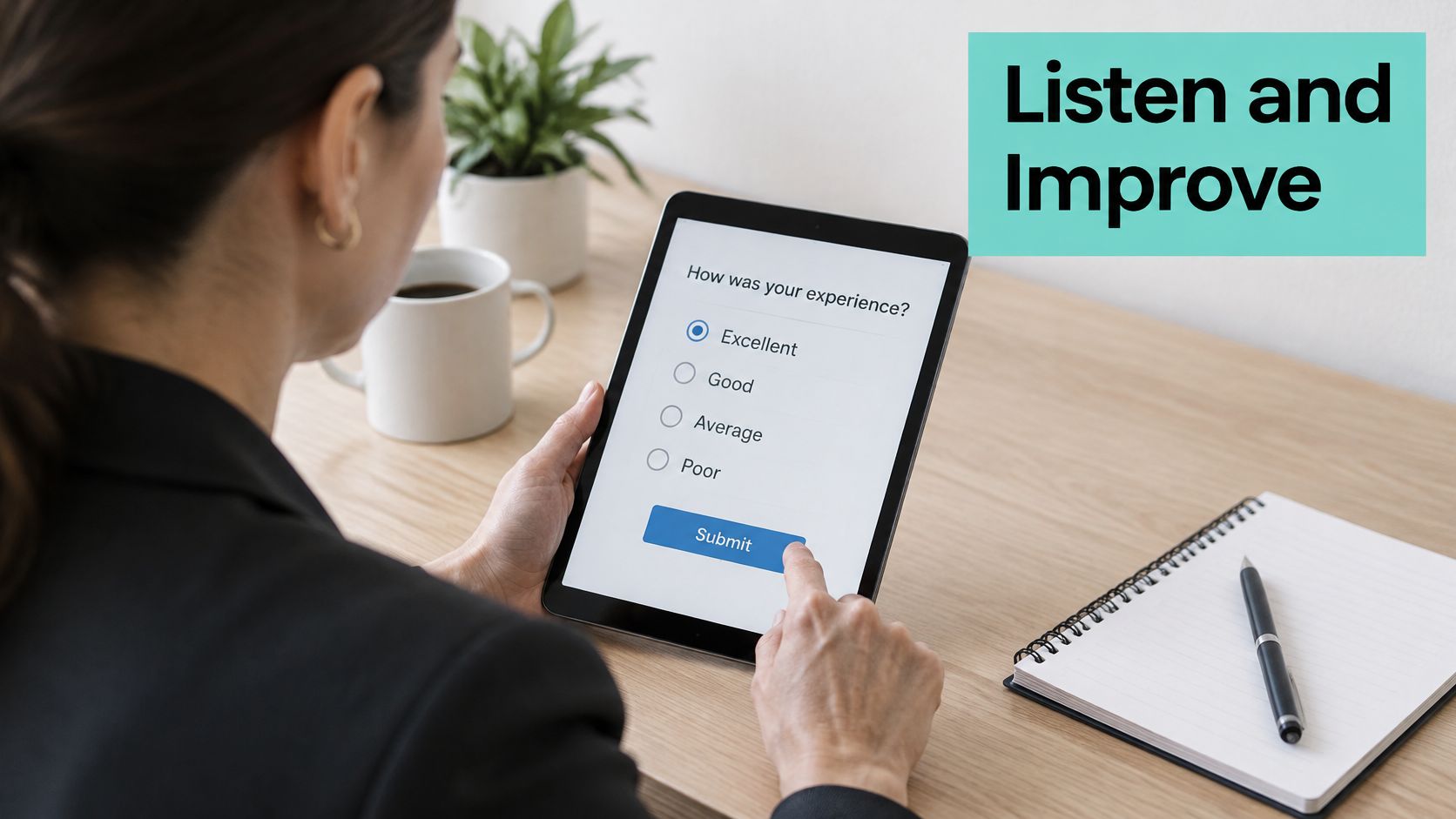
Ask two questions. How likely are you to recommend us, from 0 to 10. What's the main reason for that score. Send it after onboarding, after the first reporting cycle, and before renewal. If you compare CSAT, NPS and CES, pick the measure that matches the moment. NPS suits relationship health. CSAT suits a single interaction.
Feedback collection in the flow of work:
Worked example
A law firm surveys clients after each completed matter and calls every score below seven within 48 hours. Recovery needs action, not apology alone. A study on service recovery and customer loyalty found significant relationships for compensation, promptness, and employee behavior, while apology alone did not show a significant relationship. Fix the issue, offer a proportionate remedy when you caused it, and report the improvement in the next update.
9. Referral and Loyalty Rewards Programs
Lifecycle stage: Advocacy. KPI: referral-sourced qualified inquiries and repeat revenue from members versus non-members. Ask after a win, not during a complaint.
Rewards change behavior when they're simple and worth having. In Acxiom's 2025 consumer survey, 78% of consumers said they were more likely to remain loyal when adequately rewarded and 60% said they would choose a brand offering a loyalty program over one without one. Starbucks Rewards and Sephora Beauty Insider show the repeat-visit mechanic. Service businesses need a different version.
Worked example
A home services company gives both sides a service credit after a referred job is completed and paid. A subscription agency can add a useful deliverable, such as an extra landing page review, rather than discounting the core fee. Track referral source on every intake form.
- Check the rules first: law firms must review state bar advertising and referral-fee rules before launch.
- Reward both sides: the referrer shouldn't feel they're selling a friend.
- Time the ask: right after a positive report, a closed matter, or a five-star review.
10. Win-Back Campaigns for Lapsed Clients and Leads
Lifecycle stage: Reactivation. KPI: reactivation rate and retained revenue within 90 days of cancellation. Most lapsed customers weren't chased off. They were never asked back with a relevant reason.
Start within 7 days of cancellation. Ask one forced-choice exit question, plus one open-text box. Don't lead with a discount. Churnkey's State of Retention Report 2025 analyzed approximately $3 billion in subscription revenue and found "budget cuts" accounted for 33% of exits, with text analysis suggesting it frequently served as a proxy for product disappointment. A cheaper price won't fix weak onboarding or unclear value.
Worked example
An estate planning firm emails former consultation requests at day 90 with a short update on trust law changes and one booking link. A former agency client who cited budget gets a narrower scope option. One who cited poor fit gets a review of what changed. Limit the sequence to three or four messages. Offer a discount only when price is the verified reason, and check whether saved accounts churn again next month.
How the 10 Customer Retention Strategies Compare by Stage and KPI
Each tactic targets one lifecycle stage. Match its KPI to the outcome that stage is meant to improve, then use the example as a starting point for your own tracking.
| Item | Lifecycle Stage | Primary KPI | Best For |
|---|---|---|---|
| Structured Onboarding and Time-to-Value | Onboarding and activation | Time-to-value, measured in days from payment to the first visible result the customer cares about | New clients who need clear expectations and early results |
| Biweekly Reporting Built on Qualified Inquiries | Ongoing engagement | Qualified inquiries and cost per qualified inquiry | Clients who need clear visibility into marketing performance |
| Single Point of Contact (Dedicated Account Owner) | Ongoing relationship | First-response time by channel and retention by response-time cohort | Clients with complex needs or multiple active channels |
| Transparent Pricing and No-Contract Monthly Terms | Purchase and renewal | Pricing clarity and renewal confidence | Buyers who value predictable costs and flexible terms |
| Modular Bundles and Clear Upgrade Paths | Growth and expansion | Package expansion and account growth | Clients who want to start small and scale with results |
| Automated Email and SMS Nurture Sequences | Consideration and retention | Qualified-inquiry-to-client conversion over 30, 60, and 90 days | Businesses with long decision cycles or stalled leads |
| Practice-Area and Segment-Based Personalization | Engagement | Repeat purchase or renewal rate by segment | Businesses serving distinct audiences or service lines |
| Structured Feedback Loops and Net Promoter Score | Relationship health and renewal | Net Promoter Score | Teams seeking early warning of dissatisfaction |
| Referral and Loyalty Rewards Programs | Advocacy and retention | Referral and repeat-purchase activity | Businesses that benefit from word-of-mouth and repeat business |
| Win-Back Campaigns for Lapsed Clients and Leads | Reactivation | Client and lead reactivation | Businesses with former clients or inactive prospects |
Turn These 10 Tactics Into a 90-Day Retention Plan
Don't install ten tactics in ten days. You'll create activity and learn nothing. Pick three based on where customers leave. If clients cancel in month one or two, start with structured onboarding, a single account owner, and biweekly reporting. Your problem is proof, not promotion. Set time-to-value, first-response time, and qualified inquiries as the three numbers, then review them every two weeks.
If inquiries arrive but don't become clients, your gap sits in the middle. Build the email and SMS sequence first, then segment it by practice area or service type. A 90-day window gives high-consideration buyers time to decide without going silent. Measure booked consultations and signed work by cohort, not message opens. Keep a small holdout group if you have the volume. Otherwise you'll credit automation for customers who would've returned anyway.
If happy customers finish and vanish, work the end of the lifecycle. Add the two-question feedback loop, ask promoters for referrals within a week of a good result, and run a short win-back sequence for lapsed accounts. Read the open-text answers yourself. Patterns hide there that dashboards miss. Slow intake, confusing invoices, and unmet expectations show up in plain language long before they show up as churn. McKinsey reports that positive customer experiences yield 20% higher customer-satisfaction rates and a 10 to 15% increase in sales-conversion rates. Use those as directional benchmarks, then verify them against your own renewal and repeat purchase data.
Sequence the work in 30-day blocks. Days 1 to 30, fix onboarding and define qualified inquiry in writing. Days 31 to 60, launch reporting and one nurture track for your highest-value segment. Days 61 to 90, add feedback, referral asks, and win-back. One KPI per tactic. One owner per KPI. That's the whole operating system.
Where does outside help fit. If your team can't write, build, and schedule follow-up consistently, that's the layer to buy. SimpleLab Digital's Email and SMS Marketing starts at $495 USD per month, with advertising and third-party costs confirmed separately. The Booster package includes a four-week automated email and SMS follow-up sequence with copy, setup, and scheduling, plus onboarding, a personal Marketing Guru, and results reports every two weeks. For longer decision cycles, the Rocket package's six to twelve month nurturing programme uses agreed logic and triggers, and it does not mean a long-term contract.
Retention compounds because each fixed stage makes the next one cheaper. Better onboarding produces better reports. Better reports produce trust. Trust produces referrals and renewals. Start with the stage that's leaking customers today, measure one number, and don't add the next tactic until the first one works. That's how customer retention strategies stop being a list and start being a system your business runs every week.
SimpleLab Digital builds connected monthly marketing for small businesses and law firms, combining ads, landing pages, content, and email and SMS follow-up with one account owner and biweekly reporting on qualified inquiries. If leads stall after first contact or clients leave before they see value, visit SimpleLab Digital to review the modular packages and choose the follow-up layer that fits your next 90 days.