
Your site looks fine. The photos are current, the attorneys are real, and the contact form sends a confirmation email. Then a client calls and mentions they almost hired the firm down the street because your estate planning page never said which county you serve, and you realize the problem was never the intake script.
Most small firms sit two or three specific failures away from a steady inquiry flow, and every one of those failures is findable. A practice-area page Google can't index. A form that lands in an inbox nobody checks after 5pm. A Business Profile still listing an attorney who left in 2022. None of it shows up on a traffic chart.
What follows is the sequence I work through with a firm, in the order that makes the findings usable: crawl access first, then speed on the pages that convert, then local signals, then content quality, then the path from click to answered call, and finally a measurement baseline you can defend.
Table of Contents
- What a Law Firm SEO Audit Covers and What Passes
- How to Run the Crawl and Indexation Check
- Core Web Vitals Thresholds for Intake Pages
- Local Visibility Checks for Your Business Profile
- Practice-Area Pages and Scaled Content Triage
- Lead Path and Measurement From Click to Consultation
- Confirm Your Audit Priorities and Next Step
What a Law Firm SEO Audit Covers and What Passes
The FindLaw 2024 U.S. Consumer Legal Needs Survey reported that 97% of U.S. consumers who searched online for information about the attorney they contacted used a search engine in 2024. If Google can't crawl the page, or can't tell what service it sells, the firm loses first contact before any consultation conversation starts.
Google frames the discipline in plain terms. Its SEO Starter Guide describes optimization as helping search engines understand site content and helping users find the site through search, written for the people who own, manage or promote that content. That definition is why an audit has to examine two things at once: the machine-readable infrastructure and the client-facing clarity.
This isn't a recent discipline. Google published the first version of its SEO Starter Guide on November 12, 2008, organized around roughly a dozen recurring areas that included title and description meta tags, URL structure, site navigation, anchor text, crawlability and indexing. The point of the history is the framing: auditing is ongoing maintenance of how a legal site is crawled, indexed and interpreted, not a ranking trick you run once.
Six areas, run in sequence. Score each one as pass, fix or rebuild before you open a single report.
Law firm SEO audit scorecard
| Audit area | What you inspect | Pass standard |
|---|---|---|
| Technical crawl and indexation | Search Console coverage, robots.txt, XML sitemap, canonicals, HTTPS, status codes | Practice-area and attorney pages indexed; no key URL blocked or noindexed |
| Core Web Vitals | LCP, INP and CLS on intake, contact and practice pages | All three metrics Good at the 75th percentile of real visits |
| Local visibility | Business Profile, name-address-phone consistency, reviews, citations | Verified profile; identical NAP across website and directories; reviews steadily collected |
| Practice-area content | Page distinctness, attorney credentials, jurisdiction detail, FAQs | One authoritative page per target query; no city-swapped duplicates |
| Lead path | Form delivery, click-to-call tracking, after-hours routing, response time | Forms verified weekly; calls tracked; responses within 24 hours |
| Measurement | Indexed URLs, query impressions, qualified inquiries, signed matters, AI citations | Baseline recorded before any fix ships |
The scorecard matters because it stops the audit from becoming a 60-page PDF nobody acts on. Most firms fail two areas outright and pass four, and the two failures are usually connected. A firm that scores high on content and low on lead path will pull inquiries it can't answer, which looks like a traffic problem and isn't.
Score before you fix. Mark each area pass, fix or rebuild, and resist starting with the area that produces the prettiest report. The order of repair is set by which failure costs you inquiries, not by which one is most interesting to diagnose.
The full picture, from query to signed matter, is what a law firm SEO strategy for modern client acquisition has to connect.
How to Run the Crawl and Indexation Check
Nothing else in the audit works if Google can't reach the page, so this check goes first and finishes before you look at rankings. Work through it in this order.
The sequence below is the one that surfaces the most expensive problems fastest.
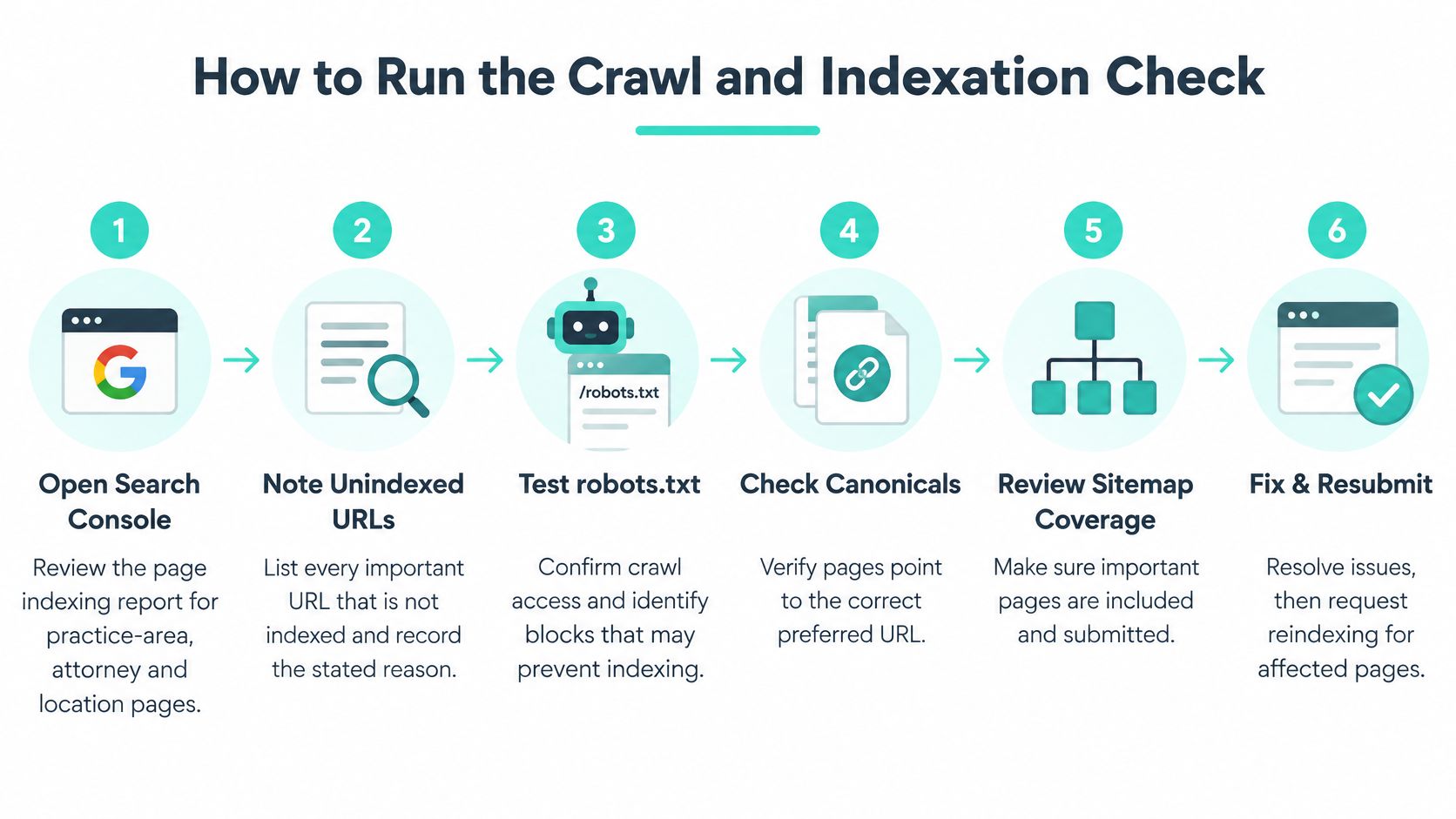
The technical checks
- Open the page indexing report. List every practice-area, attorney and location page that isn't indexed alongside the reason Google gives. "Discovered, currently not indexed" and "excluded by noindex tag" need completely different fixes, so record the reason, not just the count.
- Test robots.txt. Fetch it in Search Console and read each disallow rule against your actual folder structure. One rule blocking a practice-areas directory removes every service page from search with no warning anywhere else.
- Check canonical tags. Each page should point to its intended version. Duplicate attorney bios and competing www and non-www variants split whatever authority the page earned and confuse the query mapping later in the audit.
- Audit the XML sitemap. It should contain indexable URLs only, with nothing redirected or noindexed inside it. Submit it, because discovery through a sitemap is faster than waiting for a recrawl of the navigation.
- Verify HTTPS and status codes. Live pages return 200, moved pages return 301, and nothing in the main navigation returns a 404. Navigation links to dead pages waste crawl attention and lose the visitor who was ready to call.
- Run URL Inspection on your ten highest-value pages. Those are the pages that earn the most calls or forms, not the homepage by default. Compare the rendered HTML with what a visitor sees, because login walls, hidden text and scripts blocked by robots.txt all count as failures even when the page looks perfect in a browser.
- Hunt for stray noindex directives. Staging sites pushed live with the noindex tag intact are one of the most common causes of a sudden visibility collapse and the easiest finding to fix.
- Map one query to one page. "Estate planning attorney" and "divorce lawyer" each need a single primary page. Note cannibalization and near-duplicate location pages as you go; they get triaged in the content step, not fixed here.
If you'd rather watch the sequence before opening Search Console, this walkthrough covers the same flow, including the index coverage report and the inspection tool.
The metadata and markup checks
Titles and descriptions come next. The title tag on a practice-area page should name the practice area and the city in one clear phrase, and the description should state the service and the consultation path in language that matches what's on the page. A description promising free consultations on a page that mentions fees sets up the bounce.
Structured data gets validated page type by page type: organization or local business details on the homepage, attorney details on bios where accurate, breadcrumbs on practice pages, and FAQ markup only where the questions are visible and meet eligibility rules. Google's local business structured data guidance covers the required properties, the Rich Results Test, and rendered-page checks in URL Inspection, and it's explicit that self-serving review markup can make a local page ineligible for review rich results.
Markup buys eligibility, not position. Google's structured data policies make the distinction worth repeating: validity, accuracy and eligibility are three separate checks, and passing one says nothing about the other two.
Fix order, once the queue exists: crawl and indexation blockers, then page architecture and content quality, then structured data and conversion tracking. Nothing about a schema upgrade matters while a service page is blocked.
Re-check the same URLs on a fixed date about two weeks after each fix rather than refreshing the report daily; crawling and re-indexing legitimately take several days.
Long URL lists from a crawler also miss the pages a sitemap never included, so if you want to crawl every URL for AI readiness before setting priorities, that's the step that surfaces orphaned and forgotten pages.
Core Web Vitals Thresholds for Intake Pages
Google's field-data boundaries are unambiguous, and they're the ones to audit against.
Core Web Vitals thresholds for law firm pages
| Metric | Good | Needs improvement | Poor |
|---|---|---|---|
| LCP (Largest Contentful Paint) | 2.5 seconds or less | 2.5 to 4 seconds | Over 4 seconds |
| INP (Interaction to Next Paint) | 200 milliseconds or less | 200 to 500 milliseconds | Over 500 milliseconds |
| CLS (Cumulative Layout Shift) | 0.1 or less | 0.1 to 0.25 | Over 0.25 |
Those numbers come from Google's Core Web Vitals reporting documentation, which classifies a URL or URL group as Good only when LCP is no more than 2.5 seconds, INP no more than 200 milliseconds and CLS no more than 0.1. Search Console measures real-world visits over the previous 28 days, and its group-level figures represent the 75th percentile of those visits.
Two consequences follow for a law firm. First, a lab score from a page speed tool isn't the audit finding; the field data is. Second, a site-wide average is close to useless for diagnosis.
Test page types separately
Run the report against the homepage, each practice-area page, attorney bios, the contact page and each location page as separate groups. A firm with a fast homepage and a slow intake form can carry a healthy site average while losing the exact visitors who were ready to convert. The intake page is where the measurement earns its keep.
What usually breaks these metrics on legal sites
The causes repeat across firms, and they cluster into three buckets:
- Oversized hero images and video headers push LCP past 2.5 seconds on mobile connections. Attorney portraits and office photography are the usual culprits when nobody compressed them after the last redesign.
- Chat widgets, cookie banners and late-loading fonts shift content after it renders, which is what drives CLS above 0.1. Anything inserted above the fold without reserved space counts against you.
- Heavy third-party scripts delay the response when someone taps the call button or a form field, and that delay is exactly what INP measures.
For each failing page, record four things: the metric, the page type, the device, and the likely cause. Then assign the fix to whoever controls that template, because a developer who owns the intake template can solve in an hour what a content editor can't touch. A page that loads quickly but rearranges itself on a phone still fails the audit; the standard is all three metrics passing together, not two out of three.
Template-level fixes need a schedule, and a website maintenance checklist for law firms is the right place to sequence them so image compression and script cleanup don't undo each other.
Local Visibility Checks for Your Business Profile
Local results don't respond to city names sprinkled through copy. Google's guidance on local ranking states that results are primarily determined by relevance, distance and prominence, and each of the three needs its own fix.
The checklist below covers all three, in the order that usually finds the biggest gaps first.
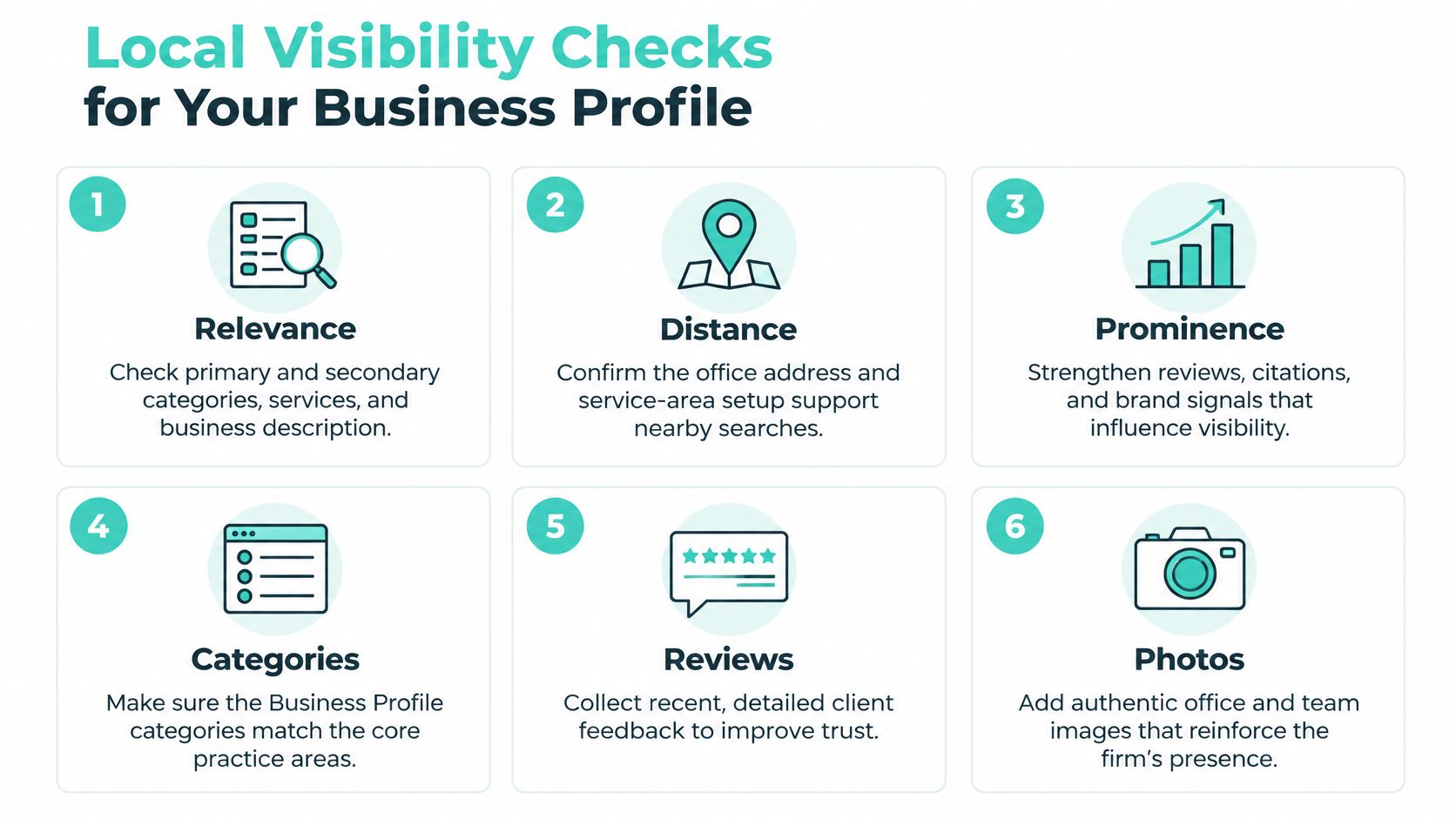
Relevance, distance and prominence are three different problems
Relevance is how well the Business Profile matches the query. Incomplete practice areas, missing service descriptions and inconsistent business details all weaken the match, which is why the primary and secondary categories should name the firm's real practice areas rather than a hopeful generic category.
Distance is calculated from the searcher or the location named in the query. No amount of city names on a website extends reach across a metro area. The audit should confirm that each office has its own verified listing and that the service-area setup reflects where attorneys meet clients.
Prominence reflects how well known the firm is, and Google can draw on links, articles, directories, review count and review score to judge it. That's the lever a small firm can pull, month after month.
The checklist I run
- ✅ Claimed and current profile. Verify ownership, then check hours, categories, services, photos and the appointment link against what the website says.
- ✅ Identical name, address and phone. Compare the website footer, the Business Profile, the state bar listing and the major legal directories character by character. A suite number formatted three ways creates three ambiguous records.
- ✅ Legitimate location eligibility. A virtual office or a co-working address can jeopardize the listing, and losing it removes the firm from the map pack entirely.
- ✅ Review volume, rating, recency and reply rate. Recent reviews with owner responses tell a better story than a large stale pile, and responses are visible to every prospective client reading them.
- ✅ Authoritative mentions. Bar association listings, local news coverage and legal directory profiles all feed prominence; a missing bar profile is a gap worth closing this week.
- ✅ Duplicate and unclaimed profiles. Flag any second listing for the same office and any unclaimed listing showing a former attorney or a closed address.
Review work also has a compliance edge. Soliciting reviews with incentives, or writing them on a client's behalf, creates professional-responsibility exposure that no ranking gain justifies.
If you track map positions across dozens of queries, it's worth knowing how to check Google rankings with an API so the numbers refresh daily instead of whenever someone remembers to check manually.
Keep it consistent with a short monthly pass
Staff moves, office changes and new practice areas all break consistency. One pass a month over the profile, the footer, the bar listing and the two or three directories that matter catches nearly everything. For a firm whose immigration work spans two languages and multiple service areas, the same checks carry extra weight, and the local SEO approach for immigration lawyers covers how that plays out.
Practice-Area Pages and Scaled Content Triage
Audits can get uncomfortable. Google defines scaled content abuse as producing many pages primarily to manipulate rankings rather than help users, and Google's spam policies name mass-generated pages, scraped or transformed material, stitched content from multiple pages and keyword-heavy pages with little value. The policy applies whether the content was produced automatically, manually or through a mix of both.

A firm publishing a personal injury page for thirty cities from one template is exposed. So is a firm that runs estate planning, family law, immigration and real estate through the same page skeleton with the practice name swapped. The comparison you're making, page against page, covers copy, attorney expertise, jurisdiction-specific rules, local facts, process explanations, original FAQs and the conversion path.
Practice-area page triage
| Page pattern | Typical problem | Action |
|---|---|---|
| Practice page with distinct copy and attorney credentials | Solid but missing FAQs or process detail | Keep and improve |
| Practice page built from a shared template | Same structure and wording as other practice areas | Rebuild with jurisdiction rules and real process steps |
| City page with only the city name changed | Near-duplicate copy across many locations | Consolidate into one strong location page or add local facts |
| Attorney bio repeated across pages | Duplicate content and unclear expertise | Give each attorney a unique bio and canonicalize the rest |
| Blog posts answering the same question | Cannibalization between posts | Merge into one authoritative article and redirect the others |
Where the replacement content comes from
Intake call notes are the most underused source of page copy in a law firm. The questions staff field in the first four minutes of a call are the questions the practice page should answer, in the words the caller used. Those notes produce FAQs nobody else in the market has written, and they're jurisdiction-specific because the callers live there.
Attorneys also hold detail that no writer can invent: which courthouse handles the filing, how long a local probate takes, what the clerk's office requires. That detail is what separates a defensible page from a rewritten competitor page.
Why consolidation beats expansion
Bigger sites aren't safer sites. A smaller set of strong, jurisdiction-specific pages usually outperforms a large set of near-duplicates, because each duplicate dilutes crawl attention and competes with its own siblings for the same query. Deleting or merging a page feels like losing ground until you watch the surviving page climb.
The content plan that follows triage is a sequencing question, and a step-by-step content marketing plan for law firms is where to put the rebuilds in order.
Lead Path and Measurement From Click to Consultation
A page can rank well, load fast, and still produce nothing if the inquiry dies between the click and the callback. Scorpion's 2025 legal client research found that 74% of legal clients research a firm online even after receiving a personal recommendation, while 72% of prospective clients will not wait more than 24 hours for a callback. A form that lands in an unchecked inbox is a failed conversion the audit should catch, in the same class as a noindexed page.
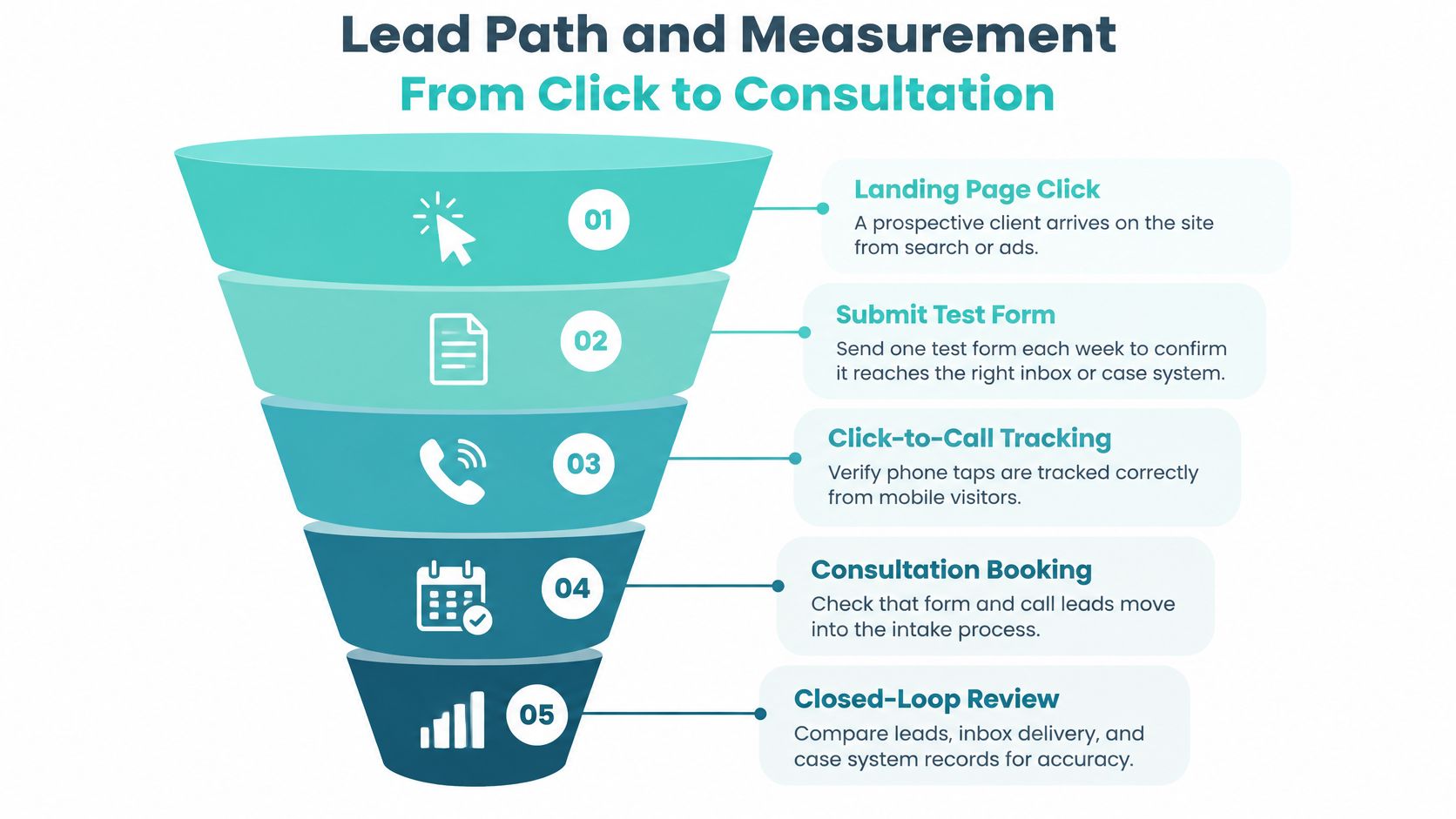
Trace the path in order
Submit a test form every week and confirm it reaches the right inbox or case management system. A thank-you message in the browser proves nothing about delivery. Verify that click-to-call fires as a tracked event, that mobile calls connect to a staffed line, and that after-hours calls route somewhere other than a voicemail nobody checks. Time-stamp the first human response, and note any conflict-screening step that adds a day before anyone speaks to the caller.
Segment before you judge any of it. An immigration inquiry, a family-law emergency and an estate-planning consultation carry different urgency and qualify on different criteria, so one blended conversion rate hides which practice area produces retainable work. If a meaningful share of calls arrives outside office hours, an AI phone answering service keeps the inquiry alive until staff return, provided the transcript lands in the same inbox your form tests already confirmed is monitored.
Record a baseline before any fix ships
Write down indexed URLs, query-level impressions for target pages, calls, forms, qualified inquiries and signed matters, with a separate line per practice area. Without that record, every later claim about improvement is a guess.
Then sample AI answers monthly. Choose 20 to 30 prompts by jurisdiction and practice area, record which firms and sources get cited, and separate branded from non-branded recommendations. Attorney at Work's research on how clients find lawyers puts Google at 86.7% as the leading attorney-research platform, with ChatGPT rising to 28.1% in 2025 from 20.5% in 2024 and 9% in 2023. AI visibility now supplements high-intent search pages, so track it beside them rather than instead of them.
Sampling is only worth the effort if you compare AI-driven inquiries with their lead quality. A citation that produces a caller who never retains isn't a win, and a missing citation in a low-value query isn't an emergency.
The reporting view that keeps this honest is the same one behind any law firm marketing ROI measurement: visibility, inquiries and signed matters in one place, so a ranking gain that produces no retained work reads as what it is.
Confirm Your Audit Priorities and Next Step
Findings become useful only when they're a queue with owners. This is the order I'd work in, regardless of how the scorecard reads:
- Crawl and indexation blockers. Nothing downstream compensates for a page Google can't index.
- Intake failures and speed. Fix form delivery, call routing and Core Web Vitals on the intake templates before adding pages.
- Local profile and NAP conflicts. Cheap to fix, disproportionately expensive to leave alone.
- Practice-page consolidation. Merge the duplicates, rebuild the thin ones, delete what can't be made distinct.
- Structured data validation. Accuracy and eligibility, page type by page type.
- Measurement setup. Baseline, call tracking, and a monthly AI sampling routine.
A two-week plan for a small firm is enough to start. Week one: clear Search Console errors, run the form test, correct the Business Profile and the footer NAP. Week two: fix the Core Web Vitals failures on intake pages and merge the duplicate city pages. One owner per task, named in writing, because audits stall when nobody controls the intake inbox or the page template.
The capacity question is real. The ABA's 2023 legal technology survey found that 28% of responding firms hired outside consultants or agencies for SEO, against 8% for Google Ads or PPC, and the same survey put overall marketing-effectiveness confidence at just 3 out of 5. Most firms are doing this without much outside help and without much confidence in the result.
Where a firm lacks in-house capacity for page rebuilds, our SEO/GEO and website maintenance service has two starting points: an audit plus ongoing optimization, or full optimization of up to 25 pages. Practice-area and location-page rebuilds sit inside the law firm marketing work, and lead-path and local-profile fixes sit alongside it. What we need from you is fixed: a clear service to promote, an advertising budget separate from any package fee, someone who can supply business information and approve work, a team member to respond to inquiries, and a way to share lead quality and sales feedback.
The single action for this week: run the crawl check and submit one test lead form. Both take under an hour, and together they tell you whether the rest of the audit is worth scheduling.
If the crawl check turned up blocked practice pages, an intake form that never arrives, or a set of city pages you already suspect are duplicates, SimpleLab Digital handles that work as a monthly service rather than a one-off report. We start with an audit and a prioritized queue, then work through the fixes and the content that supports them, month by month. Visit SimpleLab Digital to see how the audit and ongoing optimization fit together.