70% of participating legal consumers used online content to guide hiring decisions, according to a Martindale-Avvo study reported by the ABA Journal. Getting found matters, but visibility alone doesn't tell you whether a campaign attracts clients your firm can represent.
Google Ads for law firms should be judged by signed matters and acquisition economics, with compliance built into the campaign. That means connecting searches to the right services, screening inquiries properly, and knowing what happens after someone calls. A low cost per lead isn't a win if those leads never become clients.
Table of Contents
- What Google Ads Really Costs Law Firms
- Keyword Strategy by Practice Area
- Choosing the Right Campaign Type
- Aligning Keywords, Ads and Landing Pages
- Compliance Built Into Every Ad and Page
- Measuring Signed Cases Instead of Cheap Leads
- Set Your Budget by Practice Area Before Launch
What Google Ads Really Costs Law Firms
A legal search click costs more than an all-industry click in the benchmark figures below. Cost per lead also runs higher, so a campaign's economics depend on whether inquiries become suitable, paying matters, not just on the price of a form submission.
Legal search benchmarks against all industries
The figures published in On The Map Marketing's legal marketing statistics offer a comparison point for Attorneys & Legal Services search campaigns and all industries.
| Metric | Attorneys & Legal Services | All industries |
|---|---|---|
| Average cost per click | $9.87 | $5.42 |
| Average cost per lead | $131.63 | $66.69 |
| Click-through rate | 5.87% | 6.64% |
| Conversion rate | 5.55% | 8.18% |
These are averages, not a forecast for a particular firm. The figures come from one comparison, so use them together rather than mixing benchmarks from different datasets.
The allowable acquisition cost depends on matter value and conversion through the intake process. Account for attorney time, intake labor, overhead, and profit when setting a target. An apparently affordable lead can still lose money if it is unqualified or never becomes a client.
Practice areas also differ. Urgency, geography, eligibility, fees, and the firm's willingness to take a matter all affect what an inquiry is worth. Measure progress through qualified inquiries and signed cases, not cost per lead alone.
Budget check: High lead costs call for an audit of what the campaign is buying before increasing spend.
Keep advertising spend distinct from management fees, landing-page work, tracking, and intake costs. The guide to what advertising on Google really costs explains how to separate the media budget from surrounding operating costs.
Google Ads can capture existing search demand, but a confusing website or unanswered phone can waste that spend. If costs are above the comparison, review search terms, location settings, and landing-page friction before raising the budget.
Keyword Strategy by Practice Area
| Practice area | High-intent keywords | Negative keywords | Landing page |
|---|---|---|---|
| Estate planning | will lawyer near me; revocable trust attorney; probate attorney | free will template; DIY trust | Estate planning page |
| Family law | divorce lawyer; child custody attorney | divorce forms; free divorce papers | Family law page |
| Immigration | immigration lawyer; green card attorney; visa petition lawyer | visa jobs; immigration news | Immigration page |
| Personal injury | car accident lawyer; slip and fall attorney | accident report; insurance quote | Personal injury page |
| Criminal defense | DUI lawyer; criminal defense attorney | DUI school; inmate search | Criminal defense page |
| Real estate | real estate attorney; closing attorney | homes for sale; real estate agent | Real estate law page |
| Bankruptcy | bankruptcy lawyer; Chapter 7 attorney | bankruptcy forms; credit repair | Bankruptcy page |
| Employment | wrongful termination lawyer; employment attorney | job openings; resume | Employment law page |
| Business litigation | business litigation attorney; commercial dispute lawyer | court jobs; legal textbook | Civil litigation page |
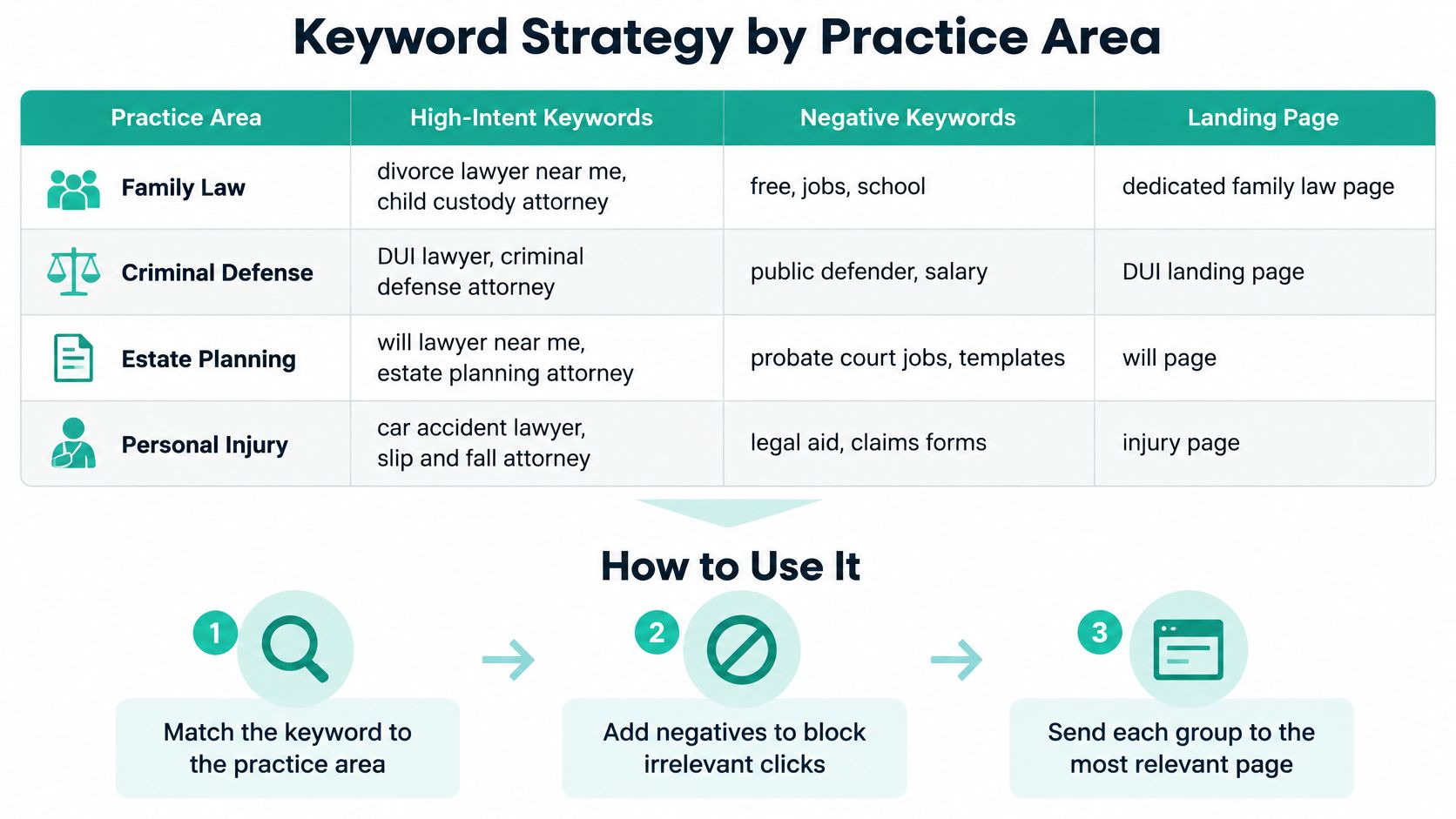
Treat this as a starting structure, not a keyword list to upload without review. Practice area defines the service you want to sell; high-intent keywords describe someone seeking representation rather than general information. The negative keywords screen out unrelated intent, while the landing page gives each group a relevant destination.
This visual condenses the keyword-to-page relationship.
Build around the matters you accept
Start with your intake criteria. An employment firm representing employees shouldn't casually buy searches from employers seeking defense counsel. A real estate firm handling purchase contracts shouldn't pay for property listings.
AISEOGrow's guidance on how to match keywords to how prospects search is useful for translating internal practice labels into language a prospective client would type. Add service locations where appropriate, but don't assume a city name alone guarantees a suitable inquiry.
Use exact and phrase match as controlled starting points in expensive practice areas. Exact match can include searches with the same meaning or intent; phrase match is not just a requirement that words appear in a fixed order. Neither removes the need to review actual queries.
Broad match deserves a test only when qualification signals and negative lists are dependable. Otherwise, automated bidding can pursue inquiries that look successful in the account but don't fit the firm.
Exclude intent carefully
DIY forms, free templates, job listings, news, and court-employment queries are common exclusion candidates. Avoid blanket exclusions that could block worthwhile prospects, such as excluding every search containing “cost” when suitable clients naturally ask about fees.
Use the Google Ads search terms report optimization guide to review what triggered ads, not just the keywords you entered.
SimpleLab Digital serves small businesses generally, with specialized practice-area marketing pages covering estate planning, family law, real estate, civil litigation, immigration, personal injury, criminal defense, employment, and bankruptcy. The operating rule stays consistent: give each ad group a coherent service intent and a matching page, then split broader groups when their searches require different explanations.
Choosing the Right Campaign Type
| Campaign type | Best use | Main risk | Measure with |
|---|---|---|---|
| Search | Practice-area intent such as wills or DUI | Broad match pulls low-intent queries | Search terms, calls, form submissions |
| Call-only | Urgent matters such as criminal defense | After-hours calls go unanswered | Call length and call-quality score |
| Performance Max | Firms with clean conversion history | Limited control over search terms | Offline signed-case imports |
| Remarketing display | Visitors who viewed a practice page but didn't call, where permitted | Privacy exposure on sensitive pages | Return visits and assisted calls |
| Local Services Ads | Eligible local practices buying leads | Lower lead costs can hide weaker signed-case results | Cost per signed case |
Match the format to the operating reality
Search campaigns are the clearest starting point when someone is actively seeking a defined legal service. Their advantage is intent visibility: you can inspect queries and adjust the offer. Their weakness is that loose targeting can turn a focused campaign into an expensive information service.
Call-only or call-focused advertising suits urgent matters when a trained person can answer. Confirm which call formats are available in your account rather than building around a label alone. Schedule delivery around actual coverage, and provide a reliable fallback instead of paying to send distressed callers to an unattended voicemail.
Performance Max becomes a more defensible test after several months of clean conversion history. It can expand reach across placements, but you give up some targeting and reporting control. Don't introduce it merely because the platform recommends expansion.
Remarketing display isn't automatically appropriate for legal services. A practice-page visit may reveal a sensitive circumstance, so permission under platform rules and applicable privacy requirements comes before audience creation. Consent alone doesn't make every sensitive-interest audience permissible.
For a practical distinction between capturing an existing search and reaching someone while they browse, consult our search advertising versus display advertising comparison.
Compare channels without confusing their economics
Local Services Ads are a separate Google channel, not a conventional Search campaign setting. Compare their eligible lead flow with Search using the same intake definitions and downstream outcomes. A cheaper inquiry doesn't establish a better acquisition channel.
Placement rules and available formats change. Lighthouse Legal's Google advertising updates for small businesses can help frame an account review, but verify current eligibility and controls inside Google before launch.
Start with Search in a narrow selection of practice areas. Add reach only when you can distinguish a useful inquiry from a convenient conversion.
Running every format at once makes diagnosis harder. A concentrated launch lets the firm identify whether the constraint is demand, messaging, qualification, or intake capacity before adding another variable.
Aligning Keywords, Ads and Landing Pages
A search for will lawyer near me should lead to a page about preparing a will, not a homepage where visitors must sort through unrelated services. The page should name the service, explain whom the firm helps, show relevant attorney credentials, and make the next step clear.
Estate-planning searches can reflect different needs. Someone preparing a will needs different information from someone administering an estate, even if the same firm handles both.
Relevance affects more than conversion
Google's auction-time Ad Rank considers the bid, expected click-through rate, ad relevance, landing-page experience, search context, competition, thresholds, and the expected impact of assets. Better alignment can improve eligibility and position without relying only on higher maximum bids.
Google reports Quality Score on a 1–10 scale, but its Quality Score guidance describes the score as a diagnostic, not a direct auction input. It also states that reported conversions do not affect ad quality. Use the component assessments to identify weak relevance or page experience, rather than treating the score as a target.
A page may collect form submissions and still fail to answer the searcher's specific question. A relevant page may also need clearer intake steps, rather than a full keyword rebuild.
The path should make sense at each step.

Check the handoff on a phone
SimpleLab Digital's approach connects ads, landing pages, content, and follow-up. Ads create the first opportunity, the landing page explains what comes next, content adds context, and follow-up keeps the conversation moving. Each step should address the prospect's immediate question.
Use this prelaunch check:
- Choose a focused destination. Give each practice area a relevant landing page, with narrower pages where search intent calls for them.
- Match the headline. Reflect the service sought without awkwardly repeating keywords.
- Identify the firm. Make the firm name and responsible lawyer visible.
- Make the next action clear. Put calling or requesting a consultation first, without competing offers.
- Test on mobile. Check loading, tap-to-call behavior, form completion, and confirmation messages.
Use this guide to build landing pages for law firm consultations and check that the ad's promise carries through to the next step. Keep advertising forms focused on starting intake. They do not need to collect a detailed case narrative.
Compliance Built Into Every Ad and Page
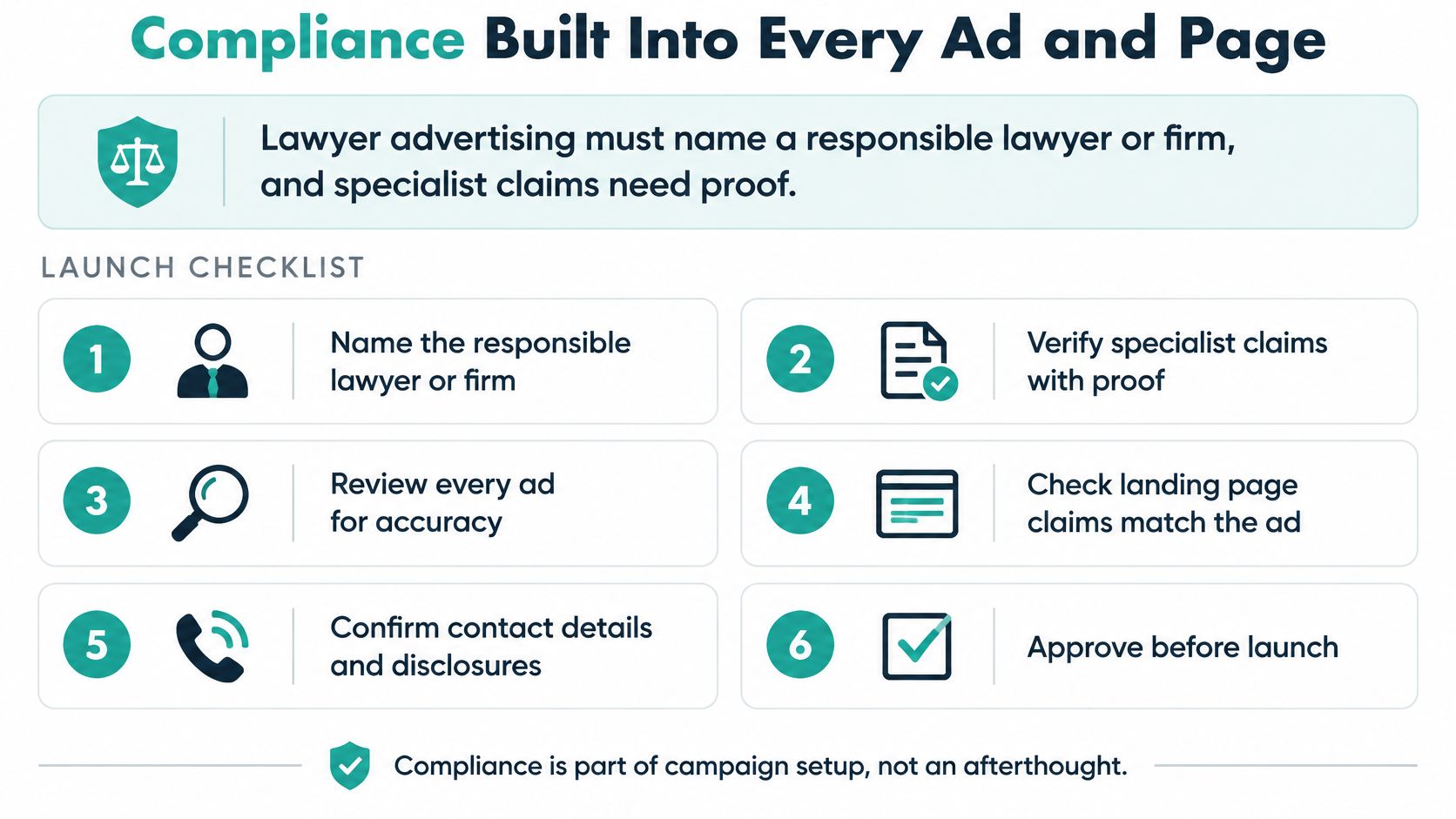
Lawyer advertising must identify a responsible lawyer or firm, and specialist claims require more than confident wording. ABA Model Rule 7.2 requires communications to include the name and contact information of a responsible lawyer or law firm and restricts claims of specialist certification unless its conditions are satisfied.
The Model Rule isn't a substitute for the rules adopted in each jurisdiction. Have the responsible attorney approve the actual campaign, including assets, destination pages, tracking, and follow-up.
Approve the complete communication
Identify the responsible firm and contact details. Review every ad format, including call-focused ads, alongside its destination. Don't assume a footer on an unrelated page fixes an incomplete communication.
Verify claims and remove guarantees. Review superlatives such as best and top, specialist language, testimonials, and outcome percentages for substantiation and local permissibility. Proof alone doesn't make every claim acceptable.
Match promises and qualifications. An ad shouldn't promise an outcome that the landing page later withdraws. Google prohibits misleading representation under its advertising policy guidance, so accuracy is also an account-eligibility issue.
Describe the service boundary. Advertise legal advice, consultation, or representation rather than suggesting that the firm issues official documents. Google's government-document support discussion illustrates why wording that implies document procurement can trigger review.
Control intake language. Forms, chat, and automated replies shouldn't imply that an attorney-client relationship already exists or provide individualized legal advice. Include a clear relationship notice, but have counsel review the actual workflow rather than relying on disclaimer text alone.
Minimize collection and control tracking. Ask only for information needed to route the inquiry, define retention and access rules, and obtain consent where required before relevant tags fire. Review remarketing eligibility separately from consent.
Check every target jurisdiction. Review disclosures, testimonials, consultation pricing, geographic claims, privacy, and solicitation requirements for the locations you serve. A campaign approved for one jurisdiction shouldn't be copied elsewhere without review.
Use the checklist as a launch gate, with a named approver.
Treat privacy as a design constraint
The Canadian Bar Association's modern advertising toolkit identifies privacy risks associated with data-driven targeting and observed or expressed interests. A search query, voicemail, or chat can reveal more than ordinary contact information.
Map which systems receive each field. Call tracking, analytics, CRM software, and email automation shouldn't all inherit unrestricted access to prospective-client narratives.
Approval standard: Review ads, pages, remarketing, and follow-up as one communication system, not separate marketing tasks.
Automated review can examine destination content, so inspect relevant website language beyond the paid landing page. Keep an approval record and repeat review when offers, templates, or automation change.
Measuring Signed Cases Instead of Cheap Leads
Cheap leads can be expensive acquisitions. A campaign can report healthy form volume while intake rejects most inquiries or fails to turn suitable consultations into engagements.
The funnel needs to extend beyond the advertising dashboard.

A channel analysis summarized by RYN Digital found that Google Ads produced a lower average cost per lead than Local Services Ads, while Local Services Ads produced a lower cost per signed case. That's a reason to test both against your own intake results, not declare a universal winner.
Worked example from lead to signed case
The following is illustrative, using the benchmark lead cost and hypothetical consultation and signing rates. It isn't a forecast.
| Funnel stage | What to track | Illustrative input |
|---|---|---|
| Lead | Calls and form fills | $131.63 cost per lead, benchmark |
| Qualified consultation | Booked and attended intakes | 40% of leads, illustrative |
| Signed case | Engagement letter returned | 25% of consultations, illustrative |
| Cost per signed case | Spend divided by signed cases | $1,316.30, calculated illustration |
The calculation is $131.63 ÷ (40% × 25%) = $1,316.30 per signed case. That excludes management fees and other acquisition expenses, so it isn't yet a fully loaded acquisition cost.
A higher fee doesn't automatically justify that acquisition cost. Consider delivery costs, delayed collection, screening losses, and the cash needed to operate while revenue remains outstanding.
Connect the CRM to the advertising decision
Track impression → click → lead → qualified consultation → signed case → collected revenue. Keep CRM stages consistent, but segment reporting by practice area so criminal defense, immigration, family law, and estate planning don't disappear into a firm-wide average.
Preserve permitted attribution identifiers, record stage changes, and import eligible offline conversions into Google Ads. Choose a primary bidding event deliberately; counting every stage as an equally valuable conversion can overstate success.
Score calls using practice-area fit, service geography, intake completion, and disposition. Duration is a clue, not proof: a long unsuitable call shouldn't outrank a brief qualified intake.
Use the accompanying video alongside a review of your actual intake workflow.
For injury practices, Attorney Assistant's guidance on how to convert injury leads into signed cases adds an intake-focused perspective. Our law firm marketing ROI guide helps frame the financial review.
Import only permitted stage flags and necessary attribution fields, never case narratives or sensitive details. Better bidding signals don't justify unrestricted disclosure.
Set Your Budget by Practice Area Before Launch
Use a go or no-go test before opening the account. Google Ads makes sense when the firm has a defined service, plausible acquisition economics, and enough intake capacity to handle the inquiries it buys.
Choose a narrow launch. Pick one or two practice areas where the expected contribution from a signed matter can support acquisition costs. Favor matters the team can screen and serve consistently, not just the firm's highest theoretical fee.
Budget against signed matters. Build a monthly plan from a target cost per signed case and the volume your team can handle. Treat the illustrative funnel as a scenario to stress-test, not a budget guarantee.
Assign the prerequisites. We ask clients for a clear service to promote, advertising funds separate from the package fee, someone to provide business information and approve work, a team member to answer inquiries, and a way to share lead-quality and sales feedback.
Complete attorney approval. Resolve compliance, privacy, destination-page, and tracking questions before any ad goes live. An unresolved approval issue is a reason to delay, not something to fix after spending begins.
Make the opening month diagnostic. Review search terms throughout the first thirty days and add appropriate negatives weekly. Check lead dispositions alongside queries so exclusions reflect business fit rather than guesswork.
Know when not to launch
If the firm can't answer inquiries reliably, fix intake first. SimpleLab Digital's packages don't include phone-call handling, so the firm needs a clear owner for that responsibility.
We offer Google Ads as a standalone digital solution starting at $495 USD per month, with advertising spend confirmed separately. Firms can review the law firm marketing and Google Ads service pages on our website to compare scope with their operating needs.
Outcomes vary by firm. A restrained launch with accountable intake is more useful than a large budget attached to unanswered calls and incomplete reporting.
SimpleLab Digital offers Google Ads management alongside landing pages, content, and follow-up services that can support the path from search to consultation. Visit SimpleLab Digital to review the Google Ads and law firm marketing options, then bring your priority practice areas, intake capacity, and acquisition targets to the planning conversation.