A 2007 Lead Response Management study, run over three years across six companies, more than 15,000 web-generated leads, and over 100,000 call attempts, found that waiting 30 minutes instead of calling five minutes after a lead arrived cut the odds of making contact by about 100 times and the odds of qualifying the lead by about 21 times (Plura's account of that Lead Response Management study). Those firms and calling habits won't match every local business, but the decay is hard to ignore.
That's the frame for how to generate leads. More traffic doesn't help if the ad, the page, the listing, the reviews, and the follow-up each make a different promise, or if nobody answers. I would build an accuracy-and-trust system first, and add another acquisition channel only after those surfaces agree.
Table of Contents
Map the Lead-to-Sale Journey First
Run the work as six stages you can count this week: ad interaction, landing page visit, inquiry, qualified lead, consultation, and closed client. One metric per stage stops a cheap form fill from looking like a win.
| Stage | Metric to Track | Usual Owner |
|---|---|---|
| Ad interaction | Click-through rate and cost per click | Ad manager |
| Landing page visit | Visit-to-inquiry conversion rate | Page owner |
| Inquiry | Response time and inquiry volume | Intake or front desk |
| Qualified lead | Share of inquiries passing fit, location and urgency checks | Intake lead |
| Consultation | Booked and held consultation rate | Sales lead |
| Closed client | Revenue per client and cost per acquired client | Business owner |
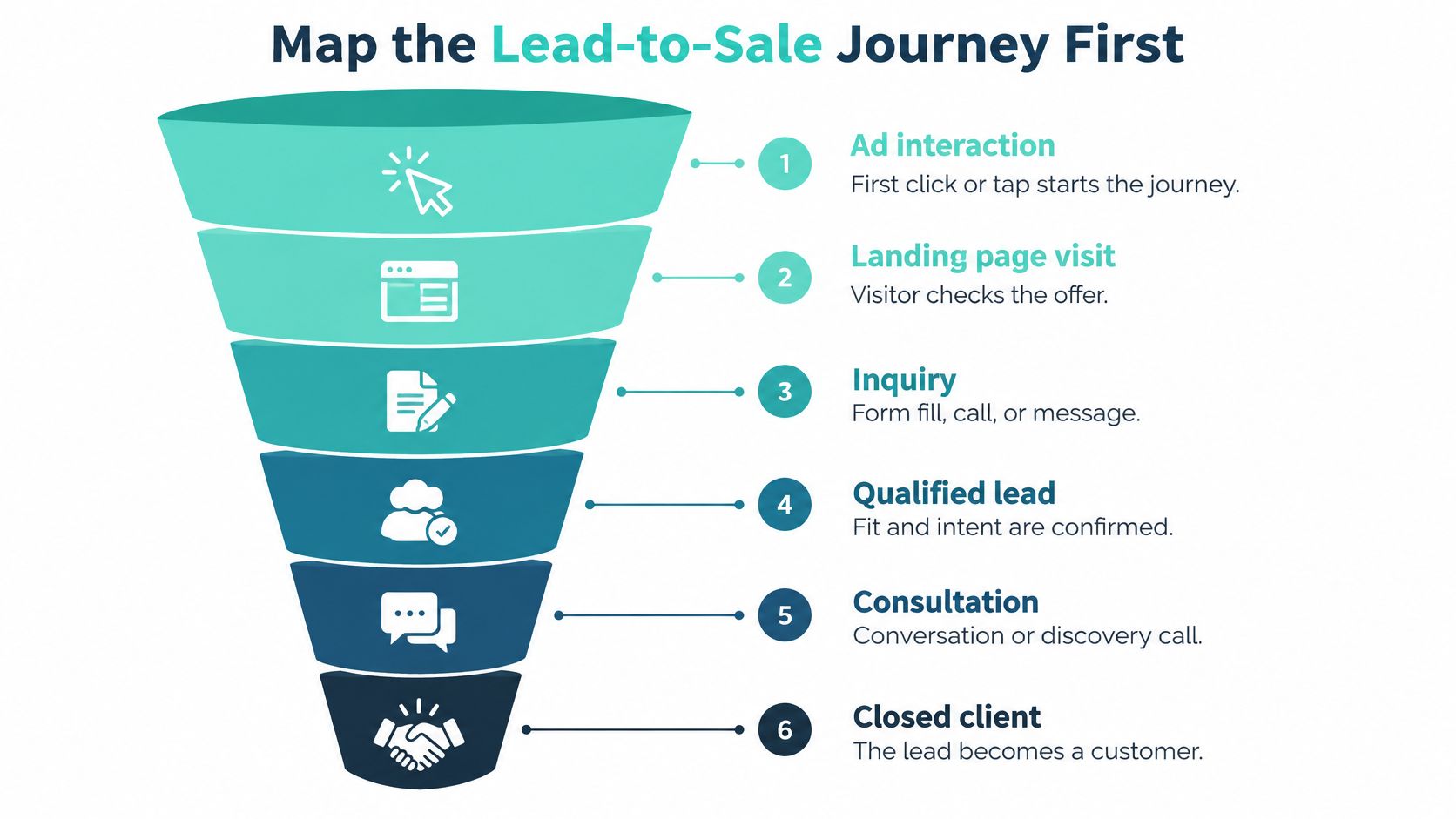
The order is the point. Clicks that never become inquiries are wasted media. Inquiries that fail fit, location, or urgency never deserved a calendar slot. Consultations that aren't held don't become revenue. The map shows where volume disappears.
Four layers between the stages
Our plan connects those stages with four layers. Ads create the first opportunity. A landing page explains the next step. Content gives people more context before they commit. Follow-up keeps the conversation moving after the first reply.
Judging a campaign only by cost per form submission hides that loss. Say a cleaning company celebrates every quote request. The jobs that get staffed are the only ones that pay rent. A practical walkthrough of turning those requests into booked work is how crews book more residential cleaning jobs.
Practical rule: Count last month's inquiries, how many passed fit, location, and urgency, and how many reached a consultation. The gap between those three numbers is the first fix.
Create an Offer Worth Requesting
Write the offer before you buy a click. Every channel and every page depends on a promise a buyer will act on.
Three questions
Which service earns the most per client? Start there. Advertising the cheapest service just to "get leads" trains the wrong pipeline.
What problem is the buyer trying to solve before they hire anyone? Use their words. "Probate is already filed and I don't know the deadline" is an offer. "Full-service estate solutions" is a brochure.
What low-risk next step would they take today? A consultation, a fixed-scope quote, or a short guide. "Learn more" is not a step.
Three offer types
Buyers who already search by the name of the service can take a direct offer, such as a free consultation or a fixed-scope quote.
Buyers who haven't named the problem need a useful asset: a checklist, a cost guide, or a short video. If that asset is a downloadable product rather than a service consult, validate your digital product idea before you spend weeks building it.
People who already inquired, and aren't ready to book, get a short planned sequence. The sequence is the offer. A random "just checking in" email is not.
Three checks before you pick a channel
- One sentence. Can a buyer repeat the value after a single read?
- You can deliver it. The team can do, this week, exactly what the page says.
- A light ask. The next step needs a name and a contact method, not a life story.
Use those same words on the ad, the landing page, and the listing. Then write down the cost per qualified inquiry you expect before launch. The first two-week review needs a baseline to beat.
Choose Channels That Match Buyer Intent
Choose the channel by what the buyer is doing in that moment. A consultation ask on a discovery platform, or a vague checklist on a "near me" search, both waste the click.
| Channel | Buyer Intent | Offer to Match | Lead Quality Signal |
|---|---|---|---|
| Google Search | Active need, searching for a named service | Service or practice-area page matching the query | Calls and forms within the same session |
| Meta and Instagram | Early interest, problem not yet named | Checklist, short guide or explainer video | Form fills that reply to a follow-up message |
| TikTok | Discovery, low prior awareness | Short clip linked to one specific offer | Share of leads passing the qualification check |
| Local listings and local SEO | Ready to call or visit nearby | Service-area page with accurate hours | Calls, direction requests and booked visits |
| Email and SMS | Existing inquiry not yet ready to book | Planned nurture sequence | Consultations booked after the sequence |
High intent, tighter volume
Google Search catches an active need. Point each ad at one service or practice-area page that matches the query. Cost per lead often looks high until you compare it with consultations held.
Local listings and local SEO catch people who are ready to call or visit. Accurate hours and a real service area beat a pile of impressions. Watch calls, direction requests, and booked visits.
Earlier intent, messier quality
Meta and Instagram meet people before they've named the problem. Lead with a checklist, a short guide, or an explainer, not a hard consult. The quality signal is whether those form fills answer a follow-up.
TikTok is discovery. One short clip, one offer, and a qualification check you run. Volume can look busy while almost nobody is a fit.
Email and SMS don't find new buyers. They move inquiries you already have. Judge them by consultations booked after the sequence, not by how many messages went out.
A small budget split across five channels produces numbers you can't read.
Start with one paid channel and one owned channel. If people already search for the service by name, start with search. If they need convincing first, start with social and carry them in email or SMS. When the site itself is the bottleneck, channels ranked by how fast they send traffic is a useful order of operations.
How to Build a Landing Page That Converts Matched Traffic
Build the page against the ad or query that sent the visitor. A generic page that mixes three intents loses the match in the headline.
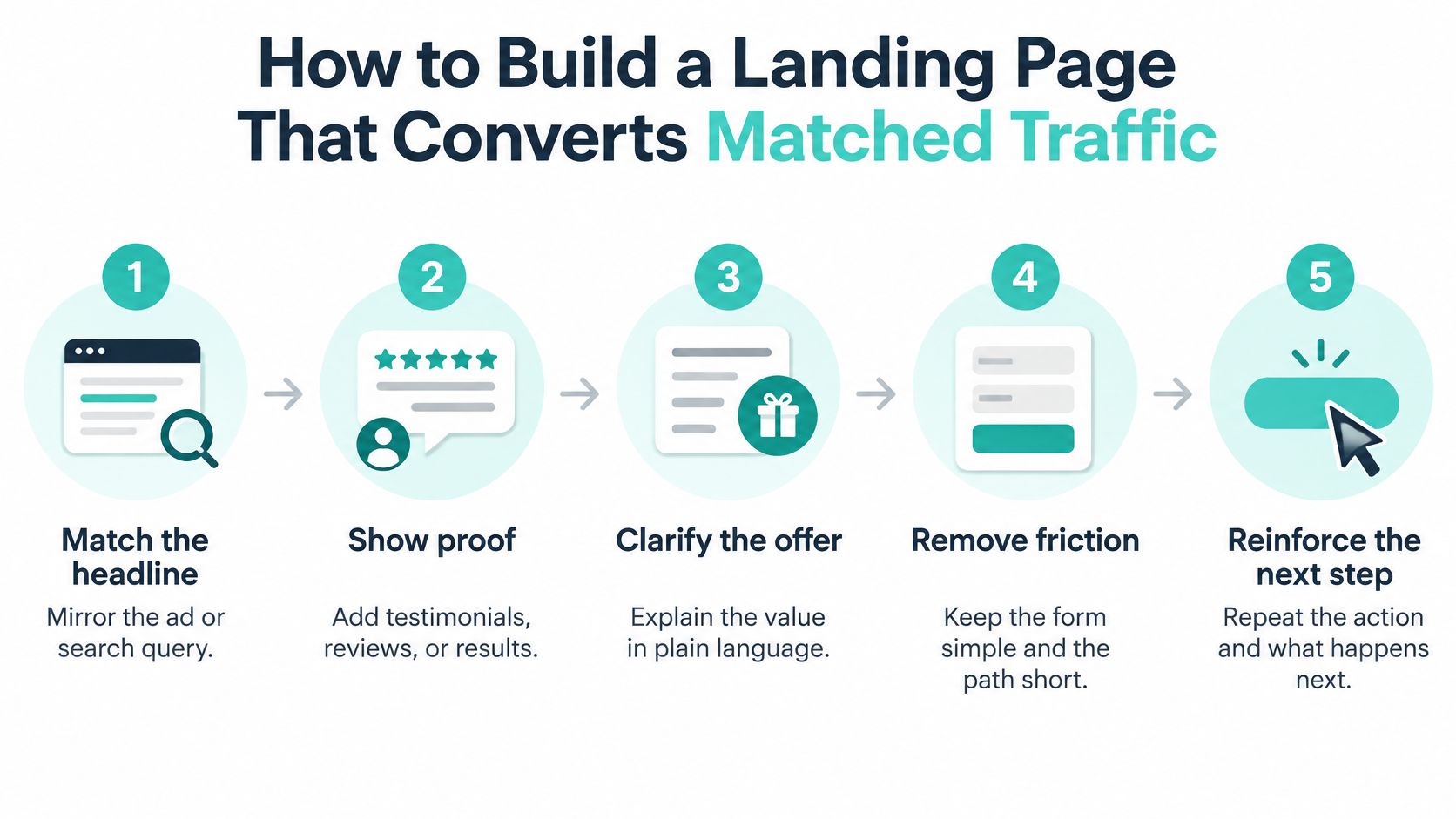
- Match the headline and the proof to the query. The visitor should see the promise they clicked, not a firm-wide slogan.
- State one offer and one next step. A consultation request or a call button. A second choice lowers the share who act.
- Strip navigation and extra fields. Name, contact method, and one short qualifying question.
- Make mobile speed and click-to-call a top priority. A lot of local visits happen on a phone between other tasks.
- Answer the main doubt with proof. A named result, a credential, or a short client quote.
- Instrument day one. Visits, form starts, completed forms, and calls.
- Change one variable at a time. Headline or form length, with traffic quality held steady.
A median is a diagnostic, not a target
Unbounce's benchmark analysis reports a 6.6% median conversion rate across landing pages, based on 57 million conversions, with industry medians from 3.8% to 12.3%. Google defines conversion rate as conversions divided by eligible ad interactions, so name the denominator every time you compare campaigns.
| Conversion Rate | Raw Conversions at 10,000 Visits | How to Read It |
|---|---|---|
| 3.8% (low end of reported medians) | 380 | Common starting point for an untested page |
| 6.6% (reported median) | 660 | Diagnostic baseline, not a target |
| 12.3% (high end of reported medians) | 1,230 | Usually a tightly matched offer and page |
At 10,000 relevant visits, that 6.6% median implies 660 raw conversions. The figure that matters is the qualified rate after you drop poor fit. A law firm or a home-service page can sit nowhere near an all-industry median, and a layout built for consult requests is a different job from a generic contact page. Landing pages for law firm consultations show that narrower brief.
Read the first result against the page's own baseline for at least four weeks. A small or uneven sample is not a winner.
Track Qualified Leads, Not Just Form Fills
Google's offline conversion guidance asks you to map the journey and bid toward steps that are likely to become revenue. Configure four conversion actions, and don't collapse them into one "lead" goal.
| Conversion Event | When to Fire It | What It Feeds |
|---|---|---|
| Call from landing page | Call connected to staff, not a missed call | Campaign reporting |
| Form submission | Valid contact details submitted | Top-of-funnel volume |
| Qualified lead | CRM marks fit, location and urgency as passed | Bidding on prospects likely to convert |
| Completed sale | Signed client or paid invoice imported from the CRM | Revenue-based optimization |
Send outcomes back
On every inquiry, store source, campaign, keyword, and consent status. Qualify on service fit, geography, urgency, and ability to engage. Import the qualified and converted events so bidding prefers people who become clients over cheap contacts. Google defines those qualified and converted leads from offline business data, which is why the CRM export is the measurement, not a side report.
We track qualified inquiries, booked conversations, new customers, newsletter engagement, and repeat business for ongoing services. Every two weeks, report cost per qualified inquiry, cost per booked consultation, and cost per acquired client, by channel. The arithmetic behind those rates is covered in what a conversion rate is and how to calculate it.
The trap inside a low cost per lead
Spam, duplicates, poor-fit prospects, and people you can't reach all sit inside a flattering cost per lead while revenue drops. Remove them from the qualified count.
A practice-area page that throws off inexpensive forms and almost no consultations should be judged on consultation cost. If the two-week note is longer than a page, nobody will read it.
Respond Fast and Nurture the Inquiries That Wait
Speed decides whether an inquiry becomes a conversation. The chart below is the split many operations still live in.
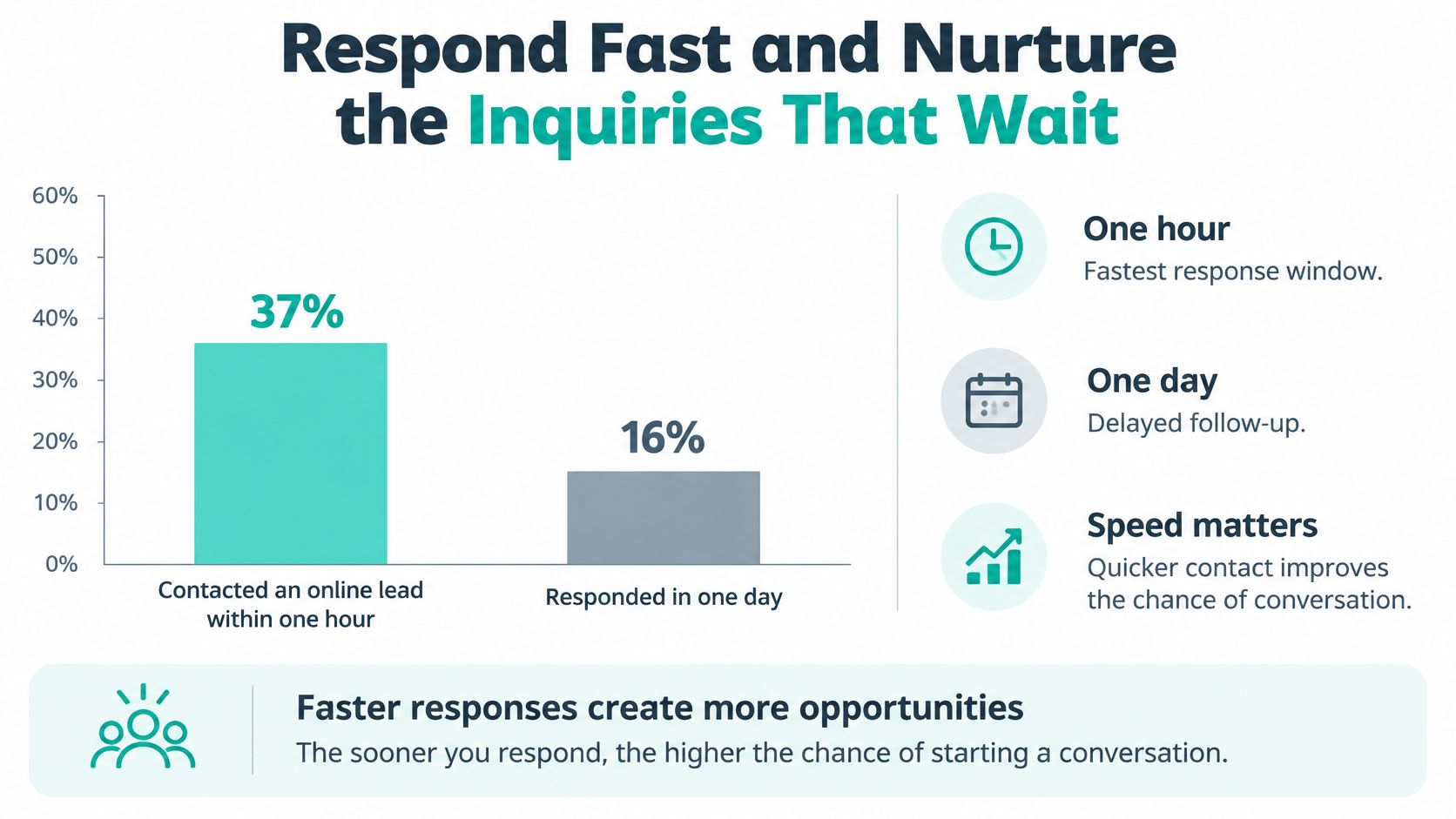
A 2011 Harvard Business Review study tested 2,241 U.S. companies by submitting online leads: only 37% contacted the prospective customer within one hour, 16% responded within one to 24 hours, 24% took longer than 24 hours, and 23% never responded at all (Retell's summary of that Harvard Business Review test). Companies contacting an inquiry within one hour were nearly seven times more likely to qualify the lead than companies waiting an additional hour, and more than 60 times as likely as companies waiting 24 hours or longer.
| Response Window | Share of Companies |
|---|---|
| Within one hour | 37% |
| One to 24 hours | 16% |
| Longer than 24 hours | 24% |
| Never responded | 23% |
Copy this setup
Acknowledgment in seconds. An automatic email or SMS so the buyer isn't staring at a blank screen.
A named owner. Routing rules, not a shared inbox.
A calendar link on that first message.
A weekend rule. A law firm inquiry at 9 p.m. Friday gets the acknowledgment and the booking link that night, not a callback on Tuesday.
When nobody is at the desk, automated customer chat from Expressify AI can hold the first reply until a person takes the conversation. It doesn't replace the owner.
People who aren't ready to book still need a sequence spread across weeks, and each note should add context rather than repeat the pitch. A legal version of that cadence is an email nurture sequence for legal leads.
Track time to first response beside contact rate. No inquiry should sit a full day before someone has spoken to it.
Keep Your Trust Signals Consistent Everywhere
Another ad channel won't repair a business that contradicts itself. Prospects cross-check before they contact you, and the mismatch is often the reason they don't.
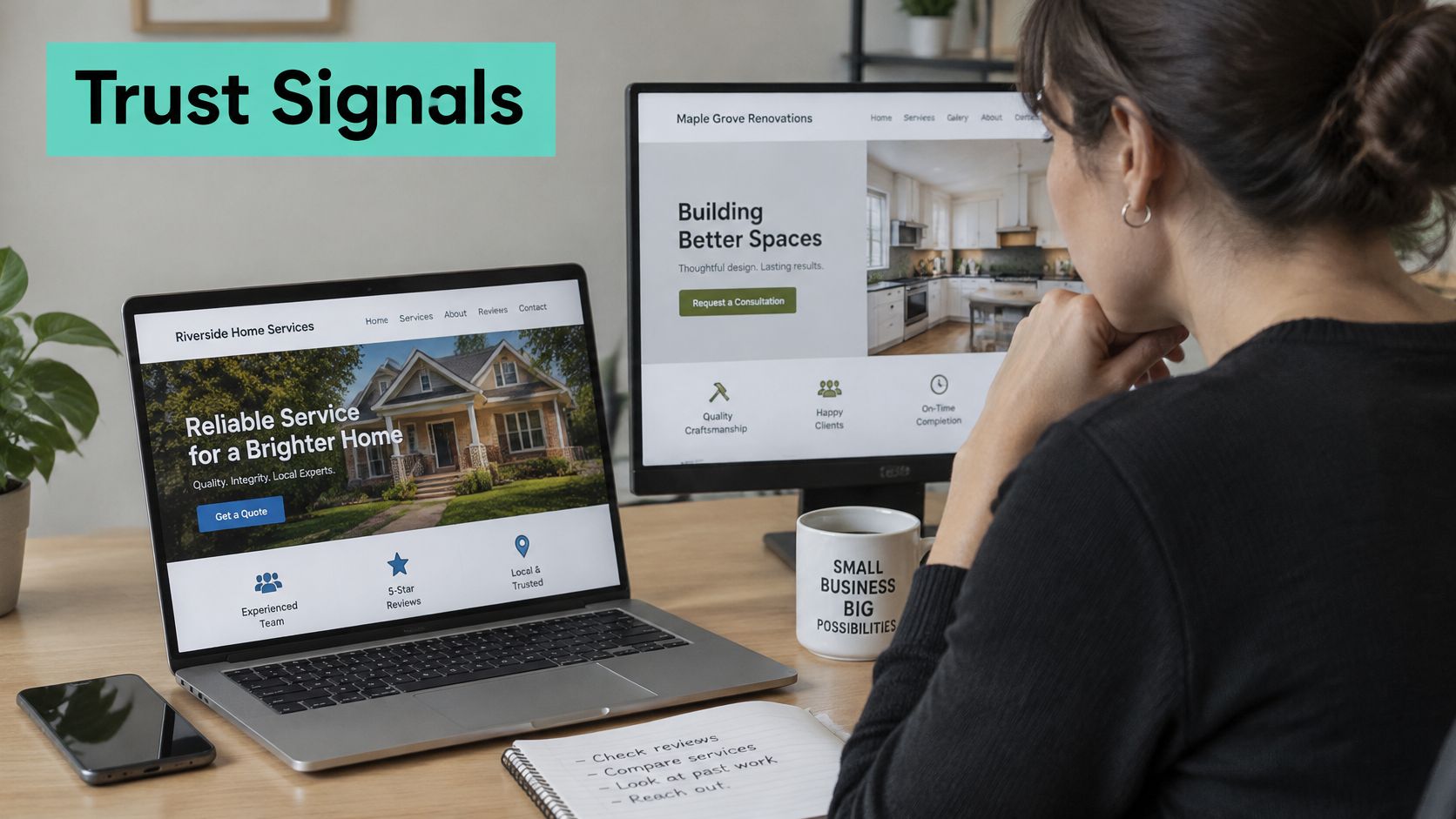
In 2025, 84% of consumers searched online for local businesses daily, 75% read at least four reviews before deciding, and 53% said inaccurate business listings would deter them (Business Wire on 2025 local search). Reviews are part of that same check. Prospects read how you answer criticism, not just the star average.
Say an estate-planning ad promises a same-week consult, the page says "contact us," the listing shows Friday hours only, and the auto-reply says someone will call Monday. The buyer has already read the reviews. The mismatch is what they remember.
Treat the ad, the page, the listing, the last three reviews, and the auto-reply as one promise repeated in five places. The audit is conversion protection, not brand housekeeping.
Put five surfaces in one row
Pick one service. Line up the ad, the page, the listing, the last three reviews, and the auto-reply.
- Ad versus page. The headline promise is the offer on the page. A "same-week consult" ad needs a page that says same-week consult, not "contact us."
- Listing versus site. Google Business Profile hours and service areas match the website. Friday-only hours on the listing and open Saturday on the site send the buyer back to the search results.
- Claims versus credentials. Practice-area language matches the attorney or provider page. Do not let the ad imply a specialist the profile does not support.
- Reviews. Responses are published, not sitting in a draft. An unanswered complaint reads as a risk the buyer has to price in.
- Follow-up. The auto-reply promises only what the team will do. "We'll call Monday" is a promise, so staff the Monday call.
For regulated services, state consultation rules and practice-area limits in plain language on the page. That consistency is a core part of law firm marketing that wins clients in 2026.
This short video is a useful pass over how a prospect cross-checks a business before calling. Then run the same pass on your own service.
Score the audit with qualified rate and consultation show rate, not impressions. Fewer inquiries that survive a cross-check beat another channel full of conflicts. I would stop adding acquisition channels until those five surfaces make the same promise.
Launch Your First Offer and Measure It This Month
One offer, one paid channel, this month. Run the earlier checks in order so you aren't launching five experiments at once.
- Pick the service with the highest value per client and a next step that passes the one-sentence, delivery, and light-ask checks.
- Pick one paid channel whose buyer intent matches that service.
- Build or fix one landing page so the headline, the offer, and the form agree.
- Turn on the four conversion events and store source, campaign, keyword, and consent.
- Set the response rule. Acknowledgment within minutes, and a named owner on every inquiry.
What has to be true before you spend
We ask for a clear service or product to promote, an advertising budget kept separate from any package fee, someone to supply business information and approve work, a team member who answers inquiries, and a way to share lead quality and sales feedback. If one of those is missing, book a call with us. We'll recommend a starting point around your goals, budget, and current marketing.
Put a two-week review on the calendar for cost per qualified inquiry, time to first response, and consultation show rate.
Watch time to first response first. If that number is a day or longer, the rest of the framework can't work yet.
SimpleLab Digital plans and manages paid media, landing pages, content, and follow-up as one path for small businesses and law firms that need qualified inquiries rather than another stack of unmatched form fills. If your ads, listings, and response times aren't making the same promise, we can sort the next step against your goals and budget. Visit SimpleLab Digital when you're ready to launch one offer and measure it this month.