The most popular advice on SEO for immigration lawyers is also the most dangerous for this practice: publish more blog posts, chase more five-star reviews, and wait for traffic to become clients. That sequence ignores how people hire, and it can put a client at risk when a public review reveals status, nationality, or case type. I'd reverse the order. Build pages by matter and place, protect confidentiality in every review request, and measure qualified consultations, not impressions.
Table of Contents
Why One Immigration Lawyer Page Falls Short
A firm usually describes itself in one broad sentence. A prospective client doesn't search that way. One parent looks for a marriage-based green card lawyer in a named city, someone in proceedings looks for removal defense help this week, and another person searches in Spanish for naturalization support. A single national page titled "Immigration Lawyer" answers none of those searches well enough to earn the call.
Search is where that short list forms. In 2024, 97% of U.S. adults who searched online for information about an attorney they contacted used search engines, according to FindLaw's 2024 U.S. Consumer Legal Needs Survey. If your page doesn't match the matter, the city, and the language in the query, you don't enter the comparison at all.
Five Assets Instead of One Page
- Keyword-to-page maps: One URL for each matter and city you serve.
- A verified local profile: Categories and services that match typed queries, with matching citations.
- Pathway hubs: Separate explanations for distinct routes, limits, and next steps.
- Safe review requests: Neutral wording that doesn't expose immigration status.
- Lawyer sign-off: A named attorney reviews claims before anything goes live.
More reviews and more posts aren't a program by themselves. The work above sits inside a broader law firm SEO strategy for modern client acquisition, but the immigration version needs tighter guardrails.
Judge every landing page by phone clicks, completed forms, booked consults, and retained matters. Impressions tell you a page appeared. They don't tell you whether the right person, with a matter you accept, in a place you serve, trusted you enough to book.
The Practice Area SEO Checklist
| Workstream | Check | Done when | Do this first |
|---|---|---|---|
| Keywords | One URL per matter and city actually served | Title and first screen name the matter and place, with no copied city swaps | Family, removal, and naturalization pages for the primary metro |
| Local profile | Google Business Profile matches the queries you want | Profile is verified and categories, services, hours, and service area are complete | Primary category and service list |
| Citations | Name, address, phone, and URL match | Google, Apple, Bing, and the state bar listing share one NAP | Those four listings before smaller directories |
| Content | Each accepted pathway has its own hub | Page states eligibility limits, a source date, and a consult step without promising a result | Hubs for matters that already produce consults |
| Reviews | Requests do not reveal immigration status | Neutral wording, no drafted review, no incentive tied to praise | A script limited to former clients |
| Compliance | A lawyer signs off before publish | Source, date, disclaimer, and responsible attorney are on the page | Any page mentioning outcomes, fees, or processing times |
Mark each row pass or fail. A row passes only when its done-when test is true on a live page, not in a draft, a spreadsheet, or a vendor report. Open the URL on a phone, read the first screen, and check the footer, the source date, and the booking path yourself.
How to Score Each Row Honestly
Keywords pass when one URL exists for each matter and city the firm serves, with the matter and place in the title and first screen. A page that swaps "Houston" for "Dallas" and changes nothing else fails, even if it's indexed.
The local profile passes when the verified Google Business Profile lists the categories and services a searcher types. Citations pass when name, address, phone, and URL match across Google, Apple, Bing, and the state bar listing. If the suite number differs on one, that's a fail until it's fixed.
Content passes when each accepted pathway has its own hub with eligibility limits, a source date, and one consult step. Reviews pass when the request uses neutral wording and no drafted review. Compliance passes when a named lawyer has signed off and every outcome, fee, or timing claim carries a source and date.
Score the live site, not the plan. A draft that's "almost ready" earns no consults.
Fix the primary metro and the three matters that already produce consults first. I wouldn't expand to new cities until those pages pass. Keep the scoring habit on a schedule alongside your routine website maintenance checklist for law firms, so a fixed page doesn't drift back to failing when hours, staff, or services change.
How to Map Keywords to Matters and Cities
Keyword research for immigration starts with your intake sheet, not a volume report. If the firm won't take the matter, the keyword doesn't belong on the map, however often people search it. If you want a starting vocabulary before you narrow it, you can find keywords for law firm SEO and then cut every term that doesn't match an accepted matter and a served city.
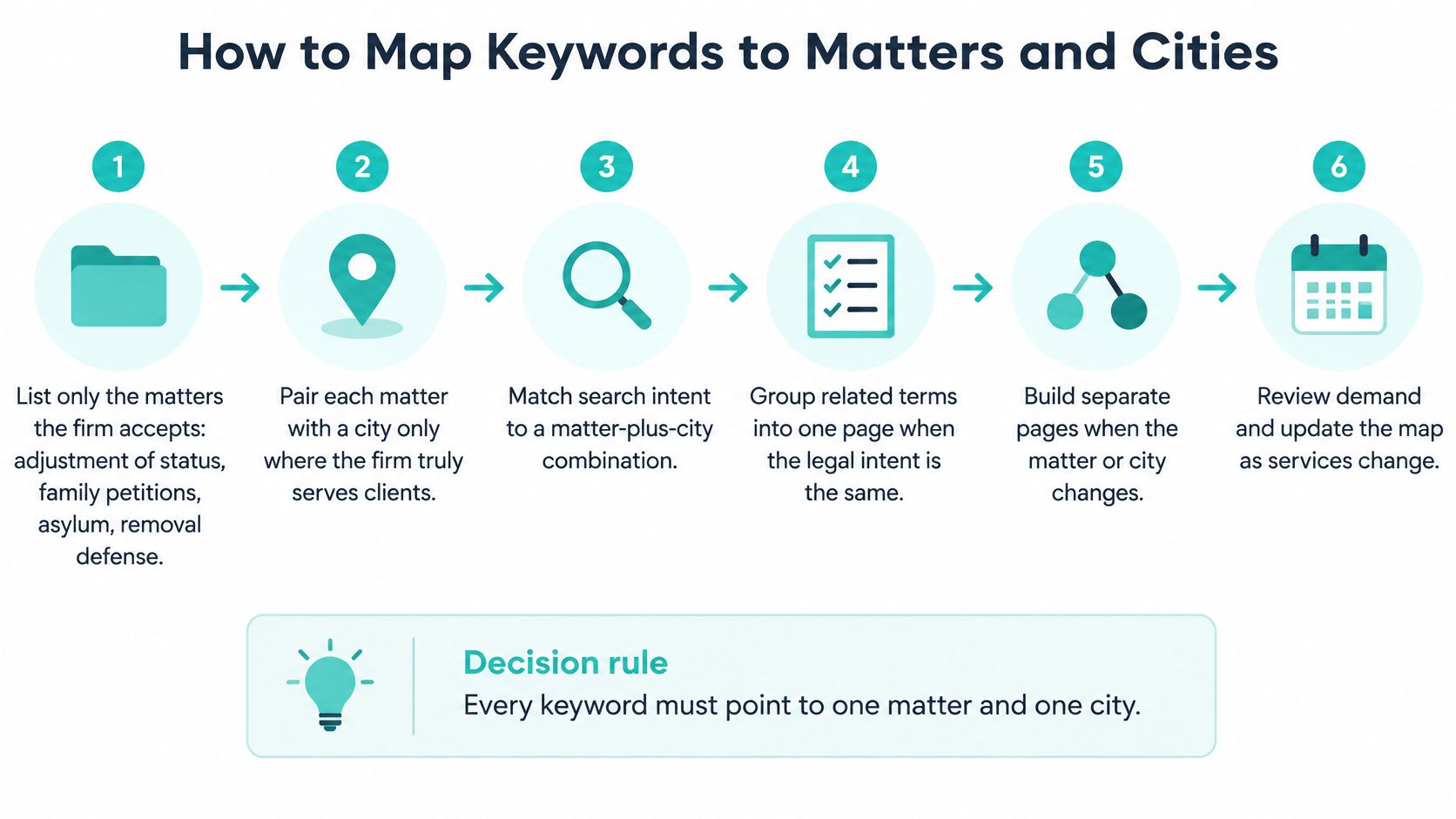
The six-step flow below shows the build sequence from matter list to measurement.
The Six-Step Build
- List only accepted matters: Adjustment of status, family petitions, asylum, removal defense, naturalization, waivers, and work visas, trimmed to what you handle.
- Pair matter with metro: Attach each matter to the metropolitan areas the office can serve, using demand data as a priority clue, not a lead forecast.
- Assign one intent per pair: Give every pair its own search intent, title, URL, and internal link from the main immigration page.
- Write boundaries, not summaries: State eligibility limits, high-level documents, and one next step. Don't paste a USCIS summary and call it a page.
- Make it crawlable and marked up: Add Organization or LocalBusiness structured data where it fits, following Google's LocalBusiness structured data guidance, validate with the Rich Results Test, submit the XML sitemap, and check indexing in Search Console.
- Record results per URL: Log consults, calls, and retained matters for each page so you know which pairs earn their keep.
Demand is concentrated enough to rank markets with evidence. In fiscal year 2024, approximately 818,500 people became U.S. citizens through naturalization, and 70% of people naturalized in FY2024 lived in 10 states, according to USCIS naturalization statistics.
| Signal | FY2024 value | Use on the site |
|---|---|---|
| Naturalizations | About 818,500, down 7% from the prior year and 12% above the 2010–2019 average of 730,100 | Size the naturalization hub |
| Top 10 states | 70% of naturalized people | California, Florida, New York, Texas, New Jersey, Illinois, Virginia, Georgia, Massachusetts, Washington |
| Mexico | 13.1% of naturalizations | Spanish-language matter pages where the office serves |
| India | 6.1% of naturalizations | Community pages where the office serves |
| Philippines | 5.0% of naturalizations | Community pages where the office serves |
| Dominican Republic | 4.9% of naturalizations | Community pages where the office serves |
| Vietnam | 4.1% of naturalizations | Community pages where the office serves |
| Five countries combined | About 33% of new citizens | Language planning, not a lead promise |
| Approved fee waiver | 14.3% of naturalized citizens | Plain-language fee and waiver explanations |
Those five countries of birth together represented about a third of new citizens, so language and community pages make sense only where the firm can serve those readers well, with reviewed translations and intake in that language. A translated page with English-only intake fails on contact.
Canonicalize or redirect near-duplicate city pages instead of letting them compete with each other. Refresh any page when agency timing or policy changes, and update the source date when you do. Stale timing claims are both a ranking problem and a trust problem.
Local Listings and Citation Consistency
Immigration law is federal, but hiring is local. People want an office they can reach, a lawyer who knows the local court and field office, and proof the firm really serves their city. Your listings have to prove that without implying offices you don't have.
The hierarchy below shows the three factors that decide which firm appears, and where citation consistency supports them.

Google states that local rankings rest on relevance, distance, and prominence, according to Google Business Profile ranking guidance. Each one maps to a specific firm decision.
Relevance is how closely your Business Profile matches a query such as "immigration lawyer" or "asylum attorney." Categories and the service list must name the matters the office handles, not a generic law-firm label. If you handle removal defense but don't list it, you're asking Google to guess.
Distance follows the searcher's location or the city in the query. You can't edit distance, and you shouldn't fake it. A profile or page shouldn't imply an office the firm doesn't have, and service-area settings shouldn't claim metros you won't travel to or staff.
Prominence is how well known the firm appears, influenced by links, directory references, and review quantity and quality. That's earned slowly through legitimate mentions and safely obtained reviews, not bought through citation blasts.
| Factor | Immigration query example | Firm action |
|---|---|---|
| Relevance | asylum attorney | Name each matter in categories and services |
| Distance | immigration lawyer in Atlanta | Show only offices the firm actually has, with no implied locations |
| Prominence | immigration lawyer reviews | Earn links, directory references, and neutral reviews |
The Citation Order I Would Follow
- Verify and complete the Google Business Profile: Categories, services, hours, photos, and service area.
- Lock one NAP on the website footer: One name, address, and phone format everywhere on the site.
- Match Apple, Bing, and the state bar listing: Fix those four before adding smaller directories.
- Skip citation blast services: Vendors that invent addresses or mass-submit create clean-up work, not prominence.
If you run two offices, each profile gets only the matters and hours for that office, and city pages link to the office that can take the consult. Track map-pack calls separately from organic form fills, so a profile fix isn't mistaken for a content win. Our guide to local SEO for immigration lawyers goes deeper on profile setup for multi-office practices.
Content Hubs for Distinct Immigration Pathways
A single "immigration services" page cannot speak to a trafficking survivor and a naturalization applicant at the same time. Humanitarian pathways carry different eligibility rules, different evidence, and different risks, and readers arrive in very different situations. Splitting them into hubs lets each page answer the person reading it.
The chart below compares FY2024 filing volumes for two of those pathways.
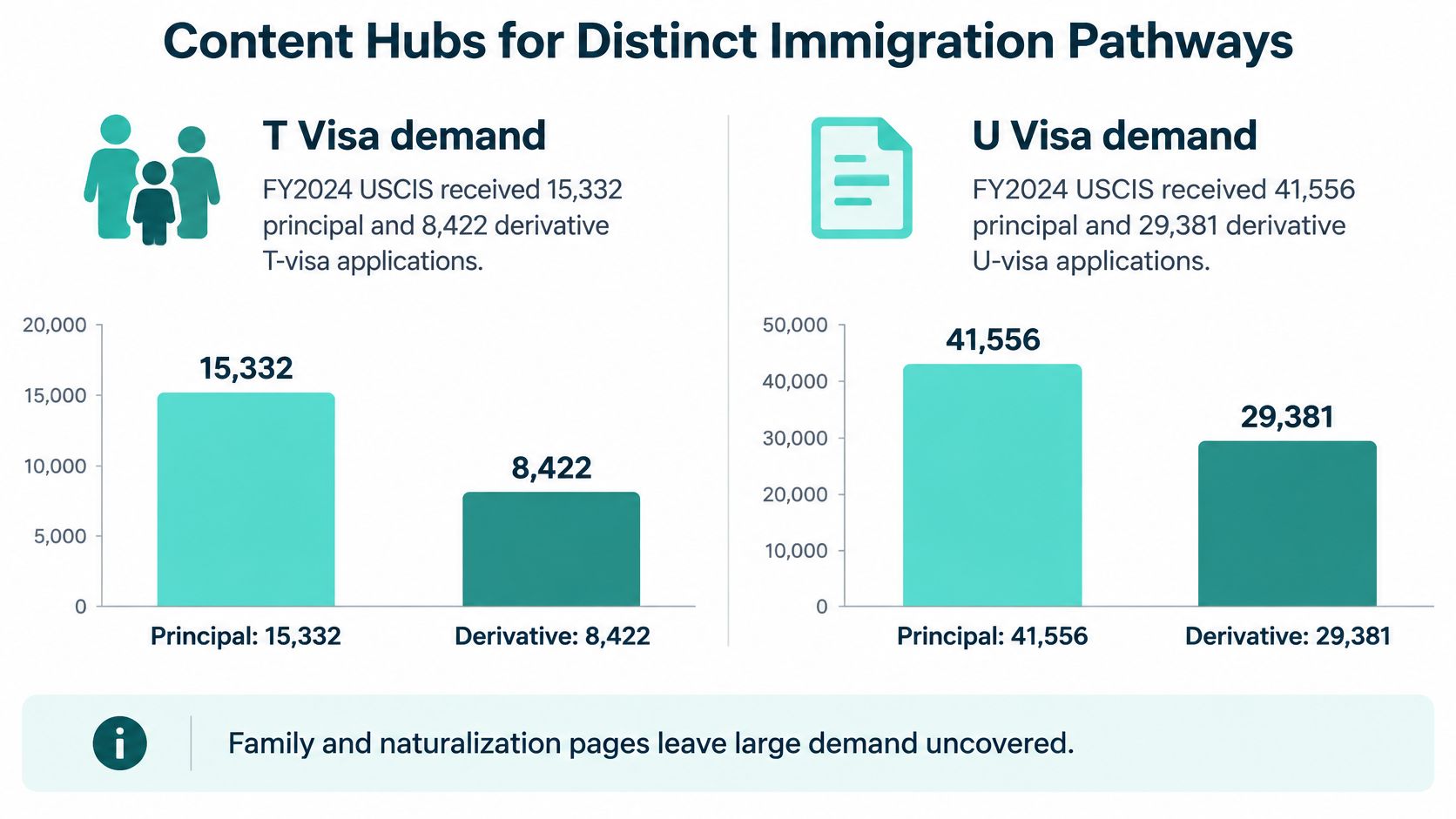
In FY2024, USCIS received 15,332 principal T-visa applications and 8,422 derivative T-visa applications, and recorded 41,556 U-visa petitions from principal applicants and 29,381 from derivative applicants, according to the USCIS FY2024 report on applications by victims of abuse. Demand at that scale justifies a dedicated hub for each pathway.
| Pathway | FY2024 figure | Hub should answer | Leave off the page |
|---|---|---|---|
| T visa, principal | 15,332 applications received | Eligibility at a high level and why a consult is required | Any promise of approval |
| T visa, derivative | 8,422 applications received | How family members relate to the principal case | A predicted result for relatives |
| U visa, principal | 41,556 petitions received | Eligibility, the long pipeline, and work-authorization questions without a guarantee | A guaranteed work permit |
| U visa, derivative | 29,381 petitions received | Who counts as a derivative | Case-specific predictions |
| Approvals are not odds | Approval totals include cases filed in earlier years | Why receipts and decisions are different counts | A success rate built from these figures |
What Each Hub Must Do
Build separate hubs for U visas, T visas, derivatives, abuse-related relief, work authorization, and naturalization. Each hub answers narrow questions. Who may qualify at a high level? How do derivatives relate to the principal case? What must a consult review before anyone can advise?
One point needs plain language on every page. Approval totals count decisions issued in a year, not applications filed in it, and petitions sit in the queue before anyone adjudicates them. Dividing one year's approvals by the same year's filings produces a fake success rate, and publishing that number misleads exactly the readers most likely to act on it.
On every hub, separate general information from legal advice, cite the agency page and the date you checked it, and distinguish statute from policy guidance that can change. Judge each hub by qualified consults booked rather than traffic, because a U-visa page that draws the right fifty readers outperforms a generic page that draws five thousand. Keep client stories off these pages entirely; on a humanitarian hub, even a vague success story can hint at a person's status or case type.
Editorial rule: Do not publish a page for a pathway the firm will not take. A hub that attracts consults you decline wastes the reader's time and your intake hours.
Write these hubs as part of a planned content marketing program for law firms, with each page owned by a named reviewer who rechecks the agency citations on a schedule. Reserve the consult call-to-action for questions that need judgment, such as inadmissibility, a prior denial, or document review, because a generic answer is least reliable there and a lawyer's assessment is the actual product.
Reviews and Claims That Stay Inside the Rules
For most local businesses, a review campaign is a volume play. For an immigration firm, it's a client-safety problem first. A public review can expose a person's name alongside the fact that they hired an immigration lawyer, and readers may infer status, nationality, or case type from small details the reviewer didn't mean to share.
The image below shows the kind of request form that needs neutral wording before it ever reaches a client.

New York's 2025 ethics opinion says attorneys may ask former clients for reviews, provided the lawyer does not draft the review or condition an incentive on favorable content, and it warns that a review could reveal protected information to immigration authorities, according to the New York Daily Record report on the 2025 ethics opinion. The request itself can use confidential information, including identity, contact details, and the fact of an immigration matter.
Three Feedback Tracks
- Private feedback: Stays inside the firm for service improvement. No publication, no pressure.
- Voluntary public reviews: Neutral wording that doesn't call the person an immigration client and doesn't ask for nationality, status, case type, or outcome.
- Testimonials and case studies: Require informed consent. Staff shouldn't translate or edit the client's words into a better advertisement, because reshaping the text reshapes the testimonial.
If a reviewer volunteers sensitive facts, don't highlight that review on your site, in ads, or in social posts. Set up monitoring so staff see new reviews quickly and can respond without confirming any case detail. For the operational side, CapyScout's Google review monitoring guide is a practical reference for alerts and response workflows you can adapt to a confidentiality-first process.
The short video below walks through related reputation questions in a format you can share with intake staff before revising your script.
Apply the same gate to page claims. The ABA explains that Model Rule 7.1 generally prohibits false or misleading communications, while Rule 7.2 permits advertising but requires the responsible lawyer or firm to be identified, according to the ABA guidance on attorney advertising ethics. So ban unsubstantiated "approved," "win," or "fastest" language, label general information as not legal advice, record the source and date for every timing or fee statement, and block unreviewed AI copy from publishing.
A safe review is more useful than a risky one.
A smaller set of independent, safely obtained reviews beats a volume push. Prominence built on exposed clients isn't an asset. It's a liability that also teaches future clients to stay quiet.
Technical Readiness and AI Answer Pages
There is no separate technical bar for AI search. Google states that the same foundational SEO practices apply to AI Overviews and AI Mode, with no additional requirements, in Google's guidance on AI features in Search. The work is more ordinary than the hype suggests: pages a search system can quote correctly, and forms a stressed reader can finish on a phone.
Five Checks on Every Pathway Page
- Open with a direct answer: Put a 40 to 60 word answer in visible text stating who may qualify, the main limit, and the consult step. If an AI summary lifts anything, it should lift that paragraph.
- Mark up only what's visible: Structured data must match on-page text. Validate with Google's Rich Results Test, and periodically measure your site's AI accessibility so extraction problems surface before consults drop.
- Hit Core Web Vitals on real-user data: Google's targets are Largest Contentful Paint within 2.5 seconds, Interaction to Next Paint below 200 milliseconds, and Cumulative Layout Shift below 0.1, per Google's Core Web Vitals guidance. A shifting layout can make a visitor tap the wrong phone link or lose a half-finished form.
- Keep forms keyboard-operable and visibly focused: Consult forms, language selectors, upload controls, and scheduling tools all need a clear focus indicator that works without a mouse. The optional Focus Appearance criterion in WCAG 2.2 (Level AAA) calls for a focus outline at least 2 CSS pixels thick with 3:1 contrast against the unfocused state, a reasonable bar for readers tabbing quickly under stress.
- Protect the consult step: Keep the call-to-action on judgment questions, such as inadmissibility, a denial, or document review, where a generic answer is least reliable.
These checks line up with how we approach generative engine optimization for law firms. AI summaries will answer basic questions without a click, so the numbers that matter are qualified consultations, branded searches, and retained matters. A pathway page can lose traffic and still produce better consults when the readers who do arrive already understand their limits.
Choose the First Three Pages to Fix
Don't start with a national blog calendar. Pick the one metro that already produces consults and the three matter pages those callers need most. Those URLs get the first month of work, and everything else waits.
This Month in Order
- Rewrite three URLs: Each gets its own intent, a source date, eligibility limits, and a single way to book.
- Complete the Google Business Profile: Then correct the four core citations before adding any new directories.
- Replace unsafe review requests: Any script that names the case type gets swapped for the neutral former-client version.
Hold new publishing until those pages are live and a lawyer has signed off. Speed without review just multiplies corrections later.
If no one inside the firm can keep pages current, we offer SEO/GEO and website maintenance starting at $990 USD per month, including maintenance plus four blogs or four priority pages a month, with options for audit plus ongoing optimization or full optimization of up to 25 pages. We publish the approved updates and content after your review. Individual outcomes vary, and the service doesn't guarantee rankings or leads.
Your next step is concrete. Score the checklist, choose the three URLs, and book the attorney review before the next publish date. That order protects clients, focuses spend, and gives you consult data worth acting on.
If your immigration pages need matter-and-city structure, safer review workflows, and lawyer-approved updates published on schedule, SimpleLab Digital can handle the SEO, maintenance, and monthly priority pages for your firm. Visit the site to compare options, confirm scope and pricing, and book an onboarding conversation about the first three pages you want fixed.