The median conversion rate for legal landing pages was 6.3% in 2024, according to Unbounce's analysis summarized by More Booked Cases. That's a page conversion, not a retained client. A useful law firm landing page must turn a specific paid search into an appropriate inquiry, then help intake move that person toward a consultation. Start by writing a single sentence that names the service, location, and next step.
Table of Contents
- What a Paid Search Page Must Answer
- Section by Section Wireframe for Two Practices
- Questions for the Public Form and Private Intake
- How to Test Calls Against Online Booking
- Speed Trust and Rules Before Launch
- Choose One Offer and Launch the Test
What a Paid Search Page Must Answer
A paid search page has a narrower job than your homepage: match one ad, one practice, and one primary next step. Someone searching for removal defense shouldn't have to sift past estate planning, personal injury, and the firm's history to find help.
The first screen should identify the legal problem you handle, the city or region served, the relevant licensing jurisdiction, and whether the visitor should call or book. Put the firm name there, but don't make it the entire message.
In Clio's 2024 legal-consumer research, only 30% of law-firm websites made hiring easy to understand, while 14% displayed pricing information. Use that gap as a practical design brief: explain the hiring decision instead of decorating around it.
Write the offer before the layout
A workable immigration offer might be a confidential removal-defense case review for people facing proceedings in the firm's service area. A criminal defense offer might be a consultation about a pending DUI charge in the courts the firm covers.
Neither offer promises a legal outcome. Both tell the prospective client whether the page is relevant.
Practical rule: Reject any headline that could sit unchanged on a different practice area's page.
Translate the offer into answers the visitor can find without hunting:
- Fit: Which matters does the firm accept, and which fall outside its practice?
- Appointment: Is this an intake conversation or an attorney consultation?
- Preparation: What should the person have ready, without sending sensitive material through the public page?
- Cost: Is there a consultation fee? Does representation generally use hourly or flat-fee billing?
- Next step: Who responds, through which channel, and what happens afterward?
The alignment should be visible before you add persuasive copy.

Keep search language specific
For a useful exercise in separating service intent, review the Texas divorce and custody search phrases from Law Office of Bryan Fagan, PLLC. Divorce and custody may belong to the same department, but they don't automatically belong on the same paid-search destination.
Apply that distinction to immigration and criminal defense. Removal defense isn't interchangeable with a family-based immigration application; DUI defense isn't interchangeable with every felony matter.
Coordinate the destination with the campaign using this Google Ads guide for law firms. The ad shouldn't promise immediate attorney access if the page only offers an appointment request.
Section by Section Wireframe for Two Practices
Build the page in the order a prospective client makes the decision: relevance, credibility, fit, process, action, and terms. Start with the mobile layout, where a long introduction can push the contact option out of view.
The examples below are copy directions, not claims to publish unchanged. Replace locations, admissions, languages, availability, and fee arrangements with facts the firm can substantiate.
Paid-search wireframe for immigration and criminal defense
| Block | Job on the page | Immigration example | Criminal defense example |
|---|---|---|---|
| Headline | Repeat the searched service and place | Removal-defense consultation in the stated city | DUI or felony-defense consultation in the stated city, matching the ad |
| Credibility strip | Show license, place, and limits | Attorney admission, immigration focus, and languages spoken | Criminal-court coverage and admission, without a dismissal promise |
| Offer | Say what the click buys | Confidential case review, not a visa guarantee | Confidential case review, same-day only if genuinely staffed |
| Proof | Match the searcher's facts | Explain how the review addresses deadlines, status category, and affected family members | Explain how the review addresses charge type, court, and next appearance |
| Hiring path | Show what happens next | Form, intake response, consultation, decision to retain | Call or form, conflict screening, consultation, decision to retain |
| Primary action | Establish one next step | Book or call, with the chosen action persistent on mobile | Emphasize click-to-call for urgent custody or court-date inquiries when staffed |
| Fee note | Reduce cost uncertainty | Consultation fee, flat versus hourly billing, and factors affecting the fee | Same information, plus what the consultation does not decide |
| Footer | Set the legal relationship | Submission does not create an attorney-client relationship | Same statement, plus accurate arrest or emergency instructions if offered |
Place the subhead directly beneath the headline. It should explain who the consultation serves, not introduce another offer. The credibility strip can include verified years in the relevant practice, but don't substitute an unexplained award badge for admission and service-area information.
Proof should be specific without turning into an outcome claim. Explain what the attorney reviews and how the practice handles relevant matter types. Don't imply that a deadline can always be extended or a charge dismissed.
Build for the inquiry, not the benchmark
The legal landing-page benchmark summarized by More Booked Cases reported 5.6% median conversion for immigration pages and 21% median mobile conversion versus 15.9% on desktop across legal pages. These are directional page-level measures, not signed-client rates, and phone conversions may be omitted.
Use those findings to justify testing mobile usability, not to forecast retained matters. Keep the chosen contact action visible without scrolling, avoid oversized hero media, and repeat the primary action after the proof and hiring explanation.
An adjacent-practice reference can help teams distinguish page scope. The Law Office of Bryan Fagan, PLLC's page about hiring a Houston tenant attorney provides a concrete service-and-place pairing. Your immigration or criminal defense page needs equally clear boundaries, even though its intake questions will differ.
A visitor should understand what the firm handles before being asked to explain what happened.
Don't combine family, immigration, estate, and injury campaign traffic on this URL. Even within criminal defense, separate materially different paid intents when the offer, qualification criteria, or intake response changes.
Questions for the Public Form and Private Intake
Use the public form to route and prioritize, not to try the case. Intake needs enough information to respond appropriately, but the paid-search page isn't the place for a detailed narrative or document collection.
A Clio operating analysis associated public website intake forms with 71% higher incoming potential-client volume than firms without them. That's an association, not a promise that adding fields or installing a form will produce the same result.
Public form versus private intake
| Information | Public form | Private intake | Why it waits or not |
|---|---|---|---|
| Name and phone or email | Required | Confirm accuracy and safe contact details | Needed to respond |
| Preferred contact method | Required | Confirm availability and contact restrictions | Supports the call-versus-booking test |
| Matter type | Short list matching the ad | Full procedural posture | Routes the campaign |
| Urgency marker | Deadline, hearing date, or custody yes/no | Verify dates and docket information | Prioritizes the queue |
| Location or status category | City and broad status or charge category | Addresses, A-number, and statute citations | Limits sensitive detail |
| Other people involved | Omit | Collect names through the private conflict-screening process before substantive intake | Enables conflict screening |
| Facts of the matter | Omit detailed narrative | Secure narrative after conflict clearance | Supports accuracy and appropriate confidentiality handling |
| Documents | No upload | Secure request later | Avoids an open ad-page file drop |
| Consent and disclaimer | Visible consent language and no-engagement statement | Confirm applicable permissions and repeat terms at engagement | Addresses calls, texts, and professional obligations |
Make each field earn its place
For immigration, use a short matter-type list that reflects the campaign. A removal-defense page might ask whether a hearing is scheduled, without requiring an A-number or a photograph of a notice.
For criminal defense, ask for the broad charge category, court location, next appearance date if known, and whether the prospective client is in custody. Allow an unknown response where appropriate. A family member making the inquiry may not have the charging documents.
Don't postpone conflict screening until after a substantive legal discussion. The private intake sequence should collect the names needed to check conflicts first, then advance to the detailed account only when appropriate.
A personal-injury form provides a useful contrast: incident date and broad injury category may help route that campaign, while medical detail belongs later. Those fields have no place on these immigration and criminal defense pages.
- Contact safety: Ask whether the chosen channel is safe for replies when the matter warrants it.
- Consent: Have counsel approve applicable call, text, and marketing permissions. Don't assume submitting an inquiry authorizes unrelated campaigns.
- Relationship: State plainly that submission does not create an attorney-client relationship.
- Urgency: Explain that submitting a form doesn't confirm representation or protect a deadline.
The same separation between initial routing and substantive intake is useful in this family-law lead-generation intake checklist.
Keep submissions, qualified inquiries, booked consultations, attendance, retained matters, duplicates, and conflict disqualifications as distinct CRM outcomes. A longer form won't fix an inbox nobody monitors.
How to Test Calls Against Online Booking
Test the contact route as an intake workflow, not merely a button label. A phone-first page with unanswered calls and a booking-first page with unavailable appointments are both broken, regardless of click-through rate.
Use this sequence to isolate the primary-action decision.
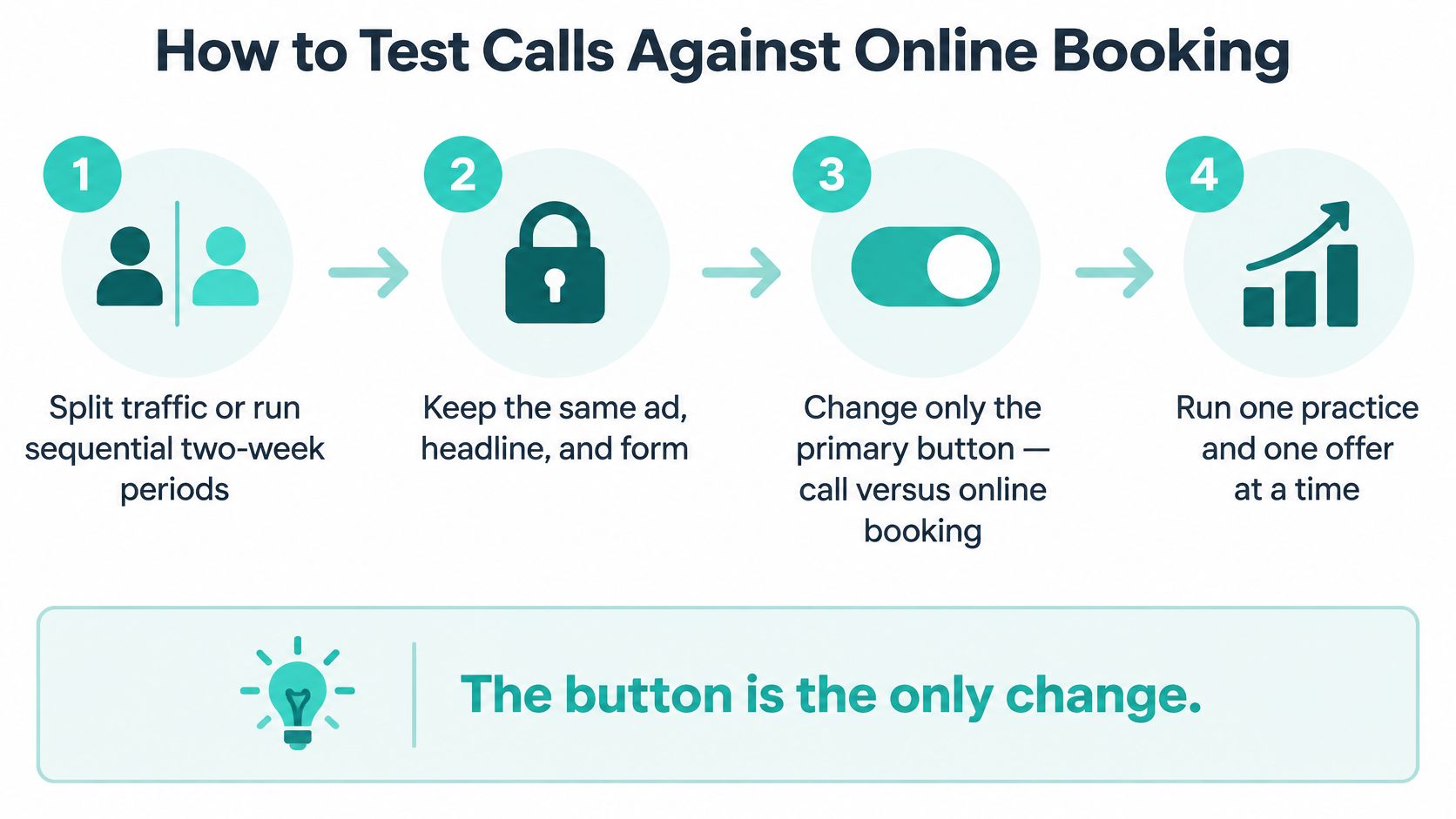
Set up a controlled comparison
- Choose the test boundary. Run one practice and one offer. Split comparable traffic between call-first and booking-first versions, keeping the ad, headline, and qualifying fields unchanged. Sequential two-week periods are an alternative test design, but calendar and demand changes can muddy the comparison.
- Verify capacity. Staff the phone during advertised hours and expose only appointment slots the firm can honor. Keep an accessible alternative contact path without giving it equal visual emphasis.
- Preserve attribution. Save source, campaign, practice, page version, consent, preferred method, and available click identifiers in the CRM. Use call tracking that preserves campaign attribution.
- Assign ownership. Send an immediate acknowledgment without implying attorney review. Route both paths to a named intake owner and log the first human response attempt.
- Judge downstream outcomes. Compare qualified inquiries, consultations booked, attendance, and retained matters. Deduplicate people who call and subsequently book online.
A study of 2,241 U.S. companies, summarized by Vida's speed-to-lead guide, found that 37% responded to web leads within an hour; those responding within an hour were nearly seven times more likely to qualify a lead than companies waiting an additional hour, and more than 60 times more likely than those waiting at least a day. This is cross-industry evidence, not a law-firm conversion forecast.
Alert intake within minutes and audit unanswered inquiries daily. Record attempted contact separately from a successful conversation.
Calls versus booking on a legal landing page
| Question | Click-to-call | Online booking |
|---|---|---|
| Best first use | In-custody, arrest, or near-court-date inquiries when staff answer | Consultations that can wait, including many immigration reviews |
| After hours | Fails when it reaches unmonitored voicemail | Works only when displayed slots are real |
| Qualification | Happens live, so intake skill matters | Starts with the short form, then conflict screening |
| What to track | Answered calls, qualified calls, consultations, retained matters | Bookings, show rate, consultations, retained matters |
| Speed bar | Set a human-response target within minutes for missed-call alerts | Confirm instantly and target human follow-up the same business day |
| Failure sign | Missed calls without a callback owner | No-shows or a calendar the front desk doesn't monitor |
These response targets are operating recommendations, not legal deadlines. Stop the call-first treatment if after-hours callers consistently reach voicemail while the booking path has usable availability.
Use the following video alongside the written test checklist when briefing the team.
Recover unfinished intake
Clio intake reporting covering 441,153 stalled U.S. matters from December 2024 through December 2025 found that only 9.5% received follow-up within 30 days, defining stalled matters as sent intake forms not returned within seven days.
Assign reminders to an owner and provide a secure return path. Keep automated acknowledgments separate from legal advice, and use only approved, consented follow-up channels.
Decision standard: Keep the primary action that produces suitable, attended consultations and retained matters at a sustainable acquisition cost, not the one with the most taps.
The same distinction between response volume and lead quality applies to testing Facebook ads for lawyers. Keep recovered bookings on the same scoreboard so follow-up performance doesn't disappear from the comparison.
Speed Trust and Rules Before Launch
Check the page as a mobile visitor using one thumb and as an attorney reviewing potentially misleading copy. Both reviews should happen on the deployed URL, including the scheduler, confirmation screen, and follow-up messages.
In Google's 2017 mobile-speed analysis, 53% of mobile visitors abandoned pages taking longer than three seconds to load; its related modeling found that increasing page elements from 400 to 6,000 reduced predicted conversion probability by 95%. These historical findings support a lean build, not a universal conversion forecast.
Remove technical barriers
Compress media, defer nonessential scripts, and test whether the offer and contact action become usable before secondary content finishes loading. Check on an actual phone with a constrained connection, not just a desktop preview.
Accessibility belongs in the same review. Reporting summarizing WebAIM's 2025 analysis of the top million home pages found about 51 accessibility errors per page, with low contrast on 79.1%, missing alternative text on 55.5%, and missing form labels on 48.2%.
The checklist below turns those findings into release decisions.
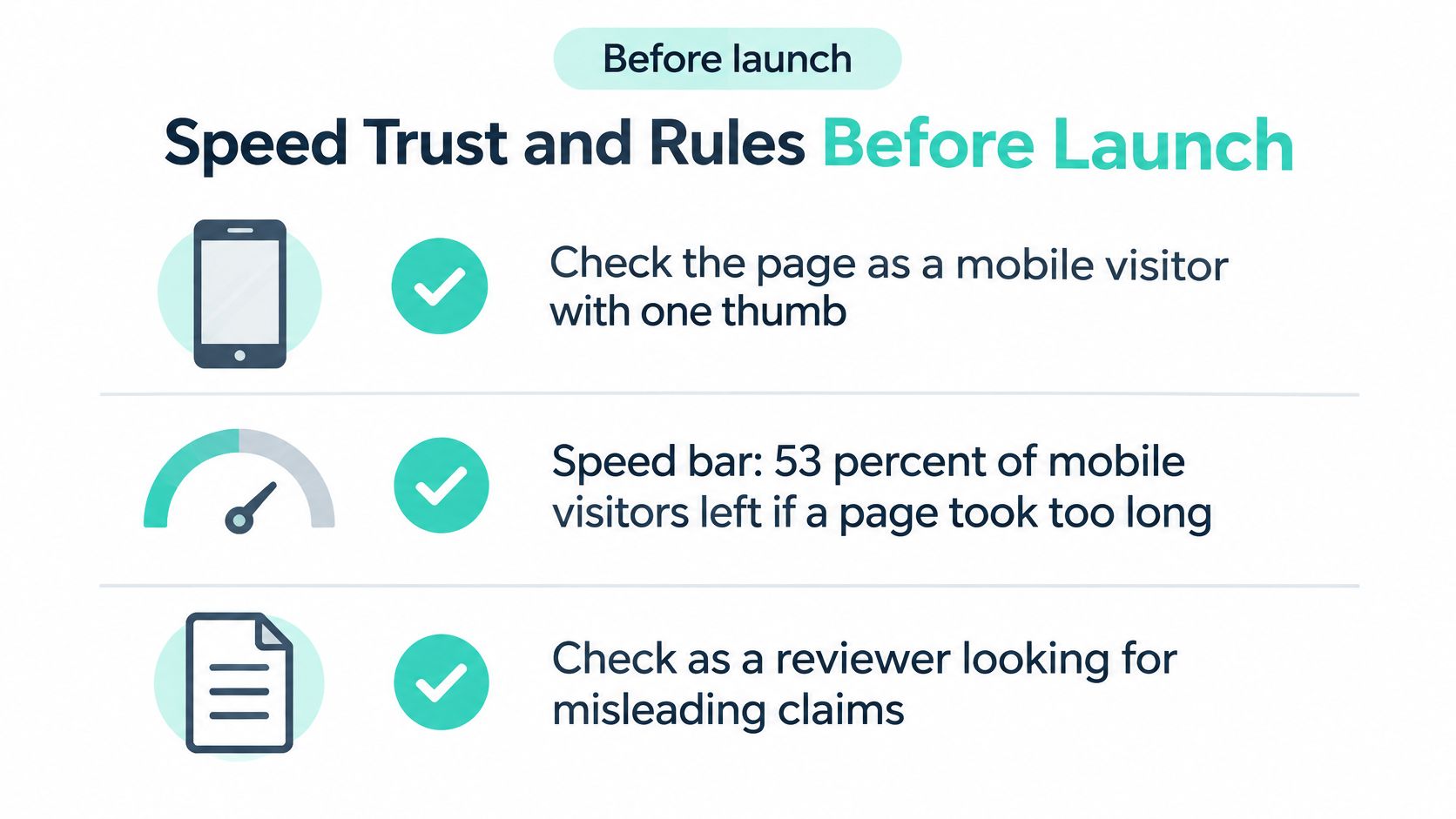
Pre-launch checks for a paid-search law firm page
| Check | Pass standard | Figure or rule to use |
|---|---|---|
| Mobile speed | Offer, credibility, and call or scheduler usable within seconds with one thumb | Google's abandonment finding supports a three-second loading target |
| Page simplicity | One offer, compressed media, few scripts | Google's element-count model supports removing unnecessary components |
| Form access | Explicit labels, readable contrast, understandable errors, keyboard operation; no reliance on an overlay | WebAIM's error categories guide manual checks |
| Advertising review | Accurate license and place, excluded matters, no outcome promise, reviewed call and text consent | Applicable jurisdiction's lawyer-advertising rules confirmed before ads |
| FAQ | Real answers about timing, documents, service area, fees, and submission; markup matches visible copy | Required properties, Rich Results Test, and URL Inspection |
Test keyboard navigation, focus visibility, screen-reader labels, validation messages, and the embedded scheduler. An accessibility overlay doesn't replace correcting the underlying form.
Verify claims and visible answers
Have the responsible lawyer confirm applicable U.S. state or Canadian provincial and territorial requirements. Review advertising labels, testimonials, case results, confidentiality language, fee descriptions, and any claim about specialization or availability against the relevant regulator's current rules.
Practice-specific advertising questions need equally specific review. The Law Office of Bryan Fagan adoption guidance illustrates why an adoption-related advertising question shouldn't be resolved using generic marketing advice; it isn't a substitute for the rules governing your campaign.
For FAQs, Google Search Central directs publishers to follow eligibility guidelines, validate markup, and test deployed pages. Valid markup doesn't guarantee a rich result. Publish useful visible answers first.
Link to the firm's existing immigration or criminal defense practice page for deeper context. Keep those links secondary, and use this Google Ads Quality Score guide to align campaign relevance with the destination rather than adding keyword-heavy filler.
Choose One Offer and Launch the Test
Choose the campaign that already has relevant search demand and a named person available to handle inquiries. Don't begin with the practice that has the most attractive stock photography or the broadest possible audience.
For the launch week, turn the plan into assigned work:
- Partner approval: Confirm the offer, accepted matters, service area, fee explanation, and advertising language.
- Page build: Publish the practice-specific blocks and short public form. Test submission, scheduling, and telephone links from an actual mobile device.
- Intake ownership: Name the person responsible for each inquiry and document the after-hours procedure.
- Measurement: Lock the definitions of qualified inquiry, booked consultation, attended consultation, and retained matter before spending.
- Daily review: Check missed calls, unanswered forms, failed confirmations, duplicate records, and calendar errors.
Make the launch decision operational
Keep the paid ad pointed at the dedicated campaign URL. Visitors who need broader practice information can follow a secondary link to the firm's matching service page without turning the landing page into a directory.
Review results by campaign and device, but allow time for the hiring decision. An inquiry that hasn't retained by the end of the launch week isn't automatically a failed lead. Use this law-firm marketing ROI guide to connect acquisition activity with matter outcomes rather than assigning revenue to every submission.
Our approach keeps the responsibilities distinct: ads create the first opportunity, the landing page explains the next step, content provides context, and follow-up keeps the conversation moving. Once the offer is live, use our digital marketing for lawyers overview to assess how those parts fit together.
Launch when the firm can fulfill the promise on the page, not merely when the page looks finished.
The first decision is whether the contact route works for suitable prospective clients and the people answering them. Fix broken handoffs before expanding traffic, then keep measuring consultations and retained matters as they develop.
We offer standalone landing pages from $595 USD as a one-time fee, giving a focused paid-search offer a dedicated destination. Visit SimpleLab Digital to discuss an immigration or criminal defense page with a clear next step and a defined intake handoff.