The usual advice to get more leads at a lower cost is incomplete for law firms. Law firm PPC works when each practice area has its own campaign, landing page, intake route and compliance review, with success measured in signed cases. Before adjusting bids, map the path from a specific search to the person responsible for handling that inquiry.
Table of Contents
- Why Law Firm PPC Is Measured in Signed Cases
- Practice-Area Campaign and Ad-Group Map
- Criminal Defense and Scheduled Estate Planning Compared
- Landing Pages and Intake Handoff That Keep Paid Demand
- Compliance Checks Before Any Ad Goes Live
- Measuring Qualified Inquiries and Signed Cases
- Confirm the Campaign Map Before You Launch
Why Law Firm PPC Is Measured in Signed Cases
A cheap form submission isn't necessarily a good lead. It might concern a jurisdiction your attorneys don't serve, a matter you don't accept or a service the searcher expects for free. Optimizing for those submissions can make the advertising dashboard look better while the firm's economics get worse.
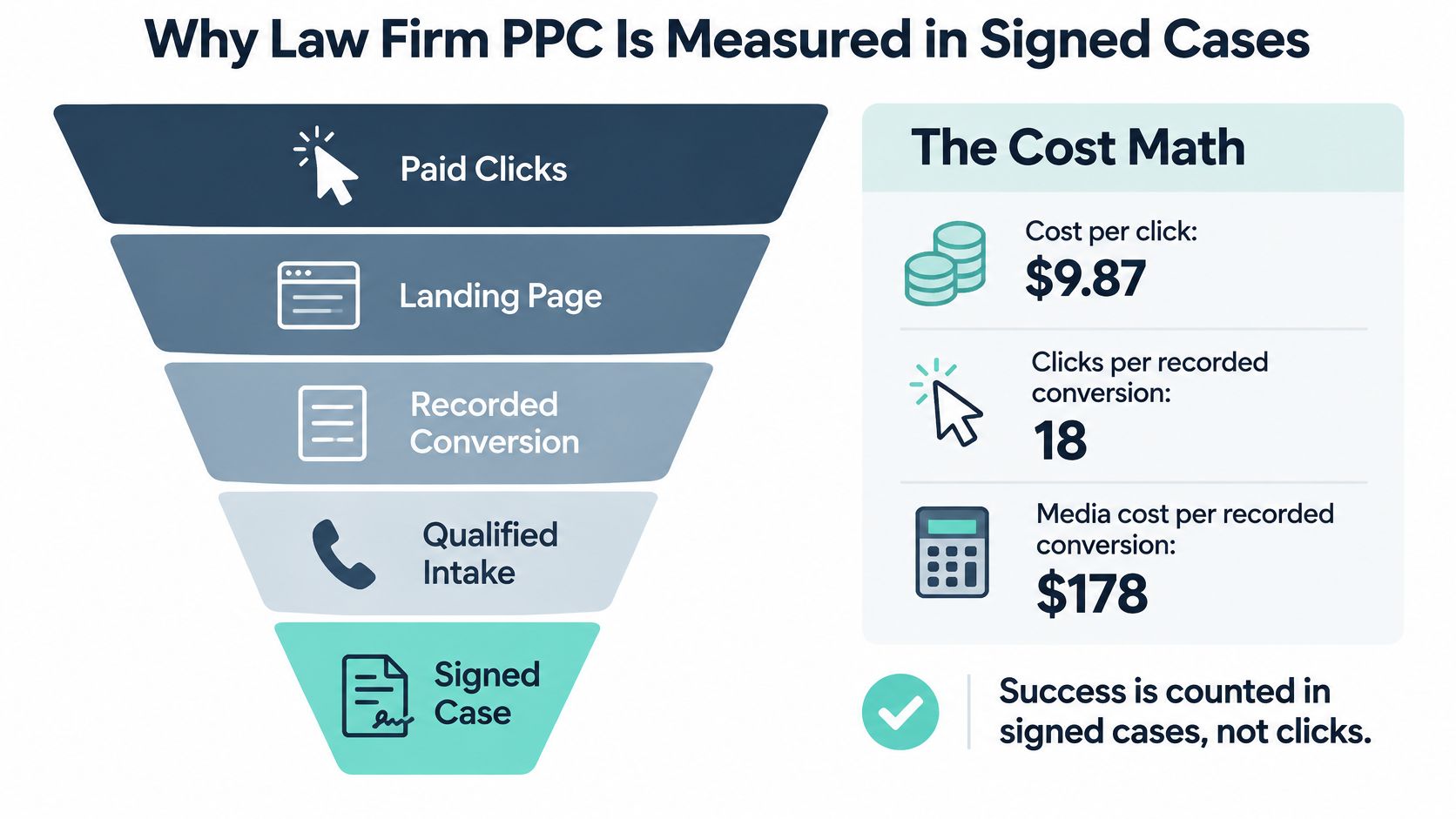
The cost of that mistake matters. For U.S. Attorneys & Legal Services campaigns covering April 2023 through March 2024, the benchmark summarized by Flint reports a median CPC of $8.94, a 5.64% conversion rate and an average cost per lead of $144.03.
Using those inputs for a planning scenario, 100 clicks cost about $894 in media spend and generate approximately 5.6 tracked conversions, or roughly $158 per conversion. That's before agency fees, landing-page costs, call handling and follow-up. The difference from the reported average cost per lead illustrates why combining benchmark averages doesn't reproduce an individual campaign's results.
The funnel below distinguishes a recorded advertising action from an actual engagement. Its cost panel uses a separate illustrative benchmark calculation, not the planning scenario above.
Define the outcomes before buying traffic
Give marketing and intake the same vocabulary:
- Qualified inquiry: A contact that matches the practice area, jurisdiction, case criteria and the firm's capacity.
- Booked consultation: A consultation slot confirmed on the calendar, not merely requested through a form.
- Retained matter: A signed engagement, rather than an encouraging conversation or an unsigned proposal.
These distinctions prevent a campaign manager from counting every submission as success while an intake manager dismisses the same contacts as unusable.
Budget rule: Decide what the firm can afford to spend acquiring a retained matter before deciding how many clicks to buy.
Practice area, geography, competition, keyword intent, ad quality and tracking configuration can all change the economics. Use benchmarks to frame a budget discussion, not to promise a result. Write down a target cost per retained matter, with room for delivery costs and profit, before approving media spend.
Practice-Area Campaign and Ad-Group Map
Build a separate campaign for each practice area you intend to promote. A shared budget and generic law-firm message conceal meaningful differences: LocaliQ's legal-search benchmark reports average CPCs of $12.30 for criminal law, $7.69 for family law and $7.92 for estate and probate law.
Those figures aren't local price quotes. They do show why a criminal defense campaign shouldn't inherit the budget assumptions, exclusions or intake process of an estate-planning campaign.
Organize ad groups around intent
Within each campaign, distinguish these intent types:
- Urgent: Arrest, charge and emergency searches that require immediate triage.
- Consultation: A legal service plus location, with a clear path toward an appointment.
- Research: Informational queries that should usually be excluded from an acquisition campaign or addressed through helpful content.
Don't create an urgent ad group for a service that doesn't need one. Start with exact and phrase match for defined service-and-location searches, then inspect actual search terms rather than assuming the match setting guarantees relevance.
Practice-area campaign and ad-group map
| Practice area and ad group | Search queries | Negative keywords | Landing page | Intake route |
|---|---|---|---|---|
| Criminal defense, urgent | arrested tonight lawyer [city]; DUI attorney near me; criminal defense lawyer [city] | jobs; salary; law school; free legal forms | Criminal defense page with city name and call-now button | Urgent line with same-day callback |
| Estate planning, scheduled | wills and trust lawyer [city]; estate planning consultation [city]; revocable living trust attorney | free will template; online will kit; estate planning jobs | Estate planning page with booking calendar | Booking queue with confirmation email and text |
| Family law, consultation | divorce lawyer [city]; child custody consultation [city]; prenuptial agreement attorney | free divorce forms; divorce advice forum; family law jobs | Family law page with consultation form and screening questions | Form routed to family team within a documented response window |
| Immigration, consultation | green card lawyer [city]; visa consultation attorney; asylum lawyer near me | immigration jobs; free visa application; immigration news | Immigration page by case type with multilingual screening form | Case-type routing to the matching attorney |
| Real estate, consultation | real estate closing attorney [city]; landlord lawyer consultation [city] | real estate license exam; homes for sale; property jobs | Real estate page for closings and disputes | Form with matter-type field routed to property team |
Replace every [city] placeholder with a real service area. Adapt terminology to the jurisdiction and the services the firm provides, rather than importing U.S. queries unchanged into Canadian campaigns.
Apply exclusions carefully
Jobs, salary, law school, free forms and do-it-yourself guides are useful starting exclusions when the objective is paid representation. But review the full query before adding a broad negative. Excluding free indiscriminately could also block someone seeking a free initial consultation that your firm offers.
For account setup, conversion tracking and bidding basics, use SimpleLab Digital's Google Ads guide to search-term optimization. The campaign map establishes which searches belong together, where they should land and who handles them.
Complete a row for every promoted practice area before writing ad copy. If the intake-route cell has no accountable owner, the campaign isn't ready.
Criminal Defense and Scheduled Estate Planning Compared
An urgent criminal defense inquiry and an estate-planning consultation shouldn't compete under identical operating rules. One caller may need help responding to an arrest now; another wants to understand options before choosing an appointment.
Think of an emergency department and an elective clinic within the same hospital. Both need capable professionals, but their scheduling, triage and communication systems serve different needs.
Criminal defense and scheduled estate planning compared
| Criterion | High-urgency criminal defense | Scheduled estate planning consultation |
|---|---|---|
| Searcher's state | Arrest or charge happening now | Planning ahead, often over weeks |
| Typical query | arrested tonight lawyer [city] | estate planning consultation [city] |
| Match type | Exact and phrase for urgent terms; broad match avoided at launch | Exact and phrase for service plus city |
| Bid approach | Higher CPC accepted for qualified, call-led urgent traffic | Bid toward booked consultations with tighter acquisition-cost tolerance |
| Ad message | Actual availability and the immediate next step | Clear scope and any consultation fee stated |
| Landing page | Call button above the fold, minimal fields | Booking calendar and plain-language process |
| Intake target | Callback inside the firm's documented urgent window | Booked slot confirmed by email and text |
| Best KPI | Cost per qualified urgent call | Cost per booked and held consultation |
| Common failure | Slow answer on urgent calls | Attracting people who only want free documents |
Availability must match the promise
An urgent click is perishable because the searcher may retain the first suitable lawyer who answers. Don't advertise immediate availability if calls reach an unattended voicemail. Adjust campaign hours or arrange genuine coverage instead.
For a geographically specific service-page reference, the Law Office of Bryan Fagan – Kingwood TX Lawyers provides a Kingwood criminal defense attorney resource. Review the relationship between location, practice area and contact path without treating another firm's wording as approved copy for yours.
Estate planning needs a different conversation. Explain what the consultation covers, what information the prospective client should prepare and whether a fee applies. The estate-planning marketing campaign blueprint offers a useful planning companion for that scheduled decision process.
Let downstream quality influence bidding
Segment bidding by practice area, geography and intent, rather than one blended account average. The operational analysis accompanying Search Engine Land's advertising-cost coverage supports connecting CRM-qualified outcomes with advertising optimization instead of valuing every form fill equally.
Use offline conversion imports for stages such as qualified inquiry, consultation held, retained client and fee collected. Keep stage definitions distinct so the platform doesn't count successive milestones as interchangeable new leads.
A higher CPC can be acceptable when an urgent inquiry fits the firm's criteria and produces a valuable engagement. Conversely, inexpensive traffic isn't efficient if intake consistently rejects it.
Label each promoted service as primarily urgent or scheduled, then give it an appropriate response standard and acquisition target.
Landing Pages and Intake Handoff That Keep Paid Demand
A landing page doesn't finish the conversion process. It starts a handoff that the intake team must complete, with clear ownership and enough information to respond intelligently.
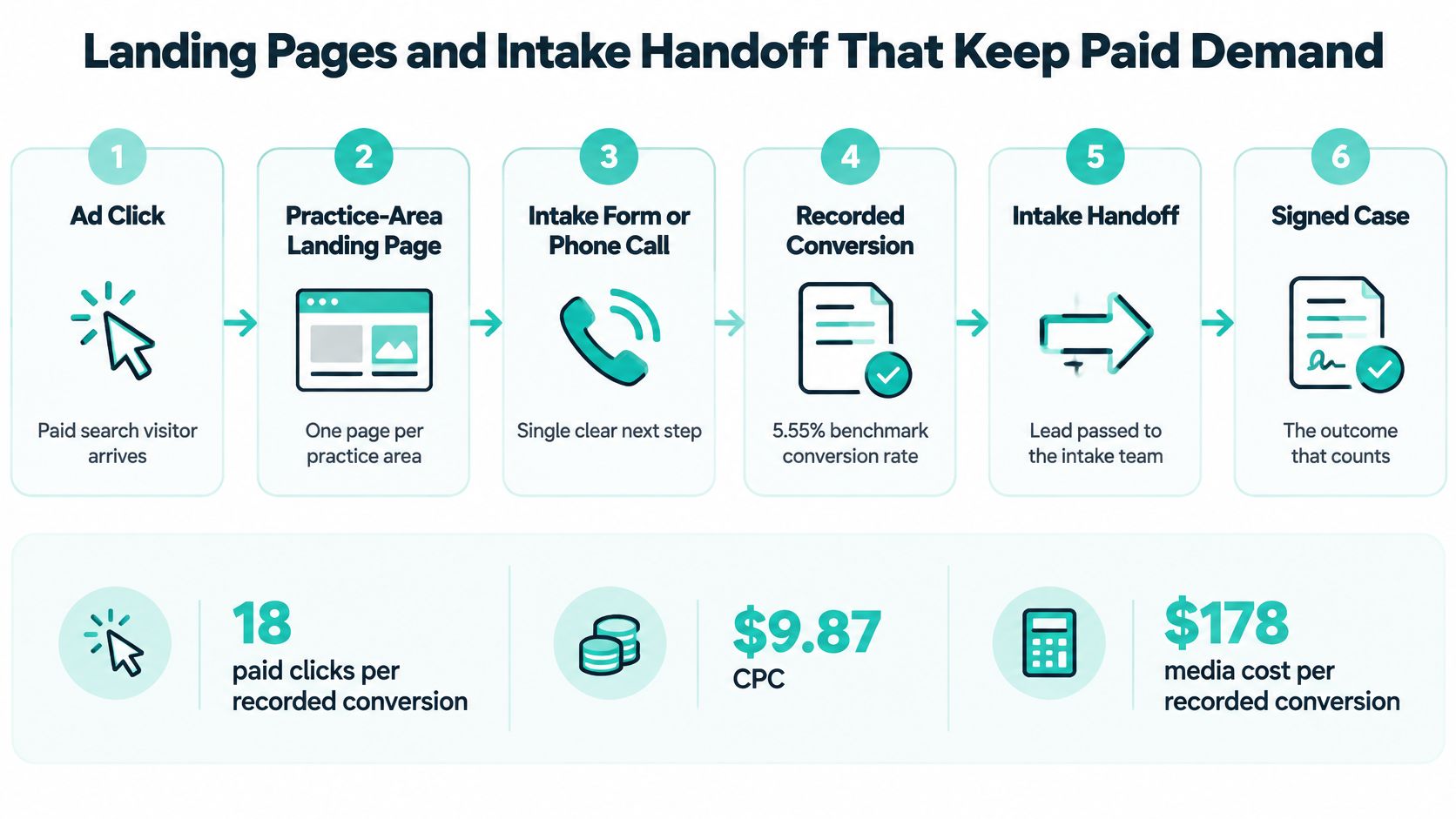
The benchmark discussion from 9 Clouds reports a 5.55% average conversion rate, equivalent to approximately 18 paid clicks per recorded conversion, and illustrates roughly $178 in media cost at a $9.87 CPC. That calculation isn't interchangeable with another dataset's reported cost per lead.
Use the flow below to check whether every paid inquiry has a route toward an engagement.
Run the handoff as a documented routine
- Match the search. Put the practice area and actual service location in the headline and first screen. Don't send a custody inquiry to a page dominated by unrelated services.
- Choose one dominant call-to-action. Lead with a call button for urgent matters or a consultation form for scheduled inquiries.
- Make the page usable on mobile. Keep the phone number tappable, compress heavy media and test the form on a phone.
- Ask only useful screening questions: matter type, location, deadline and prior counsel where relevant. Don't require a detailed confidential narrative just to request contact.
- Assign the route. Urgent calls should reach a live person; forms should trigger a callback task with a documented response window and backup owner.
- Record answered status, missed calls and call duration. Deduplicate calls and forms belonging to the same prospective client.
- Send meaningful CRM outcomes back to the advertising platform, with a consistent event definition and appropriate handling of client information.
The guide to law-firm consultation landing pages helps translate those decisions into page structure. For the operational side, the Recepta.ai guide to legal intake is a useful companion when documenting who answers, screens and follows up.
Separate marketing ownership from phone coverage
Our marketing process connects the pieces: ads create the first opportunity, a landing page explains the next step, content gives people more context and follow-up keeps the conversation moving. The firm still needs to assign the human response.
SimpleLab Digital's packages don't include phone-call handling. Establish who answers during business hours, who covers urgent inquiries outside them and who checks incomplete callback tasks.
Use the accompanying video alongside a live walkthrough of the firm's own inquiry path.
A confirmation message isn't a consultation, and an automated text isn't evidence that an attorney reviewed the matter. Tell prospects what happens next without implying that submitting a form creates representation.
Test the handoff yourself: call the firm's number after hours from a phone, submit a test inquiry and time the actual response. Fix the unanswered call or unassigned task before buying more demand.
Compliance Checks Before Any Ad Goes Live
Paid search is generally permitted, but permission to advertise isn't permission to publish every claim in every market. The practical question is how the firm approves a campaign across the states and provinces it serves.
Under ABA Model Rule 7.2, covered communications must identify a responsible lawyer or firm and contact information; specialist-certification claims require qualifying certification and clear identification of the certifying organization. Reflect responsible-firm identification in both the advertisement and its linked landing page, and have counsel review proposed specialist language.
The ABA's digital advertising ethics guidance also distinguishes advertising from paid recommendations and solicitation. A fixed advertising fee doesn't automatically make a lead-generation arrangement compliant, and an intake provider mustn't imply an independent, unpaid recommendation.
Use this checklist as an approval aid, not a substitute for jurisdiction-specific review.
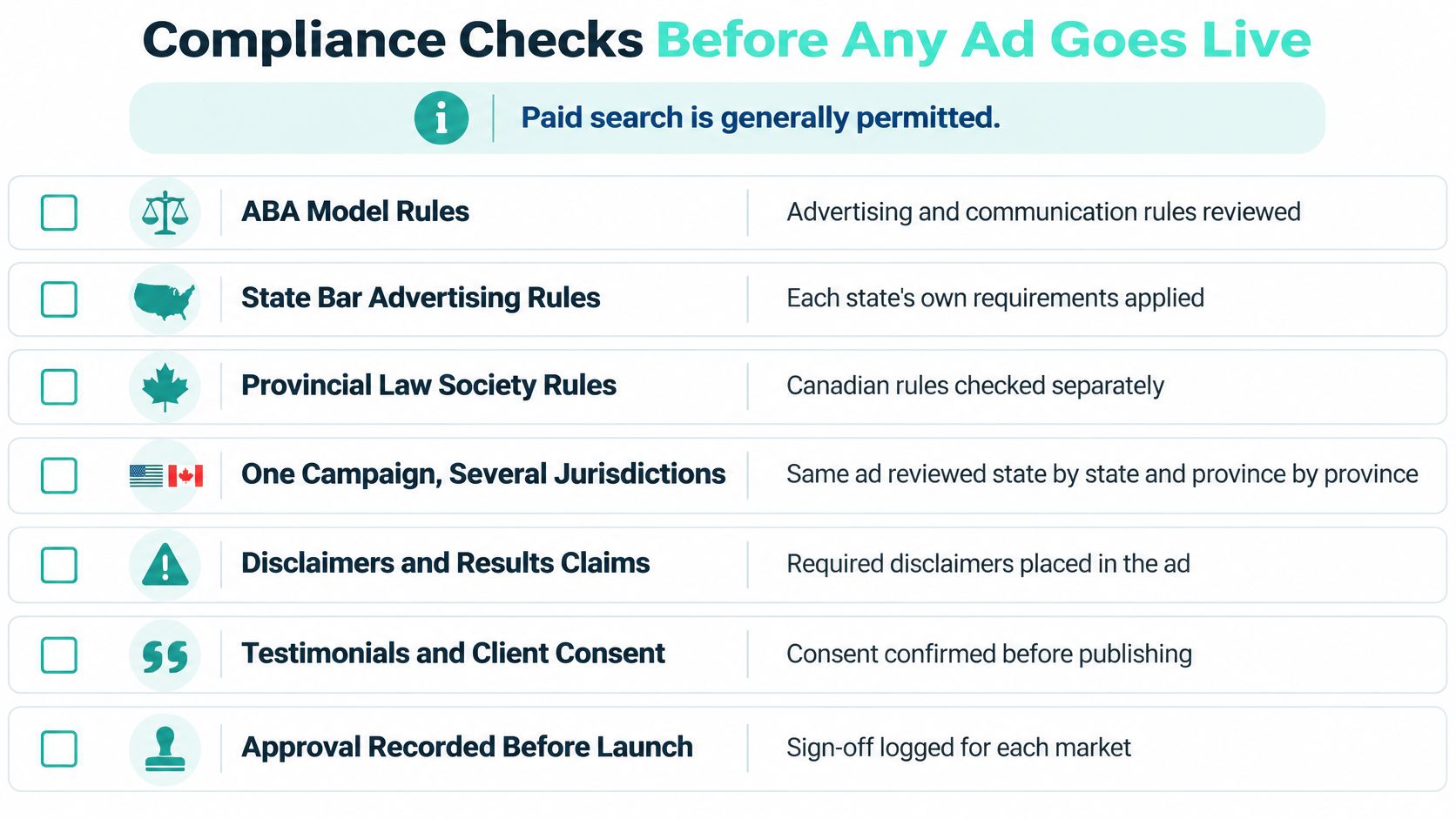
Review the applicable rule and preserve the approval
The ABA Ethics 2000 Rule 7.2 document contains a two-year retention provision after last dissemination. It's historical material, not a universal statement of current state requirements. Preserve final ad text, assets, landing-page versions, placement details and delivery dates under a retention policy checked against the governing jurisdiction.
For Ontario, the Law Society of Ontario's Rules of Professional Conduct treat firm names, letterhead and fee advertising as marketing, require verifiable and nonmisleading communications, and require quoted fees to identify scope and whether disbursements, third-party charges and taxes are additional.
- Classify each asset as advertising or potential solicitation.
- Identify the responsible lawyer or firm and contact details.
- Substantiate claims, including testimonials, outcomes and credentials.
- Check fee statements for scope, exclusions and required disclosures.
- Archive the approved version with its markets and delivery history.
- Require renewed approval when claims, fees, targeting or destinations change.
For campaigns outside Ontario, identify the applicable provincial regulator by name, such as the Law Society of British Columbia or the Law Society of Alberta, and review firm names, letterhead and fee statements under its rules. Don't treat Ontario approval as Canadian approval.
The same asset-review discipline applies across channels; our bar-compliant attorney Facebook advertising guide addresses the related social-advertising workflow.
Sources to check before launch: ABA Model Rule 7.2, each applicable state bar's advertising rules, the Law Society of Ontario rules for Ontario marketing, the relevant provincial law society elsewhere in Canada, and applicable Google Ads legal-services policies and eligibility requirements. Verify each source for the specific jurisdiction, campaign type and current requirements.
Measuring Qualified Inquiries and Signed Cases
A high click-through rate can mean your ad matches a searcher's interest. It doesn't establish that the firm accepted the matter.
Lunio's legal-services Google Ads benchmark reports a blended Search CTR of 2.93%, drawing on independent benchmarks and a 2023–2024 sample. Use that as a directional relevance diagnostic, not a target that overrides consultation quality or signed engagements.
Use a metric ladder with named sources
Metric ladder and reporting cadence
| Stage | What to count | Source | Review |
|---|---|---|---|
| Ad interaction | Clicks and CTR by ad group | Ad platform | Weekly |
| Answered contact | Answered calls, missed calls and call duration | Call tracking | Weekly |
| Qualified inquiry | Forms and calls matching practice area, location and case criteria | CRM intake log | Biweekly |
| Booked consultation | Consultations scheduled | CRM calendar | Biweekly |
| Consultation held | Appointments attended | CRM | Biweekly |
| Retained matter | Signed engagements | CRM and engagement letters | Biweekly |
| Fee collected | Revenue per matter | Billing system | Monthly |
Reconcile records rather than adding every system's totals together. A prospect who calls, submits a form and books an appointment is one person progressing through stages, not several unrelated opportunities.
The practical lead-scoring guide for lawyers can help intake define qualification consistently. Record rejection reasons such as wrong jurisdiction, unsupported matter type or no capacity, so the campaign manager knows what to change.
Calculate acquisition costs without hiding the denominator
Use these formulas:
- Cost per qualified inquiry = advertising spend ÷ qualified inquiries.
- Cost per retained matter = advertising spend ÷ signed matters.
In a hypothetical example, a campaign spending $2,000 and generating 10 qualified inquiries has a cost per qualified inquiry of $200. If two inquiries become signed matters, its cost per retained matter is $1,000.
Label whether the report uses media spend alone or fully loaded marketing costs. Don't compare one campaign's media-only cost with another campaign's total acquisition cost.
A campaign manager needs rejection reasons, not just a message that the leads were bad.
Review call and form activity weekly, reconcile CRM stages biweekly and review collected revenue monthly. Evaluate retained matters by inquiry cohort where possible, so a consultation that signs later isn't disconnected from the campaign that generated it.
Import eligible CRM outcomes as offline conversions so bidding can respond to business quality. Check cost per qualified inquiry for each practice area first, then investigate consultation attendance and retention before deciding whether to increase spend.
Confirm the Campaign Map Before You Launch
Approve or revise the campaign map before releasing the budget. A launch date shouldn't override an untested intake route or unsigned compliance review.
- Confirm scope: List the promoted services and mark each as urgent or scheduled.
- Localize targeting: Replace every location placeholder and prepare to add exclusions from the initial search-term review.
- Assign ownership: Name the landing-page owner, urgent-call responder, backup intake contact and ad approver.
- Record approval: Complete jurisdiction review and archive approved assets.
- Verify measurement: Test call tracking, form capture and CRM stages before live traffic arrives.
Our practice-area work includes estate planning, family law, real estate, civil litigation, immigration, personal injury, criminal defense, employment, business law and bankruptcy. Each still needs a defined service to promote, rather than a request to advertise everything.
Supply a media budget separate from the agency or package fee, someone who provides business information and approves work, a team member who responds to inquiries, and a regular channel for lead-quality and sales feedback.
For practice-area planning and compliance-aware review, visit our law firm marketing page. Use the Google Ads guide linked earlier for setup basics, then make the launch decision against the completed map, not the account dashboard.
SimpleLab Digital offers Google Ads, focused landing pages, content and follow-up support that connect legal searches with a defined consultation path. Visit SimpleLab Digital to discuss your practice-area campaign map, the intake responsibilities your firm will own and how qualified inquiries and retained matters will be measured.