Buying more leads can be the wrong move for a law firm. Google's ranking guidance makes responsiveness part of advertising performance, not just client service, a connection highlighted in NextPhone's analysis of lawyer Local Services Ads. Local Services Ads for lawyers make sense when eligible firms can answer local inquiries reliably and turn them into profitable retained matters. Before setting a budget, name the person responsible for every incoming call and message.
Table of Contents
- Local Services Ads Versus Search and Social Ads
- U.S. Eligibility Checklist Before You Apply
- What Local Services Ads Really Cost per Lead
- Lead Tracking That Separates Leads From Retained Matters
- Which Channel Fits Each Practice and Firm Type
- Intake Capacity Before You Raise the Budget
- Your Next Step Before Launching Local Services Ads
Local Services Ads Versus Search and Social Ads
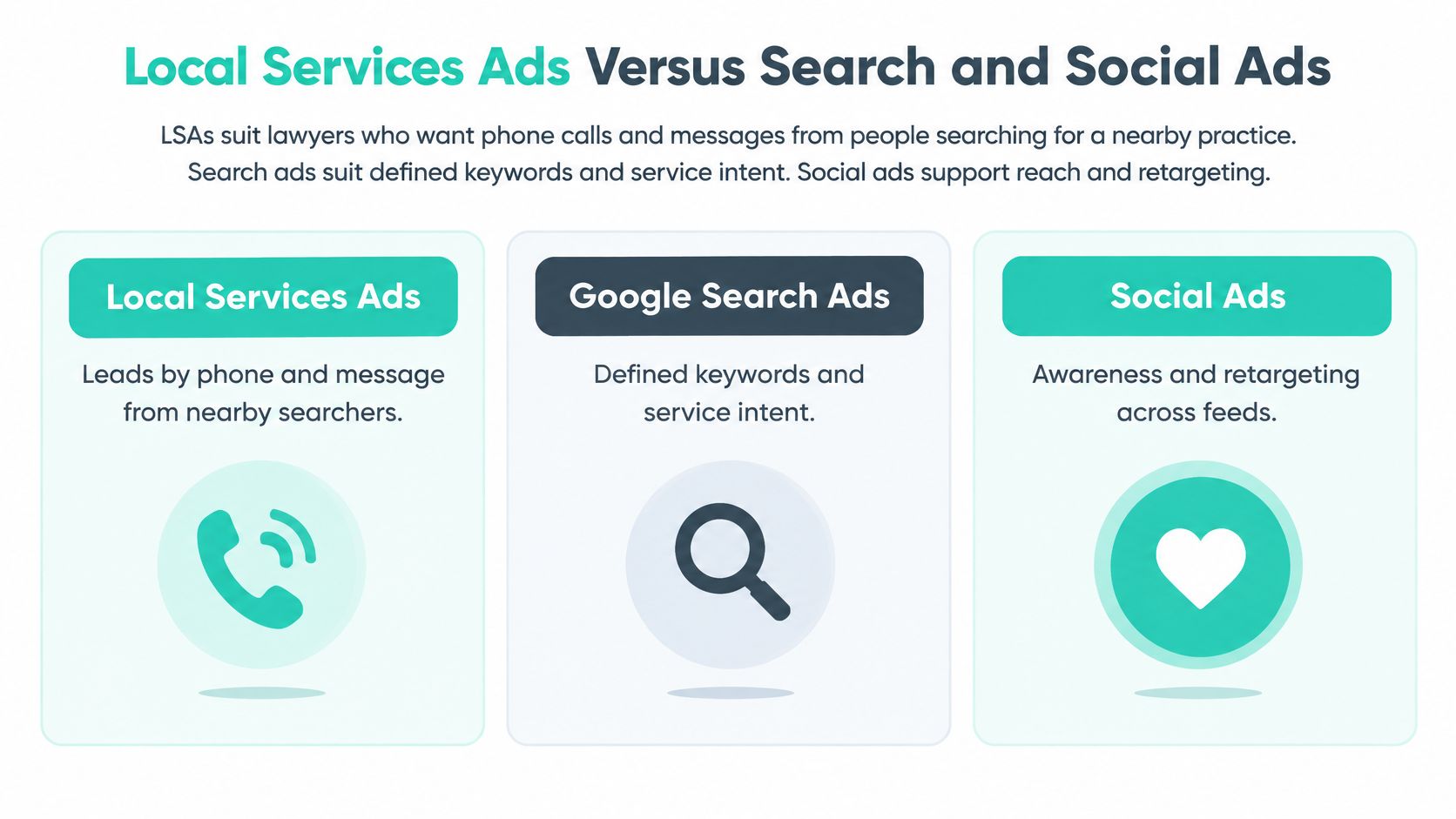
Use Local Services Ads for nearby prospects who want to contact a lawyer, Google Search Ads for defined service searches, and Facebook and Instagram Ads for awareness and nurturing. These channels serve different jobs. Don't choose between them on lead price alone.
Channel comparison for law firms
| Criteria | Local Services Ads | Google Search Ads | Facebook and Instagram Ads |
|---|---|---|---|
| Pay model | Per qualifying lead event, such as a call, message or booking, not necessarily a qualified case | Per click on bid keywords | Per result for the chosen objective, such as clicks, leads or impressions |
| Where it appears | Local unit at the top of Google Search | Search results for keyword queries | Feed, Stories and Reels on Facebook and Instagram |
| Searcher intent | Active need for a nearby lawyer | Active search for a service term | Passive, interrupted while browsing |
| Targeting | Practice area, service location and provider verification | Keywords, location and audiences | Interests, demographics and custom audiences |
| Eligibility gate | Category and location availability, screening and verified profile | Account and policy review | Account and policy review |
| Best-fit goal | Phone and message volume in covered practice areas | Specific matters with clear keywords | Awareness, retargeting and nurturing |
The distinction is intent: an active local need, an active service search, or passive browsing that requires follow-up. Someone searching for a nearby divorce lawyer needs a clear contact path; someone browsing Instagram may need educational content before considering a consultation.
Choose control or direct contact deliberately
LSAs trade keyword-level control for a prominent local provider placement. Search Ads let you separate service terms, exclusions and landing pages more precisely. Use our Google Ads guide for law firms when the matter type requires that extra control.
Local relevance also needs substance. For a Texas prospect comparing providers, the Law Office of Bryan Fagan's resource to find a trusted Humble law firm offers a local reference point, not a substitute for checking fit.
SimpleLab Digital serves small businesses generally, with specialized practice-area marketing pages spanning estate planning, family law, real estate, civil litigation, immigration, personal injury, criminal defense, employment and bankruptcy. The channel recommendation should reflect the matters a firm accepts, not a standard advertising bundle.
Channel rule: Choose the channel your intake team and practice can support. A larger budget doesn't make an unsuitable channel fit.
LSA availability is category- and location-specific. Treat eligibility as a gate before comparing projected results.
U.S. Eligibility Checklist Before You Apply
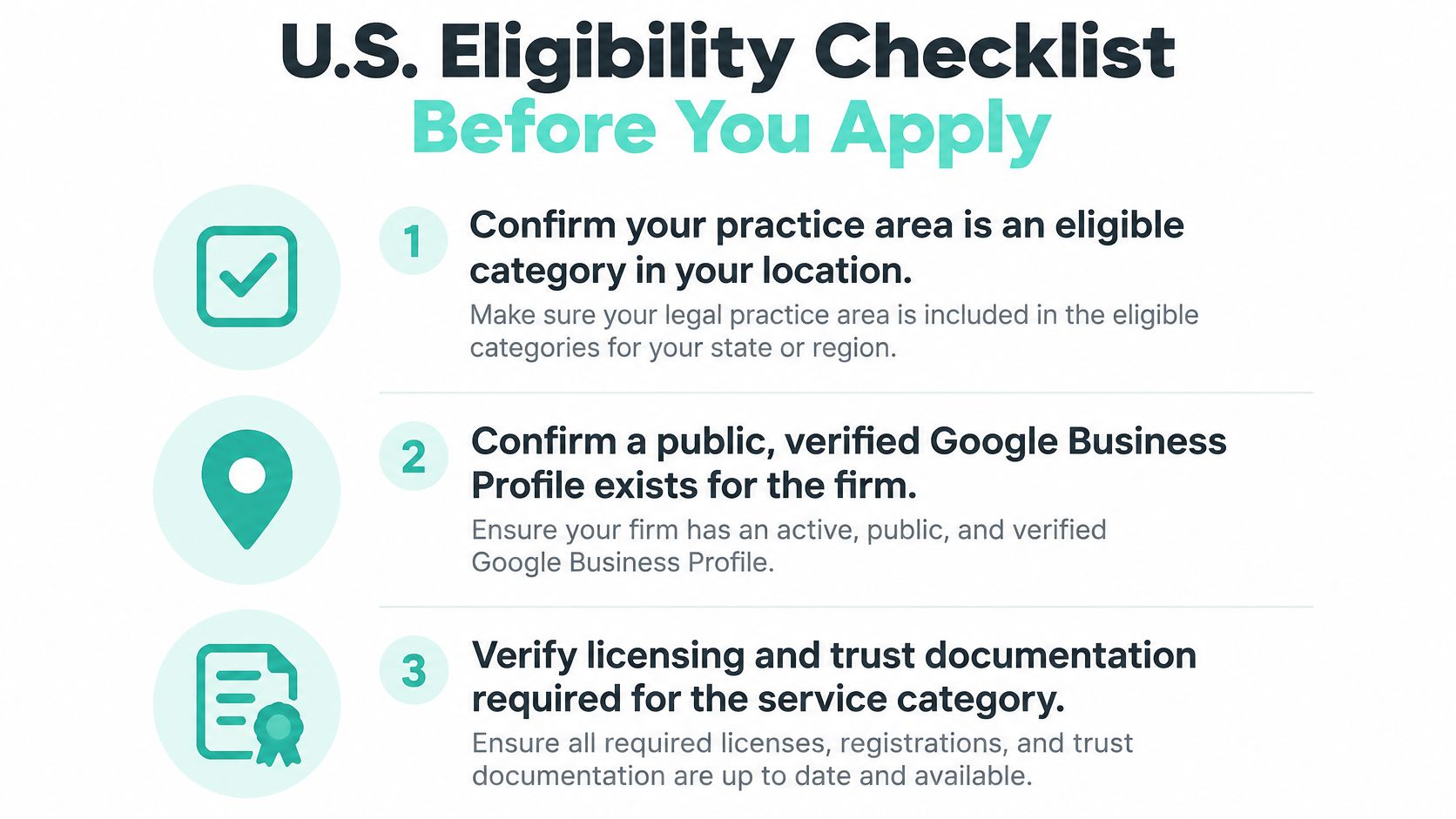
Complete verification preparation before committing to a launch date. Google's screening and verification guidance requires a public, verified Google Business Profile and says screening averages three to four weeks after documents are submitted. Requirements can include business, owner and service-professional checks, with license, insurance and background checks determined by category and country.
Complete the firm's application file
Confirm category and location eligibility. Check the actual practice category and office market in Google's current application flow rather than assuming every legal service qualifies.
Confirm a public, verified Google Business Profile. Keep profile ownership under firm-controlled access so an employee departure or agency change doesn't block administration.
Match the business identity. Reconcile the legal business name, permitted advertising name, website, licensing records and profile information before submitting documents.
Check addresses and phone numbers. Confirm that office information is accurate and that the advertised number reaches the intended intake team.
Gather licensing records. Prepare the relevant attorney and firm credentials for each jurisdiction connected to the application.
Prepare requested trust documentation. Confirm insurance details and be ready to complete the license, insurance and background checks Google requests.
Name the document and approval owner. Assign someone inside the firm to supply information, resolve discrepancies and approve accurate representations.
Keep verification separate from campaign production
Our Google Business Profile setup and reviews guide can help your team organize profile preparation. An agency can execute campaigns, but the firm remains responsible for accurate credentials and professional representations.
Successful checks may support a Google Screened or License Verified badge, where applicable under Google's current program. Follow the terminology and requirements shown in the account rather than promising a particular badge in advance.
For Canada, verify the current category and location directly with Google before including LSAs in the media plan. Neither an older U.S. rollout nor availability in London establishes Canadian eligibility. Also confirm that the advertising entity can fulfill the leads itself, rather than treating the profile as a referral storefront.
We ask clients to identify the service they're promoting, keep advertising spend separate from package fees, assign information and approval owners, provide inquiry coverage, and share lead-quality and sales feedback. Those are operating requirements, not paperwork conveniences.
What Local Services Ads Really Cost per Lead
Legal lead cost benchmarks
The legal-search figures below are attributed to LocaliQ, and the LSA figures are practitioner-reported estimates summarized in the iClick legal LSA management guide.
| Benchmark | Figure | Use it for |
|---|---|---|
| LocaliQ 2025 average cost per lead, legal search | $111.05 | Baseline comparison for your own cost per lead |
| LocaliQ 2025 practice-area cost per lead range | $72.24 to $159.17 | Spread across practice areas, not one blended target |
| LocaliQ 2025 average cost per click, legal search | $9.21 | Comparison point against Search Ad costs |
| LocaliQ 2025 conversion rate | 7% | Check against your own inquiry conversion rate using matching definitions |
| Practitioner-reported legal LSA lead range, 2026 | $195 to $250 | Upper planning case; verify in your market |
| Practitioner-reported personal-injury cost per signed case | $630 to $735 | Only if your intake converts at a similar rate |
These figures aren't a Google price card. The legal-search benchmarks aren't LSA benchmarks, and the practitioner estimates aren't neutral, universally representative measurements. Use them to test assumptions, not to promise acquisition costs.
Translate lead price into matter economics
LSAs charge for qualifying contact events rather than ordinary clicks. A call, message or available booking can create a charge without producing a case the firm wants.
The platform supports a weekly budget and bidding options including Maximize Leads, optional Target Cost per Lead, and manual Maximum per Lead, where available in the account. Choosing a bidding option doesn't remove the need to evaluate what happens after contact.
In the iClick guide's worked scenario, $200 per lead divided by a 15% valid-lead-to-signed-matter rate produces approximately $1,333 in media cost per signed matter, before intake labor and service delivery. That calculation assumes the charged leads used in the denominator are valid; invalid charged contacts would worsen the result unless corresponding costs were removed.
A cheaper inquiry isn't a better purchase when it produces fewer appropriate retained matters.
Set the ceiling before increasing spend
Calculate allowable acquisition cost by matter type from expected collected fees, delivery costs and the margin the firm needs to retain. Use collected revenue rather than the largest possible case outcome, especially when fees arrive long after acquisition.
Then reserve room for advertising management and intake expense. The remaining amount is your media acquisition ceiling, not a target you must spend up to.
Our guide to what advertising on Google really costs explains why media spend and the broader cost of acquiring business need separate treatment. Test service categories, geographic coverage and response workflows before treating a budget increase as the answer.
Lead Tracking That Separates Leads From Retained Matters
Match every Google-reported lead to a firm record. Reconcile it against a call log, permitted recording, message thread, consultation booking or matter record. Google's Local Services Ads overview describes a pay-per-lead contact model, not payment for signed clients.
Keep the original platform lead identifier in your CRM. Add practice area, call versus message, contact owner, qualification outcome and the next action so marketing and intake can resolve discrepancies without relying on memory.
Lead tracking dashboard metrics
| Metric | Definition | Where to get it |
|---|---|---|
| Valid lead rate | Share of platform leads that meet your intake criteria | Platform lead report checked against call log |
| Missed-contact rate | Share of calls and messages not answered within your response window | Phone system and message log |
| Qualified inquiry rate | Share of valid leads that match your practice area and location | Intake notes |
| Consultation-booking rate | Share of qualified inquiries that book a consultation | Calendar or CRM |
| Signed-matter rate | Share of consultations that become retained matters | Case management system |
| Cost per retained matter | Total LSA spend divided by retained matters | Ad platform spend and case system |
Keep stage definitions consistent
Distinguish basic contact validity from case qualification. An authentic inquiry can still involve a conflict, an unsuitable matter or a person the firm cannot represent. Record those reasons separately rather than labeling every non-client a bad lead.
Also keep conversion denominators explicit. A consultation-to-retained rate isn't interchangeable with a lead-to-retained rate, and mixing them can make an acquisition forecast look much stronger than it is.
Use our law firm marketing ROI measurement guide to connect source records to downstream revenue. Review lead cohorts over an appropriate decision period so recently received inquiries aren't prematurely treated as failures.
Add reputation to the operating review
Google's U.S. Local Services guidance says serious or repeatedly negative customer feedback can lower ranking or prevent an advertiser from appearing. Put review volume and complaint themes beside lead outcomes.
- Identify eligible past clients. Apply the firm's confidentiality and professional-conduct requirements before requesting feedback.
- Ask without misleading incentives. Don't pressure clients to disclose sensitive matter details.
- Monitor recurring complaints. Separate intake problems from dissatisfaction with case outcomes.
- Escalate inaccurate feedback appropriately. Use the platform's reporting process without revealing confidential information in public replies.
The partner-level financial metric is cost per retained matter by practice area. Review it alongside complaint themes so low acquisition cost doesn't conceal poor client handling.
Which Channel Fits Each Practice and Firm Type
A criminal defense firm with reliable intake coverage has a different channel problem from an estate planning solo who spends much of the day in consultations. The first can prioritize direct local contacts. The second should build a contact path that doesn't promise immediate access the lawyer can't provide.
The reception desk is part of the acquisition system, not just an administrative function.

Match the channel to the matter
For urgent criminal defense, family, immigration and personal-injury inquiries, prioritize LSAs only when someone can respond promptly, with same-day ownership as the minimum operating commitment. Use Search Ads for narrower matter keywords and specific service pages.
For estate planning and real estate, start with defined service searches, then use Facebook and Instagram to educate and nurture. Don't make social advertising the primary urgent-intake channel. Olson & Sons' questions to ask before hiring counsel offer a useful reference for the practical concerns a personal-injury prospect may bring to a consultation.
Channel decision by firm situation
| Situation | Local Services Ads | Google Search Ads | Facebook and Instagram Ads |
|---|---|---|---|
| Urgent local need such as criminal defense, family, immigration or personal injury | Primary if the firm can answer the same day and the category is open | Use for specific matter keywords | Retargeting only, not first intake |
| Planned matters such as estate planning or real estate | Secondary after Search | Primary for defined service terms | Nurture and retarget site visitors |
| Multi-office, referral or co-counsel | Only if the advertising firm or its vetted personnel fulfill the lead | Landing pages that name the handling firm | Don't use to pass LSA leads to another business |
| Intake cannot answer inside the set window | Hold the budget | Forms permit asynchronous handling, but still need prompt follow-up | Awareness only |
| Canada or a category not confirmed for that location | Don't assume availability; verify with Google | Check current Search eligibility separately | Check platform eligibility; not a substitute for LSA eligibility |
Keep the handling entity clear
Google's Local Services policies prohibit selling or passing received leads to other businesses and require fulfillment by the advertising company or its vetted personnel. Multi-office and co-counsel arrangements need careful review, not an assumption that any licensed lawyer can receive the inquiry.
Record the receiving entity, handling lawyer, conflict-clearance status and any proposed fee arrangement. Have responsible counsel check applicable jurisdictional rules, privacy obligations and permitted arrangements before implementation.
Use this video alongside your team's discussion of channel responsibilities.
The best-fitting direct-response channel is one your intake team can answer the same day.
Intake Capacity Before You Raise the Budget
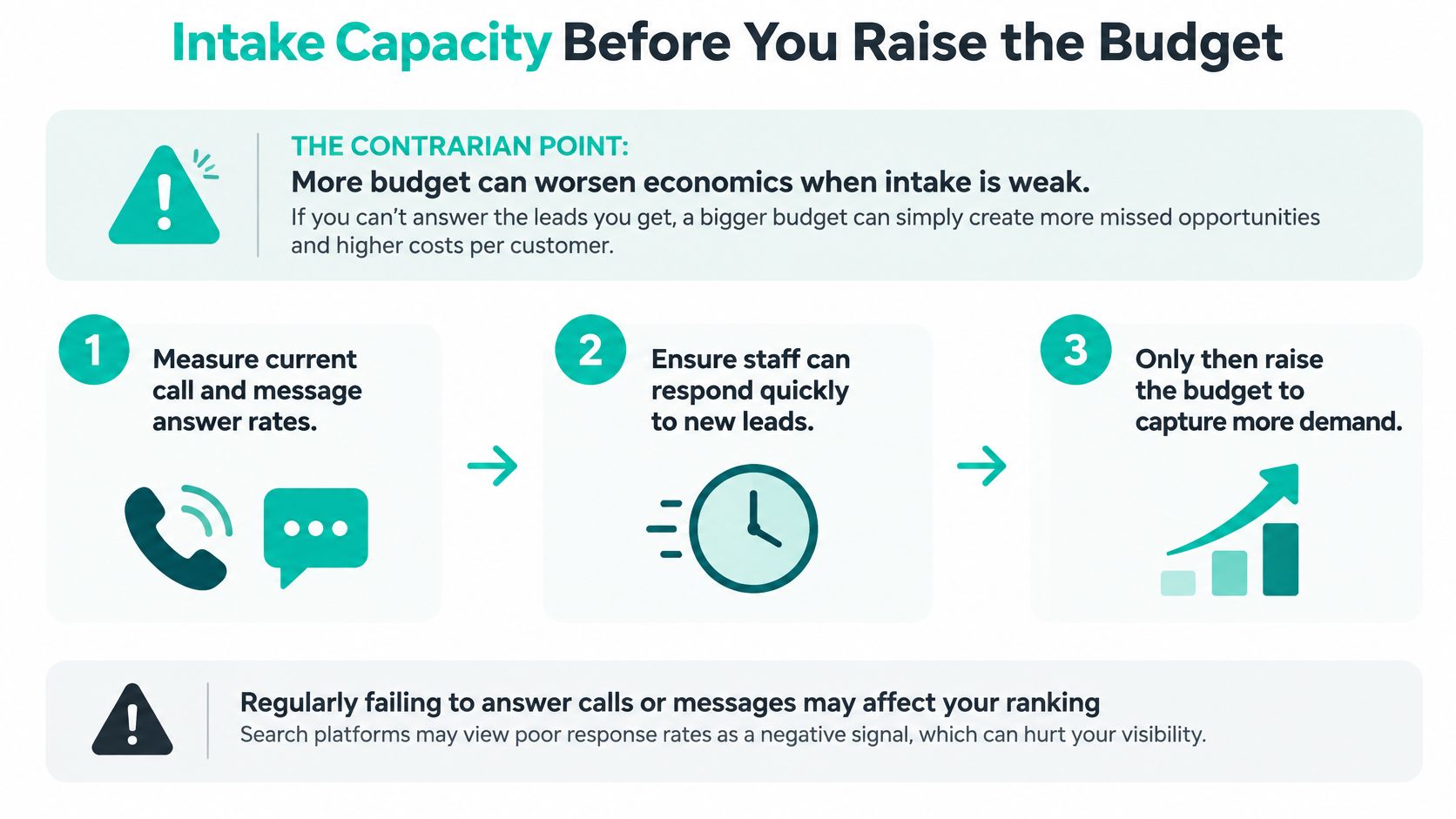
More budget can worsen acquisition economics when intake is weak. You're paying for additional opportunities without fixing the reason existing opportunities don't progress. Hiring or assigning intake coverage can therefore be a better investment than buying additional demand.
Google's Local Services help warns that regularly failing to answer calls or messages may affect ranking and states that messaging is available in both the United States and Canada. That messaging availability doesn't establish eligibility for every Canadian legal category or location.
Calculate the response threshold
- Count valid leads from a recent operating period. For example, review the last sixty days and separate business-hours contacts from after-hours inquiries.
- Measure timely contact. Calculate the share answered or recovered within your firm's defined response window, using phone and message records.
- Forecast incremental retained matters. Multiply expected additional valid leads by timely-contact rate, qualification rate and qualified-inquiry-to-retained rate.
- Compare contribution with coverage cost. Subtract incremental media spend and added intake expense from the expected contribution of those matters.
Use contribution after service-delivery costs but before acquisition expense. Otherwise, the calculation can count costs twice or mistake revenue for available profit.
Break-even test: Added intake coverage pays for itself when the contribution from the additional matters it helps retain exceeds its cost.
The minimum timely-contact rate follows the same logic:
Required contact rate = (incremental media spend + incremental intake cost) ÷ (additional valid leads × qualification rate × qualified-inquiry-to-retained rate × contribution per retained matter).
If that required rate exceeds what your team can deliver, don't increase the budget. Improve coverage, narrow the campaign or reconsider the channel.
Assign after-hours ownership
Define who checks messages, returns missed calls and handles voicemail when attorneys are unavailable. Give the backup person access to approved scheduling and escalation procedures without encouraging premature legal advice.
Our SMS follow-up guide for law firm leads can help structure appropriate follow-up. Automation should support an accountable person, not disguise an unattended inbox.
Before any increase, test call routing, voicemail instructions and message notifications from an outside phone. Confirm that the assigned person receives the inquiry and records the next action.
Your Next Step Before Launching Local Services Ads
Decide this week whether named intake staff can handle Local Services calls and messages within the firm's response window. If nobody owns that commitment, fix the contact process before approving more media spend. A vendor's production schedule is not a launch authorization while verification remains open.
If the U.S. category, location and profile checks have passed, start with a controlled weekly budget tied to the firm's acquisition ceiling. Evaluate the matters the firm accepts, not merely the number of contacts Google reports. Keep Canada off the LSA plan until someone confirms current local category eligibility.
Prepare the information prospects need
Intake staff need a clear description of accepted matters, consultation expectations and escalation boundaries. For personal-injury teams, resources such as Nares Law Group injury case guidance can help identify the kinds of case-specific questions prospects may bring, without substituting another firm's criteria for your own.
- Define acceptance criteria. State which matters, locations and client circumstances the firm can consider.
- Approve the next step. Make consultation availability, required information and follow-up ownership explicit.
- Choose the marketing scope. Connect advertising to the content, landing page and follow-up the practice needs.
SimpleLab Digital supports advertising, content, landing pages and follow-up through its packages, but full SEO services and phone-call handling aren't included. We serve broader digital marketing for small businesses as well as specialized digital marketing for lawyers; the scope still needs to match the firm's operational capacity.
Use our law firm marketing services to plan around the practice areas you intend to grow. A free planning call is optional after the intake owner is named. The immediate decision is who answers, not who buys the ads.
SimpleLab Digital offers connected advertising, content, landing pages and follow-up support to help firms turn appropriate inquiries into measurable business opportunities. Once you've assigned intake ownership, visit SimpleLab Digital to book a free call and choose the marketing support that fits your practice.