Generative engine optimization for law firms is the practice of making a firm's pages accurate, self-contained and citable inside AI-generated answers, alongside the traditional SEO work that gets those pages found. It matters because Google's AI Overviews had reached more than 100 countries and territories by October 28, 2024, and the firms that benefit are the ones measuring AI citations against booked consultations and retained matters rather than counting mentions.
Ask a managing partner which page a prospect lands on after asking an AI assistant about a custody question, and the answer is usually a shrug. The firm knows its Google rankings. It rarely knows what ChatGPT, Gemini or an AI Overview says about its practice, which jurisdiction gets named, or whether the sentence quoted is one an attorney would sign.
That gap is the whole job.
Table of Contents
- What Generative Engine Optimization Means for Law Firms
- How AI Answers Choose Which Firm Pages to Cite
- AI Search Visibility Checklist for Each Practice Area
- Keeping AI-Visible Claims Within Ethics Rules
- Fixing Source Pages, Attorney Bios and Service Details
- Measuring Visibility Against Consultations and Matters
- Start Your AI Visibility Audit This Month
What Generative Engine Optimization Means for Law Firms
Could a prospect read a sentence from your practice page without its surrounding paragraphs and still understand who it applies to? That is a practical test for generative engine optimization. SEO helps people find the page; GEO adds an editorial requirement: the passages an AI answer quotes must remain accurate when separated from the rest of your copy.
The potential audience is substantial. On October 28, 2024, Google announced that AI Overviews were rolling out to more than 100 countries and territories, according to Google's October 2024 announcement. For a law firm, that makes the wording inside a page a marketing asset worth reviewing, alongside its rankings and search appearance.
What changes for a practice-area page
A practice page has to serve readers arriving directly and provide clear passages that search systems can interpret, summarize and cite. Useful foundations include attorney biographies, jurisdiction-specific explanations, transparent service descriptions, FAQs, primary legal sources and consistent business information across profiles the firm controls.
The trade-off is precision versus brevity. A short answer is easier to extract, but cutting the jurisdiction, exceptions or limits can change its meaning. Keep those qualifications with the claim rather than relying on a distant disclaimer.
| Dimension | Traditional SEO | Generative engine optimization |
|---|---|---|
| Primary goal | Rank pages in organic results | Earn accurate citations and references inside AI answers |
| Where visibility appears | Blue links and local map results | AI Overviews, AI Mode and AI assistant answers |
| Core signals | Relevance, links, crawlable content and page experience | Self-contained, jurisdiction-labeled answers plus consistent entity data |
| Main risk | Thin, duplicate or outdated pages | Isolated sentences quoted without their qualifications |
These disciplines share the same foundation: accessible, accurate pages. GEO adds attention to how individual passages stand alone. Neither a strong ranking nor a citation makes vague service descriptions useful to a prospective client.
Practical rule: if a sentence on your site would be wrong when lifted out of context, rewrite it.
Start with the firm's most important practice-area pages and the questions each should answer. Custody timelines, visa eligibility, probate, injury deadlines and closing costs require different explanations. For each page, identify the relevant jurisdiction, the service offered and the qualifications that must stay attached to an answer.
A focused reference page, such as this court-martial and NJP defense overview, offers a concrete format to consider: defined subject matter rather than a broad sales pitch. That structure alone does not establish citation performance.
Treat each accurate AI citation as a compliance-checked marketing asset, then judge its business value against qualified inquiries, consultations and retained matters. Citation counts measure visibility; they do not establish whether the firm is attracting suitable clients.
How AI Answers Choose Which Firm Pages to Cite
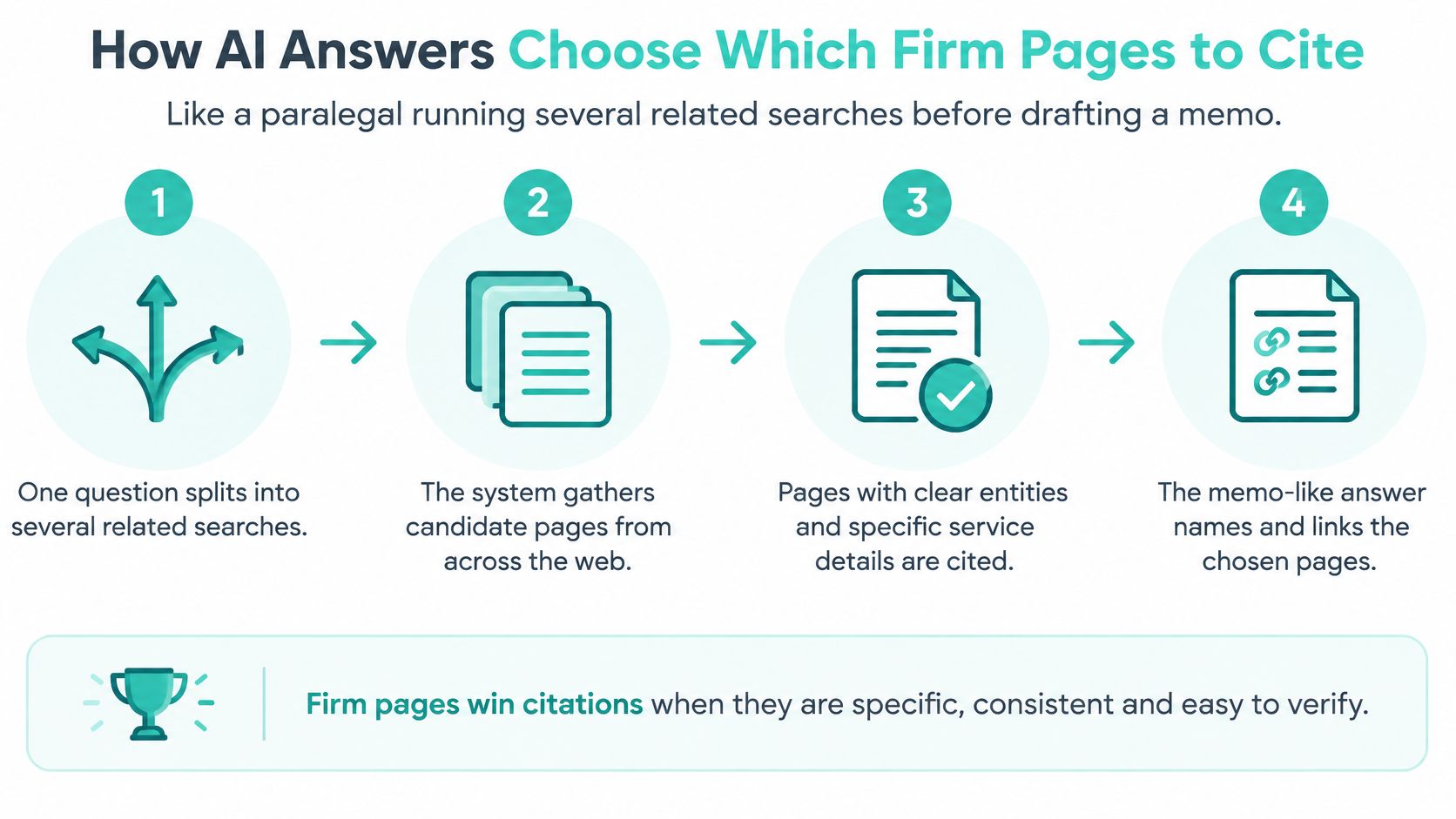
AI answers are assembled, not retrieved whole. Think of the system as a paralegal who runs several related searches before drafting a memo. It doesn't read one page and stop. It gathers, compares and writes.
Google describes a query fan-out process in its documentation for AI features in Search: the system issues multiple related searches across subtopics and data sources, then identifies additional supporting pages while generating the response. Google also says these features display relevant links so users can verify information and explore content beyond the initial query.
Here's the sequence as it affects your pages.
- A prospect asks a full question. Not "divorce lawyer," but whether a landlord must return a deposit after a lease ends.
- The system splits it into subtopics. Deadlines, required notices, exceptions, jurisdiction, small-claims limits.
- It searches across pages for each subtopic. Your practice page competes with statutes, government guides and other firms' explainers.
- It selects passages that answer cleanly. The ones naming the jurisdiction and the date survive the cut.
- It writes the summary and shows links. Some users verify. Most don't.
Why one page is rarely enough
Query fan-out rewards depth spread across connected pages. An immigration firm with a single visa page is invisible to most of these fan-out queries. The firm that publishes linked material on eligibility, required evidence, processing stages, inadmissibility issues and consultation preparation gives the system five places to find a quotable answer.
The mechanics cut both ways. More pages mean more chances to be discovered and combined, and more chances to contradict yourself. Two pages that describe the same filing timeline differently, or an attorney bio that names three practice areas while the service page names two, weaken trust and create real ethics exposure.
Directories and third-party listings feed the same process. A profile such as this best lawyers in Singapore listing either confirms your practice areas, offices and credentials or contradicts them, and the system has no way to know which version is right.
If your content plan still runs on keyword volume alone, rebuild it around the questions a client asks before they call. Our content marketing plan for law firms walks through that structure page by page.
The four-question test for any page
Read the page's first two sentences. Do they answer the question in the heading? Does the page name the jurisdiction? Does it show a date or a review note? Does it link to the related explanations a reader needs next? A page that fails two or more of those is a page AI systems will skip or misquote.
AI Search Visibility Checklist for Each Practice Area
In 2025, 28% of U.S. consumers said they would use ChatGPT to research an attorney, up from 9% in 2023, according to Rank Science's coverage of the annual legal-consumer study. People are already asking. The question is what the tools say back, and whether you've ever checked.
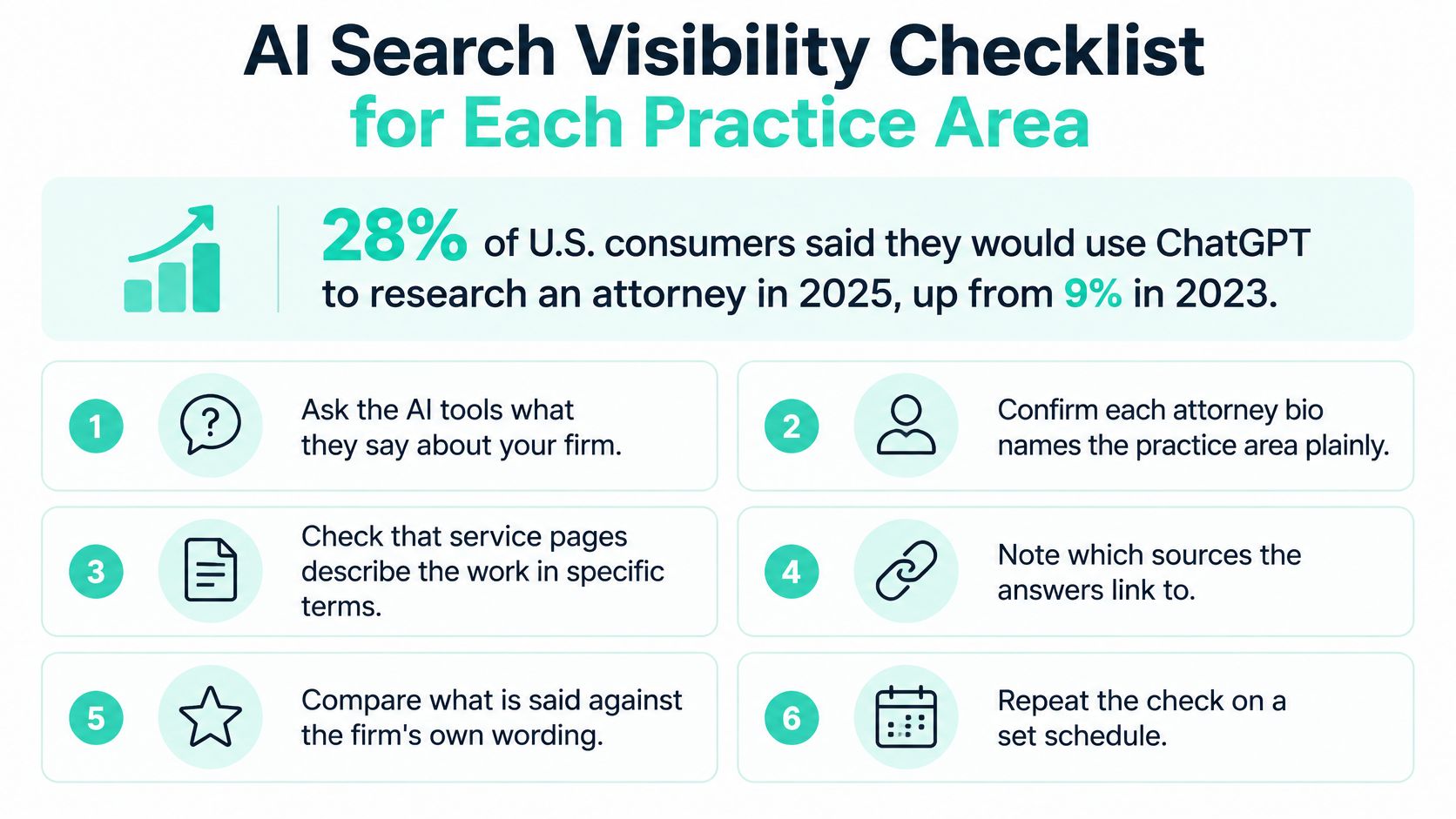
The run order
- Pick two or three practice areas. Choose the ones where a single matter is worth the most, not the ones with the most traffic.
- Write five questions per area in client language. "How long does probate take in Ohio" beats "probate duration." Name the state or province.
- Run each question in Google AI features and at least one AI assistant. Use a private browser window so personalization doesn't skew the results. Log the date, your location and the exact wording.
- Run each question a second time. Answers vary between runs, and a single result is a snapshot, not a baseline.
- Record what happened to your firm. Named, linked, paraphrased without attribution, or absent.
- Fact-check every claim in the answer. Compare it against your own page and against the primary statute or court source.
- Note which page the answer used. Then read that page's sentences in isolation and ask whether each one stands alone accurately.
- Score each question pass or fail against the standards in the table below.
- Repeat monthly and keep the log. The log is your baseline, and the only way to show movement later.
Pass standards by practice area
| Practice area | Sample test question | Page that should answer it | Pass standard |
|---|---|---|---|
| Estate planning | Does a will avoid probate in [state]? | Probate and wills page with a state note | Answer names the state, explains exceptions and avoids a universal claim |
| Family law | How long does divorce take in [state]? | FAQ with timeline by jurisdiction | Answer names the state and lists the variables that change timing |
| Immigration | What evidence supports a visa petition? | Process page with an evidence list | Firm's page is cited and the evidence list matches it |
| Personal injury | What is the deadline to file a claim in [state]? | Deadline page with a review date | Stated deadline matches the current statute the firm has verified |
| Real estate | What does a closing attorney do in [state]? | Service page for closings | Answer describes the role accurately and names the jurisdiction |
A failing answer that names your firm is worse than no answer at all. If an AI summary tells a prospect that your estate-planning page says a will avoids probate everywhere, you've published a misstatement with your name attached, and it gets repeated to the next hundred people who ask. Fix the source sentence first, then recheck the question at the next run.
Practical rule: an inaccurate answer outranks a missing citation on your fix list every time. Accuracy is the compliance question. Visibility is the marketing question.
Most firms find the same three problems in month one: pages that never name the jurisdiction, service pages that describe the firm instead of the work, and attorney bios that list practice areas without saying who is admitted where. Those are cheap to fix and they move the answers fastest.
Keeping AI-Visible Claims Within Ethics Rules
The common assumption is that AI-visible content sits outside advertising rules because the firm doesn't control the answer. That's backwards. AI systems lift sentences out of context and repeat them at scale, which makes every individual sentence an advertisement.
The rule that governs the sentence
The ABA's Model Rule 7.1 on communications concerning a lawyer's services prohibits false or misleading communication and treats a statement as misleading when it contains a material misrepresentation of fact or law, or omits a fact needed to keep it from misleading when considered as a whole. Read as a whole is the phrase that matters. A sentence lifted into an AI answer arrives without its surrounding qualifications.
Three patterns to cut:
- Outcome guarantees. "Guaranteed results" and "best lawyer" claims fail the same test online as on a billboard.
- Universal recovery language. A personal-injury page must not imply every claimant is entitled to a particular recovery.
- One-size document claims. An estate-planning page must not state that a single document solves every client's needs.
Who is accountable
The firm is. When an AI answer misstates your services or your legal position, that answer traces back to a page you published. ABA guidance ties existing duties to generative-AI work: competence under Rule 1.1 when lawyers rely on systems that may produce false conclusions, supervision of technology-assisted work under Rule 5.3, and confidentiality under Rule 1.6 when case information is supplied to third-party tools.
Canada adds a stricter test. The Law Society of Ontario's Rule 4.2-1 requires marketing to be demonstrably true, accurate and verifiable, covers claims about awards, rankings and third-party endorsements, and treats price information on a lawyer's own website as advertising, including prices available only after a visitor submits a request. Rules vary by state and province, so check yours.
The control workflow
Build an authority inventory that lists every claim the firm makes about credentials, outcomes, fees and timelines. Require attorney approval before publication. Put jurisdiction labels and publication dates on every answer-focused page. Set review triggers for statutory changes. Keep a correction log.
The correction log matters more than it sounds. You can't edit an AI answer directly. Fix the source page, record the date and the change, then rerun the same question at your next monthly check to see whether the answer moved.
Marketing copy and advertising compliance collide most often in paid channels, which is why our guide to Facebook advertising for attorneys that stays bar compliant is worth reading alongside this one. The approval discipline is identical.
Fixing Source Pages, Attorney Bios and Service Details
Fixes here are page-specific, and they start with identity. Retrieval systems need unambiguous answers to three questions: who the firm is, where it operates and what it provides.
Google's documentation on LocalBusiness structured data states that LocalBusiness markup can communicate business hours, departments, reviews in permitted contexts and other business attributes, and recommends applying relevant Organization fields because LocalBusiness is an Organization subtype. In practice that means one consistent set of JSON-LD identity data across the site: legal name, URL, logo, telephone, physical office or service area, sameAs profiles, practice-area relationships and department-level detail where it applies.
The fix order
- Make name, address and phone identical everywhere. Website, Google Business Profile, bar directory listings, chambers profiles, review sites. One firm, one spelling.
- Add JSON-LD that mirrors visible facts, then validate it. Markup claiming something the page doesn't show is a liability, not a signal.
- Rewrite attorney bios around verifiable facts. Jurisdictions of admission, practice areas, education and any recognition you can source.
- Open each practice-area page with a direct answer. Then scope, jurisdiction and exclusions, in that order.
- Add dated, jurisdiction-labeled FAQs. A date tells a system whether the answer is current.
- Remove review markup you can't support. Then audit changes monthly, because drift is constant.
Structured data does not guarantee inclusion in an AI answer. Its value is machine-readable context and validation of the facts a page already states. Firms treating markup as a magic switch end up disappointed; firms treating it as a consistency check find the actual errors.
What each page type needs
| Page type | What to add | Why AI systems need it |
|---|---|---|
| Attorney bio | Jurisdictions of admission, practice areas, education and sourced recognition | Names who is qualified to answer for the firm |
| Practice-area page | Direct answer, scope, jurisdiction and process steps | Gives a quotable answer tied to the right service |
| Service or pricing page | What the fee covers and what it excludes | Prevents a quoted price from being read as the full cost |
| Office or contact page | Address, telephone and service area matching every profile | Resolves which office and jurisdiction a page refers to |
| FAQ page | Direct answers with a publication or review date and jurisdiction | Lets an AI system cite a dated, specific answer |
A plain-language bio sentence does more work than a paragraph of adjectives. "Maria Alvarez is admitted to practice in Texas and handles estate planning and probate matters from the firm's Austin office" gives a system four facts it can check. "Maria is a passionate advocate with a heart for families" gives it nothing.
The same test applies to pricing. If a page says a flat fee covers an uncontested divorce, it has to say what's excluded: filing fees, service costs, or a contested turn. AI systems quote the number and skip the footer.
Practical rule: each practice-area page should connect one organization entity to one precise service in one named place. "Immigration services" is a category. "Family-based immigration petitions filed in Houston" is a citation candidate.
If the underlying pages are structurally weak, the redesign question usually comes first. Our planning guide for a law firm website redesign covers the page architecture decisions that make everything above easier.
Measuring Visibility Against Consultations and Matters
Say a family-law firm's FAQ answers how long a divorce takes. An AI summary picks up the range, states it, and the prospect never clicks. Sessions fall. On a traffic report, the page looks like a failure.
The behavioral data explains why. Pew Research Center analyzed browsing activity from 900 U.S. adults during March 2025 and found that 58% conducted at least one Google search producing an AI-generated summary, and that when a summary appeared, users clicked a traditional search-result link in only 8% of visits, compared with 15% when no summary appeared, per Pew's report on AI summaries and clicks. The same analysis found users ended their browsing session on 26% of pages containing an AI summary, versus 16% of pages with traditional results only.
So judge that FAQ by more than sessions. Is the firm named or cited in the answer? Do branded searches rise in the weeks afterward? Do forms and calls record AI search as the discovery source?
The metrics worth reporting
| Metric | Where to find it | What it tells you |
|---|---|---|
| Branded searches for the firm | Search console and analytics reports | Whether exposure in AI answers builds name recognition |
| Named or cited appearances in AI answers | Monthly log from the checklist | Whether a firm page is referenced for a specific question |
| Qualified inquiries | Forms and calls tagged by source | Whether prospects match the practice area and jurisdiction |
| Booked consultations | CRM pipeline | Whether inquiries move to a scheduled conversation |
| Retained matters by practice area | Case management and billing records | Whether AI-influenced leads become paying clients |
The monthly routine
- Add a discovery-source option that names AI assistants to every intake form, and script phone intake the same way.
- Log citations monthly from your checklist, so you can see movement rather than guess at it.
- Compare branded search trends with the same months a year earlier, since seasonality distorts shorter windows.
- Reconcile qualified inquiries against booked consultations and signed matters by practice area, not in aggregate.
- Judge each page by downstream results. A page producing three retained matters from twelve visits beats one with a thousand sessions and no consults.
Practical rule: if a metric can't be tied to a consultation or a matter, report it as a leading indicator and label it that way.
One honest limit. The research doesn't yet show how AI-referred prospects differ in intent, case value or conversion rate from conventional organic visitors. Measure your own numbers before drawing conclusions about them. Our guide to measuring law firm marketing ROI covers the reconciliation step in more detail.
Start Your AI Visibility Audit This Month
Make one decision now: run the baseline audit this month for the two practice areas that produce the most matters, and log every result in one shared sheet.
Three things need to be in place first. Someone who can supply business information and approve the work, a team member or process that responds to inquiries, and a standing channel where intake staff share lead quality and sales feedback. Without those three, the audit produces a document nobody acts on.
The baseline is the most useful first output because it shows which source pages need the entity and bio fixes, and which claims have to clear an ethics review before anything changes. Set up the sheet with one row per test question and columns for date, location, engine, exact wording, named or cited status, accuracy check, page used, and pass or fail. Accuracy deserves its own column because a citation that names your firm while misstating a fee arrangement or a deadline is worse than no citation at all. It sends a misinformed prospect into an intake call your staff then has to correct.
Run the audit on the two strongest practice areas rather than all of them at once. A narrow pass gives you a fix order you can act on within the month. A firm-wide pass gives you a spreadsheet that sits untouched.
If you'd rather work from a template, our law firm SEO audit checklist follows the same steps. Firms that want the work handled can review the law firm marketing options at SimpleLab Digital, where SEO/GEO and website maintenance starts at $990 USD per month with four blogs or four priority pages each month, plus options for audit with ongoing optimization or full optimization of up to 25 pages. SimpleLab works with small businesses in any industry, not only law firms.
Then open the two practice-area pages today and run the first five test questions.
That is the whole first step.
SimpleLab Digital plans, builds and manages the search, content and follow-up work that keeps a firm visible in both traditional results and AI answers, from page fixes and attorney-approved answer content to biweekly reporting tied to qualified inquiries rather than citation counts. If you want the baseline audit run for you and a clear fix order attached to it, visit SimpleLab Digital to see how the packages fit together.